Push Traffic: Is It Still Relevant in 2026?
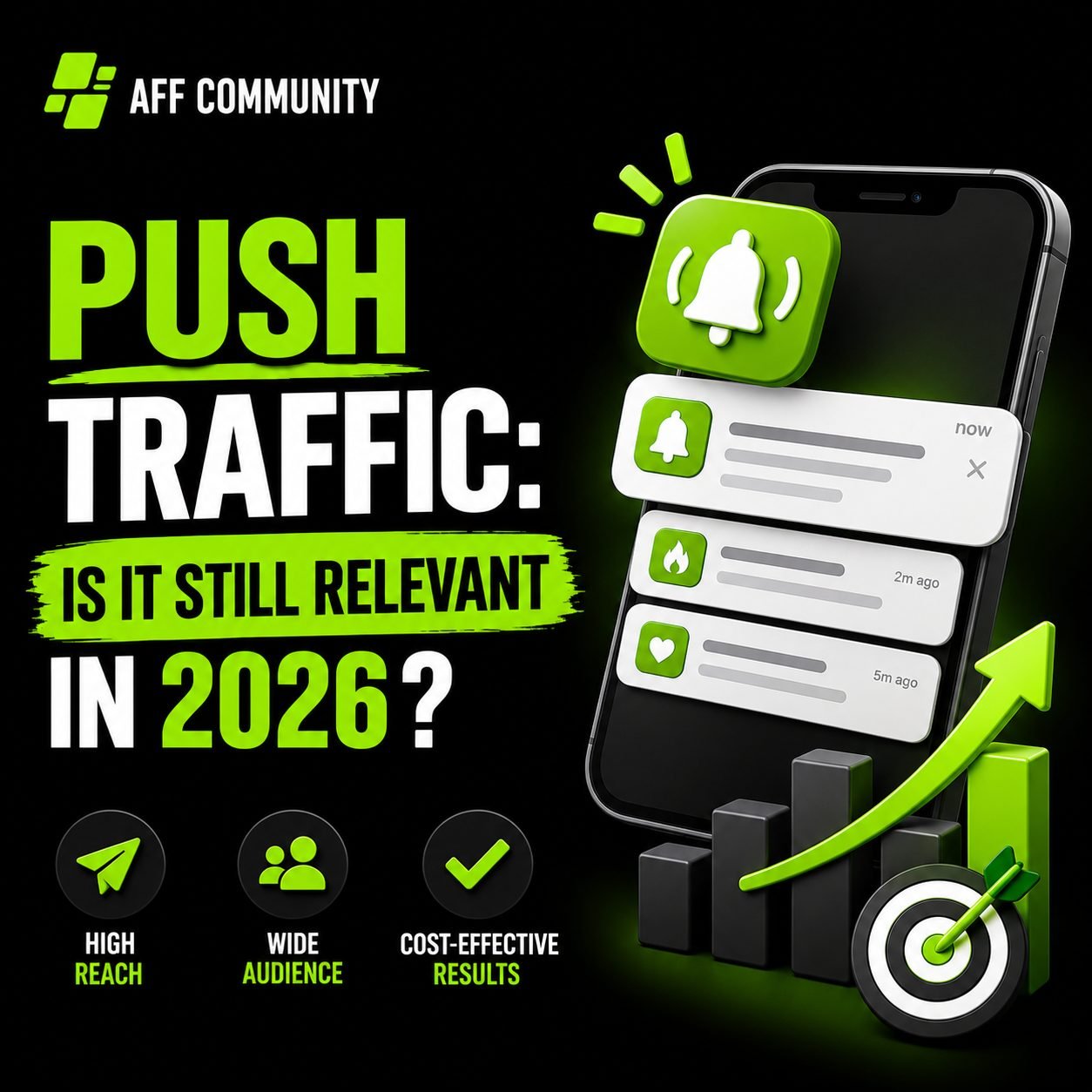
Push traffic can hardly be called a new tool in affiliate marketing. It appeared on the market many years ago, went through a period of widespread use, and has gradually become a more mature source. But is push traffic still relevant in 2026?
We believe that yes, it is still relevant. However, today it’s no longer just about getting the cheapest clicks possible and launching a single campaign “on a whim.” Results depend more and more on traffic quality, segmentation, and proper optimization.
Why Webmasters Continue to Use Push
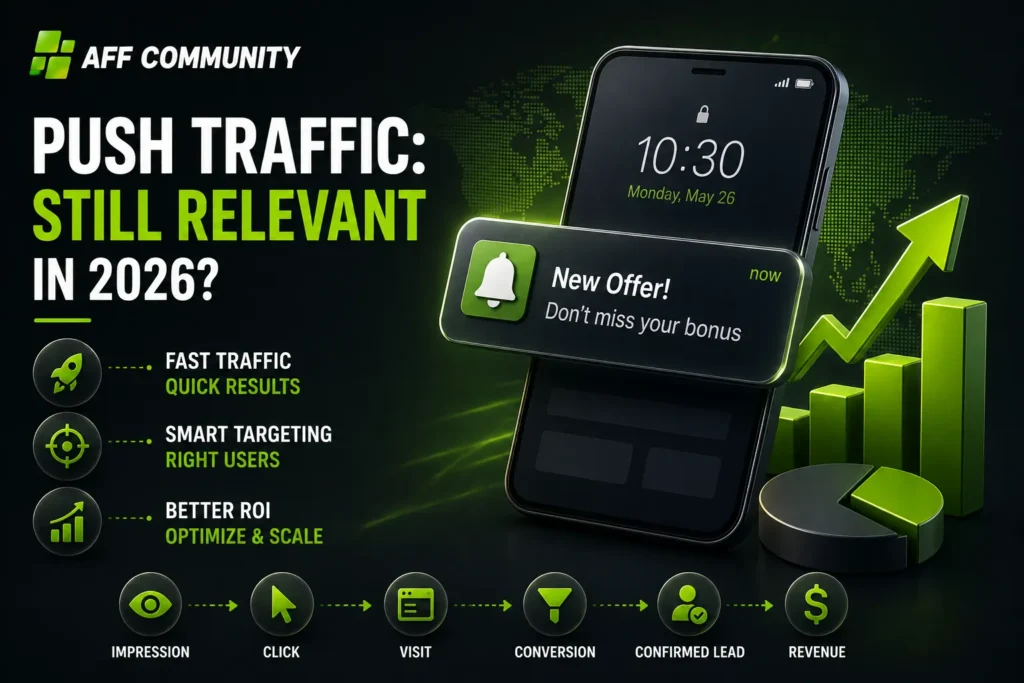
The main advantage of push advertising is the ability to quickly generate a large volume of traffic and gather statistics fairly quickly.


For a webmaster, this is convenient when testing new offers. There’s no need to invest a large budget right away: you can launch several variants, review the initial metrics, and keep only those segments that show potential.
Another advantage is the variety of geographic targets and the ability to work with different purchasing models. Push can be used as a standalone source or as a supplementary element of an advertising strategy.
At the same time, it’s important to understand that a cheap click isn’t an advantage in and of itself. If a user doesn’t match the offer’s target audience, a low cost per click will only deplete your budget faster.
What Has Changed in Push Traffic in 2026
The main change is that competition for high-quality inventory has intensified. Therefore, it is no longer enough to simply choose a network, set a bid, and upload creativity.
We recommend analyzing GEOs, devices, platforms, display times, and user behavior after the click separately.
The choice of ad network is also crucial. In our section on top ad networks for affiliate marketing, you can compare available options and traffic formats, including Push and In-Page Push.
Which verticals are suitable for Push
There is no one-size-fits-all vertical for push. Much depends on the GEO, traffic cost, and the specific offer.
Webmasters use Push ads in gambling, betting, dating, nutra, finance, sweepstakes, and mobile. In some cases, apps where users can perform a targeted action immediately after clicking through also perform well.
When selecting a GEO, we recommend looking beyond just the cost per click. The difference between Tier-1, Tier-2, and Tier-3 can significantly alter the economics of the same ad campaign. We discussed this issue in more detail in our article on the difference between Tier-1, Tier-2, and Tier-3.
Creativity Still Matters
Push ads have very little space to communicate with the user. Therefore, the headline, image, and short text must immediately grab attention and align with the offer.
In 2026, it will be particularly risky to endlessly replicate the same approach. Users quickly get used to a familiar presentation, and metrics begin to decline.
Therefore, when launching a campaign, it’s best to prepare several concepts and test them in parallel. At the same time, you shouldn’t just evaluate CTR. A high click-through rate doesn’t necessarily mean you’re getting high-quality traffic.
How to Evaluate the Effectiveness of a Push Campaign
We wouldn’t recommend making decisions based solely on CTR or cost per click. For a comprehensive evaluation, you need to look at the entire funnel:
impression → click → visit → conversion → confirmed lead → revenue.
If there are many clicks but users are hardly taking the desired action, the problem may lie with the audience, the offer, or the landing page.
Therefore, before scaling up, it’s worth checking the quality of traffic sources and segments separately. In our article on checking traffic quality before scaling up, we discussed in detail which metrics to analyze before increasing your budget.
For financial evaluation, it’s also important to consider several metrics simultaneously. Specifically, CTR, CPM, conversion rate, EPC, and ROI. We’ve written a separate article detailing which metrics are truly important for evaluating a campaign.
Is it worth starting with Push in 2026?
In short—yes, but don’t view it as a source of easy money.
Push notifications remain an interesting tool for testing offers, finding new combinations, and scaling existing campaigns. At the same time, results depend increasingly on analytics and the quality of traffic management.
We would view push notifications as part of a comprehensive media mix, rather than as a standalone “buy cheap clicks” button. The right choice of GEO, segmentation, creativity testing, and constant quality control allow you to understand where this traffic source is truly profitable.
In 2026, Push didn’t disappear—it simply became more demanding for publishers. And for those who know how to work with data, this traffic source remains quite relevant.