Media Buying: What It Is and How to Get Started
Media buying is one of the main areas of affiliate marketing. It’s not enough to simply launch an ad and wait for conversions: you need to select offers, test audiences, monitor spending, and understand how much revenue each dollar invested generates.
We’ll break down what a mediabuyer does, what skills you need to get started, and how to gradually transition from initial tests to consistently running ad campaigns.
What Is Media Buying in Simple Terms
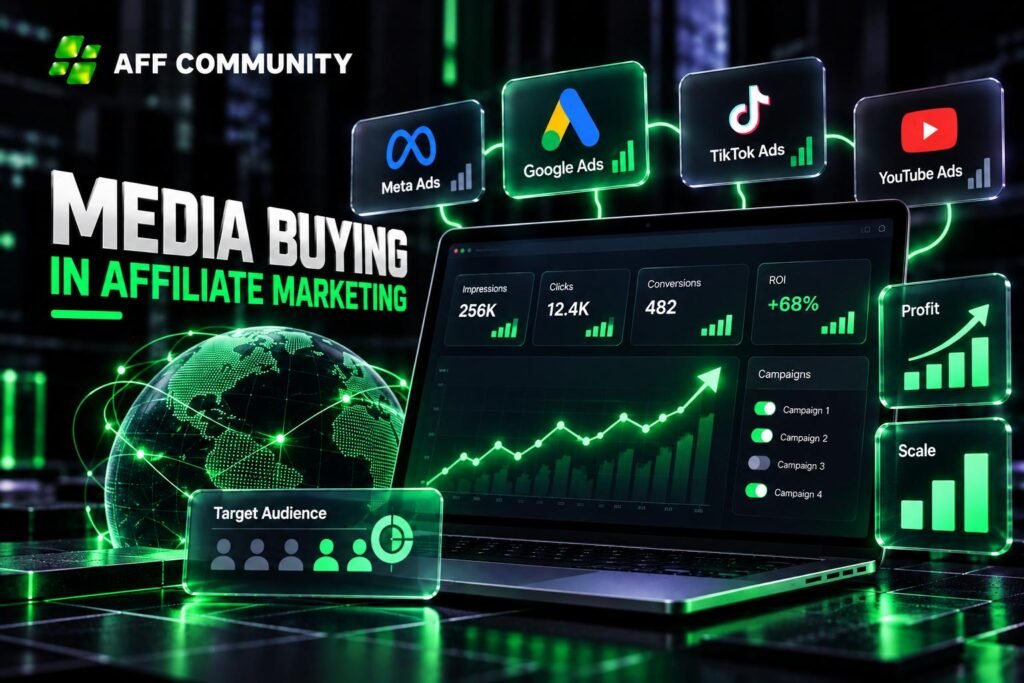
Media buying is the process of purchasing advertising traffic to drive users to a website, app, or an advertiser’s landing page. In affiliate marketing, the buyer’s goal is to buy traffic at a certain price, generate desired actions, and profit from the difference between expenses and affiliate commissions.


For example, a mediabuyer runs an ad for an offer, spends $300, and receives confirmed conversions worth $420. The difference is $120 before accounting for additional expenses. However, if the advertiser rejects some of the leads or the cost per acquisition increases, the final profit may turn out to be significantly lower.
That’s why we view media buying not as simply purchasing clicks, but as ongoing work to optimize the economics of the ad campaign.
We also recommend checking out the comprehensive affiliate marketing glossary in this article.
What Does a mediabuyer Do?
Depending on the team and traffic source, responsibilities may vary, but the work typically involves several areas:
- Selecting offers. Mediabuyer reviews the terms of the affiliate program, payouts, traffic requirements, and the target audience.
- Ad preparation. They create or test creativity, copy, headlines, and landing pages.
- Launching campaigns. They configure the ad account, budget, audiences, GEO, and other parameters.
- Analytics. They compare cost per click, conversion rates, CPA, and ROI to determine which campaigns are worth continuing.
- Optimization and scaling. Disables ineffective options and increases volume where data confirms the campaign’s profitability.
However, a mediabuyer doesn’t always work independently. In large teams, tasks may be divided among mediabuyers, designers, analysts, technical specialists, and the team lead.
How to Get Started in Media Buying
1. Choose a single vertical
It’s easier for a beginner to focus on a single niche than to try to learn about gambling, nutra, dating, finance, and product offers all at once. Each vertical has its own audience characteristics, advertising platform requirements, payment models, and moderation challenges.
We recommend choosing a niche based on your available budget, experience, and interest in the product. Our article on how to choose a vertical in affiliate marketing and avoid blowing your budget right from the start breaks down the key criteria for this decision in more detail.
2. Master a Single Traffic Source
Don’t try to run ads on Meta Ads, Google Ads, TikTok Ads, and several ad networks all at once. It’s better to focus on one source: its interface, rules, auction, ad formats, and optimization principles.
The choice depends on the vertical and your target audience. In some cases, visual ads work best; in others, search demand or native placements are more effective.
At the same time, study ad analytics and the platform’s rules. This will help you quickly understand why ads are being rejected and avoid wasting your budget on settings that are clearly unsuitable.
3. Learn to Identify and Test Ad Combinations
An ad combination is a mix of an offer, traffic source, audience, creativity, and landing page. Even a good offer may not pay off if the ad doesn’t attract the right users or the landing page doesn’t convert well.
We recommend testing hypotheses sequentially: change individual elements, track the results, and avoid drawing conclusions based on just a few random conversions. You can find ideas for tests by analyzing the market and audience behavior. A practical approach is described in the article on how to find new combinations before your competitors do.
4. Understand the Numbers
For a mediabuyer, it’s not just CTR and the number of clicks that matter. You need to understand how much a target action costs and whether the ad is paying off.
Key metrics:
- CTR — the percentage of users who clicked on the ad.
- CPC — cost per click.
- CR — conversion to the target action.
- CPA— the cost per acquisition.
- ROI— return on investment.
A high CTR doesn’t guarantee profit, and cheap traffic isn’t necessarily high-quality. That’s why we recommend evaluating the entire funnel and comparing expenses with confirmed payouts.
5. Master the tools of the trade
You don’t need to buy dozens of services right from the start. It’s enough to get a handle on the advertising platform’s analytics, expense tracking spreadsheets, and conversion tracking tools.
As your volume grows, you may need a tracker, a traffic distribution system, and additional analytics services. Our review of free tools for mediabuyer compiles solutions that help you get started without unnecessary expenses.
How to Achieve Consistent Results
The main mistake beginners make is increasing their budget too soon. A few successful days don’t prove that a campaign will consistently generate profit.
We recommend first collecting enough data, verifying conversion quality, and understanding which audiences and creativity deliver results. When testing new GEOs, be sure to consider the cost of traffic and potential payout: the calculation method is explained in the article on selecting GEOs based on the CPM-to-payout ratio.
Scale your campaign gradually, while continuing to monitor CPA, ROI, and traffic quality. If metrics deteriorate, it’s important to identify the cause rather than simply increasing spending.
Conclusion
Media buying is suitable for those who are prepared to constantly analyze metrics, test hypotheses, and make decisions based on results. To get started, you don’t necessarily need a large team or an expensive suite of tools right away, but you do need discipline, an understanding of advertising economics, and a willingness to learn from your mistakes.
We recommend proceeding step by step: choose a vertical, master a single traffic source, learn how to track metrics, and only then move on to scaling. This approach doesn’t guarantee quick profits, but it helps you establish a systematic workflow and better manage risks.