Which Metrics Really Matter in Affiliate Marketing in 2026

Many people still use the same approach: they look at the cost per lead and decide on a whim whether the campaign is working or not. If the lead is expensive—that’s it, stop. If it’s okay—they keep running it.
That approach doesn’t work anymore. In 2026, without proper analytics, you simply won’t understand where you’re losing money.
And the problem isn’t a lack of data—it’s that people aren’t looking in the right places.


Why CPL alone isn’t enough anymore
The lead cost is just the bottom of the funnel. It doesn’t explain anything.
A lead might be expensive but still profitable due to a high rate of approval.
A lead might be cheap but ultimately unprofitable because the traffic is low-quality.
If you look only at CPL, you can easily shut down a working campaign or, conversely, keep wasting your budget.
CTR shows interest, not profit
CTR is often overrated. People see a high click-through rate and assume the creativity is working.
In practice, a high CTR often just means you’ve caught someone’s attention. But that doesn’t mean the person will buy or submit a lead.
Sometimes creativity with a lower CTR yields better results because it attracts a more targeted audience.
CTR is necessary, but only as an initial benchmark.
CPC and CPM – on acquisition cost
CPC shows how much you pay per click. CPM shows how much an impression costs.
If these metrics start to rise, the campaign can go into the red even with normal conversion rates.
This is especially noticeable on platforms like Google and Meta, where traffic costs fluctuate rapidly as you scale.
But these numbers alone don’t tell the whole story. They’re just the entry point into the funnel.
Conversion is the most underrated metric
This is where the real money lies. Conversion shows how many people from clicks turn into leads or deposits. And this is where money is most often lost.
If you have a cheap click but a weak landing page, you’ll be in the red.
If conversion increases by even a couple of percentage points, your bottom-line profit can skyrocket.
That’s why good teams are constantly refining their landing pages, not just their creativity.
Approval and Lead Quality
Many people forget about this and then wonder why the campaign isn’t making money. Leads may be cheap, but if they don’t get approved, they’re useless.
This is especially important in nutra markets, finance, and crypto. There, traffic quality matters more than quantity.
Sometimes it’s better to pay more per click but get more engaged users.
Look for affiliate networks with high approval rates in the “Affiliate Networks” section
ROI is the only thing that matters
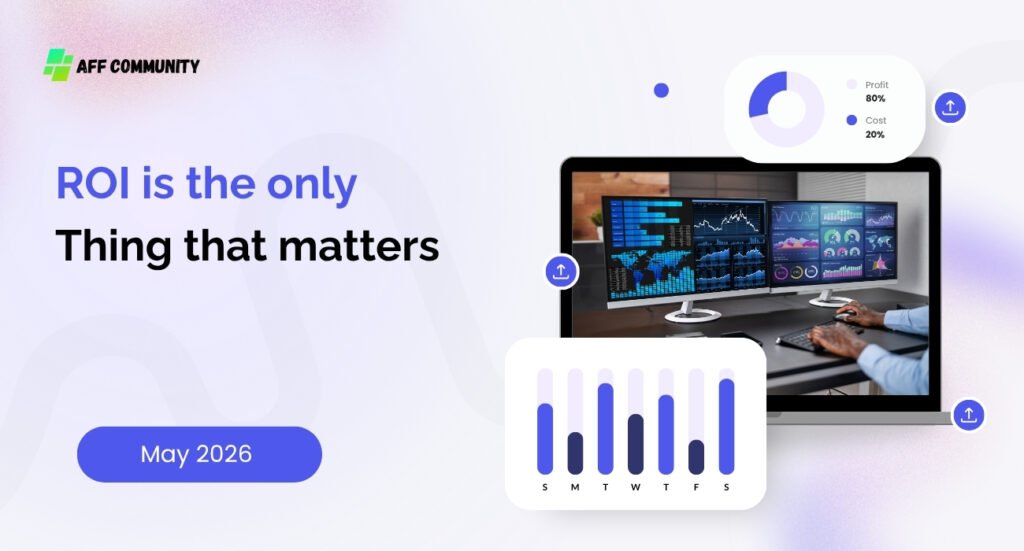
Ultimately, it all comes down to one thing: how much you’ve earned. ROI shows the real picture. Everything else is just supporting metrics.
You can have average metrics across all stages but still end up in the black. Or you can chase impressive numbers and burn through your budget.
How to approach this in practice
Strong teams don’t focus on a single metric. They look at the entire chain:
creativity → click → behavior → lead → approve → revenue
And within this chain, they identify where the problem lies:
- If CTR drops, they change the creativity.
- If people aren’t converting—they refine the landing page.
- If approval rates are low—they change their approach or traffic source.
Conclusion
In 2026, affiliate marketing isn’t about whether it worked or didn’t work. It’s about understanding the numbers.
If you don’t track metrics, you simply won’t see where you’re wasting money.
If you look at just one metric, you’ll draw the wrong conclusions. The ones who succeed are those who see the entire funnel and can quickly pinpoint the weak spot.