How to Use Data for Scaling in Arbitrage
One of the most costly mistakes in arbitrage is scaling based on gut feelings. A campaign delivers a few profitable days, the first positive numbers appear, and the team starts drastically increasing budgets. A week later, the metrics collapse, the cost per lead rises, and profit turns into a loss.
We see situations like this all the time. And almost always, the problem is the same: scaling was based not on data, but on gut feelings. In 2026, this approach is working less and less effectively.
Competition is growing, ad platform algorithms are getting more complex, and the cost of testing continues to rise. That’s why today you shouldn’t scale up when “it seems like the campaign is working,” but when the numbers confirm growth potential.


Data reveals what the naked eye can’t see
Very often, an arbitrageur evaluates a campaign based on a single metric. For example, they look only at ROI. But a profitable campaign can hide serious problems: CTR is falling, CPC is rising, audience retention is deteriorating, and traffic quality is declining.
With a small volume, this may go unnoticed. But after scaling up, such problems quickly start turning into losses.
That is exactly why, before increasing budgets, it is important to look not at a single metric, but at the whole picture.
You should scale what you can explain
There is a simple rule. If you don’t understand why a campaign works, scaling it is risky. Let’s imagine a scenario. A campaign is showing excellent ROI. But at the same time, it’s unclear which specific creative is driving results. It’s unclear which audience converts better. There’s no understanding of which funnel elements impact the final profit.
In this case, any budget increase turns into a lottery. Strong teams first identify the reason for success, and only then begin scaling.
Working with segments drives more growth than increasing the budget
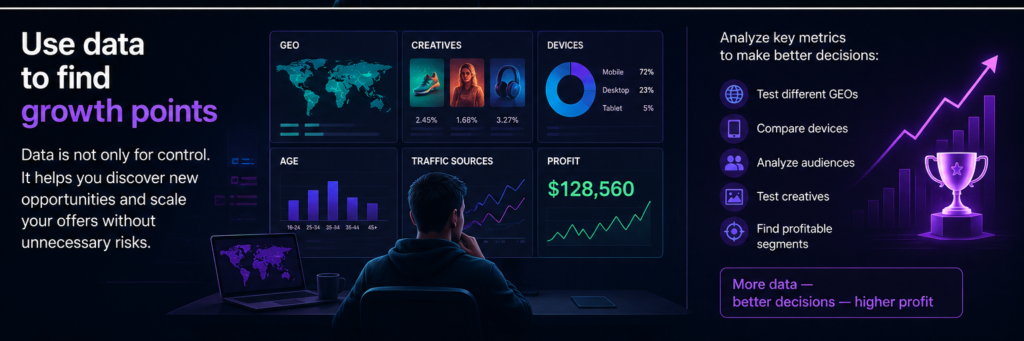
Many people think that scaling is simply increasing the daily limit. In practice, things look different. Experienced media buyers start breaking down the data: They look at different GEOs.
- Analyze devices.
- Compare age groups.
- Test individual creatives.
Very often, it turns out that one segment of the audience generates the majority of the profit. That’s where the main budgets are then directed.
This approach allows for much more stable growth than simply increasing ad spend.
Use data to find growth opportunities
Data isn’t just for monitoring. It helps identify new opportunities. For example, a campaign is performing well in one GEO.
It makes sense to test neighboring countries with similar audience behavior. Or another example: one creative format is showing a high CTR. That means it’s worth testing new variations of this approach.
This is exactly how strong teams gradually expand their working combinations without sudden jumps or unnecessary risks.
We’ve already discussed the approach to finding new directions and working hypotheses in detail at the link.
Why scaling breaks down
In practice, most problems don’t start because of bad data. The problem is that it’s interpreted incorrectly.
For example, a combination shows positive results for three days in a row. This isn’t enough to draw serious conclusions. Or consider another scenario: a single creative accidentally performs well on a small traffic sample. After scaling up, the results deteriorate sharply.
That’s why it’s crucial to distinguish between statistical noise and genuine patterns. The more data is collected, the more accurate the decisions become.
Automation is becoming essential
When traffic volumes start to grow, manual analysis becomes too slow.
That is why teams are increasingly using trackers, CRMs, BI systems, and automated reports. The faster a team receives data, the faster it can respond to market changes.
The faster a team receives data, the faster it can respond to market changes. Many processes that were previously done manually in spreadsheets are now automated through trackers, reports, and internal analytics systems. It is especially important not just to collect statistics, but to be able to interpret them correctly and identify problem areas within the funnel. The approach to traffic quality control and data management is discussed in detail in this article - https://affcommunity.org/en/lead-tracking-how-to-avoid-overpaying-for-the-same-traffic/
Data helps you stop in time
This is one of the most underrated benefits of analytics. Most affiliate marketers use data only to identify growth opportunities.
But it’s just as important to notice a decline in performance in time. Often, the right decision isn’t to increase the budget, but rather to pause the campaign and figure out the reasons for the drop.
That’s exactly why analytics helps not only to earn more, but also to lose less.
Conclusion
In 2026, scaling will depend less and less on intuition and more and more on data. The better an arbitrage specialist understands their audience, creatives, funnel, and traffic sources, the safer and more effective growth becomes.
That’s why strong teams don’t scale budgets. They scale their understanding of why their campaigns work.