Video content vs text-based SEO: which will drive more traffic in 2026
Over the last few years, the content market has effectively split into two camps. Some are convinced that the future belongs exclusively to video. TikTok, Reels, Shorts and other formats have captured the audience’s attention, and users increasingly prefer to watch rather than read.
Others continue to invest in SEO, develop websites and create in-depth expert content that consistently generates search traffic for years.
We regularly witness this debate. And the main question usually sounds the same: which is more profitable to develop in 2026: video content or text-based SEO?


The answer is not as obvious as it seems at first glance.
Why video is growing faster right now
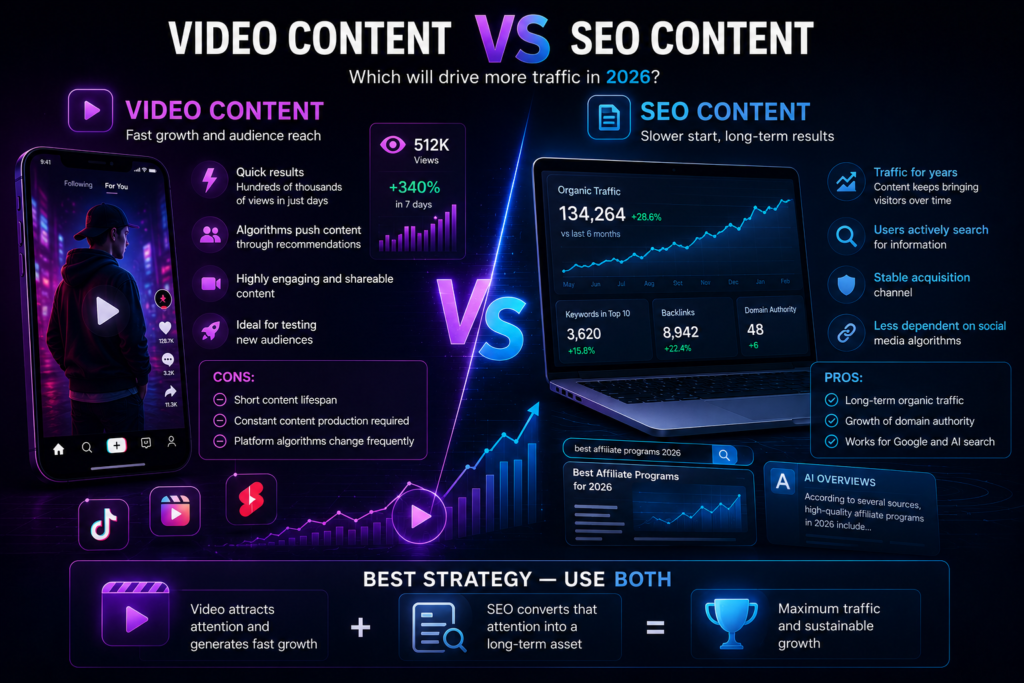
Video has one huge advantage. It grabs attention faster. Users don’t need to search for, read or analyse anything. The algorithms themselves display the content in the recommendations feed.
That’s why a good video can rack up hundreds of thousands of views in just a few days.
This is particularly noticeable on TikTok, where new accounts can achieve significant reach almost from their very first posts.
At the same time, the algorithms themselves continue to actively promote high-quality video content. We have already examined in detail which factors influence the spread of videos and why some videos get millions of views whilst others go unnoticed — we discussed this in more detail in this article.
But video has a serious drawback. It very quickly becomes outdated.
The main problem with video
Most videos have a short lifespan. Even successful content often stops driving traffic after a few weeks or months.
Algorithms switch their focus to new posts. The audience burns out. New trends emerge. As a result, you have to constantly create new content.
This is precisely why many projects become dependent on the regular production of videos. Stop producing them, and you lose reach. Stop publishing, and you start losing your audience.
SEO works more slowly, but for longer
With text content, the situation is the opposite. Yes, a good article rarely garners tens of thousands of views in the first few days after publication.
However, high-quality material can generate search traffic for years. This is particularly relevant for affiliate marketing, marketing, SEO, crypto and other niches where users regularly search for answers to specific questions.
This is precisely why many major media projects continue to invest heavily in SEO, even amidst the rise of video platforms.
Artificial intelligence enhances the importance of text
Interestingly, the development of neural networks has not killed SEO, as many experts predicted; on the contrary, ChatGPT, Gemini and other AI systems are increasingly using high-quality articles as a source of information.
Because of this, expert content gains additional value. Websites are starting to receive traffic not only from Google, but also from AI search.
We have already discussed in detail how artificial intelligence affects search results and why website owners should take these changes into account right now — we covered this in more detail here.
Essentially, a good piece of content starts working across several audience acquisition channels at once.
Where is it easier for a webmaster to make money?
If we’re talking purely about the speed of getting results, video usually wins out. Through TikTok, Reels or Shorts, you can quickly test hypotheses, find a new audience and get initial results.
But if the goal is to create a long-term asset, SEO looks far more reliable. Every published article becomes part of the site’s overall structure.
Over time, such content begins to reinforce each other through internal linking, backlinks and accumulated domain authority.
The best option is to combine both approaches
In practice, the most successful projects stopped choosing between video and SEO long ago. They use both tools simultaneously. Video helps to quickly attract a new audience.
A website helps retain that audience and generate stable search traffic. For example, a TikTok video can garner tens of thousands of views and drive users to a website where detailed reviews, case studies and expert content are already available.
This approach allows you to reap the benefits of both formats at once.
We have already discussed how content helps increase traffic volumes and why different acquisition channels reinforce one another – you can find out more by following the link.
Conclusion
By 2026, the question will no longer be ‘video or SEO’. Video provides speed. SEO provides stability.
Video helps to quickly capture the audience’s attention. SEO allows you to turn that interest into a long-term asset.
That is why the best results today are achieved by projects that use both approaches simultaneously and build an ecosystem where content works across multiple platforms at once.