Why many people calculate ROI incorrectly
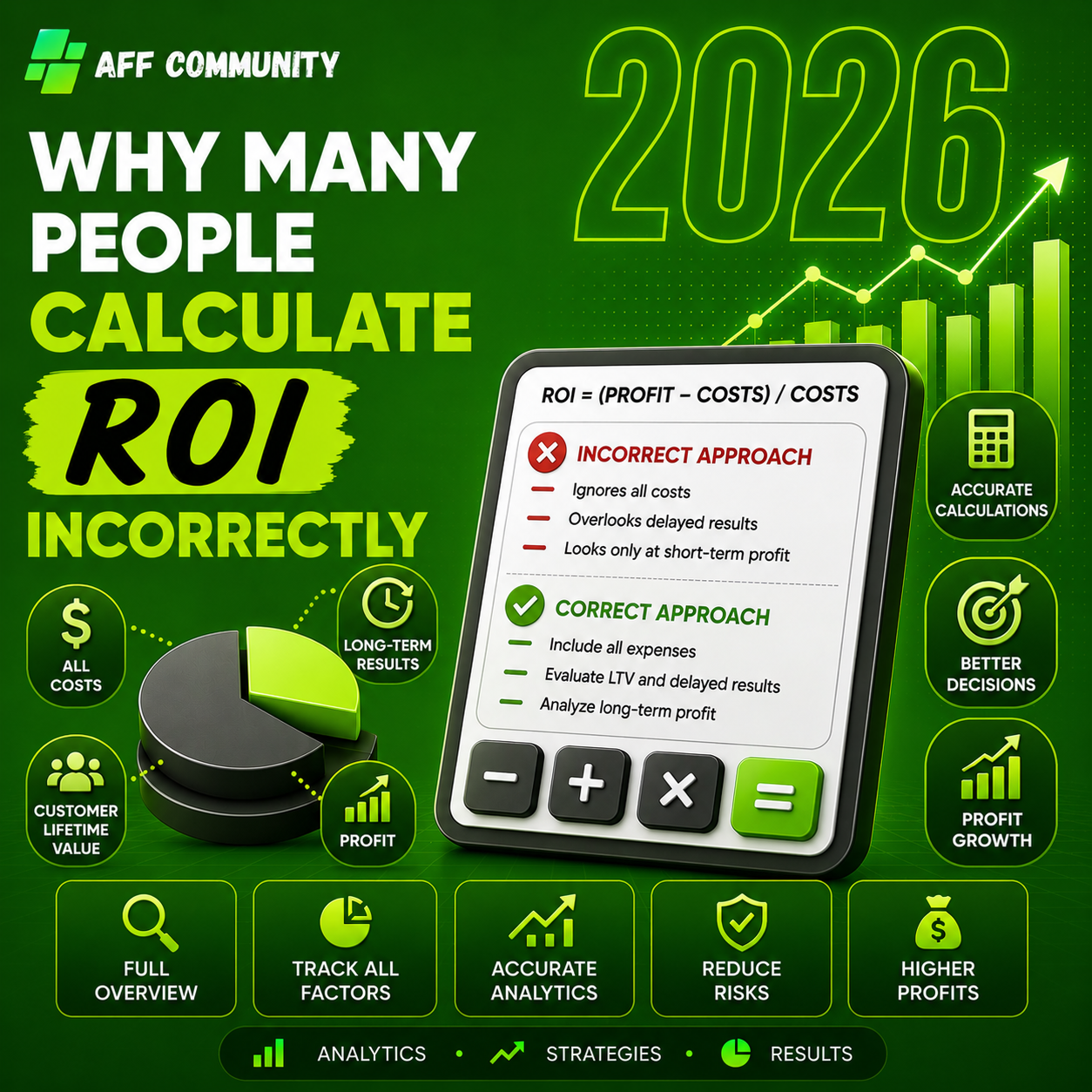
ROI is one of the most popular metrics in affiliate marketing. Virtually every buyer checks this figure daily and makes decisions based on it. The problem is that a huge number of webmasters calculate ROI incorrectly.
Our team regularly comes across situations where a campaign appears profitable at first glance, but upon closer inspection turns out to be loss-making. Or, conversely, a promising campaign is paused too early due to erroneous conclusions.
This is precisely why understanding ROI is more important than the calculation formula itself.


Why a high ROI doesn’t always mean a profit
The most common mistake made by beginners is to focus solely on the ROI percentage. Let’s consider two campaigns. The first generated a profit of $20 against costs of $10. The ROI was 200 per cent.
The second generated a profit of $1,000 against costs of $500. The ROI was also 200 per cent.
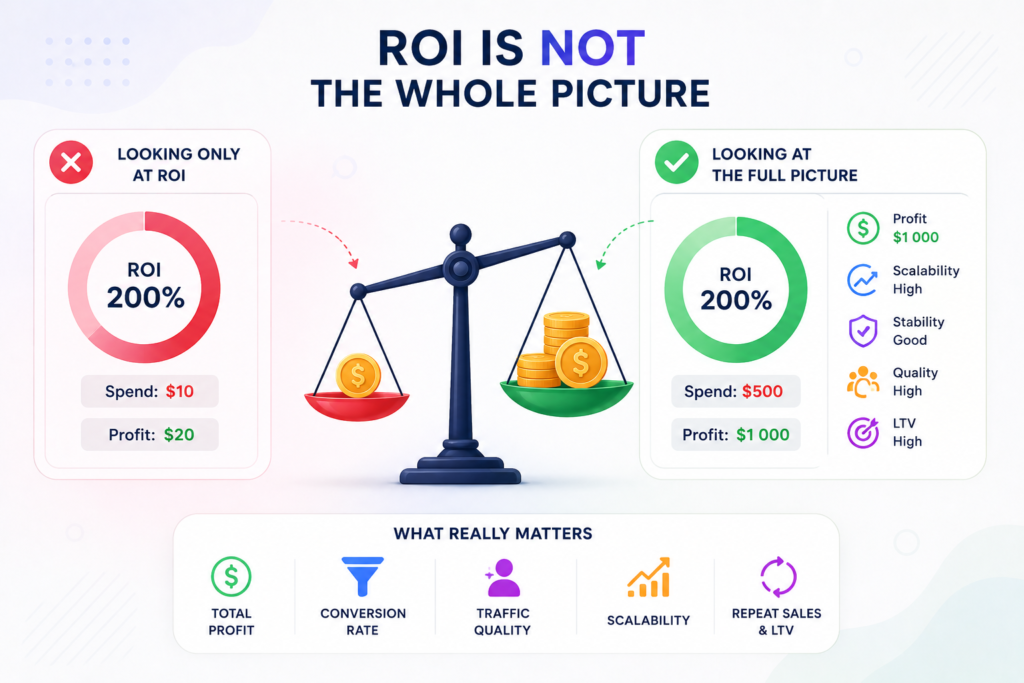
On paper, the figures are identical. But for a business, the value of these campaigns is completely different. This is precisely why experienced webmasters always look not only at ROI, but also at profit volume, scalability and the stability of results.
Often, the pursuit of an impressive percentage leads to the loss of truly strong campaigns.
The small sample size fallacy
The second problem arises when analysing an insufficient volume of data. Many people run a test, get a few leads and immediately draw conclusions. In the long run, such decisions often prove to be flawed.
A campaign might show an excellent ROI on the first $50 of the budget and completely fall apart once scaled up.
Or, conversely, it might only start turning a profit once the algorithms have completed their learning phase. This is precisely why, when analysing advertising campaigns, it is important to consider the statistical significance of the data, rather than individual successful or unsuccessful results.
Many people forget to factor in actual costs
Another classic mistake is to consider only the advertising budget. In practice, costs often turn out to be significantly higher.
The following should be included in calculations:
- account costs;
- anti-detection browsers;
- proxies;
- trackers;
- creativity costs;
- payment system fees;
- White pages;
- team labour costs.
If you only take the advertising budget into account, the ROI may appear significantly better than the actual situation.
This mistake is particularly noticeable in large teams, where infrastructure costs make up a significant proportion of expenditure.
ROI does not reflect audience quality
Very often, webmasters assess effectiveness solely on the basis of lead cost and return on investment.
However, there are metrics that ROI does not take into account. For example:
- lead quality;
- approve rate;
- repeat sales;
- customer retention;
- LTV.
Therefore, two campaigns with the same ROI can generate completely different profits for the advertiser.
It is no coincidence that experienced teams pay close attention to analysing the audience and its behaviour. The impact of user segmentation on the effectiveness of advertising campaigns was discussed in detail in this article.
Scaling changes the maths
One of the most frustrating situations for any webmaster is a successful test that stops working after scaling. The reason is simple.
As volumes increase, the metrics begin to change:
- The cost of traffic rises.
- Competition increases.
- CTR decreases.
- Audience quality deteriorates.
As a result, ROI begins to fall gradually. This is precisely why a successful test does not guarantee successful scaling.
Why you shouldn’t focus solely on ROI
In practice, strong webmasters use several metrics simultaneously. ROI remains an important metric, but it is by no means the only one.
The following are also analysed:
- profit volume;
- conversion rate;
- cost per lead;
- traffic quality;
- scalability of the campaign.
It is precisely the combination of these factors that enables well-informed decisions to be made.
We’ve already explained why optimising the sales funnel and working on conversion rates often have a greater impact on profit than attempts to improve a single metric – you can find out more via the link: https://affcommunity.org/en/optimizing-traffic-processing-and-increasing-conversion/
ROI and the Age of Automation
By 2026, the situation will become even more complex. Advertising platform algorithms are increasingly making decisions independently.
As a result, publishers must analyse not only the final metrics but also the reasons behind any changes in them.
Those who understand the factors that make up their profit gain a significant advantage over those who focus solely on the ROI figure in their reports.
Conclusion
ROI remains one of the most important metrics in affiliate marketing, but on its own this figure rarely reflects the full picture. A high ROI does not always mean high earnings. A low ROI does not always mean a poor campaign.
That is why professional teams analyse not just a single figure, but the entire system of metrics as a whole.
It is precisely this approach that enables them to make the right decisions and scale profitable campaigns without any unpleasant surprises.