Top SEO Trends for Summer 2026
SEO continues to evolve rapidly. While just a few years ago, successful promotion simply required gathering keywords, writing content, and building backlinks, that’s no longer enough in the summer of 2026. We’re seeing that search engines have become significantly better at understanding user intent, evaluating content quality, and taking behavioral signals into account. These changes are particularly noticeable in competitive niches, including affiliate marketing, finance, iGaming, and SaaS.
Let’s break down the key trends that are currently having the greatest impact on website rankings.
Artificial Intelligence Is Changing Search
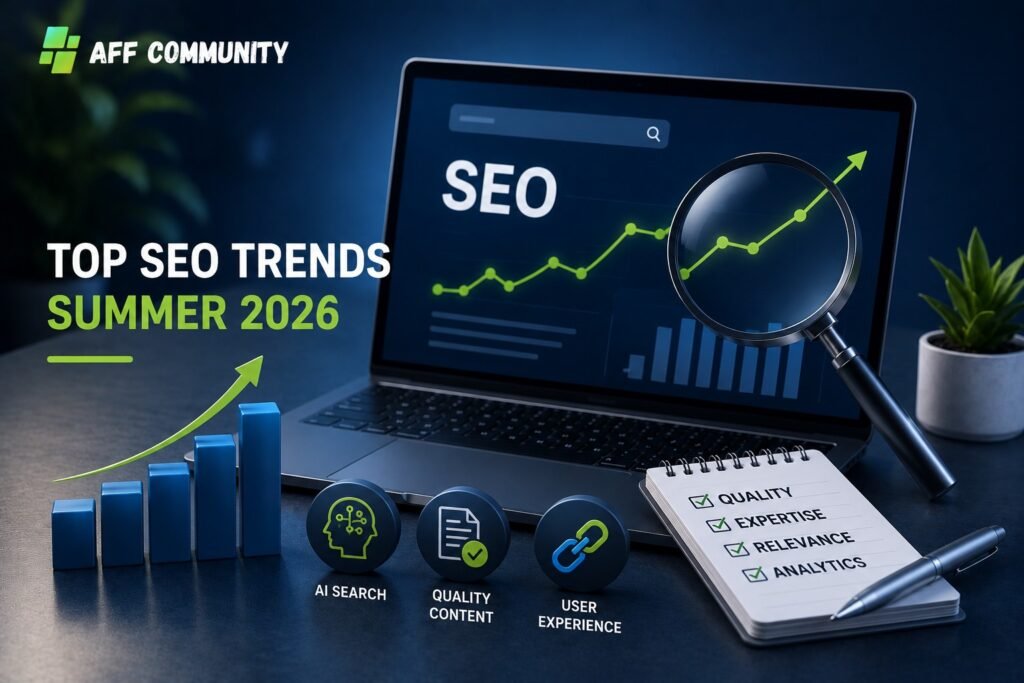
The major development of 2026 was the rapid advancement of AI-powered search. ChatGPT, Gemini, and other AI systems are increasingly generating ready-made answers instead of the usual list of ten links.


This means that simply ranking in the top results is no longer enough. Content must be structured in a way that language models can utilize it.
We recommend focusing on:
- clear subheadings;
- a logical structure;
- expert explanations;
- answers to frequently asked questions;
- the relevance of the information.
The more understandable the content is to artificial intelligence, the higher the likelihood of appearing in AI service recommendations.
We discussed in more detail how to optimize articles for modern language models in this article.
Behavioral factors are becoming even more important
Search engines are getting better at analyzing user interaction with a website. Today, the following metrics are evaluated:
- Page depth.
- Time spent on the page.
- Bounce rate.
- Engagement.
- Navigation between pages.
If a website has a high bounce rate, it becomes significantly more difficult to maintain good rankings.
Therefore, it’s important to create content that truly helps users solve their problems, rather than simply containing a large number of keywords.
Internal linking affects SEO
We’re increasingly noticing that a well-structured website helps new content get indexed faster and strengthens the rankings of existing pages. This is especially true for large niche-based projects.
Each new article should be logically linked to previously published content.
This helps search engine crawlers better understand the site’s structure and allows users to find additional information more quickly.
Site speed remains a key factor
Despite advances in artificial intelligence, technical optimization is still very much a part of SEO. If pages take too long to load, users will leave before the content even finishes loading.
Therefore, in the summer of 2026, you should regularly check:
- page load speed;
- page display stability;
- mobile responsiveness;
- proper image display;
- server performance.
This is especially critical for projects that rely on paid traffic, where every additional second of loading time increases the cost of acquiring a user.
Expertise Takes Center Stage
Search engines are getting better and better at distinguishing superficial articles from truly useful content. Today, the sites that come out on top are those that publish:
- original research;
- case studies;
- real-world examples;
- practical recommendations;
- up-to-date statistics.
Content without practical value is gradually losing ground, even with good optimization.
That’s exactly why we recommend regularly updating old content, adding fresh data, and sharing your own experience.
Query clustering is becoming essential
Another trend for 2026 is creating thematic clusters instead of publishing a large number of disparate articles.
Search engines are getting better at determining a website’s expertise in a specific field.
For example, if a site publishes dozens of high-quality articles on Google Ads, moderation, White Page, and analytics, its authority in these topics increases significantly.
That’s why we recommend planning content in advance by major topics and linking articles together.
You can read more about how to properly work with semantics before creating content in the article at this link.
Analytics Helps You Grow Faster
You can no longer develop SEO “by gut feeling.” After publishing each article, you need to analyze:
- rankings;
- CTR in search results;
- organic traffic;
- user engagement;
- conversions.
Only by consistently working with data can you understand which articles are actually delivering results and which ones need to be updated.
Conclusion
The summer of 2026 shows that SEO continues to evolve toward quality, expertise, and useful content. Artificial intelligence is changing the way people search for information, search engines are analyzing user behavior more deeply than ever, and technical optimization remains a crucial part of successful promotion.
Our team and I are confident that today, the projects that succeed are not those that publish the most content, but those that create truly useful content, regularly update their articles, skillfully structure their websites, and carefully analyze the results of their work.