Agency Google Ads Accounts in 2026: How Affiliates Can Work Stably and Ban-Free
Google Ads remains one of the most powerful traffic sources for affiliates and media buyers. But in 2026, the rules have changed: moderation algorithms have grown smarter, simple ban-bypass schemes no longer work, and the cost of a mistake is a drained budget and frozen campaigns. Scaling without losses requires a well-built infrastructure. This article breaks down what it consists of, what to watch out for, and which tools actually get the job done.
Why Google Ads Remains a Priority Traffic Source in 2026
Despite growing competition from TikTok Ads and programmatic platforms, Google holds its position as the leader in reach and traffic quality. Search engine audiences are people with a clear intent — to buy, learn, or solve a problem right now. That's why CPL and ROI on Google Ads remain competitive across most verticals, from nutra to finance.
There's a catch, though: Google has been systematically tightening moderation. In 2025–2026, the platform introduced enhanced AI screening of landing pages, stricter business verification requirements, and began applying bans more aggressively at the domain and payment account level. Running campaigns "straight out of the box" with a fresh account and no prepared infrastructure has become increasingly difficult.


The Main Challenges for Affiliates Working with Google Ads
Moderation and Bans
The most common pain point for media buyers: a campaign goes into review, then gets rejected — or the account gets banned outright. The reasons vary: a landing page that doesn't meet platform requirements, a suspicious domain, IP history, an unverified business account. Importantly, Google increasingly bans not just a single campaign, but the entire account — along with its accumulated history, Quality Score, and credit balance.
The Cost of a New Account and Loss of Trust
A new Google Ads account is essentially a blank slate — no history, no trust, minimal limits. The platform's algorithms treat such accounts with suspicion by default: higher CPCs, lower reach, more frequent reviews. That's exactly why working with trusted agency accounts has become the standard for professional affiliates.
Business Verification
Since 2024, Google has been steadily expanding its advertiser verification requirements. By 2026, certain niches — finance, healthcare, legal services — are effectively off-limits without proof of a registered legal entity. Without verification, an account faces serious restrictions on ad formats and budgets.
What Is an Agency Google Ads Account and Why Do You Need One
An agency account is an ad account created and managed by an official Google partner (an agency with a direct agreement). These accounts have their own MCC (Manager Account), an accumulated history of interaction with the platform, higher budget limits, and — critically — priority support during moderation.
Renting an agency account solves several problems at once: you get a "warmed-up" account with history, skip the lengthy trust-building phase, and can launch campaigns the same day. For affiliates working in grey verticals or highly competitive niches, this is a decisive advantage.
The Infrastructure for Stable Operations: Three Key Elements
1. A Trusted Agency Account
The foundation is the account itself. What matters here: the MCC domain history, a clean record with no prior warnings, a credit line (to avoid prepayment dependency), and fast access. A good provider connects the account on the same day you apply — not after a week of back-and-forth.
2. A Safe Page (White Page)
A Safe Page is the interstitial page that a Google moderator sees when reviewing an ad. Its job is to comply with platform requirements, look credible, and raise no suspicion. The key requirement: uniqueness. Copied or AI-generated Safe Pages have long been in Google's algorithm databases and don't help — sometimes they even accelerate a ban.
3. Account Verification
If you're working in niches that require business verification — get it done. You can do it yourself, or delegate to a service that handles end-to-end verification, including for both individuals and legal entities.
PPC Rebels and Money Safe: An Ecosystem for Professional Launches
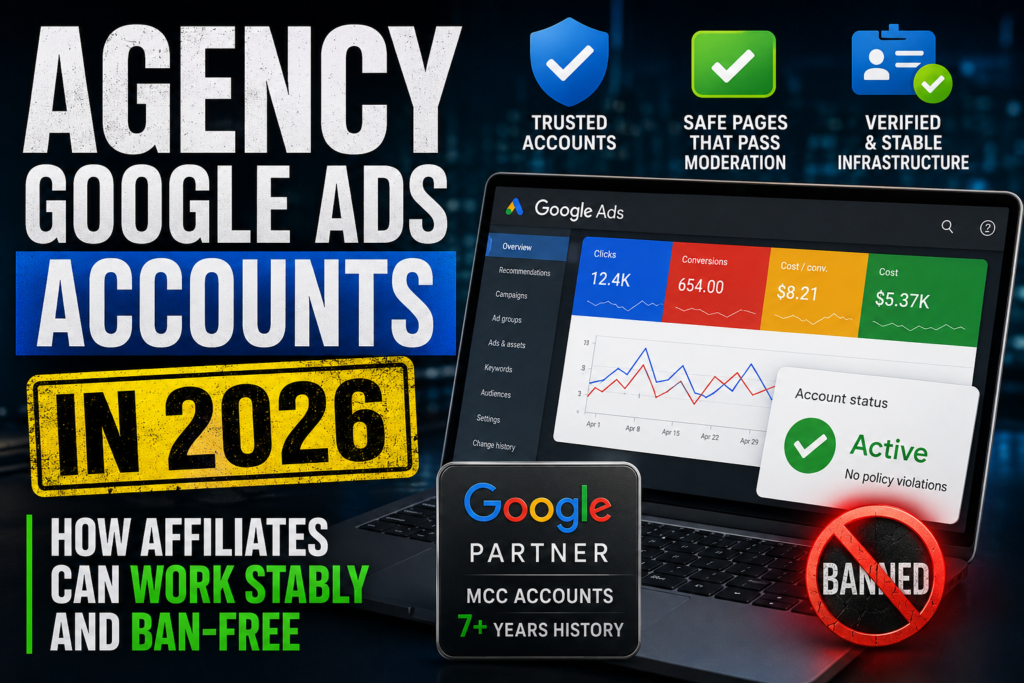
An interesting partnership has formed in the affiliate tooling market, with two services covering different parts of the same infrastructure stack. PPC Rebels is an agency Google Ads account rental service with its own MCC, over seven years of platform history, and 24/7 support. The team handles both white and high-risk verticals, reviews each case individually, and ensures launch on the day of payment. Working in tandem with PPC Rebels is Money Safe — a service specializing in the creation of unique Safe Pages on WordPress and HTML with aged domains, built to pass moderation on Google Ads, Facebook, TikTok, and other traffic sources. While PPC Rebels handles the trusted account side, Money Safe closes the white page side — giving the affiliate a ready-made, end-to-end bundle instead of piecing together infrastructure from different vendors.
What a Proper Google Ads Campaign Launch Looks Like in 2026
Here's a workflow that reduces the risk of bans and improves your chances of passing moderation:
- Choose an agency account. Ask your provider about the account's history, the availability of a credit line, and support for your vertical.
- Prepare a Safe Page. Order a unique white page — not a template, not AI-generated. The domain should have history (at least a month of "warmup").
- Get verified. If your niche requires business verification — complete it before launch, not after a ban.
- Structure your campaigns properly. Separate ad groups logically; don't overload one account with unrelated offers from different verticals.
- Monitor and scale gradually. Don't launch with a large budget from the start — let the account "warm up" on moderate spend, then scale.

Common Mistakes That Lead to Bans
Using someone else's or copied landing pages Google has long indexed landing pages and can detect duplicates. If your offer has already been tested by dozens of other affiliates using the same landing page, the probability of a ban multiplies.
Sudden budget spikes A sudden jump in spend on a new or recently warmed-up account is a classic review trigger. Increase budgets gradually — 20–30% per day is considered a safe pace.
Mixing verticals Running gambling and children's products from the same account is a bad idea. Algorithms track ad themes and may flag the account as suspicious due to incompatible topics.
Ignoring landing page quality Quality Score affects not just your CPC, but also how frequently your account gets reviewed. A slow page, missing privacy policy, or broken links all lower your score and draw more moderator attention.
Conclusion: Infrastructure Is Everything
In 2026, success with Google Ads isn't a matter of "luck" or "the right offer." It's a matter of infrastructure: a trusted account, quality Safe Pages, completed verification, and a well-structured campaign setup. Affiliates who build this system in advance scale without losses, while competitors keep recreating accounts after each ban. The sooner you move from an ad-hoc approach to a systematic one — the higher your profit ceiling.