How to Increase ROI Without Increasing Your Budget
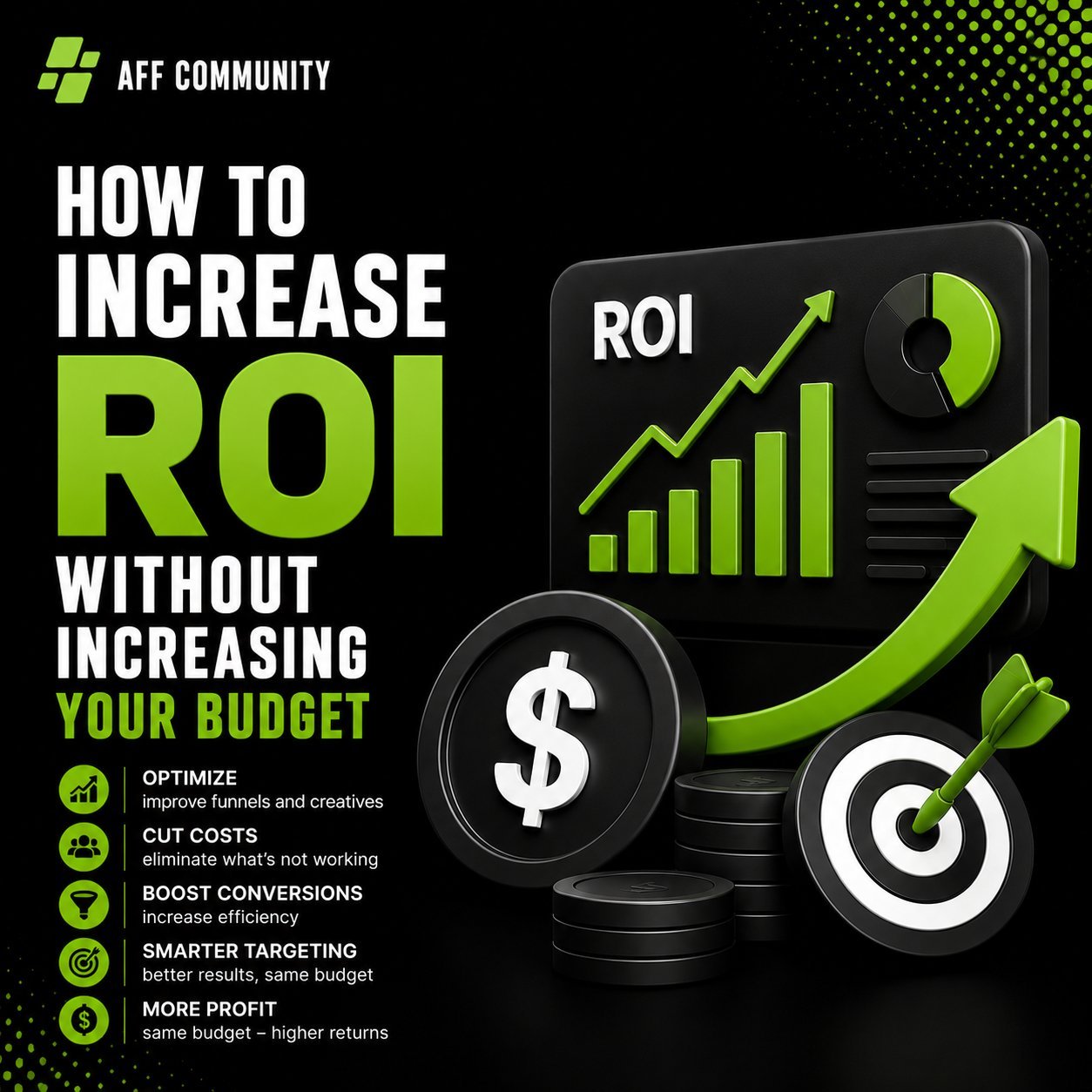
Most webmasters believe that to grow profits, you need to constantly increase your advertising budget. The logic seems obvious: more investment = more traffic = higher revenue.
But my team and I regularly see cases that prove the opposite. Some teams spend thousands of dollars a day and barely break even, while others, with the same expenses, gradually increase their ROI by optimizing existing campaigns.
In practice, profit growth is far from always linked to a budget increase. More often than not, it starts with improving the quality of the ad-link combination.


Don’t Scale a Loss-Making Campaign

The most common mistake is trying to compensate for a low ROI with additional spending.
If a campaign is already showing weak results, increasing the budget almost never fixes the situation. First, you need to figure out which element is performing worse than the rest. It could be:
- creativity;
- the audience;
- the offer;
- the landing page;
- or the traffic source.
Only after addressing the weak link does it make sense to consider scaling up. That’s exactly why skilled webmasters start by analyzing statistics, not by increasing the budget.
Focus on conversion
Even a small increase in the conversion rate (CR) can significantly boost the overall ROI—without changing your ad spend at all.
Conversion depends on many factors:
- page load speed;
- landing page quality;
- how well the offer meets user expectations;
- a clear call to action.
Sometimes changing just one element of the page is enough to increase total profit by tens of percent. That’s exactly why experienced teams regularly test different landing page variations.
Update your creativity before metrics start to drop
Many webmasters only start looking for new creativity after a noticeable drop in CTR. In practice, you need to act much sooner.
Any audience gradually gets tired of seeing the same ads. The longer the same creativity is shown, the higher the likelihood of CPM increasing and conversion rates decreasing.
That’s why strong teams prepare several new options in advance and regularly update their ad materials. This allows them to maintain high performance without increasing costs.
Analyze Your Audience
Another way to increase ROI is to eliminate ineffective traffic. Very often, one segment of the audience generates the bulk of the profit, while another simply drains the budget.
That’s why it’s important to regularly analyze:
- age;
- gender;
- devices;
- placements;
- interests;
- GEO.
After disabling underperforming segments, the overall effectiveness of the campaign can increase significantly even without additional investment.
This is precisely why segmentation remains one of the most underrated optimization tools. You can read more about this in the article at the link.
Monitor lead quality
A high number of conversions does not always mean high revenue. If an ad campaign attracts low-quality users, the advertiser may lower the rate at which it approves applications, reduce payouts, or even terminate the partnership altogether.
Therefore, it’s essential to analyze not only the cost per lead but also its quality. In many cases, reducing the volume of low-quality traffic boosts the final ROI much more significantly than attracting new users.
Work with numbers, not emotions
Another mistake is making decisions based on intuition. Any change to an ad campaign should be data-driven.
Before pausing a campaign or testing a new hypothesis, it’s worth answering a few questions:
- Why has the CTR changed?
- At what stage is the conversion rate dropping?
- Which audience segment has stopped generating profit?
- How has the EPC changed?
- What changes occurred after the latest adjustments?
It is precisely this approach that allows you to gradually increase campaign effectiveness without increasing costs.
Useful recommendations for working with analytics and scaling can be found in this article.
Continuous optimization is more effective than constantly increasing the budget
Professional teams rarely rely solely on increasing spending. They are constantly looking for small improvements:
- A 5% increase in conversion rate.
- A 10% decrease in CPM.
- A slightly higher CTR.
- A slightly better approval rate.
Ultimately, it’s the sum of these small changes that leads to a significant increase in ROI. This approach requires more analytics but delivers much more stable results over the long term.
Conclusion
You can increase ROI without increasing your advertising budget. In many cases, optimizing creativity, audiences, landing pages, and analytics yields significantly greater results than simply scaling up spending.
That’s exactly why top webmasters focus not on spending more, but on ensuring that every dollar invested generates maximum profit.