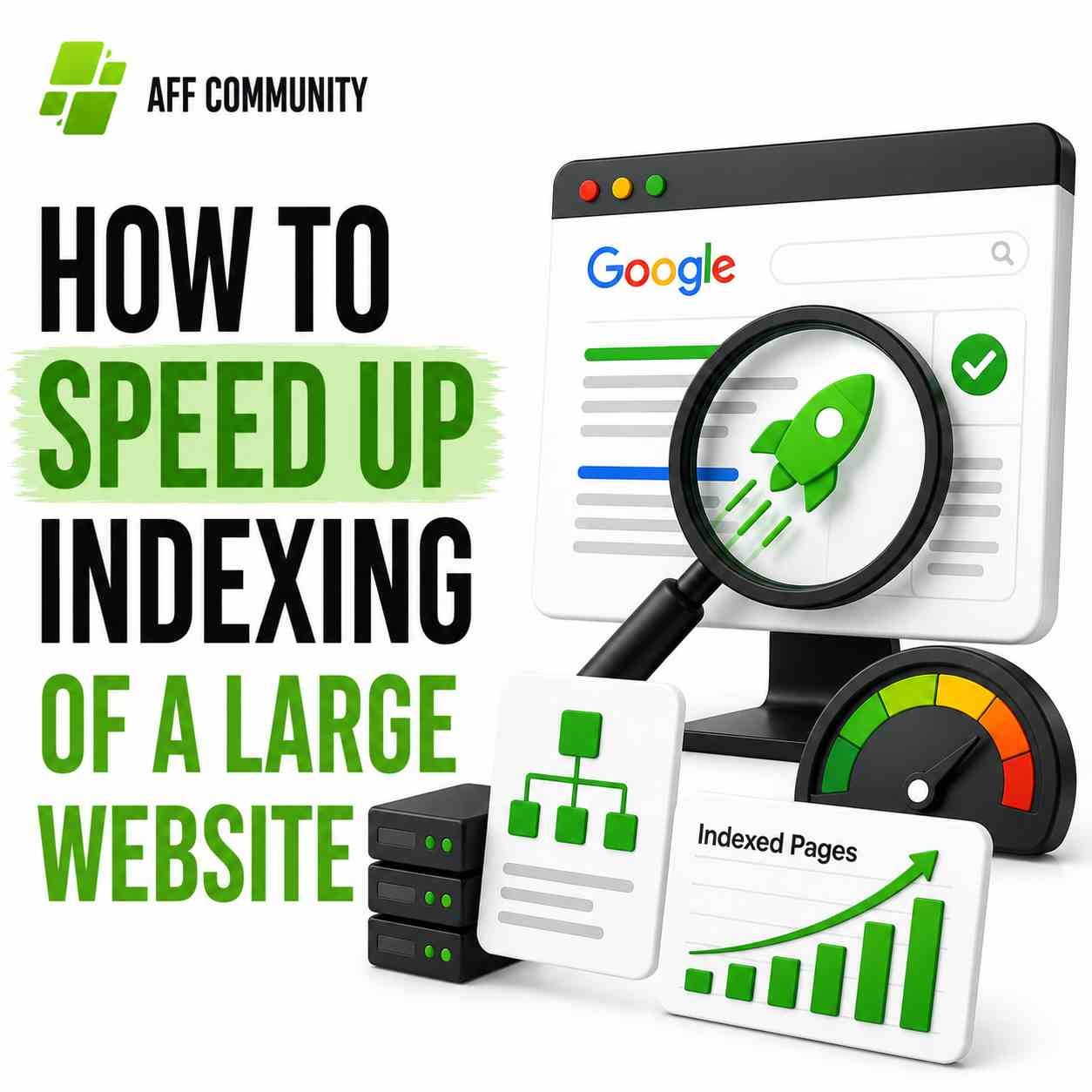
How to Speed Up Indexing of a Large Website
For a small website, indexing isn’t usually a critical issue. But when there are hundreds or thousands of pages, the situation changes. New content is added regularly, some older content is updated, and the search engine bot doesn’t always have time to crawl the entire site quickly.
This is particularly problematic for affiliate marketing projects: if an article focuses on a timely traffic source, offer, or trend, its value may already have diminished after a few weeks. That’s why we view speeding up indexing as part of an overall SEO strategy.
Start with the site structure
The first thing to check on a large project is how easily the search engine bot can navigate between pages.


A new article shouldn’t be buried deep in the structure without a single link from other content. If content is grouped into thematic clusters and pages are linked to one another, it’s easier for the bot to discover new URLs.
We recommend adding internal links from already indexed content to new articles. However, these links should be logical and not added solely for the sake of quantity.
XML Sitemap – A Basic Tool
A sitemap is especially important for large websites. It helps search engines discover URLs that may not be obvious through standard navigation.
However, the sitemap shouldn’t become a dumping ground for all existing URLs. You shouldn’t include pages with errors, duplicates, technical URLs, or pages that shouldn’t be indexed.
If the site is updated regularly, the sitemap must also be kept up to date.
Remove Technical Obstacles
Sometimes the problem isn’t with Google’s speed, but with the site itself. The crawler may encounter unnecessary redirects, server errors, incorrect canonical tags, or pages blocked from indexing.
On large projects, it’s especially important to periodically check:
- robots.txt;
- canonical tags;
- page HTTP status codes;
- the sitemap;
- duplicate URLs;
- pages with `noindex`;
- page load speed;
- the mobile version.
The less technical clutter the crawler has to navigate around, the more efficiently its crawl budget is used.
Don’t create hundreds of low-quality pages
For affiliate marketing sites, this is one of the most common problems. When a team starts mass-producing content targeting similar keywords, the number of URLs grows rapidly, but the site’s actual value may not increase.
As a result, pages appear that differ only minimally from one another. Instead of rushing to index such content, it’s better to first assess whether each page is truly useful to users.
It’s especially important to monitor the quality of content created using AI. AI-generated content isn’t a problem in and of itself, but AI-generated content and its impact on Google rankings depend directly on the quality, originality, and usefulness of the final content.
Boost new pages with internal links
After publishing an article, we recommend not waiting for the search engine to discover it by chance.
Find several relevant pieces of content that Google already knows about and create natural links from them to the new page. This simultaneously helps the crawler find the URL faster and builds context around the new article.
At the same time, it’s important to strike a balance. Extensive linking shouldn’t turn into dozens of random links. A few thematically related links are much more useful.
For a broader SEO strategy, check out how Link Building in 2026 works today. Nowadays, link quality, relevance, and the authority of the source are more important than the sheer number of backlinks.
Content Should Attract Natural Links
Another way to speed up discovery and boost new pages is to create content that people want to link to.
Research, case studies, statistics, detailed guides, and unique data are much more likely to earn external mentions. And as these increase, so does the number of ways search bots can discover your content.
We’ve covered in detail what kind of content earns natural links. Content featuring unique data and practical experience works particularly well.
Monitor Your Site’s Speed
A large project can receive many search queries simultaneously from both users and bots. If the server responds slowly, this becomes an additional bottleneck.
Therefore, it’s worth regularly monitoring page load speed, image sizes, the number of requests, and server stability. This is important not only for SEO but also for users who arrive at the site from advertising sources.
What to Do After Publishing a New Article
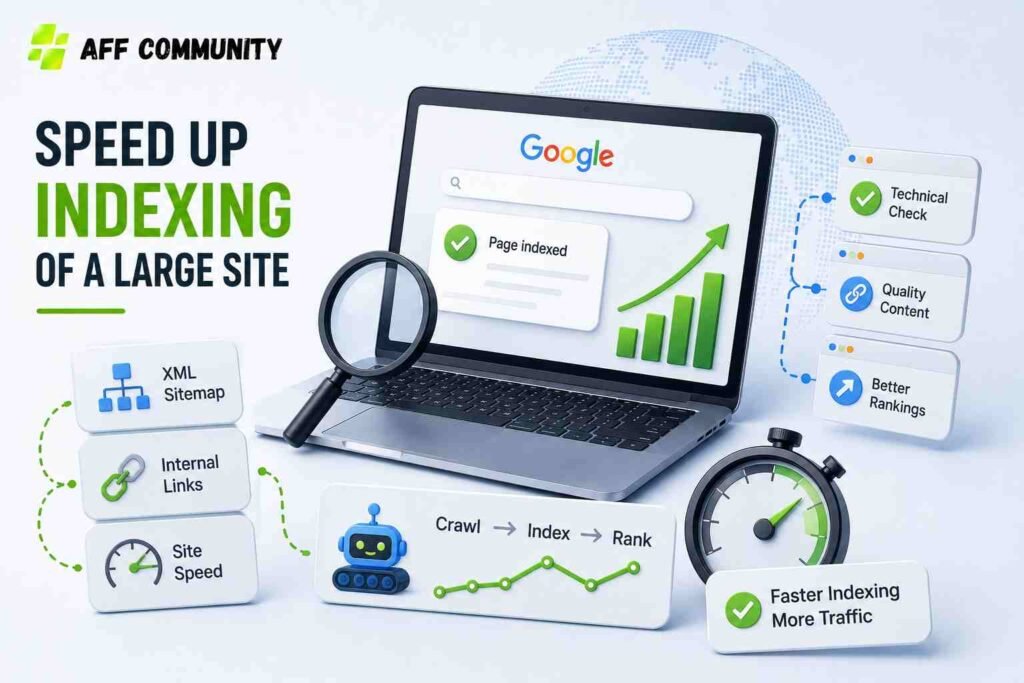
We would use a simple process: publish → sitemap → internal linking → check for technical errors → monitor indexing → analyze results.
If the volume of new content becomes very large, it’s also helpful to regularly delete or merge underperforming pages. A large website shouldn’t grow solely based on the number of URLs.
And most importantly—there’s no magic button that’s guaranteed to make Google instantly index the entire site. The project owner’s task is different: to make it easy for the search engine to discover, crawl, and understand the value of every important page.
This is especially important for an affiliate site: the faster high-quality content gets indexed, the sooner it has a chance to attract organic traffic for relevant search queries.