In-App Traffic in 2026: A Global Overview
Just a few years ago, many viewed in-app traffic as a supplementary source of users. Today, the situation has changed dramatically. Billions of people spend time in mobile apps every day, and ad networks have learned to effectively monetize this audience.
We’re seeing that by 2026, in-app traffic has firmly established itself as one of the key traffic sources for publishers. With the right approach, it allows you to acquire large volumes of users, test various verticals, and scale profitable ad combinations without the intense competition typical of traditional Meta or Google auctions.
What Is In-App Traffic
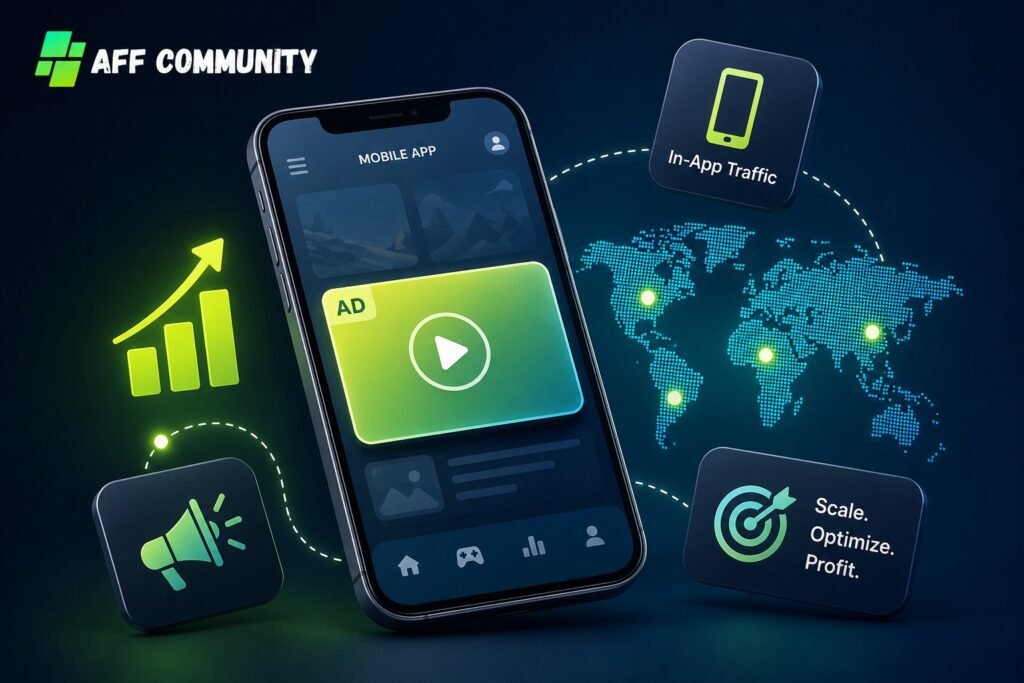
In-App traffic refers to ads displayed within mobile apps. A user launches a game, opens a utility app, uses a weather service, or accesses any other app and sees an ad.


Depending on the platform, various formats are available:
- banners;
- interstitials;
- rewarded video;
- native ads;
- playable ads;
- video ads.
The main advantage of this type of traffic is the massive mobile audience in virtually every country around the world.
Which verticals perform best
Despite the versatility of this traffic source, certain verticals show significantly better results. First and foremost, these include:
- Mobile apps.
- iGaming.
- Betting.
- Utility.
- VPN.
- Finance.
- E-commerce.
That said, a lot depends on the ad network and the specific geographic region. For example, in the gambling sector, In-App has long been considered one of the most promising verticals thanks to its ability to generate large volumes of mobile traffic.
Why In-App Continues to Grow
The main reason is a shift in user behavior. People are spending more and more time in mobile apps rather than in a browser.
Consequently, advertising budgets are gradually shifting to follow the audience. An additional advantage of In-App is the variety of ad networks available.
Ad buyers can test dozens of platforms, compare traffic costs, and find less competitive auctions.
This is precisely what allows for high-quality traffic volumes even in popular verticals.
Key Considerations for Creativity
For in-app advertising, it’s not enough to use the same ads as in Facebook Ads. User behavior within an app is different.
Most often, attention spans are limited to just a few seconds. Therefore, creativity must capture the user’s interest as quickly as possible. The following work best:
- short videos;
- product demonstrations;
- dynamic opening seconds;
- clear calls to action.
It is precisely the quality of the ad creativity that often determines the final cost per user acquisition. The approach to adapting creativity for modern advertising platforms is discussed in detail in this article.
How to Choose a GEO
Many beginners immediately start working with Tier-1 markets, hoping to get the highest-paying conversions. But In-App advertising allows you to scale successfully even in less competitive countries.
In many Tier-2 and Tier-3 markets, the cost of traffic is significantly lower, and the size of the mobile audience continues to grow rapidly.
That’s why, before launching a campaign, you need to evaluate not only the potential payout but also the cost per user, competition, and the specifics of the target market.
Analytics Is Becoming the Key Tool
Working with In-App is practically impossible without constantly analyzing statistics. You need to track:
- CTR.
- CPM.
- CR.
- Cost per install.
- Lead cost.
- User retention.
Even small changes in individual metrics can significantly impact the final ROI. That’s why successful teams analyze data daily and regularly disable underperforming platforms, replacing them with new traffic sources.
We discussed in detail how to make decisions based on analytics in the article at this link.
What’s Next for In-App
We believe that the importance of in-app traffic will continue to grow. Ad networks are actively implementing machine learning algorithms, refining targeting, and offering new formats for user engagement.
At the same time, competition is intensifying, which means that the teams that test new hypotheses faster than others, work with analytics, and regularly update their creativity will come out on top.
Conclusion
In 2026, in-app traffic remains one of the most promising sources for webmasters. The massive mobile audience, the variety of ad formats, and the ability to work across different verticals make it an effective tool for both testing new combinations and scaling successful campaigns.
Our team and I are confident that a systematic approach, high-quality creativity, and competent data analysis are what allow us to maximize the potential of in-app advertising, regardless of the chosen region or vertical.