Nutra: Effective Campaigns and Offers
In Nutra, it’s not enough to simply find an offer with a high payout and run traffic to it. One campaign might generate a steady profit, while another could burn through your budget with the exact same settings. The difference usually lies in the combination of GEO, product, advertising angle, pre-landing page, and lead processing quality.
We view nutra as a vertical where results depend not on a single successful piece of creativity, but on the entire funnel. Let’s break down which offers are worth testing and how to build campaign combinations that can be scaled.
Which nutra offers are worth testing
There’s no universal top-performing offer that works equally well across all GEOs and traffic sources. At the start, it’s best to choose a product tailored to a specific audience and payment model.


Key areas for testing:
- Weight loss and weight management. A broad audience, many advertising angles, and high competition. Here, it’s important to stand out with your presentation, not with promises of instant results.
- Beauty and personal care. Skin and hair care products are well-suited for visual creativity, product demonstrations, and content-driven sales funnels.
- Joints and mobility. It’s important to consider the audience’s age, trust in the product, and GEO-specific characteristics. Aggressive medical claims can harm both conversion rates and the moderation process.
- General wellness category. Vitamins and supplements for everyday well-being allow you to test different audience segments, provided that advertising claims align with the product’s properties.
Before launching a campaign, we recommend comparing not only the payout but also the conversion type: confirmed lead, paid order, or cash-on-delivery (COD) purchase. A high cost per lead does not guarantee profit if the majority of leads are not confirmed.
Other nuances of selecting offers and working with nutraceutical affiliate programs are discussed in the article on the specifics of using nutraceutical affiliate programs in affiliate marketing.
Three Combinations to Test
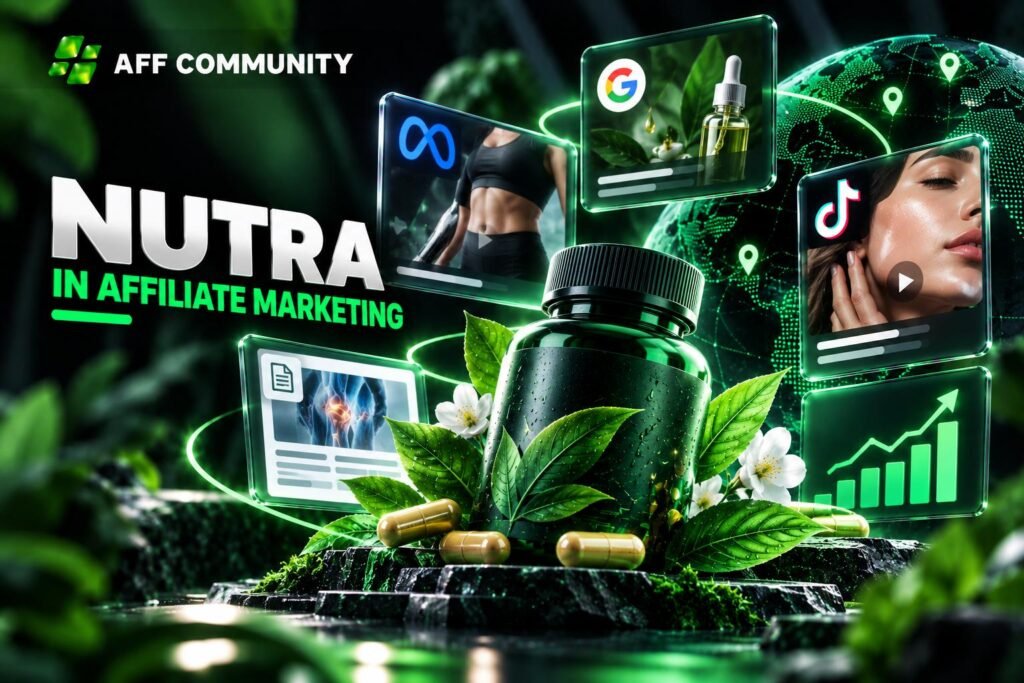
These aren’t ready-made combinations with a guaranteed ROI, but rather working hypotheses that can be adapted to available offers, GEOs, and advertising restrictions.
1. Native Ads → Pre-sell Article → COD Offer
Suitable for products that require additional explanation before ordering. Native creativity draws attention to a familiar problem, the pre-landing page highlights the product’s features, and the landing page leads to the order form.
Here, you need to look not only at CTR and lead cost, but also at approval rate, redemption rate, and the total cost of a confirmed order.
2. Meta Ads → Short Video → Offer in the Beauty Vertical
With this combination, you can test product demonstrations, textures, application methods, and real-world usage features. Instead of a generic promise of “perfect results in just a few days,” it’s better to highlight specific, verifiable benefits.
It’s important to follow the platform’s advertising policies: avoid using misleading results, questionable reviews, and images that exploit the audience’s insecurities.
3. TikTok → UGC Creativity → Content Pre-roll
Here, a native presentation style is tested: a familiar situation, a personal experience using the product, or a product review without the feel of a direct TV commercial. The opening hook plays a key role—it should quickly explain why the user should keep watching.
Before launching, you must verify that the specific product and advertising model are permitted on the selected platform. You can find current approaches to engaging the audience in our analysis of effective triggers for nutra offers.
How to Find a Working Advertising Angle
Even a good offer can fail due to weak creativity. We recommend testing several combinations: ease of use, product composition and properties, usage scenarios, packaging demonstrations, or responses to common objections.
Don’t change everything at once: if a single test varies the video, text, audience, and landing page, it will be difficult to pinpoint the cause of the results. It’s better to change one key element at a time and track the metrics.
At the same time, creativity must align with the landing page. If the ad promises one thing but the landing page describes something else, the user loses trust. Common mistakes that reduce ad effectiveness are listed in the article about creative design errors and their impact on ROI.
Which Metrics Show Actual Profit
Internally, you shouldn’t evaluate a campaign based solely on CTR, CPC, or the number of leads. This is especially true for the COD model, where some leads aren’t verified or don’t result in a purchase.
We recommend tracking:
- CTR and CPC—how well the creativity grabs attention and how much each click costs.
- CR and CPL—what percentage of users submit an application and how much each lead costs.
- Approve and conversion—how many applications are approved and how many orders actually result in a purchase.
- ROI and net profit—how much remains after advertising expenses and other costs.
If leads are cheap but not approved, the cause may be irrelevant traffic, an unsuitable GEO, poor lead processing, or a mismatch between promises made at different stages of the funnel. Therefore, before scaling up, you need to assess lead quality and verify whether the campaign remains profitable at higher volumes. A practical breakdown of this task can be found in the article on optimizing traffic handling and increasing conversion rates.
Conclusion
At its core, a successful campaign is built around the alignment of the product, the audience, and the funnel. Start with a few well-founded hypotheses, test creativity and pre-landing pages, track confirmed conversions, and don’t scale your campaign based solely on cheap leads.
And most importantly, don’t look for a single “magic” combination. Consistent results come when the buyer understands what drives conversions, which metrics are limiting profit, and exactly what needs to be improved before the next scaling phase.

