Pinterest in affiliate marketing: How to Make Money
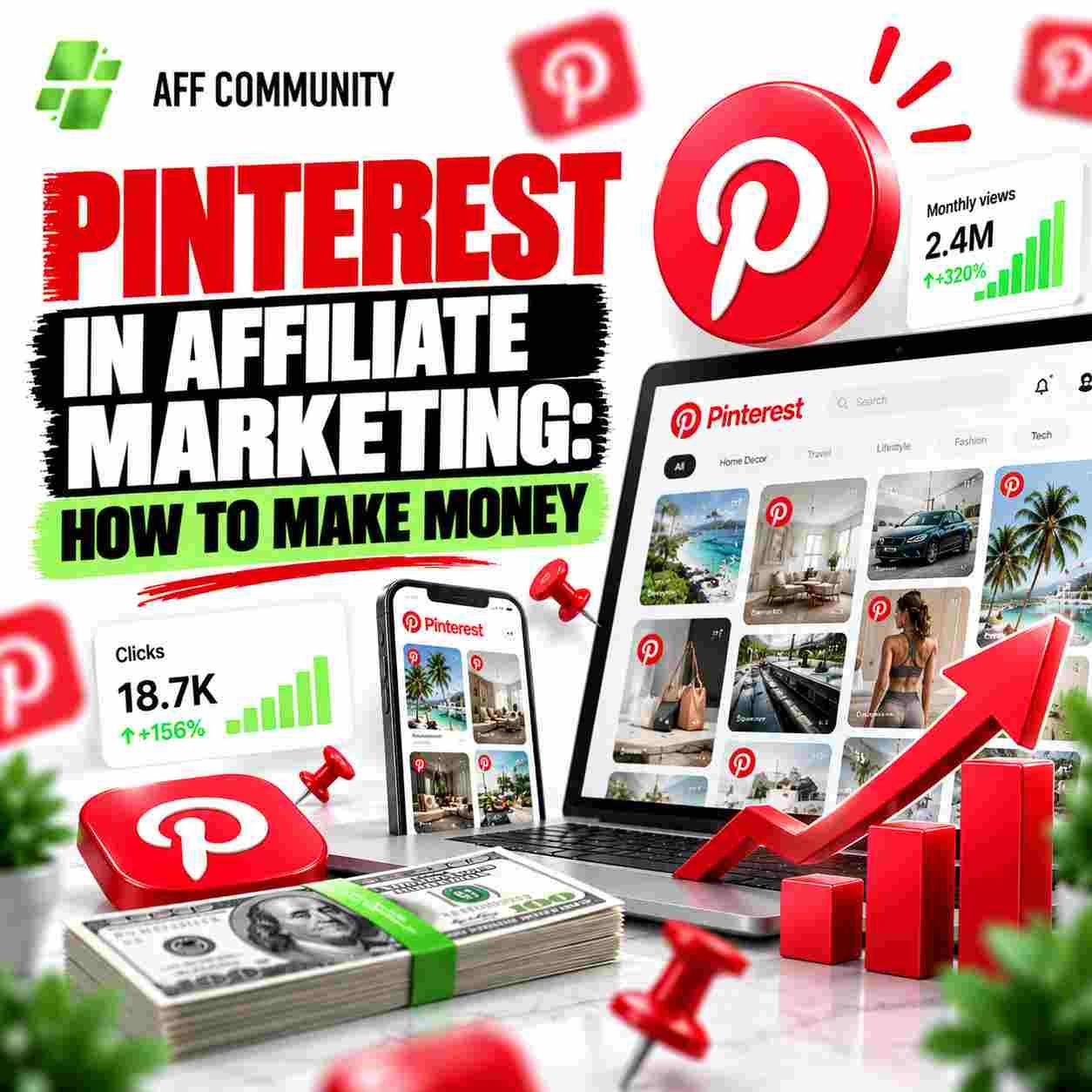
Pinterest is often seen simply as a platform with pretty pictures and ideas. We see it differently: it’s another source of traffic that can be integrated into an affiliate marketing funnel to attract users both organically and through paid promotion.
The main advantage of Pinterest is that content here can have a much longer lifespan than a typical ad. A single successful pin can continue to drive traffic weeks or even months after it’s published.
How Traffic from Pinterest Works
The mechanics are quite simple: pin → click → pre-landing page or website → offer → conversion.


At the same time, Pinterest itself is more like a visual search engine than a classic social network. Users often arrive there with a specific interest in mind: they’re looking for a product, an idea, instructions, a collection, or a solution to a specific problem.
That’s why it’s especially important to choose the right topic and design the pin itself effectively.
We’ve already covered in detail Pinterest as a source of semi-free and paid traffic - it clearly shows why it makes sense to view the platform specifically as a source of traffic, rather than simply as a social network.
How to Make Money
Pinterest itself doesn’t directly generate revenue for a publisher. Monetization occurs only after the user clicks through. You can work with:
- CPA offers;
- product offers;
- subscriptions;
- mobile apps;
- information products;
- e-commerce;
- your own websites and content projects.
But don’t try to run just any offer. Pinterest works well for topics that naturally align with users’ interests.
For example, you can build visual content around beauty, fashion, interior design, travel, recipes, lifestyle, products, and various how-to topics.
Conditional free traffic or paid traffic?
At the outset, we wouldn’t consider these approaches mutually exclusive.
Conditional free traffic takes time: you need to regularly create pins and test headlines, images, and search queries. On the other hand, successful content can drive traffic without the need to pay for every click.
Therefore, Pinterest can be used as part of a strategy for freemium traffic via a blog. This option is particularly interesting for those building a long-term content project.
Paid promotion allows you to test a hypothesis faster, but here you need to carefully calculate the economics.
How to Create Pins That Drive Clicks
The main mistake is creating a pretty image without a clear reason to click. We would test several elements at once:
- Visual. It should stand out among neighboring posts.
- Headline. The user should immediately understand what they’ll get after clicking through.
- Description. Here, you can use relevant search phrases and provide additional context about the content.
- Landing page. The Pin and the website must match each other. If a user expects to see a selection of products but lands on a completely different page, the conversion rate drops rapidly.
As with other traffic sources, continuous testing is key here. Don’t draw conclusions based on a single Pin - it’s better to create several variations and compare them against each other.
Where to Look for Growth Opportunities
Pinterest shouldn’t be evaluated solely by the number of clicks.
We look at the entire chain: impressions → clicks → website visits → conversion → revenue.
Tracking is useful for this. Trackers and TDS in affiliate marketing help you understand exactly where a user came from and which segments actually deliver results.
For example, one type of pin might generate twice as many clicks but convert less effectively into leads. In that case, simply scaling it up would be a mistake.
Pinterest + SEO
Another interesting option is to combine Pinterest with SEO. A pin directs a user to an article, review, roundup, or other useful content. Once on the page, you can guide the audience further down the funnel.
This works especially well for content-driven projects, where a single piece of content can drive traffic from multiple channels at once.
We consider this approach promising precisely because consistent SEO traffic in 2026 can be combined with additional sources of traffic, rather than relying solely on paid advertising.
How to Calculate Earnings
Let’s say Pinterest generated 20,000 clicks in a month. If 5% of users took the desired action, that results in 1,000 conversions. At a payout of $2, that’s $2,000 in revenue.
But if it cost $1,500 to acquire those users, the net profit would be only $500.
Therefore, the number of clicks alone doesn’t tell the whole story. The overall economics of the campaign are much more important.
For the Conditional free traffic model, the situation is more interesting: after creating content, the cost per additional click may decrease, since older posts continue to receive impressions and clicks.
What to Keep in Mind in 2026
Pinterest shouldn’t be viewed as a “run a picture - get paid” button.
You need to constantly test topics, visuals, search queries, and landing pages. At the same time, it’s important to monitor audience quality and not violate the rules of the platform itself or the specific affiliate program.
We recommend starting with a small volume of content, identifying a few effective directions, and only then increasing production.
Conclusion
Pinterest can be an interesting source of affiliate marketing traffic precisely because of the combination of visual content, user search behavior, and the long lifespan of posts.
To make money here, you need more than just one good image—you need a complete funnel: content → click-through → landing page → offer → analytics.
If you can find topics and pin formats that consistently drive your target audience, you can turn Pinterest from a supplementary channel into a full-fledged part of your affiliate marketing system.