Why Offers Are Suddenly Shut Down
In affiliate marketing, there’s a situation that can ruin even a perfectly functioning campaign: yesterday the offer was generating steady conversions, and today the affiliate networks announce that they’re no longer accepting traffic.
For a beginner, this often feels like a disaster. You’ve already tested your creativity, found a working GEO, collected statistics, and gradually increased your budget and suddenly the offer disappears from the catalog or becomes unavailable for new leads.
We believe that closing an offer doesn’t always mean there’s a problem with the affiliate network or the advertiser. In most cases, there’s a very specific reason behind it. The affiliate’s task is to understand these reasons in advance and not to build their entire business model around a single source of income.


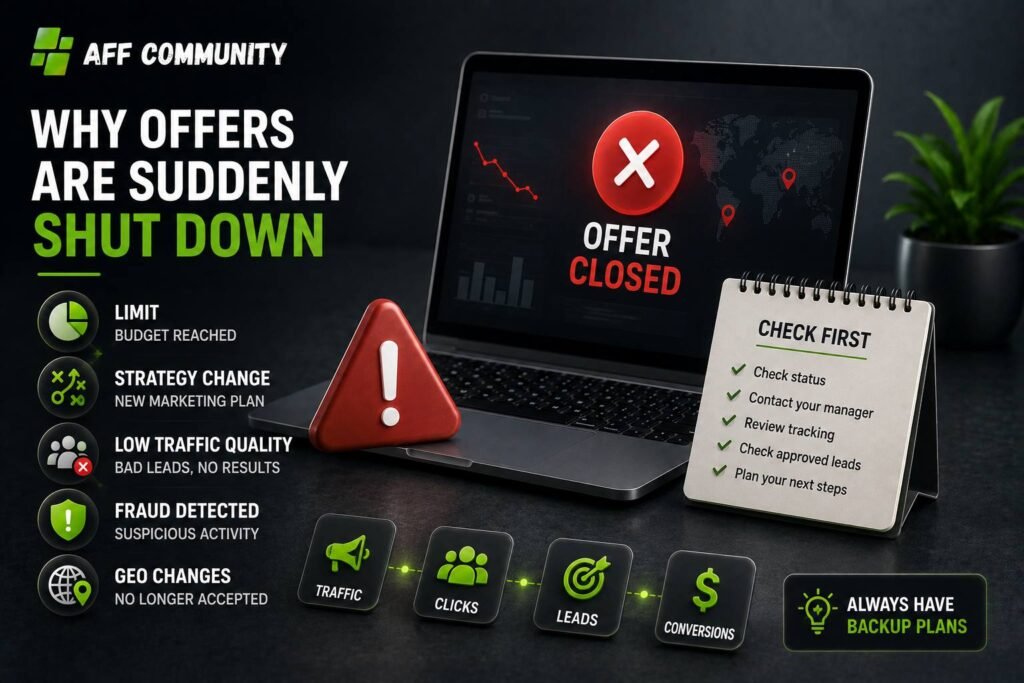
An offer may end due to a limit
The simplest reason is that the advertiser has received the required number of leads. Every product has a specific marketing budget. If an advertiser planned to attract, for example, several thousand customers per month, once the target volume is reached, they may simply no longer need additional traffic.
This happens particularly often with limited-time promotions, seasonal products, and new offers. In such a situation, the webmaster has not actually done anything wrong. The offer simply fulfilled the task set before it.
Sometimes an affiliate network warns webmasters in advance that they are approaching the limit. But you shouldn’t always count on this.
That’s why we recommend communicating regularly with your account manager and checking in advance whether the offer has volume restrictions.
An advertiser may change its marketing strategy
A company might have originally planned to acquire customers through affiliate networks but then change its strategy.
For example, the advertiser might decide to shift the budget to in-house marketing, launch an internal advertising team, or focus on a different GEO.
For a publisher, this can come as a surprise: the offer was still accepting traffic yesterday, but today it’s been closed. At the same time, the problem may not be related to the quality of the webmasters’ work at all. That’s exactly why you shouldn’t view every closure as a punishment.
The problem may lie in the quality of the traffic
A completely different situation arises when an advertiser is dissatisfied with the quality of the audience they’ve attracted.
A large number of sign-ups doesn’t necessarily mean a good result. If users:
- don’t verify their information;
- don’t complete the desired action;
- submit a large number of invalid applications;
- come from prohibited sources;
- use incentivized traffic;
- exhibit suspicious behavior.
The advertiser begins to lose money. As a result, the affiliate networks may first lower the rate, then restrict certain traffic sources, and ultimately close the offer entirely.
Therefore, before scaling up, it’s important to understand not only the number of conversions but also their quality. We discussed this approach in detail in the article “How to Check Traffic Quality Before Scaling Up”.
Sometimes an offer is closed due to fraud
Another serious reason is fraudulent or suspicious traffic.
If an advertiser detects a large number of bots, duplicate registrations, artificial clicks, or other anomalies, the affiliate network may suspend traffic until the situation is clarified.
Moreover, problems with a single traffic source can sometimes affect the entire offer. For example, several webmasters may start running massive amounts of questionable traffic. The advertiser notices a surge in suspicious leads and temporarily disables the affiliate channel entirely.
In such a situation, legitimate affiliates also become victims of others’ actions. Therefore, it’s important to monitor your own statistics and avoid using traffic sources whose quality you can’t properly control.
An offer may be closed due to changes in GEO
Another common reason is a change in operating conditions in a specific country.
An advertiser may have previously accepted users from a certain GEO and then stopped running campaigns there. There are various reasons for this:
- Changes in legislation.
- Rising customer acquisition costs.
- Changes in demand.
- The emergence of competitors.
- Payment issues.
- Product withdrawal from the market.
However, the offer itself may continue to run in other countries. Therefore, if a manager informs you about a GEO closure, you should immediately clarify whether the restriction applies to the entire offer or only to a specific region.
Sometimes this situation even opens up a new opportunity: you can transfer the working campaign to another GEO if the economics allow it.
What Happens to Traffic After Closure
This raises an important practical question: what should you do if you’re already running traffic? The first rule is do not continue running ads automatically.
If the affiliate networks have stopped accepting leads, you need to find out the exact closure time.
This is especially important when working with a large budget. If the ad platform continues to generate clicks but the affiliate networks are no longer accepting conversions, money will be wasted without the ability to monetize the traffic properly.
We recommend the following steps immediately:
- stop scaling;
- contact your account manager;
- clarify the offer’s status;
- check which leads will be counted;
- determine whether you can redirect the traffic;
- only then decide whether to resume advertising.
Why It’s Important to Monitor Statistics
Sometimes, the closure of an offer can be predicted in advance. For example, if conversions drop for several days in a row, the number of rejected leads increases, or the quality of traffic changes, this could signal problems within the offer.
It doesn’t necessarily mean it will be closed tomorrow. But such changes are worth discussing with your manager. It’s especially helpful to compare current metrics with those from previous periods.
If a traffic source previously consistently delivered a certain conversion rate, and then the metrics suddenly worsened without any changes on the buyer’s part, you need to investigate the cause.
Sometimes the problem really does lie with the offer. We’ve analyzed situations like this in the article “Why Did Traffic Drop? A Checklist for Reviewing Campaigns in Affiliate Marketing”.
Don’t put all your traffic on a single offer
One of the most costly mistakes is building your entire team around a single offer. Let’s say a publisher found a great offer and gradually increased the budget from $100 to $5,000 per day.
As long as everything is working, the strategy seems ideal. But if the advertiser suddenly closes the offer, virtually the entire cash flow stops along with it.
That’s why we recommend having several active campaigns.
This doesn’t mean you need to run campaigns on twenty offers at the same time. It’s enough to gradually test alternatives and understand which products can replace your main offer in case of problems.
This approach is especially important when dealing with large volumes.
Exclusivity Doesn’t Protect Against Termination Either
Sometimes a publisher receives an exclusive offer and believes they now have a long-term advantage.
But exclusivity doesn’t mean the offer will last indefinitely.
The advertiser can still change the budget, close a GEO, revise the terms, or completely shut down the affiliate program.
Therefore, even an exclusive offer should be viewed as a working asset, not as a guaranteed source of income. It’s much more important to understand the economics and have backup options.
What to Do After an Offer Is Closed
If an offer has indeed been closed, don’t immediately write off the entire campaign as a loss. First, analyze exactly what made it profitable. For example:
GEO + traffic source + creativity + audience + payment model.
If the underlying mechanics work, you may be able to apply them to another product. Let’s say a certain type of audience converted well. In that case, you can look for an alternative offer with a similar product and the same terms.
That’s exactly why we recommend keeping a record of your tests, creativity, and statistics.
When a new offer appears, your team will be able to test a familiar hypothesis much more quickly.
Conclusion
An offer can be shut down suddenly for dozens of reasons: the advertiser’s budget has run out, a limit has been reached, the GEO has changed, traffic quality has deteriorated, fraud has been detected, or the company has completely revamped its marketing strategy.
We recommend treating an offer as a temporary working tool. As long as it delivers good ROI, we scale it up. But at the same time, keep alternative options in reserve.
And most importantly—always ask the manager why the offer is being closed and what exactly will happen to the traffic that has already been sent. Sometimes this allows you to save part of the campaign, transfer it to a different GEO, or quickly find a replacement while competitors are just starting to look for a new offer.