FOMO in Affiliate Marketing: Does It Work?
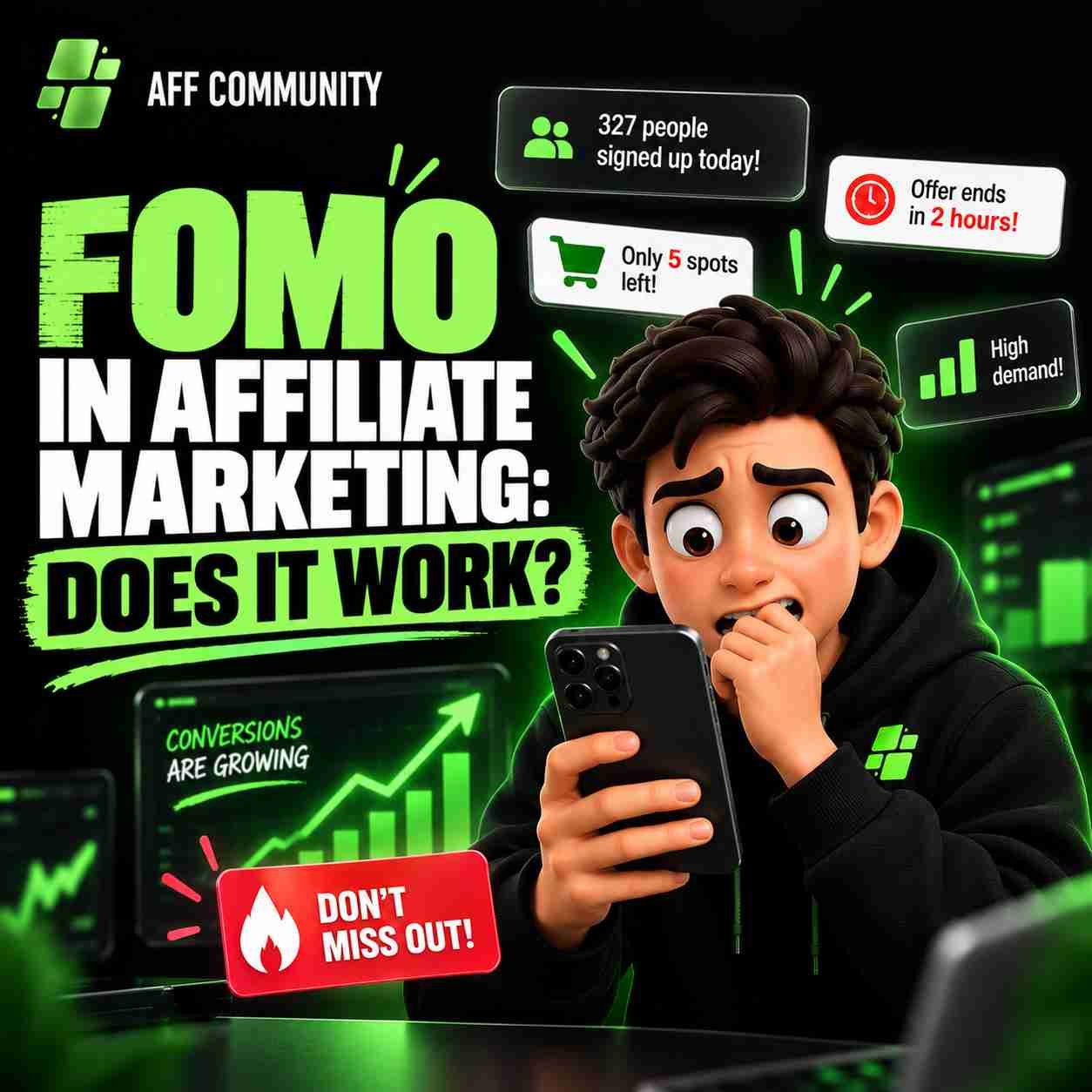
FOMO is one of those psychological triggers that arbitrage marketers have been using for a long time, but its actual effectiveness is still a subject of debate. A user sees a limited-time offer, a countdown timer, a message about the last few spots available, or high demand, and must decide: take it now or come back later.
In practice, the second option often means the person won’t come back at all.
We decided to investigate just how much FOMO actually helps in affiliate marketing and where the line is drawn between an effective trigger and cheap clickbait.


What Is FOMO in Arbitrage
FOMO stands for Fear of Missing Out—the fear of missing an opportunity.
In marketing, it’s used to shorten the time between a user’s interest and the desired action. A person is already interested in an offer but is putting off a decision. FOMO adds an extra motivator: if they don’t act now, the offer might disappear.
The mechanism usually revolves around three elements:
- a limited timeframe;
- a limited quantity;
- and the perception of high demand.
That said, FOMO doesn’t necessarily mean an aggressive full-screen timer. Sometimes it’s enough to clearly show the actual limitation or an additional benefit for making a quick decision.
Consumer behavior studies also link scarcity cues and social proof to heightened FOMO and changes in the intention to take action.
Where FOMO Works Best
In affiliate marketing, this approach makes particular sense when users are already inclined to put off making a decision.
For example, this could include products, subscriptions, services, various promotions, and limited-time offers.
But it’s important to understand: FOMO doesn’t create desire out of thin air.
If a person has absolutely no need for a product, the message “2 hours left” is unlikely to suddenly turn them into a buyer. However, if interest has already been sparked, adding a sense of urgency can eliminate the usual “I’ll think about it later” mindset.
That’s precisely why we view FOMO not as a replacement for a good offer, but as an additional element in the sales funnel.
Countdown Timers: They Work, But There’s a Catch
Countdowns are one of the most popular FOMO tools.
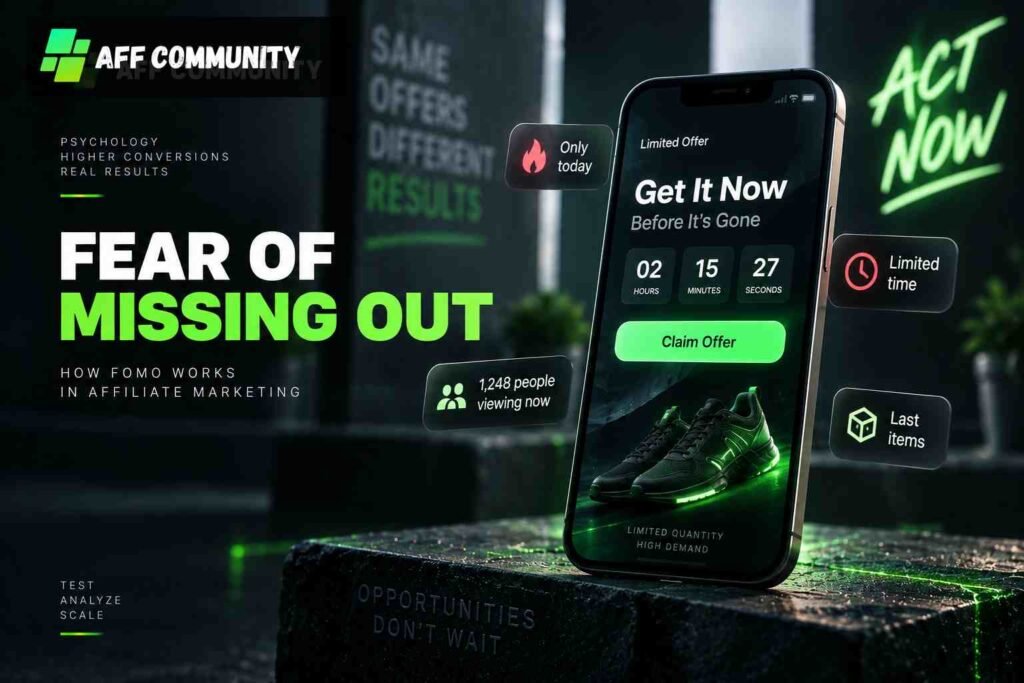
The user sees a specific end time for the promotion and realizes there’s no more time to put off a decision. This mechanism works especially well on landing pages with a clear offer.
But an endless timer that, after refreshing the page, keeps showing “10 minutes left” quickly turns into a cheap gimmick.
If the audience realizes the deadline isn’t real, trust plummets. Modern FOMO approaches increasingly emphasize actual scarcity or a real expiration date for the offer, rather than artificial pressure.
FOMO Starts with the Creative Itself
An arbitrage specialist can use a scarcity trigger right in the ad itself.
For example:
- “Today Only”,
- “Last Few Spots”,
- “Bonus Available Until Midnight”,
- “Offer Ends Today”.
But it’s important not to overdo it here. The creative should first hook the user and only then spark the desire to click through. In our article on mistakes when creating ad creatives, we’ve already discussed why an overloaded or overly clickbait-y approach can reduce ad effectiveness.
FOMO works best as part of a broader concept, rather than as the sole selling point.
What about social proof?
Another option is to show that other people are already interested in the product.
The number of purchases, real reviews, user activity, or the popularity of a specific offer send an additional signal: “Others are already making a decision; maybe I shouldn’t put it off either.”
But there’s a crucial point here—the numbers and reviews must be real.
Inflating the number of buyers or fabricating fake notifications just to boost the CTR is a bad strategy. A short-term increase in conversions can backfire and lead to trust and reputation issues.
FOMO and Audience Warm-Up
It’s particularly effective to use FOMO not immediately after a click, but closer to the desired action.
A cold user might not even understand why they need the product. If you pressure them with a timer right away, it’s more likely to cause irritation.
First, you need to explain the value of the offer, address the main objections, and only then add a time limit.
This approach works particularly well with audience warming in affiliate marketing: first, we build interest and trust, and then we give the user an additional reason not to delay taking action.
How to Tell If FOMO Is Profitable
Don’t evaluate the strategy based solely on CTR. Let’s say that after adding a timer, the number of clicks increased. That doesn’t necessarily mean the campaign has become more profitable.
You need to compare: CTR → CR → CPA → payout → ROI.
If FOMO increased the number of clicks but attracted a lower-quality audience or reduced the overall conversion rate, this tactic doesn’t make sense.
That’s why we recommend testing FOMO as a separate hypothesis: one version of the landing page without the trigger, the second with a real time limit, while keeping all other conditions as consistent as possible.
To evaluate the results, it’s helpful to look not at a single metric but at the entire set of campaign metrics. Even in the article on optimizing traffic handling and increasing conversions, the emphasis is on a comprehensive approach to user engagement, rather than on a single element of the funnel.
The main mistake is creating an artificial scarcity
FOMO can indeed work—but only because people are afraid of missing out on a real opportunity.
If every day ends with a “final promotion,” every week features “only 5 spots left,” and the timer restarts after a page refresh, users will quickly stop believing such ads.
We therefore recommend using FOMO only when the limitation can be explained by the actual mechanics of the offer.
For example, the promotion is actually ending, the bonus is truly available for a limited time, or the quantity of the product is genuinely limited.
Conclusion
FOMO in affiliate marketing is a useful tool, but it’s not a magic “+30% conversion” button.
It works best when combined with a solid offer, strong creative, a clear benefit, and proper lead-in. At the same time, artificial scarcity can backfire and erode trust.
We would test FOMO as a standard A/B testing hypothesis: launch a control version, add a real sense of urgency, collect statistics, and compare not only the CTR but also the final profit.
If a user already wants the product, sometimes all they really need is one reason to stop putting off the decision.