How to Properly Test Ad Creatives
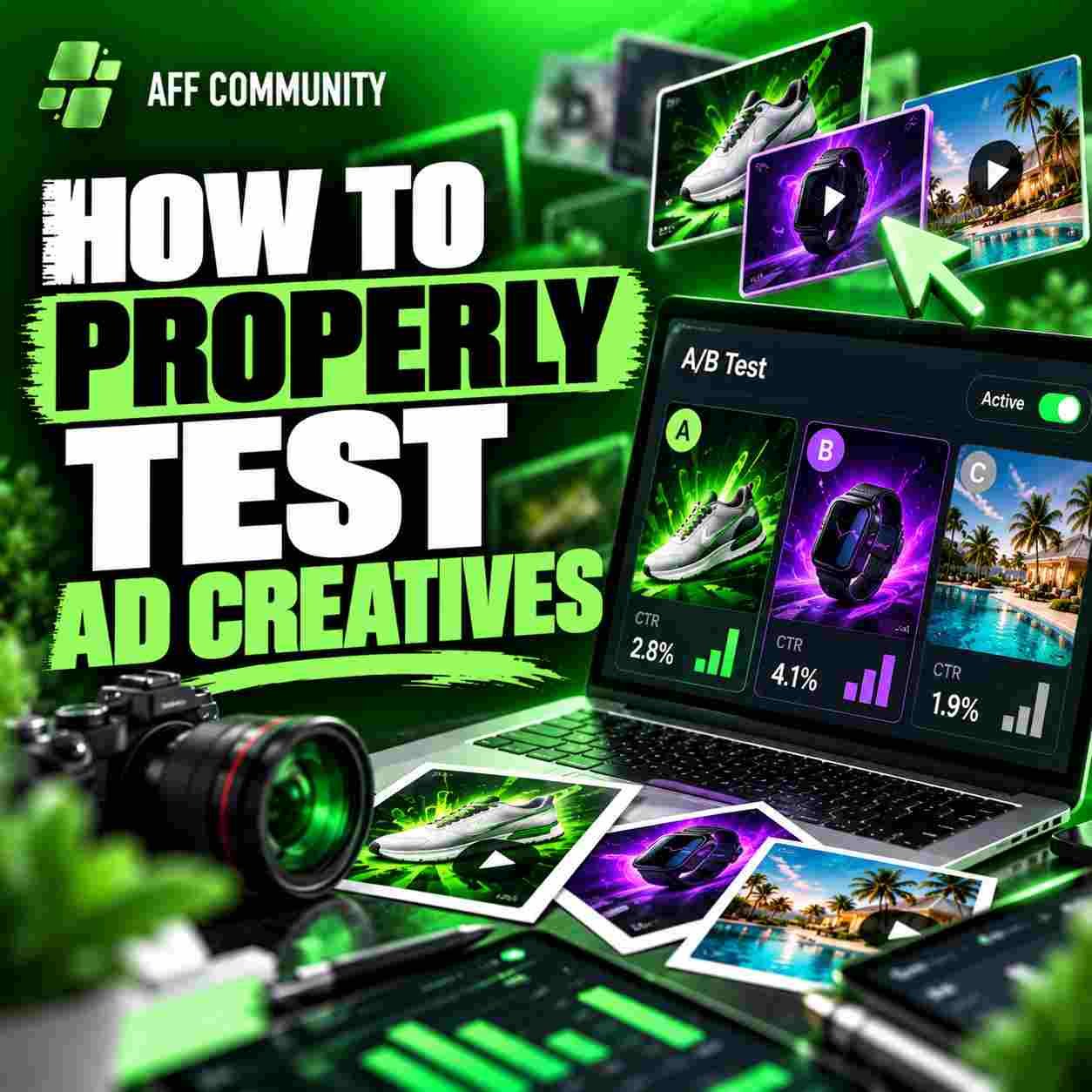
In affiliate marketing, you can have a good offer, a decent GEO, and a reasonable budget, but still end up in the red. Very often, the problem starts with the ad creativity itself.
We believe that testing creativity isn’t just about running ten random images and choosing the one with the highest CTR. A proper test should show which hypothesis works, for which audience, and how it delivers results.
Don’t Test Everything at Once
One of the biggest mistakes is changing the image, text, headline, CTA, and format all at the same time.


Let’s say the first creativity is a video with UGC, the second is a static image, and the third is a meme. If the third option wins, we don’t actually know what exactly worked.
That’s why it’s better to test individual hypotheses. For example:
- the same visual but different headlines;
- the same text but different images;
- the same idea in both video and static formats;
- an emotional approach versus a rational one;
- different CTAs.
This way, you gradually gain an understanding of which elements actually influence the results.
The basic principles are discussed in more detail in the article on ad creatives in affiliate marketing and how to test them.
How Many Variants to Run
We generally don’t recommend starting with either a single creativity or a huge batch of several dozen.
For an initial test, you can prepare 3–5 variants that differ based on specific hypotheses. For example:
- Creativity #1 - focuses on the user’s problem.
- Creativity #2 - focuses on the benefit.
- Creativity #3 - demonstrates the product.
- Creativity #4 - uses social proof.
- Creativity #5 - uses a more aggressive hook.
This approach provides enough data for an initial comparison without turning the test into a pointless drain on your budget.
Which Metrics to Monitor
CTR is just the beginning of the analysis. A high CTR doesn’t necessarily mean the creativity is good. Users may click actively but fail to take the desired action after landing on the page.
That’s why we look at at least a few metrics:
- CTR: how well the creativity captures attention;
- CPC: how much it costs to get a click;
- CR: how users convert after landing on the page;
- CPA: how much a conversion costs;
- ROI/ROAS: how well the ad ultimately pays for itself.
If creativity has a high CTR but an expensive CPA, you can’t simply declare it the winner. It may be effective at attracting a curious but non-target audience.
That’s exactly why it’s helpful to consider conversions and their impact on ad performance when evaluating a campaign.
Don’t pause the creativity too early
Another extreme is pausing the creativity after just a few dozen impressions.
With a small data set, the difference between two variations could simply be a coincidence. That’s why we first determine the minimum amount of data needed specifically for a given campaign, and only then compare the variations.
That said, there’s no need to wait indefinitely either. If creativity receives a sufficient number of impressions and clicks but consistently underperforms on key metrics, it’s better to reallocate the budget.
The winning version needs refinement
Let’s say one version outperformed the rest. That doesn’t mean you should run only that one for a month.
The next step is to generate derivative hypotheses. If a specific hook worked, you can keep it and change the visual. If the visual performed well, test several new headlines.
This way, a single winning creativity can yield a whole group of new variations.
We’ve separately discussed mistakes in creativity design that affect ROI, since even a good test can quickly lose effectiveness due to banner fatigue or improper presentation.
Test for a specific geographic region
Creativity cannot automatically be considered universal. What works well in one geographic area may perform significantly worse in another. Language, cultural context, visual preferences, the level of competition, and user reactions to ad messages all differ.
Therefore, when rolling out a campaign to a new geographic area, we don’t simply copy the old creativity - we run a separate test.
Even within a single campaign, it makes sense to compare the metrics of different audience segments.
What to Do After the Test
After completing the first stage, we divide the creativities into three groups:
- Winners: we keep them and start scaling them up.
- Promising: We refine them and retest.
- Weak: We pause them and stop spending budget on them.
Next comes the second cycle: new visuals, new hooks, new formats, and variations on the working mechanics we’ve already identified.
It’s especially important not to confuse good creativity with a good conversion funnel. If users don’t convert well after clicking, the problem may lie in the next stage of the funnel. Before scaling up, it’s therefore worth checking the quality of the traffic you’re receiving.
How to Avoid Wasting Your Budget on Tests
We recommend determining the following in advance:
- how much money you’re willing to spend on a test;
- which metrics you consider key;
- what CPA is acceptable;
- under what conditions creativity should be paused;
- how many variants you’re testing simultaneously.
Another important point: don’t change your strategy in the middle of a test. If today you’re comparing five creative hypotheses, but tomorrow you completely change the audience and budget, it becomes difficult to compare the results.
It is this systematic approach that transforms testing from simply spending a budget into actually gathering data.
Conclusion
Proper testing of creativity isn’t about finding a single pretty image.
We view it as a sequential process: hypothesis → several variants → launch → data collection → comparison → refinement of the winning variants → new test.
The key is to always understand exactly what we’re testing and which metric should confirm the hypothesis.
This is how we gradually build our own library of effective hooks, visuals, and ad mechanics. And over time, this library becomes one of the affiliate marketing team’s most valuable assets.