The Comprehensive Affiliate Marketing Dictionary: All Terms Explained in Plain Language
In the world of affiliate marketing, you could spend a week reading buyers’ chat logs and still not understand half of the messages. “The creo burned out,” “the approval dropped,” “the offer’s on hold,” “we’re running it into the budget,” “the team went to the dumpling shop”—to a beginner, this sounds like a whole different language.
We decided to compile a comprehensive dictionary and explain the basic terms as simply as possible. It covers basic concepts, metrics, ad formats, technical slang, vertical names, and words that buyers use in their day-to-day work.
A
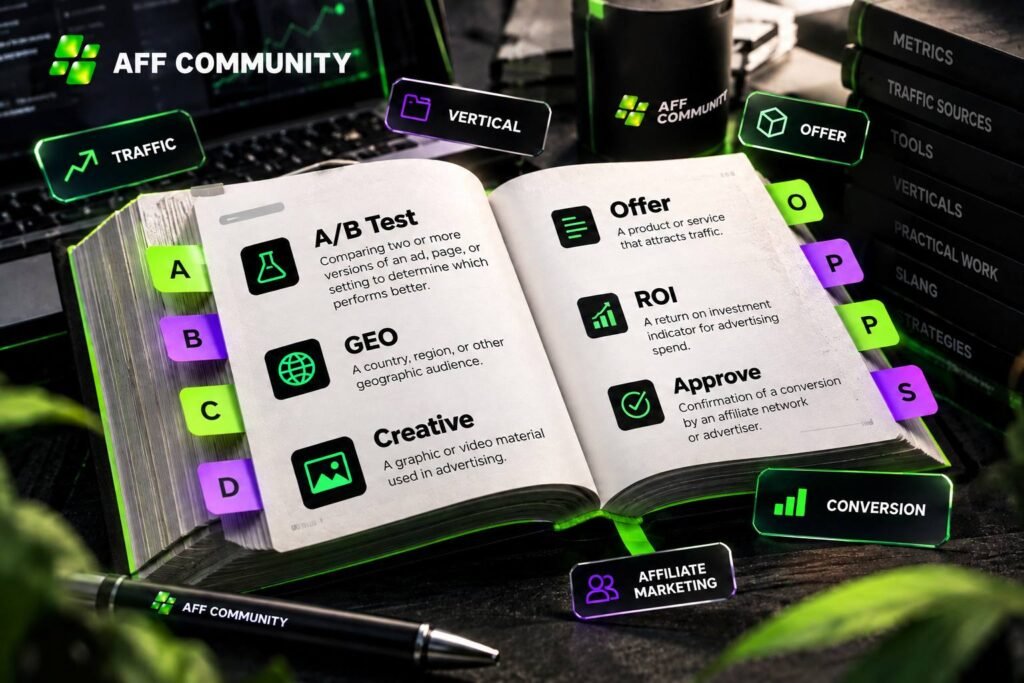
A/B Test (Split Test)—comparing two or more versions of an ad, page, or setting to determine which one performs better.


API — an interface through which different services automatically exchange data. For example, affiliate networks can send conversions to a tracker.
Ad Tech — technologies and platforms used to buy, sell, display, and analyze digital advertising.
Advertiser — an advertiser, product owner, or offer owner.
Adult — a vertical featuring products and content for an 18+ audience.
Account — an account on an ad network, affiliate networks, service, or other platform.
Anti-detection browser — a browser that allows you to create separate profiles with different digital environment settings.
Anti-Case — an analysis of a failed campaign: what went wrong, how much money was lost, and what conclusions were drawn.
Anti-Fraud — a system that protects against fraudulent and low-quality traffic.
Approve — confirmation of a conversion by an affiliate network or advertiser.
Upsell (Upsell) — an additional sale made to a user after the main action or purchase.
Affiliate marketing — a model in which an arbitrageur buys traffic and directs it to an offer, earning money on the difference between expenses and the payout received.
Webmaster — a specialist who buys and monetizes traffic.
Rental account — an advertising account provided for temporary use.
Affiliate — a partner who receives compensation for referred users or sales.
Auto-approval — automatic confirmation of conversions without manual verification of each application.
Auto-registration — an account registered automatically or in bulk.
Agency dashboard — an advertising dashboard with advanced features and limits, typically intended for agencies.
AdWords — a colloquial term for Google Ads.
B
Bump – an increase in the bid or payout for high-quality traffic.
Banner – a graphical advertising format.
Banner advertising – advertising in the form of a graphical block on a website or platform.
Banner blindness – a situation where a user automatically ignores familiar ad blocks.
Banner traffic – users who arrived via banner ads.
Baseline – a baseline metric or initial result against which subsequent changes are compared.
Betting – the vertical of betting on sports and other events.
Bid – the bid an advertiser or buyer offers for an impression, click, or other advertising action.
Billing – a payment system for advertising or services.
Binary options – binary options.
Traffic Exchange — a platform where participants buy and sell traffic.
Blacklist — a list of platforms, sources, or entities that are excluded from an advertising campaign.
Black Page — a page containing the main advertising offer in schemes that use content segmentation.
Brute force — the process of trying a large number of combinations of data or account credentials.
Pay-per-action sites — services where users are paid for performing simple actions, such as viewing ads or clicking through.
Bourge / BourgeNet— an international audience and traffic, most often from countries outside the CIS.
Bourge traffic— traffic from international GEOs.
In
Whitelist— a list of permitted platforms, sources, domains, or parameters.
White page — a neutral informational page that meets the requirements of an advertising platform.
Wap-click — a model in which a user confirms a paid action via the mobile operator’s infrastructure.
Webmaster — a specialist who attracts and monetizes traffic.
Webs — a colloquial term for webmasters or publishers.
Wager — a requirement regarding the volume of bets or gaming turnover that must be met before bonus funds can be withdrawn.
Vertical — a specific market segment: gambling, nutra, dating, finance, e-commerce, and others.
Showcase—a page or website where users are shown several offers at once.
Funnel—the user’s journey from their first interaction with an ad to the desired action.
G
GEO — a country, region, or other geographic audience to which traffic is directed.
Gambling — the vertical of games of chance, casinos, and related products.
D
Dashboard — a panel that aggregates key metrics and data from various systems.
Dating — the vertical of dating and communication services.
Deposit — the act of a user adding money to an account.
Deeplink — a link that leads directly to a specific section or screen of a website or app.
Domain — a website address, such as example.com.
Doorway Page — a page or website created primarily to attract search traffic and subsequently redirect the user.
Early Repayment — early fulfillment of a financial obligation; more commonly used in the financial sector.
Post-Farming — the continuation of farming and account preparation after the initial stage.
Z
Prohibited Traffic — traffic that is prohibited by the terms of an offer, affiliate networks, or advertising platforms.
ZRD — a colloquial term for various requirements and restrictions imposed by advertising platforms regarding permitted actions.
PZRD — an expanded term for payment or advertising restrictions used in the professional slang of certain teams.
I
Install — the installation of an app.
Traffic source — the platform or channel from which users come: Google, Meta, TikTok, push network, SEO, etc.
In-page push — a push notification that appears directly within a web page.
iGaming — a broad segment of online gambling and related digital gaming products.
C
Campaign / Advertising Campaign — an advertising campaign.
Cap — the maximum number of conversions that an affiliate network is willing to accept over a specific period.
Case Study — a detailed analysis of an ad campaign, including metrics, actions, and results.
King / Mom — an account with a strong track record and high trust from the advertising platform.
Click-Through Rate / CTR — the percentage of users who clicked on an ad after it was displayed.
Click Fraud — artificial or low-quality clicks that lack legitimate advertising intent.
Cloaking — a technology for segmenting content for different categories of visitors.
Conversion / CR — the percentage of users who performed a target action.
Convert — a colloquial term for conversion.
Creativity / Creo — advertising material: video, image, text, banner, or a combination of these elements.
Crypto — a vertical related to cryptocurrencies, exchanges, wallets, and other crypto products.
Crash game — a game where the multiplier increases until it stops randomly, and the user must act quickly to collect their winnings.
Cookies — small pieces of data that a website stores in the user’s browser.
Captcha — a verification method designed to distinguish a real user from an automated system.
L
Landing Page / Lander — the page a user lands on after clicking an ad.
Lead — a user who has performed the desired action, such as submitting a request.
Lead Generation — the process of acquiring potential customers.
Run traffic — direct users to an offer.
Break even — generate more revenue than you spend.
Break even — expenses are roughly equal to revenue.
Operate at a loss — expenses exceed revenue.
Log / Log-account — login credentials or the account itself, as used in technical slang.
Locker — a mechanism that restricts access to content until the user performs a specific action.
LPO — a metric related to the number of leads generated by an offer.
LTV — the amount of money a user brings to the business over the entire period of interaction.
M
Macros — variables that automatically insert data into links, trackers, or advertising systems.
Midlet — an intermediate technical element in certain advertising and mobile scenarios.
Microloans / Payday Loans—short-term financial loans.
Mislead—advertising that misleads the user.
Mobile—mobile traffic or work with mobile devices.
Moderation—checking ads, websites, or content for compliance with platform rules.
Monetization — a method of converting traffic or an audience into revenue.
Motivated traffic — users who are offered a reward for completing a target action.
Spam rate — the proportion of low-quality or useless traffic.
N
Native / Native advertising — advertising that is visually and contextually integrated into the platform’s format.
Naming — the name of a product, page, project, or advertising element.
News aggregator — a platform that collects news from various sources.
Nutra — a product vertical for health, beauty, weight loss, and other consumer wellness products.
O
Ad — advertising material displayed to a user.
Owner — the owner of an offer, business, project, or advertising resource.
Optimization — adjusting a campaign based on data to improve results.
Offer — a product or service promoted by a publisher.
CPA offer — an offer where payment is made for a specified target action.
Offer Page — a page featuring the actual product offer.
Offer Wall — a page or system where users are shown a variety of available offers.
White Offer — a product that can be promoted openly and without using gray-hat methods.
Gray Offer — an offer with additional restrictions or stricter advertising requirements.
Product Offer — an offer for a physical product.
Offer Wall — a showcase featuring a variety of offers.
Reach — the number of unique users who were shown content or an ad.
P
Domain Parking — hosting a domain on a special page without a full-fledged website.
Affiliate Program / AP — a program in which an affiliate receives compensation for referring customers.
Affiliate Network / CPA Network — a platform that connects advertisers and webmasters and provides them with offers.
PayPal / Palka — a colloquial name for PayPal.
Click-through — a user’s click on a link that redirects them to another resource.
Pixel — code used to track user actions and events on a website or within an advertising system.
PIN submission — a model in which a user confirms an action via a PIN code or mobile authentication.
Payment method — a payment tool or method for receiving or withdrawing money.
Impression — a single instance of an ad being displayed to a user.
User — a person who interacts with a website, app, or ad.
Pop-up — a pop-up ad window.
Pop-up notifications — pop-up messages used to attract attention.
Popunder — an ad window that opens in a separate tab or behind the current window.
Traffic — the number of visits to a website over a specific period.
Postback — a server-side transfer of conversion information between systems.
Traffic stream — a separate channel or segment of traffic within a campaign.
Weight-loss offers — a colloquial term for offers related to weight loss.
Pre-landing page / Pre-land / Intermediate page / Transit page — an intermediate page between an ad and the main offer.
Private offer — an exclusive offer available to a limited group of partners.
Sample — an offer to try a product in a small quantity or at a special price.
Proxy — an intermediary server through which an internet connection passes.
Profit — net profit after deducting expenses.
Push — an advertising notification delivered to a user via a browser or device.
Performance Buying — purchasing traffic with a primary focus on results: a lead, purchase, deposit, or other conversion.
R
Consumables — the tools and infrastructure needed to get started: accounts, proxies, trackers, domains, etc.
Rebill — the repeated charging of a user for a subscription.
RevShare — a model in which an affiliate receives a percentage of the revenue generated by a referred user.
Redirect — the automatic redirection of a user from one page to another.
Advertising platform — a place where ads are displayed.
Advertiser — a company or individual that sells a product and pays for acquired customers.
Relevance — the extent to which an ad matches a user’s interests or search query.
Retargeting — showing ads again to users who have already interacted with the product.
Retriv — traffic or activity that returns after a previous interaction.
Referral — a user referred by another partner.
Referral link — a link that allows you to determine which partner referred the user.
Rotator — a system that automatically distributes users among multiple links, offers, or pages.
S
Sub — an additional link parameter that allows you to distinguish between traffic sources and segments.
Self-regs — independent account registration without the involvement of an operator or manager.
Newly registered account — a recently registered account.
Sweepstakes — a vertical market consisting of promotions, giveaways, and prize-based mechanics.
Campaign — a combination of a traffic source, offer, creativity, landing page, and other elements that yields a specific return on investment.
Simple campaign — a campaign with a minimal number of intermediate elements.
Complex bundle — a scheme with multiple stages, pages, traffic sources, or routing options.
Seller — a vendor of goods or services.
Semantic core — a set of search queries used to promote a website or advertising campaign.
Smartlink — a link that automatically selects the appropriate offer or destination for the user.
Spend — advertising expenses.
CPA marketing — an affiliate marketing model where payment is made for a specific action.
Statistics / Stats — data on advertising campaigns and conversions.
SubID — an additional identifier in an affiliate link for more detailed traffic analysis.
T
Targeting — tailoring ads to a specific audience.
Text link — a standard link with a text anchor.
Teaser — a small ad unit with an image and brief text.
Teaser network — an ad network specializing in teasers.
Ticket — a support request submitted to an advertising platform, affiliate networks, or service.
Products — the physical goods vertical.
Trust — the level of trust in a domain, account, page, or source.
Traffic — a flow of users.
Teaser traffic — users coming from teaser networks.
Social traffic — users from social media platforms.
Mobile traffic — users on mobile devices.
Trafficback — redirecting unsuitable traffic to another offer or destination.
Tracker — a system that collects and analyzes data on advertising traffic.
Trending Accounts—accounts used to work with current formats and trends on the platform.
Trash—low-quality leads or traffic that do not meet the advertiser’s requirements.
F
Fan Page / FP—a page for a brand, project, or topic on a social network.
Farming—the process of preparing and “running” accounts before full-scale advertising campaigns.
Farm — a colloquial term for the farming process or prepared accounts.
FB — a colloquial abbreviation for Facebook.
Fulfillment — a set of operations involving the processing, packaging, and delivery of goods to the buyer.
Fraud / Fraud — fraudulent or artificial traffic.
H
Hold — the period during which conversions are verified before affiliate commissions are paid.
Hosting — a service on which websites and other web resources are hosted.
T
Target Audience — people who are potentially interested in the advertised product.
Target Action — an action for which the affiliate networks or advertisers pay: registration, purchase, deposit, installation, etc.
Ch
Check / To Check — to verify something: an account, domain, offer, statistics, payment, or traffic source.
Sh
Shaving — a situation where a portion of actual conversions is not counted or is displayed differently in the affiliate’s statistics.
Shaving — the process or practice of underreporting the number of conversions.
Key Advertising Metrics
We’ve compiled a separate list of terms that a buyer needs to understand from day one on the job.
CPA (Cost Per Action / Acquisition) — the cost of a single target action.
CPC (Cost Per Click) — the cost of a single click.
CPM (Cost Per Mille) — the cost per thousand impressions.
CPL (Cost Per Lead) — the cost of acquiring a lead.
CPS (Cost Per Sale) — the cost per sale.
CPI (Cost Per Install) — the cost of an app installation.
CPF (Cost Per Fun) — the cost of acquiring a user or an action related to game mechanics.
CPP (Cost Per Rating Point) — the cost of one audience rating point.
CTR (Click-Through Rate) — the ratio of clicks to impressions.
CR (Conversion Rate) — the percentage of users who completed a target action.
EPC (Earnings Per Click) — the average revenue generated per click.
ER (Engagement Rate) — the level of audience engagement.
ERR — a metric for audience response or engagement, depending on the analytics system used.
KPI — key performance indicator.
LTV (Lifetime Value) — the total value of a user over the entire period they use the product.
NPS — a measure of users’ willingness to recommend the product.
OL (Organic Likes) — organic likes.
PF (Purchase Frequency) — purchase frequency.
PPL (Pay Per Lead) — a pay-per-lead model.
PPV (Pages Per Visit) — the number of pages viewed per visit.
ROI — return on investment.
ROMI — return on marketing investment.
RPC (Revenue Per Click) — revenue per click.
RPR (Repeat Purchase Rate) — repeat purchase rate.
TOS (Time On Site) — time on site.
TSS (Time Spent on Site) — time spent by a user on the site.
TV (Total Visits) — total number of visits.
VPK — a specialized metric used in certain advertising and affiliate systems.
Win Rate — the percentage of won auctions or successful ad impressions.
Payment and Compensation Models
CPA — a fixed payment for a target action.
CPL — payment per lead.
CPS — payment per sale.
CPI — payment per app install.
RevShare — a percentage of the client’s revenue.
Hybrid — a combination of several payment models, such as CPA + RevShare.
Payout — the amount an affiliate receives for a confirmed conversion.
FTD (First Time Deposit) — a user’s first deposit.
Bump — an increase in the affiliate’s payout for high-quality traffic.
Approval Rate — the percentage of confirmed leads out of the total number.
Hold — the verification period before payment.
Daily Cap — the daily limit on the number of conversions accepted.
Traffic Sources and Formats
Contextual Advertising — ads related to a search query or page content.
Targeted Advertising — advertising with an audience tailored to user parameters.
Native advertising — ads that visually blend in with the surrounding content.
Push notifications — promotional notifications.
Pop-up — a window that appears on top of the page.
Popunder — a window that opens behind the current page.
Clickunder—a click or advertising action triggered after a user clicks.
Pre-roll—an ad video that plays before the main video.
Zero-click traffic—traffic in which the user receives the final result without the typical click-through on an ad.
Domain traffic—traffic associated with domain-based ad formats.
Search traffic — visits from search engines.
Organic traffic — free traffic from organic search results.
Social traffic — users from social media.
Push network — an advertising network specializing in push traffic.
Pop network — a network specializing in pop-up formats.
DSP — a platform for the automated purchase of ad impressions.
SSP — a platform through which ad inventory owners sell their ad inventory.
RTB — a real-time automated auction for ad impressions.
First-price auction — the winner pays the bid they submitted.
Second-price auction—the winner pays a price based on the next-highest bid, according to the mechanics of the specific auction.
Ad Network—a platform that connects advertisers with ad inventory owners.
Self-Service Ad Network—an ad network where advertisers create and configure campaigns on their own.
Technical Tools
TDS (Traffic Distribution System) — a system for distributing traffic according to specified rules.
Cloud-based tracker — a tracker operating on the cloud infrastructure side.
Server-side tracker — a tracking system operating on the server side.
Postback — a server-side transmission of a conversion event.
Pixel — code that records user actions.
Macro — a dynamic variable that automatically inserts data into a link or report.
Spy service — a tool for analyzing competitors’ ad campaigns and creativity.
Anti-fraud system — a system for detecting suspicious users, clicks, and conversions.
Proxy — an intermediary server between a user and a website.
VPN — a technology for establishing a secure connection via a remote server.
Browser Fingerprint — a set of browser and device characteristics that can be used to identify a user’s environment.
Anti-detect — a software solution for managing individual browser profiles and digital environment settings.
Ads and Content
Creativity — a short term for advertising creativity.
UGC creativity — an ad styled to look like user-generated content.
AI creativity — advertising material created or significantly processed using neural networks.
Hook — the first phrase, frame, or idea designed to capture the user’s attention.
Swipe — ready-made advertising material or an idea that can be used as a basis for new creativity.
Mislead — an advertising presentation that gives the user a false impression of the product.
Creative fatigue — a decline in ad effectiveness due to the audience seeing it too often.
A/B test — a comparison of several ad variations.
Verticals
Nutra — health, beauty, weight loss, and related products.
Dating — dating and relationships.
Gambling — casinos and games of chance.
Betting — sports and other types of betting.
Finance — financial products.
Crypto — cryptocurrency products and services.
E-commerce—the online sale of physical or digital goods.
Education / Edu—education, courses, and training.
Adult—products and content for ages 18 and older.
Sweepstakes—promotions, giveaways, and prize-based campaigns.
Mobile / Apps — mobile apps and products for smartphones.
Antivirus / VPN — security and privacy software products.
GEO and Audience
Tier-1 — the most lucrative and competitive markets.
Tier-2 — markets with average traffic costs and competition.
Tier-3 — cheaper GEOs with lower purchasing power.
Tier-4 — additional low-cost markets identified by some ad networks.
Burzh — foreign traffic.
RU-GEO — Russian-speaking or Russian audience segment.
Target / Targeting — settings that determine who will see the ad.
Target Audience — the target audience.
Relevance — how well an ad matches a user’s interests.
Webmaster Slang
Stats / Stats Report — campaign statistics.
Stats dropped — campaign metrics have worsened.
Run / Liv / Lit — to launch and direct traffic to an offer.
Sliv — the process of purchasing and directing traffic.
To “dump into a pelmeni shop” — to get a zero or negative result.
Profit — to earn more than you spend.
Minus — a loss.
Plus — a positive financial result.
The combo worked – a combination of elements unexpectedly yielded good results.
The creativity burned out – the ad stopped converting properly.
The offer took off – the offer is converting well in a specific GEO and traffic source.
The offer died – the offer’s economics no longer satisfied the buyer.
Approval rate dropped – the affiliate networks began approving a smaller percentage of leads.
Trash – low-quality conversions.
Shave – suspicion of under-counted conversions.
Farm – prepare accounts for operation.
Check – verify.
Scale – increase traffic volume and budget.
Modern Terms 2026
TikTok Shop — TikTok’s built-in e-commerce infrastructure that allows users to sell products directly through the platform.
Crypto-payout — receiving affiliate commissions in cryptocurrency.
Buying Team — a team of specialists who collectively purchase and optimize traffic.
Team Lead — the head of the buying team.
Performance Marketing — marketing focused on measurable results.
Performance Buying — purchasing ads with a focus on target actions and cost-effectiveness.
AI-Creativity — creativity generated using generative AI.
Cookieless Tracking — tracking users and events without relying on traditional cookies.
Mini Apps — small applications that run within a platform’s ecosystem, such as Telegram.
Telegram Ads — Telegram’s advertising infrastructure.
Telegram Clicker / Tap App — an app or mechanism in which the user interacts with the interface via clicks or taps.
Floating Push — a floating push format that appears on top of the page’s content.
Calendar Push — advertising notifications in a calendar format.
CC Submit — a model in which the user enters credit card information to complete a target action.
The Most Important Thing for Beginners
If you’re just getting started in affiliate marketing, there’s no need to try to memorize the entire glossary in one evening.
We recommend starting with the basic chain of terms: offer → vertical → GEO → source → creativity → landing page → tracker → CR → CPA → payout → approval → ROI → profit.
Once you understand this chain, most case studies and work chats will no longer look like a jumble of random acronyms.
After that, you can move on to the technical side: trackers and TDS for traffic analysis and distribution.
If you’re specifically interested in the practical side of these terms, it’s also helpful to understand the reasons for ad account bans, because in today’s industry, technical infrastructure and traffic quality are directly linked to results.
Fraud is a separate topic. Terms like “motive,” “click fraud,” “trash,” “anti-fraud,” and “low-quality lead” are becoming increasingly common, so a basic understanding of fraud protection in affiliate marketing can no longer be considered optional knowledge.
And once a campaign starts generating revenue, the next stage begins—scaling. Here, it’s important not just to increase the budget, but to understand which metrics allow you to do so without undermining profitability. Data-driven campaign scaling helps with this.
Finally, if an affiliate network’s statistics unexpectedly differ from the tracker’s data, don’t jump to conclusions right away. You need to figure out where the discrepancy originated and whether it’s actually a case of conversion fraud. A practical breakdown can be found in the article on verifying and protecting conversions from fraud.
Conclusion
Affiliate marketing jargon is constantly changing. Basic terms like CPA, CR, offer, creativity, GEO, and ROI remain the foundation, but new concepts are constantly emerging—AI creatives, TikTok Shop, crypto-payout, performance buying, Mini Apps, and others.
We believe that this glossary should be viewed not as a textbook to be memorized, but as a practical tool.
The faster you understand what buyers, affiliate managers, and ad platforms are talking about, the faster you can analyze case studies, identify mistakes in your campaigns, and make data-driven decisions.
And most importantly - the terminology starts to stick on its own once you move from reading to actually running campaigns.