The Best Tools for A/B Testing Landing Pages
In affiliate marketing, even a small change to a landing page can affect conversion rates. A new headline, a different button, or a shortened sign-up form can sometimes generate more profit than yet another attempt to find a cheap traffic source.
We recommend not relying on intuition, but rather testing hypotheses on real users. This requires A/B testing and a service that helps you properly split traffic between page versions and compare the results.
What Is A/B Testing for Landing Pages
An A/B test is an experiment in which users are randomly assigned to one of two page versions. Version A usually serves as the control, while version B contains the change being tested.

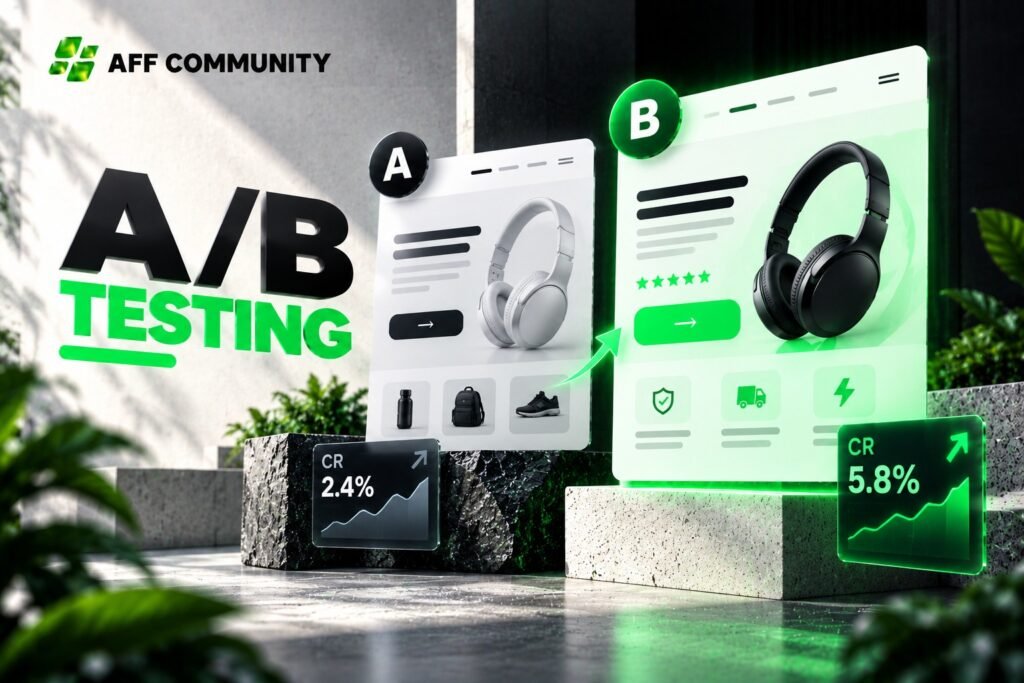
For example, you can compare two headlines, the placement of a form, the text on a CTA button, or different versions of the first screen. It’s important to define the primary metric in advance: conversion to a lead, a purchase, or another desired action.
If you change everything at once, it will be difficult to determine exactly what influenced the result. Therefore, we recommend testing specific hypotheses and considering not only the number of conversions but also the quality of leads. The basic principles for evaluating results are outlined in the article on conversions in advertising.
The Best Services for A/B Testing
1. VWO
VWO is a platform for website and user experience experiments. It supports A/B testing, split URL testing, multivariate experiments, and user behavior analysis. It includes tools for working with different audience segments.
This service is ideal for teams that need not only to compare landing page variations but also to study visitor behavior. Features and current pricing are available on the official VWO website.
2. Unbounce
Unbounce combines a landing page builder with experimentation tools. It’s a convenient option for marketers and webmasters who want to quickly create landing page variations without constantly involving a developer.
The service is particularly useful for testing advertising hypotheses: you can test different page variations and optimize them for paid traffic. For more details, visit the official Unbounce A/B testing page.
3. Optimizely
Optimizely Web Experimentation is designed for more complex experiments and teams that prioritize audience segmentation, integrations, and centralized test management.
It makes sense to consider this tool when experiments are conducted regularly and landing pages are just one part of a broader optimization system. Before making a choice, evaluate the implementation cost and the availability of the features required for your specific project.
4. Convert Experiences
Convert Experiences is a specialized platform for A/B testing and web page experiments. It’s worth considering if you need a standalone tool to test hypotheses without switching to a large enterprise system.
Before purchasing, compare pricing plan limitations, the volume of traffic you can test, integrations, and available experiment methods. It’s best to check the current terms directly with the provider.
5. Google Analytics 4 in conjunction with a testing platform
GA4 is useful for analyzing visitor behavior and tracking events, but it is not a direct replacement for a full-fledged tool for running A/B tests. Google Optimize was discontinued on September 30, 2023, so it is no longer possible to build a new testing workflow using it. Google lists third-party integrations, including VWO, Optimizely, and AB Tasty. Source: Google Analytics Help.
Which Service Should a Webmaster Choose?
The choice depends on your goals and technical capabilities:
- Need to quickly test landing pages without a developer—start with Unbounce if its builder and pricing plan suit your needs.
- Need experiments and user behavior analysis—explore VWO’s capabilities.
- Have a development team and a complex experiment system—consider Optimizely.
- Need a dedicated tool for testing pages—compare Convert Experiences with alternatives in terms of cost and limitations.
Don’t choose a service based solely on the number of features. It’s more important that it works correctly with your landing page, doesn’t break conversion tracking, and allows you to analyze the events you need.
How to Conduct A/B Tests Without Wasting Your Budget
We recommend following a simple process:
- Identify a bottleneck. For example, users actively click on ads but rarely submit a request.
- Formulate a hypothesis. Speculate on what change might improve the result and why.
- Change one key element. This makes it easier to link the result to a specific change.
- Choose a metric in advance. Don’t switch between metrics in search of the one that looks better.
- Wait until you have enough data. A few conversions don’t guarantee you’ve found a winner.
- Check lead quality and ROI. An increase in conversion rate doesn’t always mean an increase in profit if the new leads convert to sales at a lower rate.
Also consider the ad source, device, and GEO. A change that improved conversion on mobile devices may not yield the same results on desktop. And you can draw ideas for testing headlines and visual elements from the practice of creating and testing ad creativity.
That said, testing the landing page is only part of the funnel. If users get lost after submitting a lead or if leads aren’t processed properly, changing the page alone won’t be enough. We explored this topic in more detail in our article on optimizing traffic processing and increasing conversion rates.
Conclusion
A/B testing helps you make decisions based on data rather than subjective impressions. For small projects, simplicity and speed of implementation are key; for large teams, flexibility, segmentation, and in-depth analytics are essential.
Start with a single clear hypothesis, test it on a sufficient volume of traffic, and evaluate its impact on bottom-line profit. It is precisely this approach that helps improve landing pages systematically, rather than turning every test into yet another waste of budget.

