Will AI Buyers Replace Webmasters?

Over the past two years, artificial intelligence has become one of the most talked-about topics in the affiliate industry. Neural networks are already capable of writing copy, creating creativity, analyzing data, and even launching ad campaigns.
Against this backdrop, a question is being asked more and more often: Will AI webmasters replace traditional publishers?
Our team and I believe that the market is indeed changing. But talk of a complete replacement of media webmasters is still greatly exaggerated.


Why Many Are Talking About the End of Manual Arbitrage
The reason is obvious. Modern advertising platforms are increasingly using machine learning.
Meta selects audiences on its own. Google automates bid management. TikTok is increasingly making decisions without human intervention.
At the same time, AI tools are emerging that help create creativity, write copy, and analyze statistics.
From the outside, it may seem that the role of the webmaster is gradually disappearing. But in practice, things look different.
What AI systems can already do
Today, artificial intelligence is indeed capable of automating a significant portion of routine work.
It can:
- analyze large volumes of data;
- identify patterns;
- generate options for creativity;
- write ad copy;
- assist with analytics.
It’s no coincidence that many teams are already actively integrating AI into their processes. We discussed in detail how neural networks are used in modern affiliate marketing in this article.
But even the most advanced tools currently operate only within the scope of a specific task.
Where AI Still Falls Short Compared to Humans
The main problem with artificial intelligence is a lack of context. A neural network can analyze numbers. It can propose hypotheses. But it doesn’t understand the market the way an experienced webmaster does. Affiliate marketing is constantly changing: new offers appear, and moderation rules shift. New connections and approaches emerge.
In many cases, it is human experience that allows one to spot opportunities before competitors do.
This is especially noticeable when working with new traffic sources and non-standard verticals.
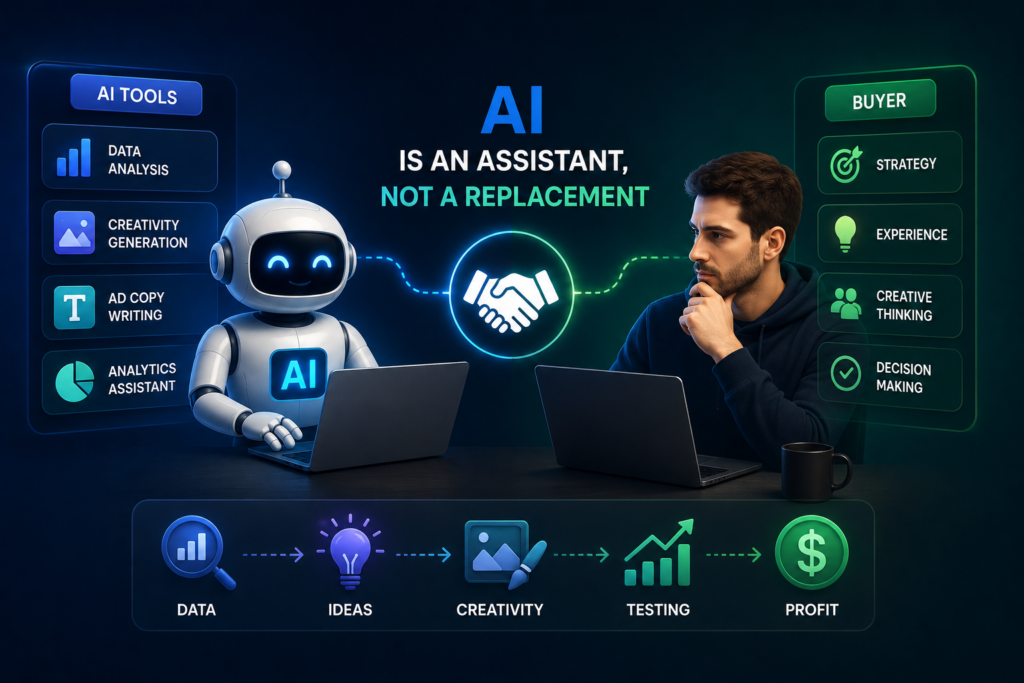
AI Is Becoming an Assistant, Not a Replacement
In practice, we’re seeing a different trend. Strong teams aren’t replacing people with machine learning. They’re using AI to empower buyers. For example:
- a buyer analyzes statistics faster;
- a designer receives dozens of options for creativity;
- a content creator speeds up the preparation of materials;
- and an analyst identifies patterns more quickly.
As a result, the entire team’s efficiency increases. Essentially, those who know how to use new tools correctly come out on top.
The biggest threat isn’t AI itself, but other publishers using AI
Many people fear that neural networks will take away their jobs. In our view, the real threat looks different. The problem isn’t artificial intelligence itself. The problem is that competitors are starting to use it sooner.
If one team analyzes data manually while another automates processes using AI, the advantage gradually shifts to the latter.
That’s exactly why it’s important today not to ignore new technologies, but to learn how to work with them.
We discussed in detail how artificial intelligence is changing the traffic market and advertising processes in this article.
What Will Happen in a Few Years
Most likely, the profession of a publisher won’t disappear. But the requirements for specialists will change. There will be fewer routine tasks and more analytical work: strategic thinking will become more important than technical actions.
The ability to quickly test hypotheses will prove more valuable than manually configuring campaigns.
Essentially, the market is moving toward a model where humans make decisions and artificial intelligence helps implement them. This scenario currently appears to be the most likely.
Conclusion
AI buyers won’t replace webmasters in the coming years. However, they are already changing the rules of the game.
Buyers who learn to use neural networks for analytics, creativity, and process automation will gain a significant advantage over their competitors.
Therefore, the main question today is not “Will AI replace publishers?” but “How effectively can publishers themselves work with AI?”