How to Check Traffic Quality Before Scaling
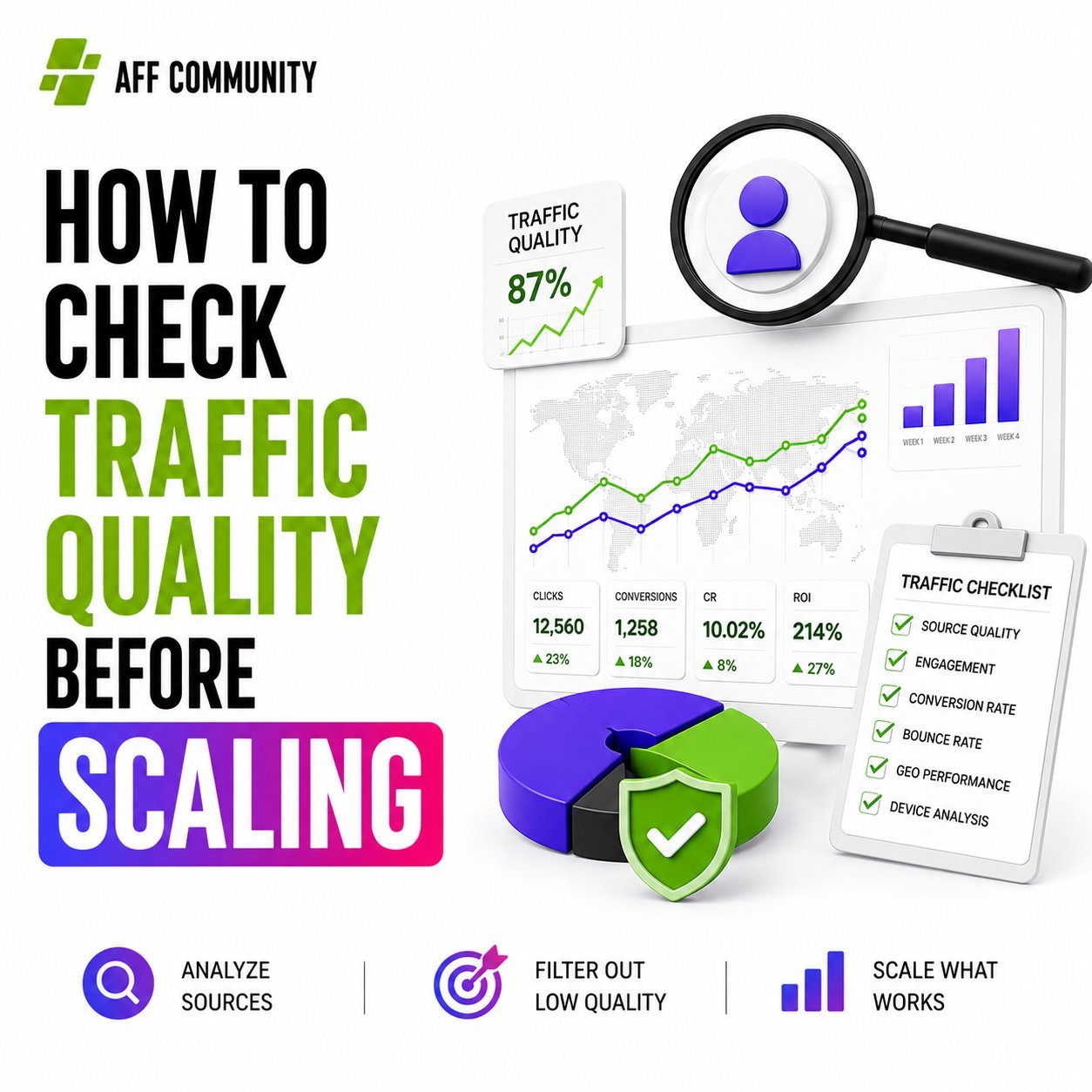
The most dangerous moment in affiliate marketing doesn’t begin when a campaign starts losing money. It’s much worse when it’s showing good results, and based on that, the buyer decides to drastically increase the budget.
At low volumes, virtually any campaign can appear profitable. A few successful days, a couple of strong levels of creativity, good conversion rates—and it feels like you’ve struck gold. But after increasing the budget, the numbers suddenly start to decline.
We encounter these situations regularly. And almost always, there’s one reason: before scaling, they only checked profitability, but not the quality of the traffic itself.


That’s why, before significantly increasing your budget, you need to evaluate not only the ROI but the entire chain from the first click to the final conversion.
Don’t just look at ROI
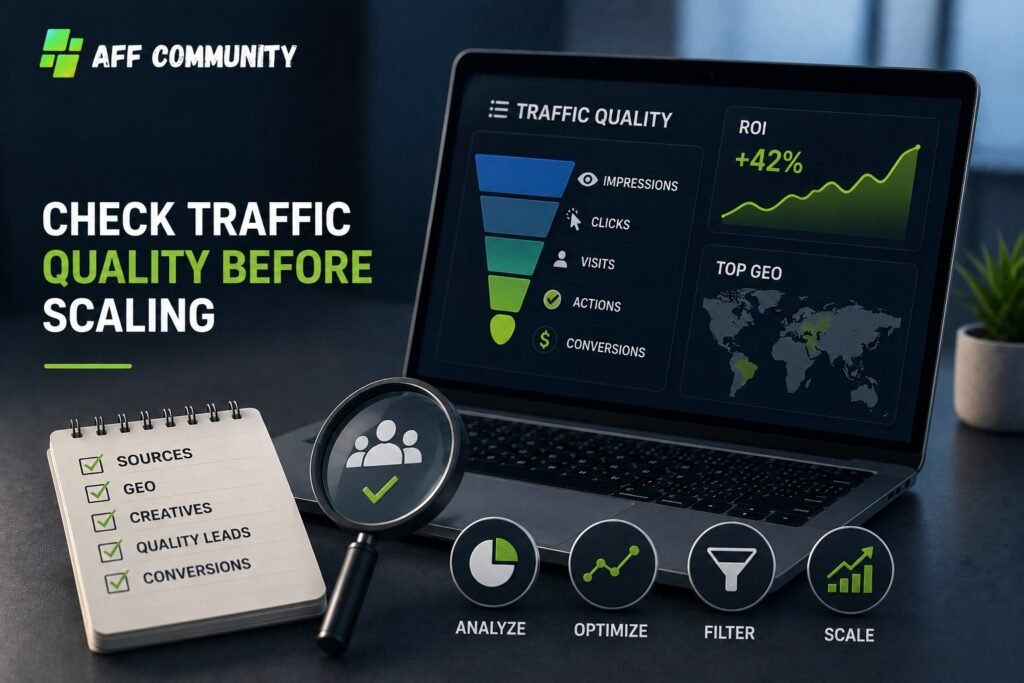
ROI is an important metric, but on its own, it tells you almost nothing about the quality of the audience.
Let’s consider a campaign that shows a 40% ROI. At first glance, everything looks great. But upon closer inspection, it may turn out that:
- most of the leads come from a single source;
- conversions are based on a small volume;
- user quality is gradually declining;
- some of the traffic doesn’t reach the target action;
- the results are driven by just one or two pieces of creativity.
If you increase the budget for such a campaign several times over, the whole setup could quickly fall apart.
That’s why, before scaling up, we recommend looking at several metrics simultaneously. A good breakdown of the key KPIs can be found in this article about which metrics are truly worth tracking in affiliate marketing.
Analyze traffic at different levels
Traffic quality cannot be determined by a single metric. You need to gradually dig deeper into the statistics. First, look at the source, then at the GEO. After that—device, placement, audience, creativity, and individual segments.
For example, an ad network might show an average ROI of 30%, but upon further analysis, it turns out that half of the sites are operating at a loss, and only a few sources are generating the bulk of the profit.
In this situation, scaling up the entire campaign is risky. It’s better to identify the strong segments and gradually increase the budget specifically there.
See what happens after a click
Traffic quality becomes particularly evident once a user moves to the next stage of the funnel.
A high CTR doesn’t necessarily mean the audience is interested in the offer. A user may actively click on an ad but then close the page, fail to fill out a form, or fail to take the desired action.
That’s why it’s important to compare metrics at different stages:
impression → click → visit → action → confirmed conversion.
If there’s a sharp drop at any stage, that’s where you need to look for the problem.
Sometimes the issue lies not with the traffic source, but with the landing page or user flow. We discussed in detail how to identify such weak spots in our article on optimizing traffic flow and increasing conversions.
Check Lead Quality
Another mistake is assuming all conversions are equal. For affiliate networks, ten applications may seem better than five. But if only two out of ten applications are confirmed, while four out of five are, the real picture will be completely different.
Therefore, before scaling up, you need to look not only at the number of leads but also at what happens to them afterward.
It’s especially important to compare user quality by:
- geo;
- sources;
- ad platforms;
- creativity;
- audience types.
If one segment consistently generates cheap but low-quality leads, scaling it up will only compound the problems.
Look for anomalies in the statistics
High-quality traffic usually follows a certain pattern of behavior. If a huge number of clicks suddenly appears from a single source, an unusually high CTR, or a sharp spike in conversions, this isn’t necessarily a cause for celebration.
Sometimes such changes are related to the platform’s specific characteristics or low-quality ad inventory.
You should analyze the situation particularly carefully when the numbers look too good compared to other sources.
To do this, it’s helpful to compare statistics over time rather than looking only at today’s results.
We recommend analyzing at least several time periods: day-over-day, week-over-week, and results following a budget change.
Test the ad set before increasing spending
Before scaling up, it’s helpful to go through a comprehensive checklist. Ask yourself:
- Do I understand where the profit is coming from? If the answer is no, it’s too early to scale up.
- Do I understand which segment is delivering the best results? If not, break down the statistics first.
- Are the metrics stable? Three successful days don’t necessarily mean the ad set has proven its effectiveness.
- What will happen when you increase the volume? If you don’t understand how scalable your audience is, increasing the budget turns into an experiment at your own expense.
Use spy services for additional verification
Even before scaling up, it’s helpful to see what your competitors are doing.
Spy services let you study advertising approaches, creativity, and the ad combinations they use. This doesn’t provide a ready-made answer as to which source will be profitable specifically for you, but it helps you see the big picture of the market.
For example, if a particular approach has been widely used by competitors over a long period of time, this can serve as an additional signal for analysis.
And if virtually no one is testing the segment you’re interested in, that’s also a reason to consider why that might be the case.
We’ve compiled a selection of spy tools for this type of analysis in a separate article at this link.
Don’t confuse random success with high-quality traffic
One of the most costly mistakes is mistaking a fluke for a pattern. Let’s say a campaign generated several low-cost conversions in a row. The publisher triples the budget, and then doubles it again.
After that, the cost per lead rises, the conversion rate drops, and the ROI gradually turns negative. What happened? It doesn’t necessarily mean the traffic source has deteriorated.
Perhaps the initial result was simply based on a small sample that didn’t reflect the real picture.
That’s exactly why scaling should only begin after accumulating a sufficient amount of data.
The more data you collect, the easier it is to distinguish a trend from a random spike.
Monitor Quality After Scaling
Even if the preliminary check is passed, this doesn’t mean you can stop analyzing the campaign after increasing the budget.
On the contrary, the first few hours and days after scaling require particularly close monitoring.
You need to compare the new metrics with the statistics from before the budget increase. If, after scaling:
- CPM increases;
- CTR declines;
- conversion cost rises;
- lead quality drops;
- user behavior changes.
Don’t automatically assume that you need to increase the budget even further. Sometimes the right decision is to pause, return spending to the previous level, and figure out the cause.
Conclusion
Before scaling up, it’s important to check not only how much revenue the campaign is generating, but also why it’s generating that revenue.
We follow a simple principle: you shouldn’t scale based on a pretty number in your dashboard, but rather on a clear and predictable system.
If you know which traffic source delivers high-quality traffic, which geos and segments perform best, which levels of creativity attract interested users, and where the weak spot in the funnel is, increasing your budget becomes a manageable process.
But if all your profit depends on a few random conversions, scaling turns into a lottery.
That’s why the best time to increase your budget isn’t when a campaign is simply showing a profit, but when you can explain where that profit came from and whether you can replicate it with a larger volume of traffic.