How to Prove the Quality of Your Traffic to an Affiliate Network

In affiliate marketing, it’s not enough to simply generate a lot of leads. It’s important for the affiliate network to understand that these leads are truly high-quality, meet the terms of the offer, and have good potential for further monetization.
This issue becomes particularly pressing when an advertiser starts working with large volumes. At the beginning, the affiliate networks may be content with limited statistics, but as the number of leads grows, the manager begins to ask questions: where is the traffic coming from, what sources are being used, why has the conversion rate changed, which GEOs yield the best results, and how consistent is the audience quality?
We believe that the quality of traffic should be proven not with words, but with numbers. The more transparently a publisher presents their statistics, the fewer questions the affiliate networks will have.


What affiliate networks mean by “high-quality traffic”
First and foremost, it’s important to understand that traffic quality isn’t determined by a single metric. A large number of leads doesn’t necessarily mean anything.
You could generate a thousand sign-ups, but if users don’t verify their information, don’t complete the desired action, or turn out to be invalid en masse, that volume is practically useless to the affiliate program.
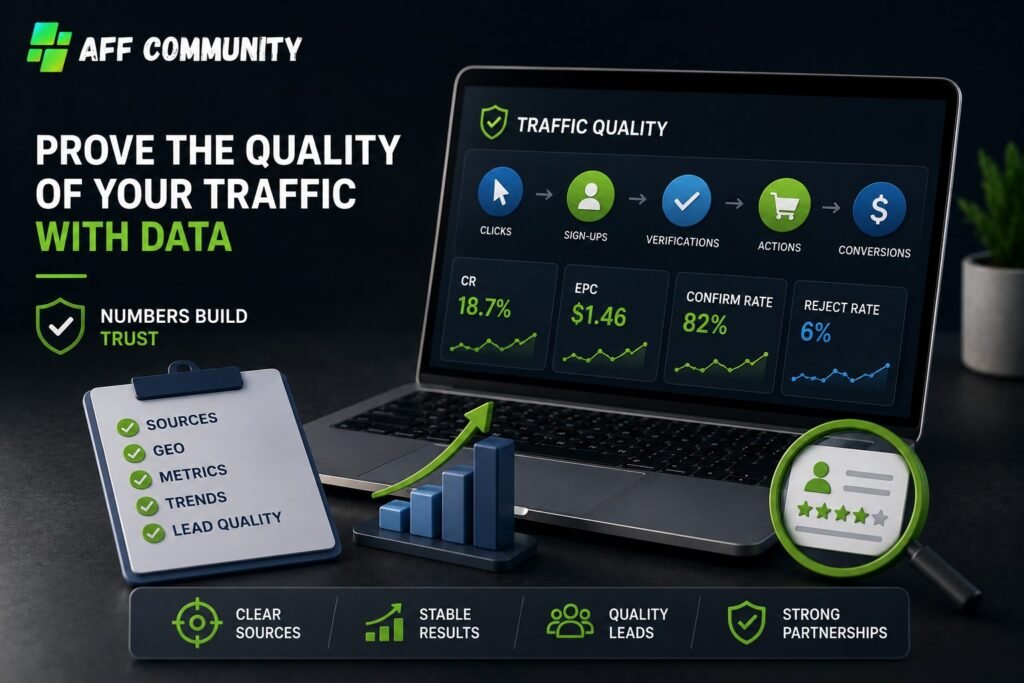
Therefore, when assessing quality, they typically look at the entire chain:
source → click → sign-up → verification → desired action → subsequent user activity.
The more stages a user completes, the more valuable that traffic is. At the same time, different verticals may have completely different quality criteria. In some cases, registration is important; in others, it’s a deposit, a purchase, repeat activity, or a confirmed lead.
Therefore, before launching a campaign, we recommend carefully reviewing the terms of a specific offer and understanding in advance which user actions the affiliate networks consider high-quality.
Show statistics, not promises
One of the weakest approaches when communicating with affiliate networks is to say, “I have good traffic.” To a manager, this means practically nothing.
Specific statistics are much more convincing. For example:
- traffic source;
- GEO;
- number of clicks;
- number of leads;
- CR;
- acquisition cost;
- EPC;
- lead confirmation;
- rejection rate;
- trend in results.
You don’t have to send the manager a huge spreadsheet with all available data. It’s much better to prepare a short and clear report that immediately shows where the audience is coming from and how it behaves after landing on the page.
At the same time, it’s important not to sacrifice quality for quantity of metrics. Sometimes five or six key metrics are enough for the manager to get a good understanding of the traffic.
We’ve covered the topic of lead tracking and how to avoid overpaying for the same traffic in a separate article. This approach is especially useful as volumes begin to grow; you can read about it in this article.
Don’t hide your traffic source
If an affiliate program asks where users are coming from, trying to give the most general answer possible usually just raises more questions.
Answering “I buy traffic from ad networks” doesn’t tell them much. It’s much better to explain in more detail: which ad platform is used, which geographic regions are targeted, what type of audience is being attracted, what ad formats are used, and where the user is taken after clicking.
This doesn’t mean you have to reveal all of your team’s inner workings or hand over every detail of your campaign to the affiliate networks.
But basic transparency is essential. This is especially important when there’s a sharp increase in volume. If the affiliate networks received 100 leads yesterday and 5,000 today, the manager will naturally want to understand what happened.
If the buyer has reliable statistics and a clear explanation for the growth, the situation looks much less stressful.
Use trackers
It’s very difficult to prove traffic quality without proper tracking. If all the statistics are scattered across several ad platforms, Excel files, and managers’ correspondence, it’s practically impossible to quickly get an objective picture.
A tracker allows you to link the source, campaign, creativity, GEO, and final conversion.
This makes it possible not just to tell the affiliate networks that the traffic is high-quality, but to show exactly which segment is delivering results.
For example, you might find that users from a specific geographic region convert significantly better than others. Or, conversely, a certain ad network might generate a lot of clicks but yield virtually no confirmed leads.
In such situations, the numbers speak louder than any explanation.
Show Trends
One of the most powerful things you can demonstrate to an affiliate program is consistency. Let’s say, in a single day, a publisher received 200 leads with an excellent conversion rate (CR). That’s interesting.
But it’s much more compelling to show that similar results are sustained over a week or a month. It’s precisely this consistency that helps distinguish a random spike from a normal, stable performance pattern.
Therefore, when communicating with affiliate networks, it’s helpful to present statistics broken down by time periods. For example, you can compare: the first week of the campaign, the second week, the point when the budget was increased, and the period after scaling up.
If the metrics remain relatively stable, trust in the traffic source grows. If, on the other hand, the quality fluctuates sharply up and down, it will be harder for the manager to view such traffic as predictable.
Monitor conversion at every stage
Poor conversion doesn’t always mean poor traffic. Sometimes the problem lies within the funnel itself.
A user may respond normally to ad creativity and navigate to the landing page, but then fail to complete the desired action due to an inconvenient form, slow loading times, or unmet expectations.
Therefore, when statistics are questionable, you shouldn’t immediately blame the traffic source. You need to look at the entire user journey.
We’ve repeatedly pointed out that the final result depends not only on the number of clicks but also on how well the post-click audience processing is structured; you can read more about this in this article.
This is especially important when communicating with affiliate networks. If a manager says that lead quality has declined, it’s better not to argue but to work together to identify at which stage the problem arose.
Don’t abruptly change your traffic mix without explanation
Another point that’s often underestimated is a sudden change in traffic source or creativity. Let’s say affiliate networks are used to receiving a certain volume of high-quality traffic from you. Then you completely change your approach and start driving users in a different way.
Even if the volume increases, the quality may change. Therefore, when scaling up, it’s better to let the manager know in advance what’s happening. For example: “We’re increasing the volume from the current source” or “We’re testing a new geographic target, so the volume will be higher than usual for the first few days.”
This kind of communication looks much more professional than a sudden increase in the number of leads by several times.
Additionally, if the quality does change, the affiliate networks will be able to link it to a specific change more quickly.
Demonstrate quality through creativity and audience behavior
Creativity directly influences which audience enters the funnel. Ads that are too aggressive may yield an excellent CTR but attract users who don’t initially match the offer.
As a result, the advertiser gets cheap clicks and impressive stats in their ad dashboard, while the affiliate networks see low-quality leads.
That’s why you shouldn’t evaluate ad creatives based solely on CTR. It’s important to look at what happens after the click.
If one creativity generates fewer clicks but leads to significantly more confirmed users, it may actually prove to be more valuable for the entire partnership.
What to Do If an Affiliate Network Suspects Poor Traffic
The worst strategy is to immediately escalate the issue into a conflict. If the affiliate networks claim that quality has deteriorated, you first need to gather data.
Compare the period when everything was working normally with the current statistics. Examine the geographic locations, traffic sources, devices, creatives, and conversion rates. If a problem has indeed arisen, try to pinpoint its source.
If, however, your data shows consistent quality, you can provide it to the manager and ask them to specify the nature of the complaint.
Another important point: don’t ignore the possibility of traffic shaving. If the advertiser’s statistics and the affiliate networks’ data begin to diverge noticeably, you need to investigate the causes rather than drawing conclusions based solely on gut feelings.
We’ve covered methods to help mitigate the risks of such situations in this article.
Reputation Matters More Than a Single Successful Month
The affiliate networks gradually form their own opinion of each webmaster.
If a webmaster consistently drives stable traffic, doesn’t hide their traffic sources, communicates effectively, and responds quickly to issues, trust in them grows.
And at some point, they no longer have to prove the obvious every time.
The manager understands that this partner knows how to handle high volumes and maintains control over the quality of their audience. That’s exactly why traffic quality isn’t just a matter of statistics—it’s also a matter of reputation.
Conclusion
You can only prove the quality of your traffic to an affiliate program if you have transparent analytics and a clear understanding of your own network.
We recommend not trying to convince the manager with phrases like “I have clean, high-quality traffic.” Instead, it’s better to show the numbers, trends, sources, and user behavior.
A good publisher doesn’t just drive leads. They understand who these users are, where they came from, what they did after landing on the page, and why the affiliate networks should consider them valuable.
When all this information is backed up by statistics, the conversation with the affiliate networks becomes much easier. And most importantly, this approach not only helps prove the quality of the traffic but also allows the webmaster to more quickly identify weaknesses in the campaign and make data-driven decisions.