Bing Ads in affiliate marketing: How to Run Traffic
When it comes to contextual advertising, most webmasters immediately think of Google Ads. But Bing Ads also remains an interesting source of search traffic, especially if you want to diversify your advertising efforts and avoid relying on a single advertising platform.
We view Bing Ads primarily as an additional source for testing ad combinations. Here, you can work with search demand, target audiences with specific intent, and find less competitive auctions in certain niches.
Why You Should Try Bing Ads
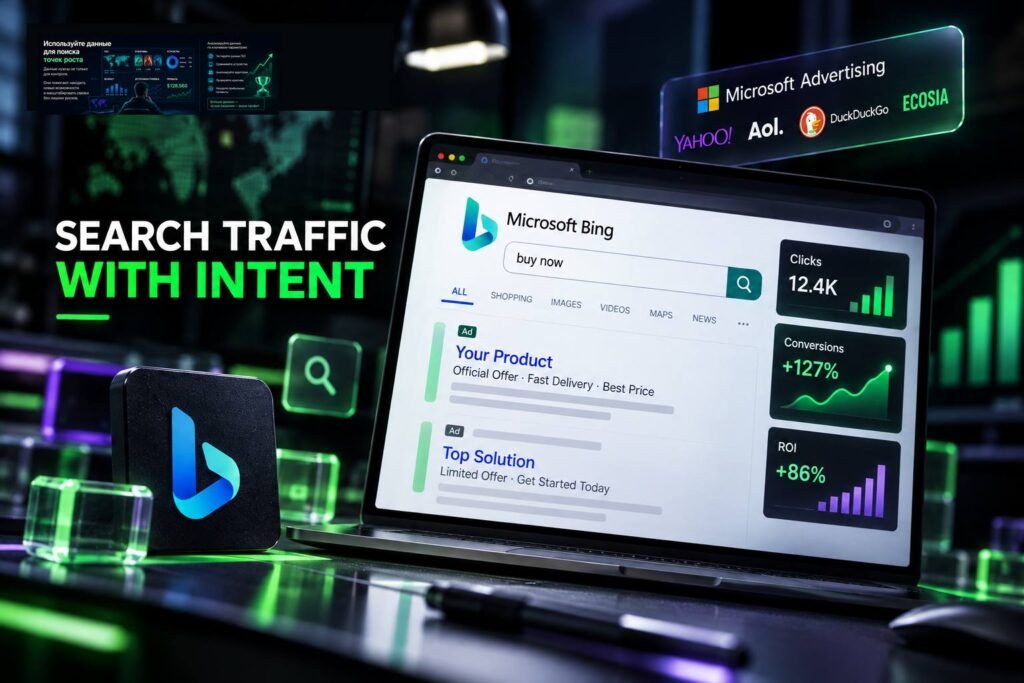
Bing’s main advantage is search traffic driven by users who already have a specific intent.


Users enter queries related to a product, service, or problem themselves, and advertisers get the opportunity to show them a relevant ad.
In addition to Bing, Microsoft Advertising ads can also appear on partner search platforms, including Yahoo, AOL, DuckDuckGo, and Ecosia. Therefore, the actual reach may be broader than the platform’s name suggests.
That said, Bing shouldn’t be viewed as a “cheap copy of Google.” Its audience, competition, and campaign economics have their own unique characteristics.
Before launching a campaign, we recommend researching various traffic sources for affiliate marketing and comparing them not only by cost per click but also by the quality of the users they attract.
Which Verticals to Test
There is no universal list of verticals for Bing Ads. We would start with offers where users are genuinely searching for a solution via a search engine.
These could include:
- e-commerce;
- finance;
- insurance;
- software and SaaS;
- subscription services;
- mobile apps;
- travel;
- certain mainstream offers.
Before launching, be sure to check the platform’s rules and the affiliate networks’ restrictions. Pay special attention to verticals where advertising platforms impose additional requirements.
How to Set Up Your First Campaign
We don’t recommend starting with hundreds of keywords right away.
First, build a small semantic core and categorize queries by intent. For example, you can group commercial queries separately, and informational and brand-related queries separately.
Next, create relevant ads for each group.
The same principle applies here as with any other traffic source: ad → landing page → offer must align with one another.
To monitor effectiveness, set up tracking and UTM parameters right away. This will allow you to later compare campaigns and individual ad groups based on actual results. The basic principles of working with UTM parameters in advertising are especially useful when testing multiple sources simultaneously.
Don’t run your entire budget all at once
The primary goal of Bing Ads isn’t to maximize revenue from day one, but to gather data.
We launch a limited test budget and monitor:
- CTR;
- CPC;
- spend;
- conversions;
- CPA;
- lead quality;
- revenue;
- ROI.
We also track search queries separately and block irrelevant traffic.
At this stage, it’s important not to draw conclusions based on just a few clicks. Proper optimization requires a sufficient amount of data.
For a more detailed look at the approach to evaluating effectiveness, see the article on metrics that really matter in affiliate marketing.
Keywords—Half the Battle
One of the biggest mistakes when working with Bing is collecting a huge number of keywords and simply running them all into a single campaign.
We prefer to segment keywords by meaning. Commercial queries, for example, should generally be separated from general informational ones. This allows for a better understanding of which groups actually drive buyers or leads.
We also always use negative keywords. If the offer is paid, but the campaign constantly attracts an audience searching for terms like “free,” “download,” “forum,” or “reviews,” the budget will be wasted on users with completely different intent.
Creativity also needs to be tested
In search advertising, there’s no need to create dozens of visuals, as you would on Meta or TikTok, but ad copy still requires testing.
We change headlines, benefits, CTAs, and offer wording, and then compare the results.
The key is not to change everything at once. Otherwise, it’s impossible to determine which element influenced the result.
The same logic applies when testing other ad sources: proper testing of ad creativity allows you to distinguish valid hypotheses from random spikes.
When to Scale Bing Ads
We only begin scaling once we understand the economics.
If the campaign consistently generates conversions, the CPA stays within an acceptable range, and the quality of leads satisfies the affiliate networks, you can gradually increase the budget.
However, you shouldn’t suddenly multiply your spending several times over. First, increase the budget in small increments and see if the economics hold up.
If, after scaling, the CPC rises, the conversion rate drops, or the audience quality changes, return to the previous level and investigate the cause.
Common Mistakes When Working with Bing Ads
In practice, we most often encounter several issues:
- launching a campaign without first analyzing the offer;
- overly broad keyword targeting;
- lack of negative keywords;
- no tracking;
- spending a large budget too quickly;
- evaluating a campaign based solely on clicks;
- failure to test ads;
- ignoring the advertising platform’s requirements.
That’s exactly why it’s better to view Bing Ads not as “just another button to click,” but as a full-fledged source that requires its own strategy.
Conclusion
Bing Ads can be an interesting tool for a publisher who already knows how to work with search traffic and wants to expand their media mix.
We’d start with a small test, carefully build out the keyword list, monitor search queries, set up proper tracking, and evaluate not the number of clicks but the overall profitability of the campaign.
If the numbers add up, we scale up. If not, we don’t try to salvage the campaign with endless budget top-ups; instead, we change the offer, the semantic targeting, the landing page, or the entire approach to buying traffic.
This is a fundamental principle of affiliate marketing: it’s not the traffic source that makes a campaign profitable, but the right combination of offer, audience, ads, and analytics.