Click Fraud: How to Detect
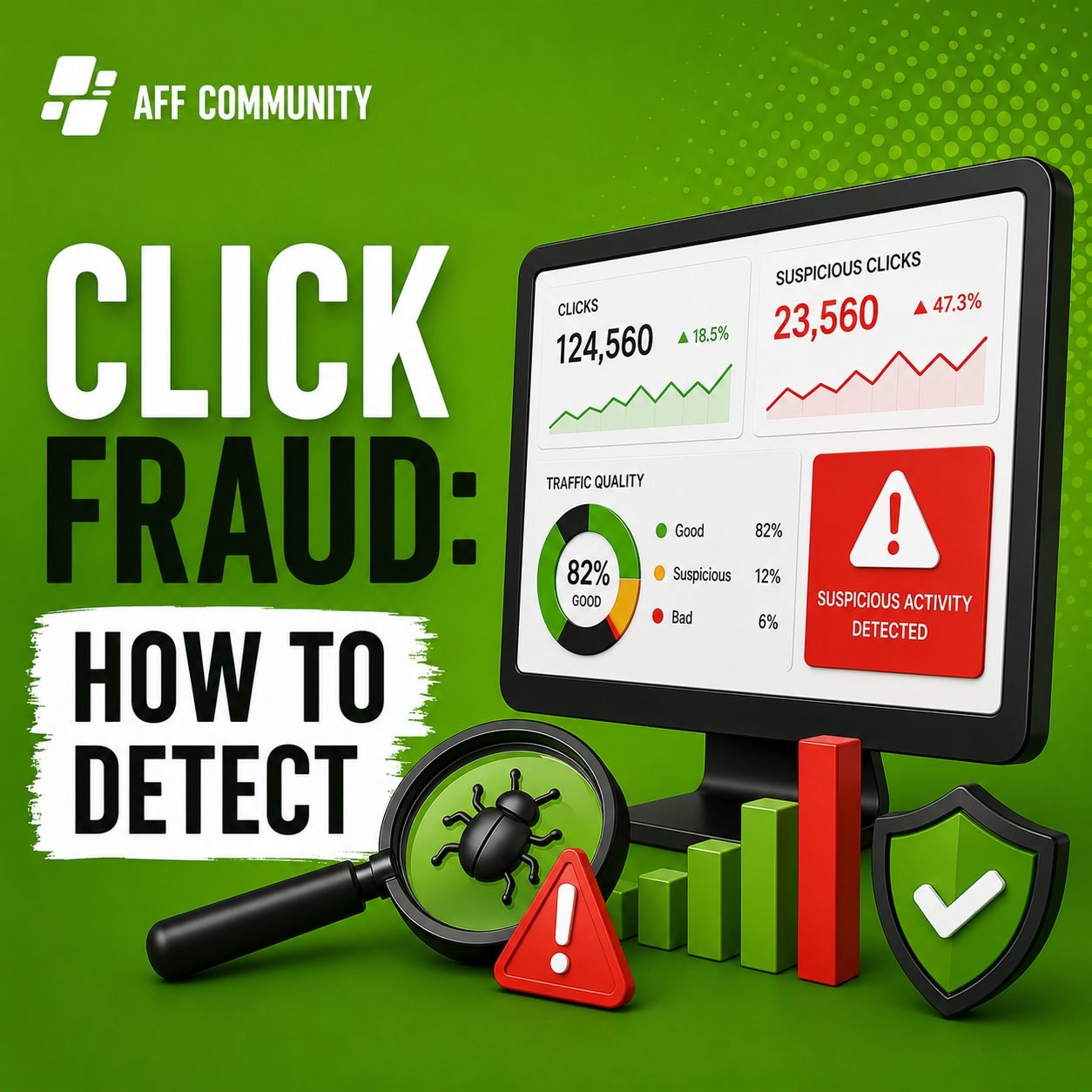
Click fraud is one of those problems in affiliate marketing that’s easy to underestimate. As long as the ad dashboard shows clicks, the CTR looks normal, and the cost per click remains reasonable, it may seem like everything is fine with the campaign.
But then things start to look strange: there are a lot of clicks but almost no conversions, users aren’t staying on the site, and the statistics differ sharply from other traffic sources.
We believe that click fraud should be investigated not when the budget has already been exhausted, but at an early stage. The sooner the advertiser notices an anomaly, the less money they’ll lose to that traffic source.


That said, click fraud isn’t necessarily caused by primitive bots that simply click on ads. Modern click fraud can be significantly more sophisticated and masquerade as normal user behavior.
What Is Click Fraud
Click fraud is the artificial generation of clicks on ads without the user having any genuine interest in the offer.
The motives can vary. Some people try to profit from the advertising model, others want to inflate a platform’s metrics, and sometimes competitors intentionally generate low-quality clicks to increase the advertiser’s costs.
For a publisher, the problem is clear: money is being charged for clicks, but users aren’t generating any real value within the funnel.
The most common signs:
- a large number of clicks without conversions;
- identical or suspiciously similar sessions;
- sudden spikes in activity;
- unusual timing patterns between clicks;
- suspicious concentration of traffic;
- a large number of users who immediately leave the page.
However, none of these signs on its own proves fraud. That’s why we always recommend analyzing several metrics at the same time.
Why a High CTR Doesn’t Prove Anything
One common mistake is assuming that a high CTR is a sign of good creativity and high-quality traffic. In reality, CTR only shows how often users click on an ad.
Let’s say a campaign achieved an 8% CTR. At first glance, that’s an excellent result. But if users close the page almost immediately after clicking and don’t take the desired action, there’s nothing to celebrate.
A high CTR can be due to aggressive creativity, accidental clicks, or the specifics of a particular ad placement.
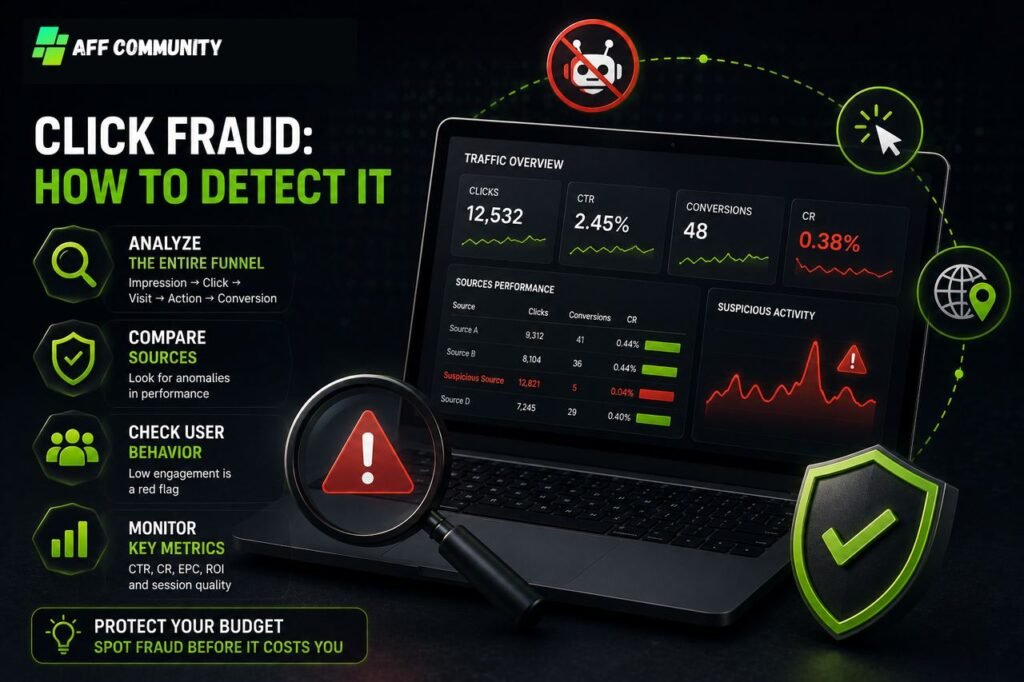
That’s why we recommend looking at the entire conversion path:
impression → click → landing page → interaction → conversion → confirmed action.
If a problem arises between the click and the next stage, you need to look for the cause precisely there.
Compare traffic sources with one another
The easiest way to detect suspicious traffic is to compare it with other sources.
For example, you have three platforms. The first generates 1,000 clicks and 40 conversions. The second generates 900 clicks and 35 conversions. The third generates 1,200 clicks and only 3 conversions. At the same time, the cost per click is roughly the same across all of them.
This result doesn’t automatically mean that the third platform is engaging in click fraud.
Perhaps it has a completely different audience or an ineffective ad placement. But the source definitely warrants further investigation.
We recommend looking not only at the final conversion rate but also at user behavior after landing on the page.
That’s exactly why it’s important to conduct a thorough traffic quality check before increasing your budget, rather than focusing solely on the campaign’s profit. We’ve already covered a useful checklist for this kind of analysis in the article “How to Check Traffic Quality Before Scaling.”
Look at User Behavior
A bot can learn to click, but it’s much harder for it to mimic a normal potential customer.
Therefore, after identifying a suspicious source, you need to see what happens after the click.
Pay attention to:
- time on page;
- page depth;
- number of pages viewed;
- actions within the form;
- repeat visits;
- transitions between funnel stages;
- conversion to the target action.
If thousands of users visit the page but virtually all of them leave within a few seconds, that’s a serious red flag.
The situation becomes even more interesting when the statistics from a suspicious source look virtually identical every hour or day.
With a real audience, behavior usually varies. There are peaks in activity, different devices, and various interaction scenarios. Statistics that are too perfect should sometimes be cause for concern.
Check IP addresses, devices, and GEO
Another level of analysis involves technical parameters.
If you have access to the relevant statistics, it’s worth looking at:
- IP addresses.
- Device types.
- Operating systems.
- Browsers.
- Geolocation.
- Click time.
- Frequency of repeat actions.
For example, a large number of clicks from a single technical configuration does not in itself prove click fraud. But if the device, IP segment, time of activity, and subsequent behavior all match simultaneously, the likelihood of an anomaly increases.
It is especially useful to compare this data across multiple sources.
If one platform differs significantly from the others in several parameters at once, it should be flagged for further review.
Look for sharp spikes
Click fraud can often be detected by its dynamics.
Suppose a campaign receives roughly the same number of clicks for several days, and then suddenly receives several hundred clicks within 20 minutes.
At the same time:
- CTR increases sharply;
- the cost per conversion rises;
- there’s almost no increase in leads;
- users barely interact with the website.
This is already a compelling reason to pause and investigate. We advise against making decisions based solely on one hour’s worth of data. First, it’s helpful to compare the spike with historical data and check whether there was an objective reason for it.
For example, the ad platform might have launched an additional placement or changed the distribution of impressions.
Don’t confuse click fraud with a poor audience
This is a particularly important point. Not every low-quality user is a bot. The ad platform may very well be driving real people who are simply not interested in your offer.
As a result, the advertiser sees a lot of clicks, low conversion rates, and immediately concludes that it’s fraud. But the problem may lie in the targeting, creativity, or an incorrectly selected audience.
Therefore, before blocking a traffic source, you must distinguish fraudulent traffic from simply low-quality traffic.
Which metrics to use for verification
We do not recommend basing your anti-fraud analysis on a single metric. You need to look at a combination of metrics.
First and foremost:
- CTR. Helps you understand how actively users interact with the ad.
- CPC. Shows the cost per click.
- CR. Lets you see whether clicks are turning into desired actions.
- EPC. Helps assess the economic value of traffic.
- ROI. Shows the final financial result.
But you also need to analyze user behavior and conversion quality. Our resources on “metrics that really matter in affiliate marketing” provide a good guide to the analytics system.
What to Do If You Detect a Suspicious Source
The key is not to keep automatically pouring your budget into it in the hope that the statistics will correct themselves. If a source shows clear anomalies, we recommend:
- Record the time period and volume of the suspicious traffic.
- Compare it with other sources.
- Check technical and behavioral metrics.
- Review statistics at the placement and segment levels.
- Pause or limit the suspicious source.
- Forward the data to the ad network or affiliate networks if further verification is required.
However, do not delete statistics or change settings before you have saved the raw data. Otherwise, it will be much more difficult later to prove exactly what happened.
How to Reduce the Risk of Click Fraud
It is impossible to completely eliminate fraudulent clicks, but the risks can be significantly reduced.
We recommend using:
- tracking of all ad clicks;
- separate statistics by source;
- regular analysis of ad placements;
- automated rules for suspicious anomalies;
- anti-fraud tools;
- conversion quality control.
It’s especially important not to wait for the affiliate networks or ad networks to report the problem on their own.
Modern anti-fraud systems analyze multiple factors simultaneously, including user behavior, device, GEO, and interaction patterns.
Conclusion
Click fraud cannot be detected by a simple rule like “lots of clicks without leads = fraud.” Real analysis is much more complex.
Our team and I look at several levels simultaneously: the source, dynamics, technical parameters, user behavior, conversion, and the bottom line.
The key is not to confuse fraud with ordinary low-quality traffic. In one scenario, the problem must be solved through anti-fraud measures and blocking the source, while in another, you need to adjust the targeting, creativity, or the campaign itself.
The sooner a webmaster begins analyzing not just the number of clicks, but the quality of each stage of the funnel, the less likely they are to waste a significant portion of their budget on click fraud.