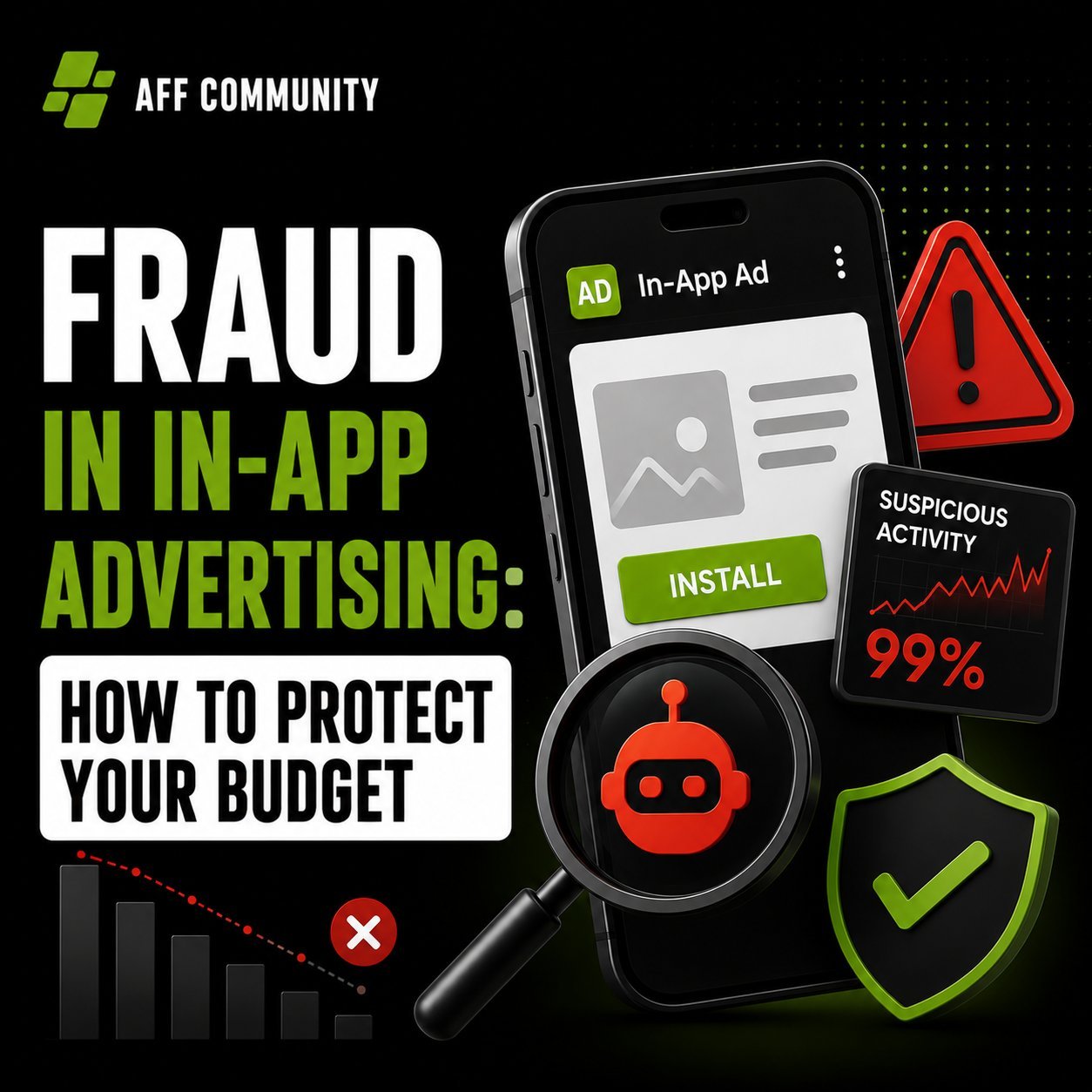
Fraud in In-App Advertising: How to Protect Your Budget
In-app advertising continues to gain popularity, and as traffic volumes grow, so does the number of fraudulent schemes. We regularly receive questions from publishers who can’t understand why their ad campaigns are generating a large number of clicks but virtually no conversions.
In many cases, the problem is specifically related to fraud. Unscrupulous traffic sources can quickly “drain” an advertising budget, creating the illusion of activity without any real value for the advertiser. Therefore, protection against fraudulent traffic has become an essential part of working with in-app advertising.
What Is Fraud in In-App Advertising

Fraud refers to any invalid or artificially generated interactions with ads that do not reflect the behavior of real, interested users.


In practice, this can include:
- automated clicks;
- artificial app installs;
- attribution source spoofing;
- low-quality incentivized traffic;
- other methods of obtaining payments without genuine audience interest.
The main problem is that, on the surface, such statistics may look quite convincing until you begin analyzing traffic quality.
Early Signs of Fraudulent Traffic
Fraud can be identified based on a combination of several factors. Most often, you should pay attention to:
- an unusually high CTR;
- a large number of clicks without conversions;
- sharp spikes in traffic volume;
- an abnormally short time spent interacting with the app;
- identical behavioral metrics among a large number of users.
If such signs appear immediately after connecting a new traffic source, you should carefully check the quality of that source.
We discussed in detail which metrics to analyze first in this article.
Don’t Rely Solely on the Number of Clicks
One of the most common mistakes made by beginners is evaluating a campaign based solely on cost per click or traffic volume.
In practice, it’s much more important to analyze users’ subsequent behavior. We recommend tracking:
- conversion;
- audience retention;
- cost per lead;
- ROI;
- and the quality of post-installation events.
These metrics are what allow you to determine whether a traffic source is bringing in real users or just burning through your budget.
Constantly analyze ad placements
Even within a single ad network, traffic quality can vary significantly. Therefore, after launching a campaign, you need to regularly compare the performance of individual placements.
If a particular source consistently shows poor results, it’s best to disable it and reallocate the budget to higher-quality placements. This approach helps gradually increase overall ROI and reduce losses.
High-quality creativity also helps
At first glance, it may seem that creativity has nothing to do with fraud prevention. In fact, well-crafted ads are more likely to attract an interested audience and allow ad network algorithms to optimize impressions more effectively.
Additionally, high-quality ad creatives have a positive impact on CTR and overall conversion rates.
We discussed the principles of creating modern ad creatives in this article.
Choose Reliable Ad Networks
Not all in-app platforms monitor the quality of their inventory with the same level of care.
Before launching a new campaign, it’s worth researching the ad network’s reputation, the available analytics tools, and its capabilities for filtering out suspicious traffic.
Working with trusted partners does not guarantee the complete absence of fraud, but it significantly reduces the likelihood of incurring major budget losses.
Conclusion
It’s impossible to completely eliminate fraud in in-app advertising, but its impact can be significantly reduced. Regularly analyzing statistics, monitoring the quality of ad platforms, evaluating user behavior, and working only with reliable sources help preserve your advertising budget and improve campaign effectiveness.
We recommend treating the fight against fraud as an ongoing process. The more carefully you analyze data and the faster you respond to suspicious changes, the higher the likelihood of maintaining campaign profitability, even with large volumes of mobile traffic.