How Search Ads Will Change After the Transition to AI Search
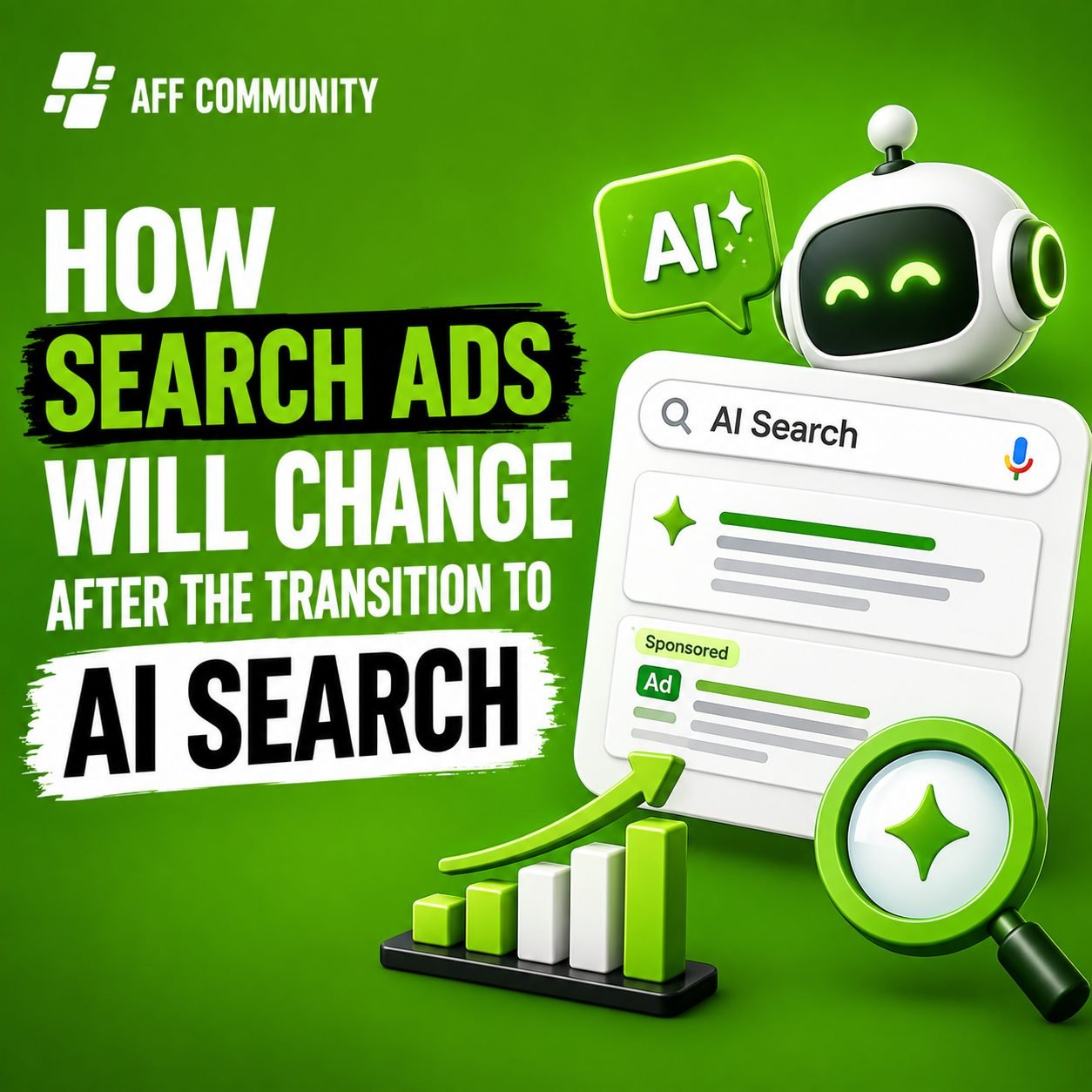
We believe that AI search won’t kill Search Ads, but it will significantly change how they work. Users are increasingly getting a ready-made answer right in the search results, so the familiar pattern of “entered a query → opened several websites → chose the one they needed” is gradually changing.
Google is already developing AI Overviews and new ad formats for AI search. In 2026, the company specifically announced new ad formats designed for the era of AI search.
For a publisher, this means one thing: what matters most is not simply the presence of a keyword, but understanding the user’s intent.


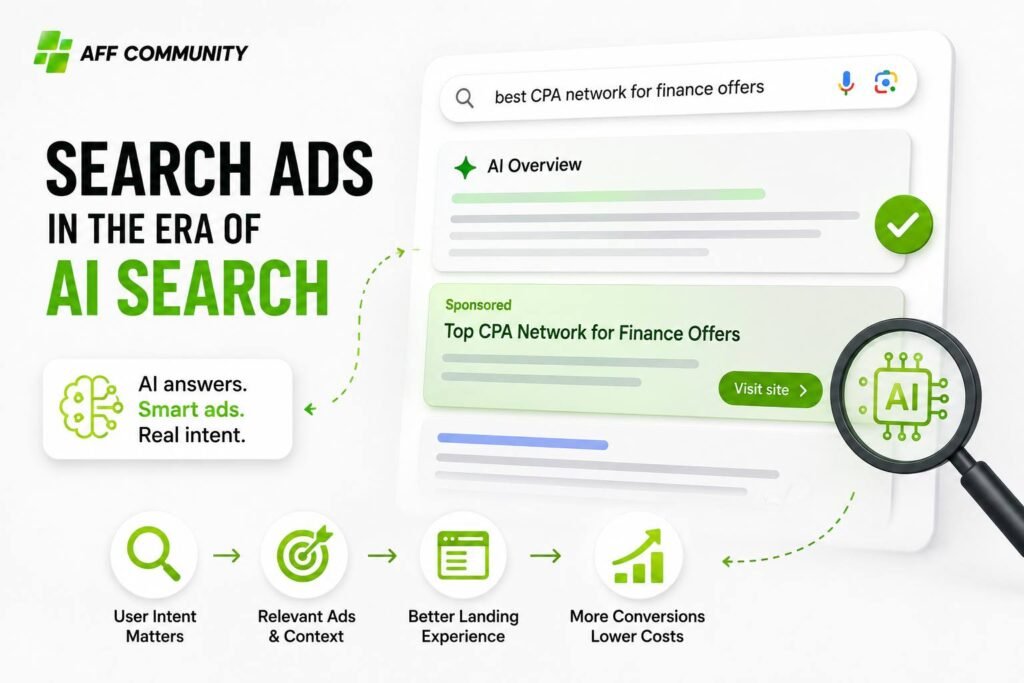
Informational queries will lose some clicks
Informational traffic will be most affected by these changes. Previously, a user could type a question into Google, open several articles, and gradually move on to a commercial offer. Now, some of these queries are resolved directly within the AI response.
This is already affecting user behavior: 2026 studies show that when an AI Overview is available, clicks to external sources occur significantly less frequently.
For publishers, this means they need to rethink how they handle broad semantics. A keyword that generates many cheap informational clicks may turn out to be less valuable than a small volume of commercial queries.
Therefore, we recommend dividing semantics into at least several groups: informational, research-based, commercial, and transactional.
Commercial intent will become even more important
If a person searches for “what is CPA,” AI may well answer their question completely.
But when the query becomes “the best CPA network for financial offers” or “where to book a consultation on team management,” the user already needs a specific option.
This is precisely where Search Ads retain their main advantage—they allow you to work with already established demand.
We would therefore not abandon search advertising; on the contrary, we would analyze more carefully the queries that bring users as close as possible to the desired action.
It’s also worth keeping a close eye on the cost per click. On the AffCommunity website, we’ve already discussed how to lower the cost per click in Google Ads, including optimizing ad quality, keywords, and landing pages.
Keywords are no longer the sole guide
AI-powered search understands the meaning of a query and its context much better.
A user might type a long question instead of a short phrase. For example, not “team consulting,” but “how to improve team effectiveness in a fast-growing company.”
This is an interesting signal for a marketer. Long-tail queries allow for a better understanding of a user’s problem and a more precise match for an ad.
That said, we don’t recommend simply expanding the semantic scope for the sake of quantity. Every new query must be evaluated in terms of its commercial value.
If a user is looking solely for information, but the offer requires an immediate application, there’s too great a gap between intent and the offer.
Ads Will Be Integrated Into AI Responses
Another important change is that ads themselves are beginning to appear within new search interfaces.
Google is already testing ad formats created specifically for AI Search, and AI Max is expanding the automation of targeting and creativity in search campaigns.
This is gradually changing the approach to optimization.
Previously, we primarily focused on an ad’s position relative to other advertisers. Now, the context in which the system displays the ad is becoming crucial.
The ad must logically correspond to the user’s query and continue their search journey.
Essentially, Google is trying to shift from a “show an ad based on a keyword” model to a “find the right commercial offer for a specific intent” model.
The landing page also needs to evolve
If a user receives a more detailed answer even before clicking, they arrive at the site already prepared.
This means a weak landing page becomes even less effective. We recommend answering the key questions as quickly as possible:
- what the company offers;
- who the product is suitable for;
- what the terms and conditions are;
- why the offer can be trusted;
- what action to take next.
Don’t force users to search for the information they need through several screens of marketing copy.
The more specific the search query, the more precise the landing page must be.
Brand-related search will become more valuable
AI search can have an interesting effect: a user first becomes familiar with a brand through an AI response, content, or a mention, and then searches for it on Google on their own.
As a result, an additional chain emerges:
content → brand awareness → brand-related search → Search Ads → conversion.
This is precisely why we believe that brand development is becoming a crucial part of any search strategy.
At AffCommunity, we’ve already discussed how to generate branded searches on Google and why such demand is typically higher quality than cold search traffic.
SEO and Search Ads will become more closely intertwined
Just a few years ago, it was possible to draw a fairly clear line between SEO and paid advertising.
Now the line between them is gradually blurring.
Content helps establish expertise; the user encounters the brand in a search result or an AI response, and then returns with a commercial query. The result is a unified funnel where different channels work in tandem.
That’s precisely why we don’t view AI search as solely an SEO issue. For a publisher, this represents a shift in the entire user journey.
A good example is the development of AEO. This approach aims to make content a source for AI responses, rather than simply occupying a position in traditional search results. We’ve covered AEO for publishers in more detail.
What Webmasters Should Do Right Now
We wouldn’t recommend drastically changing all active campaigns. It’s much wiser to adapt them gradually:
- First, review the semantics and remove queries that generate traffic but don’t generate revenue.
- Second, segment campaigns based on user intent.
- Third, test longer and more specific search terms.
- Fourth, improve the “search term → ad → landing page” chain.
And most importantly—evaluate not only CTR and CPC, but also the ultimate cost of the target action.
Conclusion
AI Search isn’t killing Search Ads. It’s making them more contextual.
Informational traffic may indeed remain partially within the search engine, but commercial demand is becoming even more interesting. At the same time, Google is developing new ad formats and automation that allow offers to be displayed in an AI environment.
We believe that the future of Search Ads lies with those teams that stop thinking solely in terms of keywords.
It’s essential to understand user intent, traffic quality, and the entire journey from search query to conversion. This is precisely what will allow you to remain profitable even when traditional search results finally transform into an AI-first environment.