How to Scale Up from a $100-a-Day Budget to $1,000
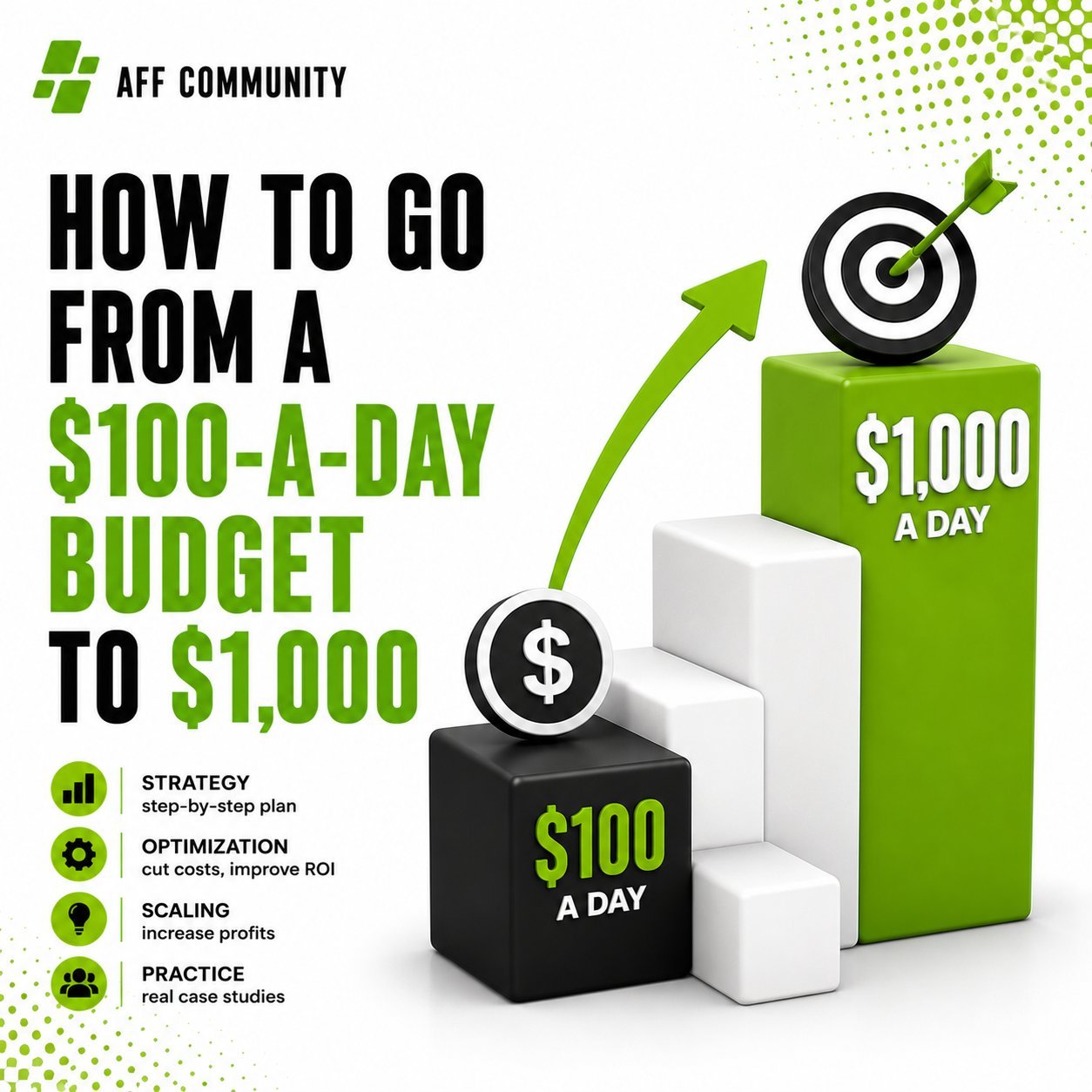
Most webmasters are able to find a profitable campaign and scale it to a steady $100 a day. But it’s right after reaching that milestone that the hardest part of the job begins—scaling.
We regularly speak with webmasters who successfully pass tests, achieve a positive ROI, and then lose profit the first time they try to increase their volume. The reason is almost always the same: they start scaling their budget instead of their system.
In practice, the transition from $100 to $1,000 a day isn’t just about increasing bids—it’s a complete overhaul of your approach to managing traffic.


First, stabilize the campaign

The first mistake is scaling the campaign immediately after a few successful conversions. The campaign must demonstrate consistency.
If today’s ROI is 70% and tomorrow it’s already -20%, it’s too early to talk about scaling. Before increasing volume, it’s important to ensure that the results are consistent over several days and aren’t just a fluke.
We recommend first fully understanding which elements are driving profit: the audience, creativity, the offer, or the traffic source.
Only then should you move on to the next stage.
Scale Gradually
When the campaign shows stable results, the temptation arises to drastically increase the budget. It is precisely at this point that most campaigns begin to lose effectiveness.
It’s much safer to increase volume gradually, constantly analyzing changes in the metrics.
If, after another budget increase, the CPM spikes, the CTR drops, or conversion rates start to fall, it means the system is already exceeding its comfort zone.
In such a situation, it’s better to look for new growth opportunities rather than continue pouring money into a single campaign.
By the way, you can find a separate breakdown of how to properly use statistics when scaling in this article.
Create new ad groups, not just one “permanent” one
A common misconception is hoping that a single ad group can remain profitable for months on end.
In practice, any campaign gradually loses its effectiveness:
- The auction dynamics change.
- New competitors emerge.
- The audience stops responding to the creativity.
That’s why professional teams always test new hypotheses in parallel.
While one campaign is scaling up, another is in the testing phase, and a third is already being prepared to replace the previous one.
It is precisely this system that allows for sustained growth without sharp drops.
Automate Processes
When the daily budget reaches several hundred dollars, it becomes difficult to manage everything manually.
That’s exactly why strong teams gradually automate some of their processes:
- they use analytics systems;
- they set up automated rules;
- they implement tools for working with creativity;
- they optimize internal processes.
The less time spent on routine tasks, the more attention you can devote to finding new opportunities for growth.
Work on your infrastructure
With small budgets, many problems go unnoticed. But as you scale up, weak infrastructure begins to create serious limitations.
The load on advertising accounts increases. Audits become more frequent, and the likelihood of bans rises.
Therefore, it’s worth focusing in advance on high-quality accounts, anti-detection browsers, proxies, and payment systems.
It is the stability of the entire system that allows you to scale up smoothly.
If you’re working through Meta, we recommend familiarizing yourself with the principles of building Business Manager trust in advance.
Don’t be afraid to delegate
Up to a certain point, one person can manage all processes on their own.
But scaling from $100 to $1,000 a day almost always requires dividing responsibilities:
- you’ll need a designer;
- a content manager;
- a campaign manager;
- an assistant;
- and an analyst.
Trying to do everything on your own starts to slow down the project’s growth. That’s exactly why most successful webmasters eventually become team leaders.
We discussed in detail how to properly structure processes within an affiliate marketing team in the article at this link.
Don’t focus on today’s profits—focus on the system
The main difference between a webmaster with a $100 budget and a team operating on $1,000+ per day isn’t the size of their budget. It’s a difference in mindset.
Professionals structure their processes so that profit depends not on a single campaign, but on the entire system:
- Constant testing.
- Regular updates to creativity.
- Reliable infrastructure.
- High-quality analytics.
- Diversification of traffic sources.
This is precisely what allows for smooth scaling even amid constantly changing advertising platform algorithms.
Conclusion
The transition from a $100 to a $1,000 daily budget rarely happens thanks to a single lucky break.
It’s the result of systematic work, sound analytics, high-quality infrastructure, and constant testing of new hypotheses.
It’s precisely this approach that allows you to scale your profits—not your expenses—gradually transforming affiliate marketing from a series of individual campaigns into a fully-fledged, stable business.