Native Advertising in 2026: Does It Still Work?
Native advertising isn’t dead, but the “run a clickbait headline, add a cheap pre-roll, and wait for the profits” approach is increasingly running up against competition, the quality of platforms, and the economics of the conversion funnel.
We view native ads as a distinct discipline within media buying. It’s not enough to achieve a high CTR here: you need to attract users who won’t just click on a curious image, but who will take an interest in the offer and perform the desired action.
Why Native Ads Still Work
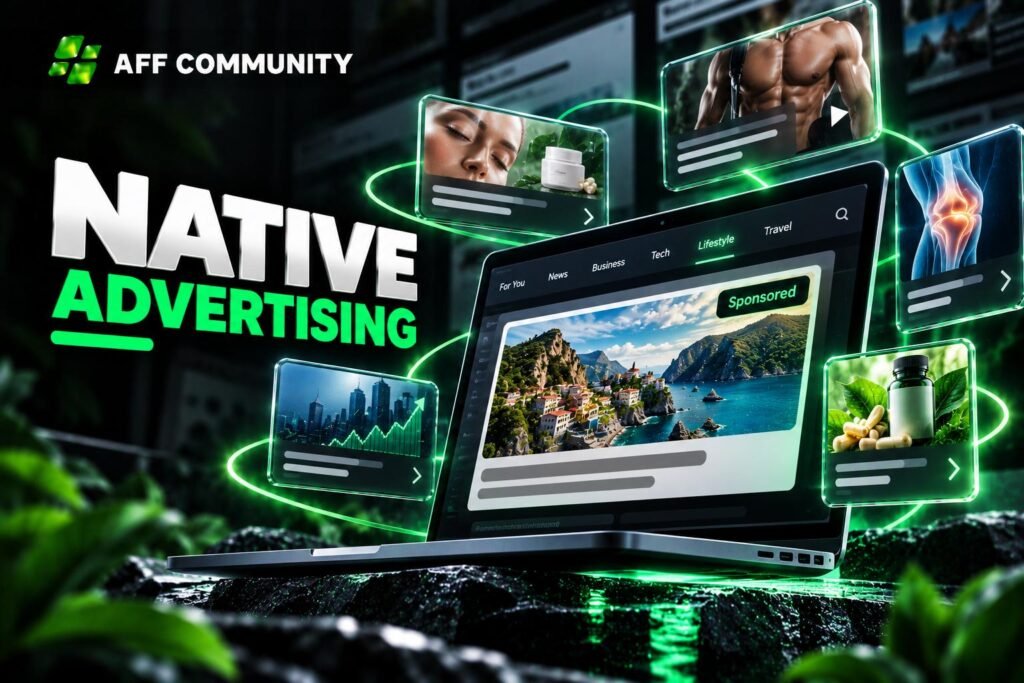
The key feature of native ads is that they blend organically into the platform’s content. Users see a recommendation next to an article or news story and decide for themselves whether to click through. This format is well-suited for offers that require an explanation before purchase: nutras, financial products, e-commerce, and certain informational offers.

By 2026, the market hadn’t disappeared—it had simply become more competitive. According to OpenAdLibrary’s July 2026 data, its index tracked over 725,000 native ad creativities across 49 networks. While this doesn’t prove the profitability of every source, it does show that advertisers continue to actively use the format.
For buyers, the conclusion is simple: there’s no need to look for “dead” or “alive” native ads in general. You need to find a working combination of GEO, vertical, platform, ad placement, and landing page.
We recommend checking out a comparison of classic and new traffic sources in this overview.
Which combinations are worth testing
1. Native Ads → Pre-landing Page → Offer
A classic model for nutra content and products with complex propositions. Creativity hooks the user with a specific problem or a useful insight, the pre-landing page expands on the topic, and the landing page guides the interested user toward the desired action.
It’s critically important that the headline doesn’t promise something that isn’t in the content. Clickbait may boost the CTR, but if the visitor closes the page immediately, the ad budget is simply wasted.
2. Native Recommendations → Expert Content → E-commerce
Instead of a direct sale, the user first receives a product comparison, an explanation of features, or a practical analysis. This funnel is useful when the decision requires trust and multiple touchpoints.
3. Native ads → content funnel → repeat conversion
Not every visitor is ready to buy right away. Part of the audience may return via retargeting, email, or another permitted communication channel. That’s why it’s important to analyze not only the first session but also subsequent conversions—taking into account correct attribution and user consent.
Which creativity offers the best chance of success
In native ads, the combination of headline and image is especially important. They should spark interest while also matching the page’s content. Instead of an abstract “You won’t believe what happened,” it’s better to test a specific angle: a problem, a comparison, an unusual fact, or useful advice.
We recommend testing several variations of headlines and images without changing all campaign elements at the same time. This makes it easier to understand what influenced the CTR, page depth, and conversion rate. Practical testing principles are outlined in the article on creating and testing ad creativity.
Another important point is transparency. Native advertising should not disguise ads as real news, fabricate reviews, or create a false impression that experts endorse the product. In addition to losing trust, such approaches can lead to ad rejections and issues with ad platforms.
How to Evaluate the Effectiveness of Native Advertising
CTR alone does not indicate whether a campaign is profitable. To evaluate the campaign, you need to track the entire chain:
- CTR and CPC—how well the creativity captures attention and how much each click costs.
- Pre-landing page engagement—whether the user stays to read the content or closes the page almost immediately.
- CR and CPA—what percentage of visitors convert and how much each desired action costs.
- ROI and conversion quality—whether there is a profit remaining after advertising and other expenses.
If clicks are cheap but there are no conversions, the problem may lie in the quality of traffic, an irrelevant headline, a weak pre-landing page, or an unsuitable offer. In this case, it’s worth reviewing the stages of the funnel rather than simply increasing the bid. Additional ideas for working with your audience can be found in the breakdown on how a webmaster can run an audience.
Before scaling up, it’s helpful to study competitors’ creativity: which angles are recurring, how long ads remain active, and which pages they lead to. However, a long display duration alone does not guarantee profitability. To test hypotheses, you can use spy services for affiliate marketing.
Finally, evaluate not only the quantity of leads but also their quality. The approach to measuring conversions and interpreting results is detailed in the article on conversions in advertising.
Is it worth getting into native advertising in 2026?
Yes, if you have a budget for testing, the ability to analyze platforms, and a willingness to work on the entire funnel. Native advertising can be a useful source of traffic, but it doesn’t guarantee cheap leads or a quick return on investment.
We recommend starting with a single vertical, a few creative hypotheses, and a clear ROI model. First, find a combination that delivers high-quality conversions at a low volume, and only then increase your budget.
In 2026, success will go not to those who know how to buy the cheapest clicks, but to those who understand what kind of users come from a specific platform and how much profit the entire funnel generates.

