How to Find Profitable Mobile App Offers
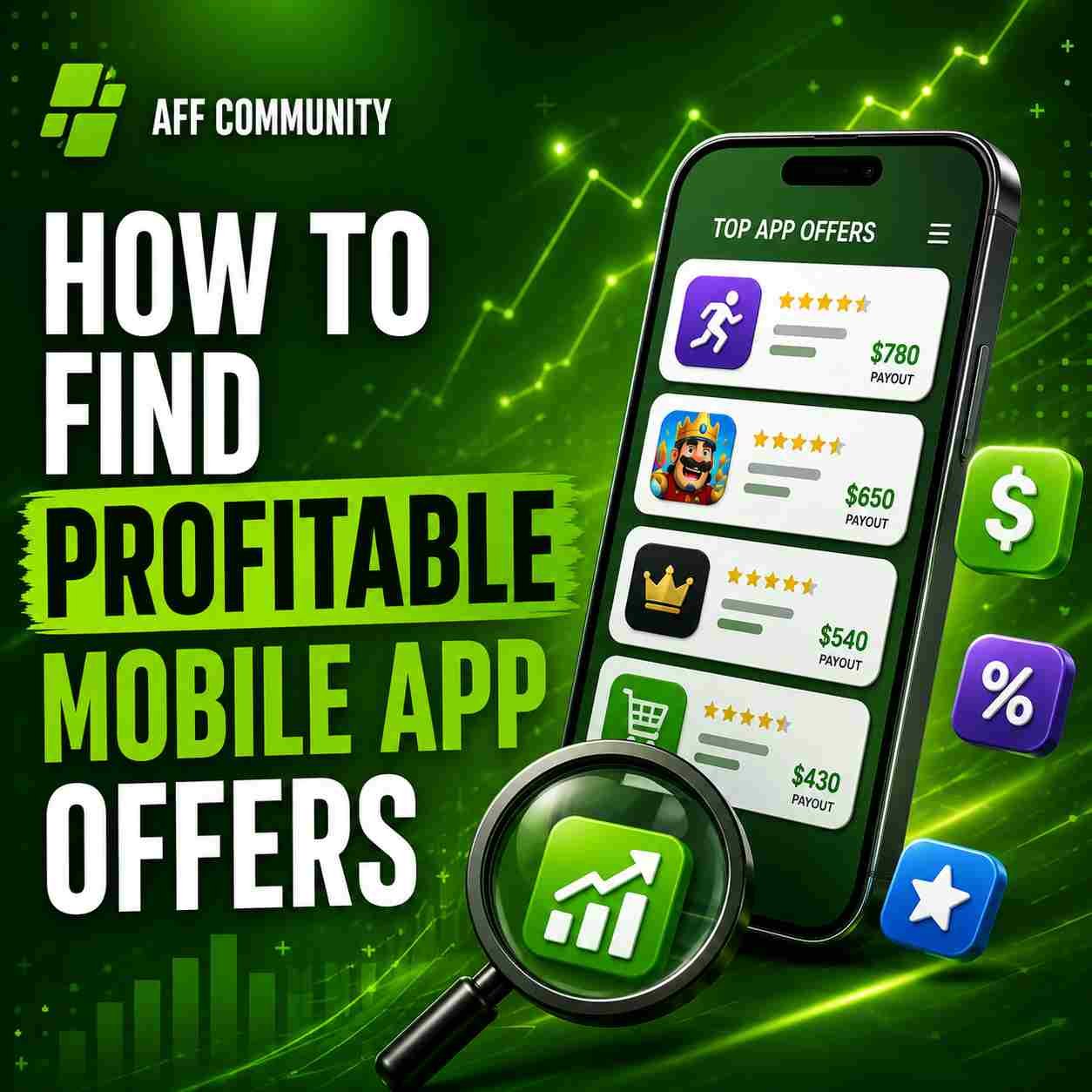
Mobile apps have long since ceased to be a secondary niche in affiliate marketing. Users spend a tremendous amount of time within apps, and advertising platforms make it possible to generate large volumes of mobile traffic. In 2026, we’re seeing particularly strong interest in app offers from webmasters.
But finding an offer with a high payout doesn’t necessarily mean finding a profitable deal. In mobile affiliate marketing, it’s much more important to understand how much it actually costs to acquire a user and what value that user brings to the advertiser.
Where to Find Mobile App Offers
It’s best to start with affiliate networks. That’s where you can find offers from app developers and advertisers with various payment models: CPI, CPA, CPL, RevShare, and hybrid options.


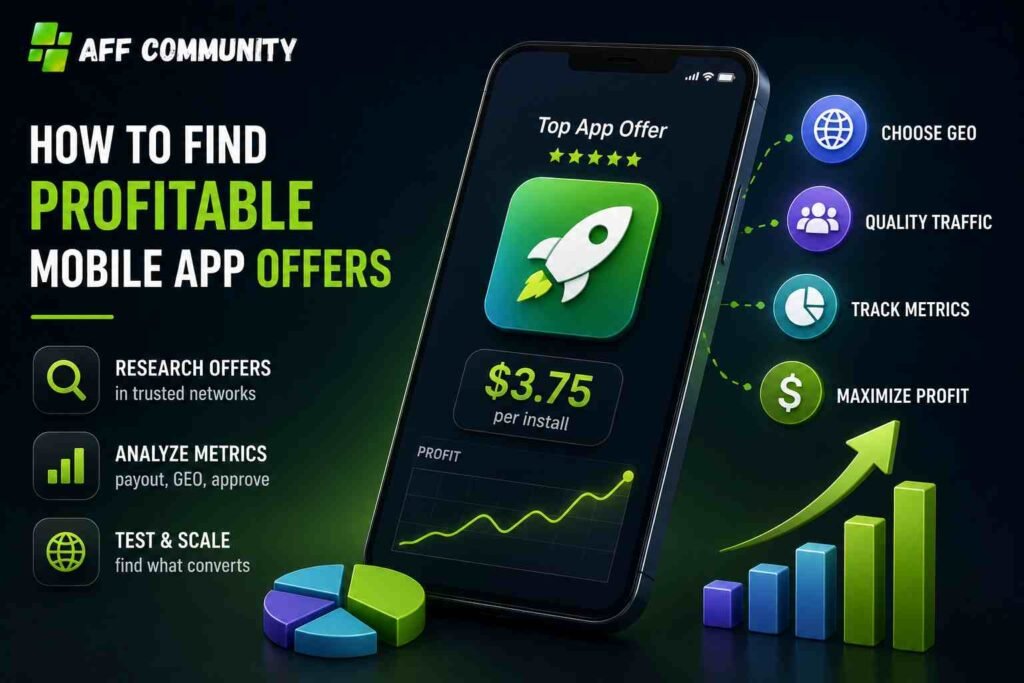
When searching, we recommend not limiting yourself to the payout amount. For example, an offer with a high CPI may turn out to be less profitable than one with a lower payout if the former requires expensive traffic or has a low approval rate.
It’s also helpful to identify the vertical in advance. In 2026, apps in categories such as utility, VPN, finance, e-commerce, entertainment, gaming, and other sectors are actively used among mobile traffic. We analyzed the market in more detail in our article on the development of in-app traffic in 2026.
Which Metrics to Look For
Before launching an offer, we recommend gathering as much information as possible:
- payout amount;
- payment model;
- allowed GEOs;
- types of allowed traffic;
- creativity requirements;
- minimum conversion volume;
- lead approval and quality;
- hold period;
- source restrictions.
It’s especially important to understand which action is being paid for. App installation and user registration are far from the same thing. The situation is even more complicated with offers where payment is made only after the first payment or another specific action. Therefore, it’s incorrect to compare offers based solely on CPA or CPI.
Geo can completely change the economics
The same app offer can yield completely different results in different countries.
In Tier-1, the potential payout is often higher, but the cost per acquisition increases accordingly. In Tier-2 and Tier-3 markets, traffic may be cheaper, but user spending power, competition, and audience behavior differ.
That’s exactly why we recommend testing several GEOs first, and only then determining the direction for scaling. If you’re just starting to work with different markets, it’s helpful to review a comparison of Tier-1, Tier-2, and Tier-3.
Focus on actual profit, not just payouts
Let’s say an app pays $4 per install. At first glance, the offer seems attractive. But if the average cost of a high-quality install is $5, the campaign will be unprofitable.
Therefore, before scaling up, you need to track at least the following:
costs → clicks → installs → confirmed conversions → revenue → ROI.
It’s also important to account for the delay between installation and confirmed conversion. Otherwise, you might pause the campaign prematurely or, conversely, continue spending your budget on low-quality traffic.
Where to Get Traffic for App Offers
After selecting an offer, you need to choose a traffic source. For mobile apps, In-App is particularly interesting: ads are displayed directly within mobile apps and allow you to reach a large number of users.
But this is far from the only option. Depending on the offer’s terms, you can test Meta Ads, TikTok, Google, native ads, push notifications, Conditional free traffic, and other sources.
If you plan to work with organic TikTok traffic, it’s important to consider the specifics of mobile devices and the platform itself. We’ve covered how to prepare smartphones for UBT traffic from TikTok in a separate post.
Don’t forget about creativity
Even a great offer might not work due to poor creativity. For mobile apps, the first few seconds of user interaction are especially important.
You need to test different approaches: interface demos, app usage scenarios, short videos, problem-solution formats, and other concepts.
At the same time, some of the routine work can already be automated. AI and machine learning help analyze ad campaigns, segment audiences, and identify patterns in large datasets. We wrote more about this in our article on the application of AI and machine learning in affiliate marketing.
How to Tell If an Offer Is Truly Profitable
We recommend not drawing conclusions based on just the first few conversions. Mobile app offers need to be tested against a sufficiently large data set.
First, check the traffic quality, then compare GEOs, creativity, and platforms. After that, disable underperforming segments and gradually increase the budget for those where the ROI remains positive.
The main rule is simple: don’t look for the offer with the highest payout, but rather the offer with the best ratio of user acquisition cost to revenue per user.
It is precisely this approach that allows you to find truly profitable mobile app offers and scale them without the illusion that a high cost per conversion automatically means high profits.