The Main Reasons for Account Suspensions in Google Ads
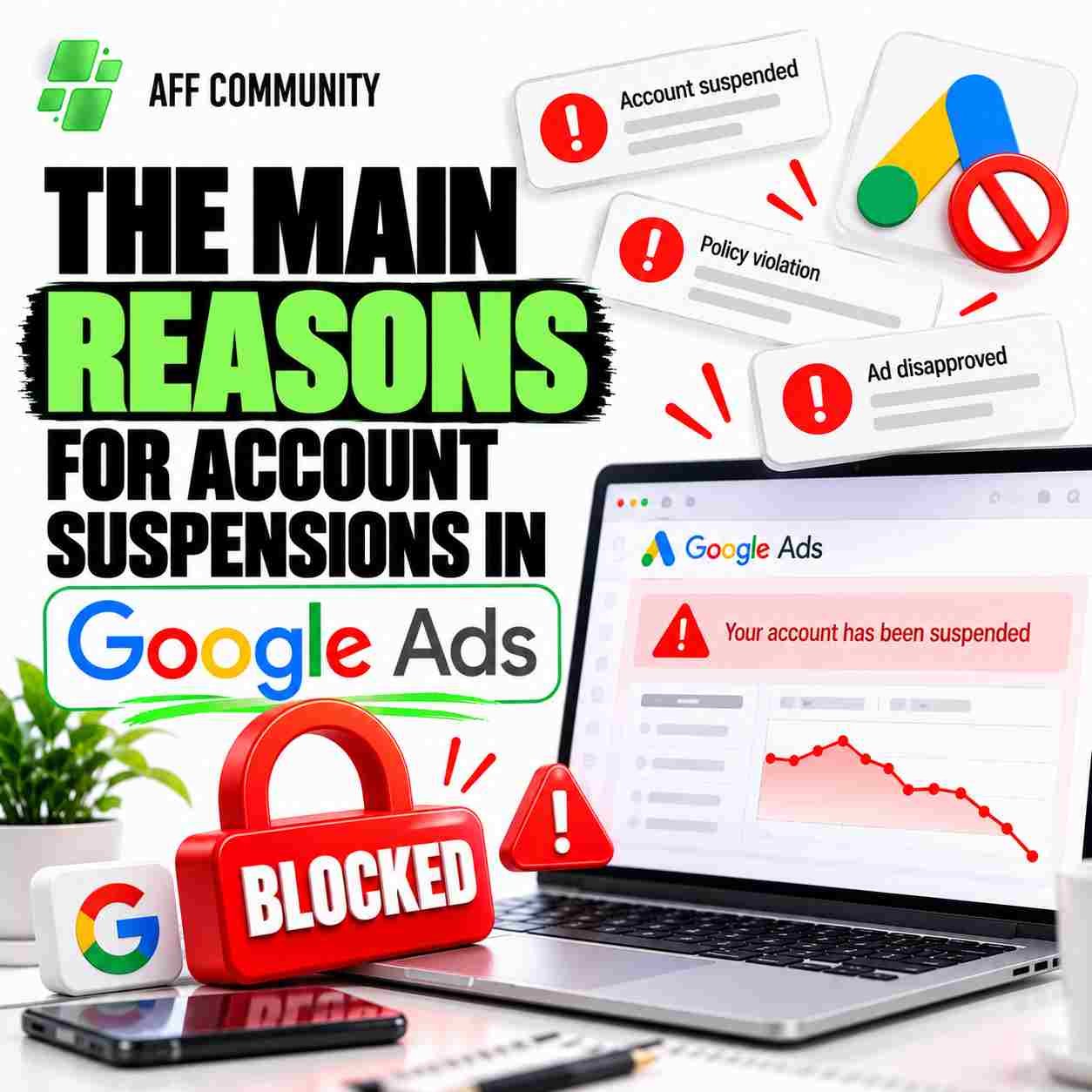
Google Ads remains one of the most promising platforms for arbitrage, but at the same time, it’s a platform where a single mistake can cost you your ad account and the budget you’ve already spent. We regularly receive questions about Google Ads suspensions, and in most cases, the reason turns out to be quite specific.
That said, a suspension isn’t always caused by a single violation. Google evaluates an ad campaign holistically: the account, the ad, the website, payment information, the domain, and post-click behavior.
Mismatch Between the Ad and the Landing Page
One of the most common reasons is when a user sees one promise in the ad but, after clicking, lands on a page with a different offer.


For example, an ad promises a discount or a specific service, but the user doesn’t find the advertised terms on the landing page. It’s even worse when the ad copy seems neutral, but the landing page itself contains aggressive promises, prohibited content, or a completely different topic.
For Google, it’s important that the entire chain makes sense: search query → ad → landing page → call to action.
We covered this topic in detail in our article on mistakes that drain your budget and get your Google Ads accounts suspended.
A Problematic or Suspicious Website
Even a good ad won’t help if the website itself raises red flags.
Slow loading times, a large number of redirects, a lack of proper information about the company, a strange page structure, technical errors, and inconsistent content—all of these can serve as additional red flags triggering a review.
You should be especially cautious with new domains. If a website has just launched and starts running a large volume of ads almost immediately, it’s harder for the system to build trust in such an advertiser.
Therefore, before launching a campaign, we recommend checking not only the creative assets but also the entire technical side of the website, and you should always use only trusted services for creating white pages.
Abrupt Actions on a New Account
Another common mistake is to create a new advertising account and immediately start acting as if the account has been active for several months.
A large budget from day one, numerous campaigns, constant changes to settings, and rapid scaling can appear unnatural to the system.
This is precisely why many arbitrage specialists focus on warming up the ad account before launch. While this doesn’t guarantee against suspension, it helps build a more consistent history of account activity.
Violations of Advertising Policies
Google imposes separate restrictions on a number of verticals and advertising approaches. In affiliate marketing, you need to be especially careful with finance, cryptocurrency, gambling, adult content, healthcare, and other categories with stricter requirements.
The problem arises not only when directly promoting a prohibited product. Sometimes the trigger is the wording in an ad, an image, a promise of results, or the content of a landing page.
Therefore, before launching a campaign, we recommend checking the rules specifically for your target region and vertical, rather than relying on the assumption that “it works for others.”
We discussed the current specifics of working with this platform in the article Arbitrage via Google Ads in 2026.
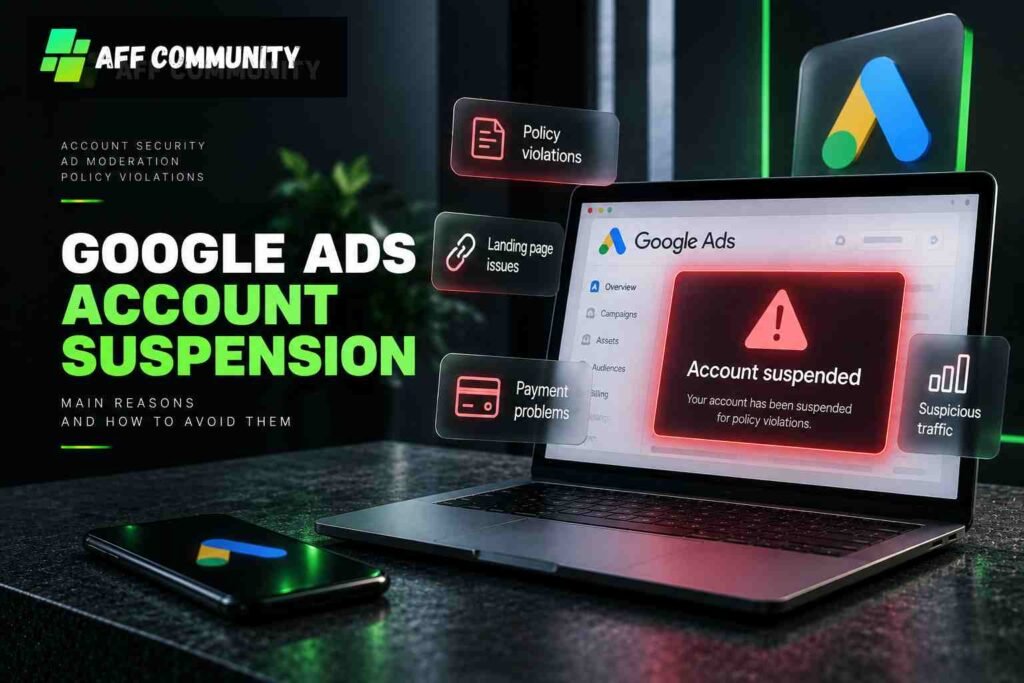
Issues with Payment Information
Billing is a separate risk area. Inconsistencies in payment information, suspicious activity, frequent changes to payment details, or payment issues can lead to additional reviews and restrictions.
It’s important here that the advertiser’s information, payment profile, and actual business details don’t contradict each other.
You can’t view payment details separately from the account: for the platform, this is part of the overall trust profile.
Low-Quality or Suspicious Traffic Behavior
Google isn’t just interested in what happens before a click. The user’s behavior after the click is also important.
If the system detects an abnormal number of clicks, sudden spikes in activity, or other suspicious patterns, this may trigger an additional review.
That said, not all poor-quality traffic indicates fraud. Sometimes the problem lies in incorrect targeting, ad creatives, or audience selection.
Therefore, before increasing your budget, it’s helpful to check traffic quality before scaling, rather than focusing solely on the number of clicks and ROI.
Aggressive scaling
Let’s take a closer look at a situation where a performing campaign is suddenly scaled up rapidly.
Let’s say a campaign has been performing well for several days. The advertiser increases the budget severalfold, adds new GEOs, and simultaneously launches a large number of ads.
As a result, the campaign’s behavior changes, traffic volume increases, new signals appear for the algorithms, and the account may be flagged for review.
Scaling must be controlled. In this case, it’s helpful to look not only at profit but also at the metrics that really matter in arbitrage.
What to Do If Google Ads Has Already Suspended Your Account
First, don’t panic and don’t try to create dozens of new accounts right away.
You need to identify the specific reason for the restriction, check your ads, website, payment information, and account history. If Google offers to undergo a review or file an appeal, you should first figure out the reason for the suspension and only then submit a request.
We follow a simple principle: it’s better to view a suspension not as a coincidence, but as a signal to review your entire advertising infrastructure.
Conclusion
A Google Ads suspension rarely comes out of nowhere. Most often, the system detects a combination of factors: a problematic landing page, a mismatch between the ad and the website, policy violations, suspicious payment activity, erratic account behavior, or low-quality traffic.
In 2026, it’s no longer enough to simply write a good ad. The entire advertising journey needs to look sound - from the account and payment setup to the landing page and user behavior after the click.
It is precisely this systematic approach that reduces moderation issues today and allows you to work with Google Ads for longer without the constant fear of losing your account.