Why Google Ads Accounts Get Suspended: Possible Reasons
Google Ads suspension is one of the most unpleasant situations for a publisher. Campaigns are paused, the budget stops working, and regaining access can take time. However, accounts aren’t always suspended immediately: at first, ads may be rejected, and then restrictions may affect the entire advertising account.
We recommend focusing not on ways to bypass moderation, but on identifying the specific reason for the suspension. Let’s break down why Google Ads might suspend an account and what to look out for before launching an ad campaign.
1. Violation of Advertising Policies
The most obvious reason is promoting products, services, or content that violate Google Ads policies. Specific topics are subject to special restrictions, certification requirements, and geographic conditions.


You should pay particular attention when reviewing campaigns in the finance, cryptocurrency, gambling, nutra, and other regulated niches. Even if an ad appears neutral, the website’s content and the offer itself may fall under these restrictions.
Before launching, we recommend reviewing the specific rules for your category. You should also check separately whether the advertiser is required to provide identity verification, business verification, or special permits.
2. Mismatch Between the Ad and the Landing Page
The ad promises one thing, but after clicking, the user sees something else. For example, an ad offers a free service, but a paid subscription immediately appears on the landing page. Or the ad describes informational content, while the website actually promotes a product with different terms and conditions.
Such discrepancies can raise suspicions that users are being misled.
We recommend checking the entire chain: the headline, ad text, URL, landing page content, and call-to-action. Terms, prices, and restrictions must be clear and consistent with one another.
We wrote more about the specifics of launching campaigns and source risks in our article on affiliate marketing via Google Ads in 2026.
3. Suspicion of Circumventing Moderation Systems
Attempts to hide a website’s actual content, show one page to moderators and another to users, use deceptive redirects, or create linked accounts to continue prohibited activities can result in serious penalties.
It’s important to understand the difference between standard technical website configuration and the intentional concealment of information from the advertising platform. The mere presence of a redirect does not constitute a violation, but its purpose and outcome are significant.
If an account is suspended, creating new accounts to continue the same activity can make the situation worse. It’s better to first address the cause and follow the official appeal process.
We always recommend using high-quality white pages and verified cloaking services.
4. Payment and Verification Issues
Google Ads may restrict an account due to suspicious payment transactions, outstanding balances, issues with the payment method, or failure to pass the necessary verifications.
A separate risk arises if the advertiser’s information does not match the documents provided or if the business information appears contradictory.
Before launching a campaign, check:
- the accuracy of payment details;
- that there are no outstanding balances;
- that the advertiser’s information is up to date;
- your verification status and any requests from Google;
- and the security of your account access.
Do not ignore notifications in your ad account or emails from the platform: they may specify the exact nature of the violation.
5. Issues with the Website and Technical Infrastructure
Even a valid ad doesn’t guarantee successful moderation if the website is unavailable, infected with malicious code, contains suspicious scripts, or redirects visitors to unexpected pages.
We recommend regularly checking the landing page’s availability, the mobile version, loading speed, SSL certificate, and the functionality of all links. If the website uses third-party plugins, it’s important to update them promptly and monitor their security.
When analyzing campaigns, it’s helpful to evaluate not only the ads but also what happens after a click. In our article on checking traffic quality before scaling, we discussed how to identify problem areas in the funnel.
6. Low-quality creativity and misleading promises
Aggressive wording, unsubstantiated results, promises of guaranteed earnings, and artificially creating a sense of urgency can raise questions from moderators and users.
However, an ad rejection in and of itself does not always mean that the account will be blocked. You need to look at the reason for the rejection, your history of violations, and the nature of the problem.
We recommend making your creativities clear, not promising anything the product doesn’t guarantee, and checking your ad materials in advance for compliance with the platform’s rules. Useful guidelines for adapting ad materials are covered in the article on how to adapt creativities to meet the requirements of advertising platforms.
What to Do If Your Account Has Already Been Suspended
First, open the Google Ads notification and determine the exact reason for the restriction. Then, review your website, ads, payment information, and account settings—depending on the specified violation category.
Don’t repeatedly submit the same appeals or change only the ad text if the problem lies with your website or business information. Correct the confirmed violations, gather supporting evidence and documents, and then submit a well-founded appeal through the official Google Ads interface.
Additional recommendations for safely managing ad campaigns are compiled in the article on security and affiliate marketing.
Conclusion
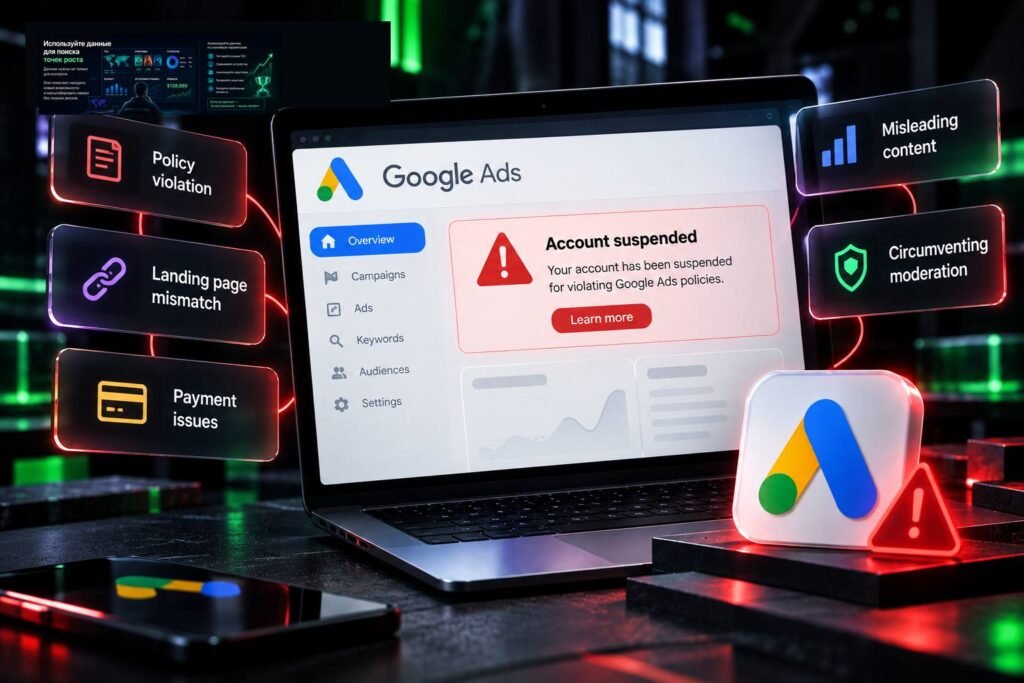
Google Ads may suspend an account due to violations of advertising policies, mismatches between the ad and the landing page, attempts to circumvent moderation, payment issues, or technical security problems with the website.