Comparison of Traditional vs New Traffic Sources in 2026
In 2026, it will no longer be enough for a publisher to simply choose Facebook Ads or Google Ads, find a winning combination, and scale the budget. Competition, customer acquisition costs, and advertising platform restrictions are forcing teams to seek out additional channels and distribute traffic across multiple sources.
We believe that the question today isn’t which source will completely replace traditional platforms, but rather how to build an effective mix of paid, organic, and quasi-free traffic.
Traditional Sources: Why They Remain Relevant
Traditional channels include Meta Ads, Google Ads, TikTok Ads, ad networks, native advertising, and push notifications. They differ in formats, audiences, and purchasing models, but they allow you to generate a controllable flow of visitors provided you have a budget and the right setup.


Meta Ads is suitable for working with visual creatives, testing hypotheses, and attracting an audience through social media. However, advertisers must take into account moderation requirements, competition, and fluctuations in ad costs.
Google Ads allows you to target search queries and use other ad formats. Its advantage is the ability to reach users who are already searching for a specific product or solution. However, the availability of certain topics depends on the platform’s rules and requirements for advertisers.
Ad networks and native advertising help expand reach beyond major social platforms. They can be useful for various verticals, but traffic quality and conversion rates depend heavily on the specific platform, GEO, and offer.
You can learn more about the differences between advertising platforms in our review of ad networks for affiliate marketing.
New and Alternative Traffic Sources
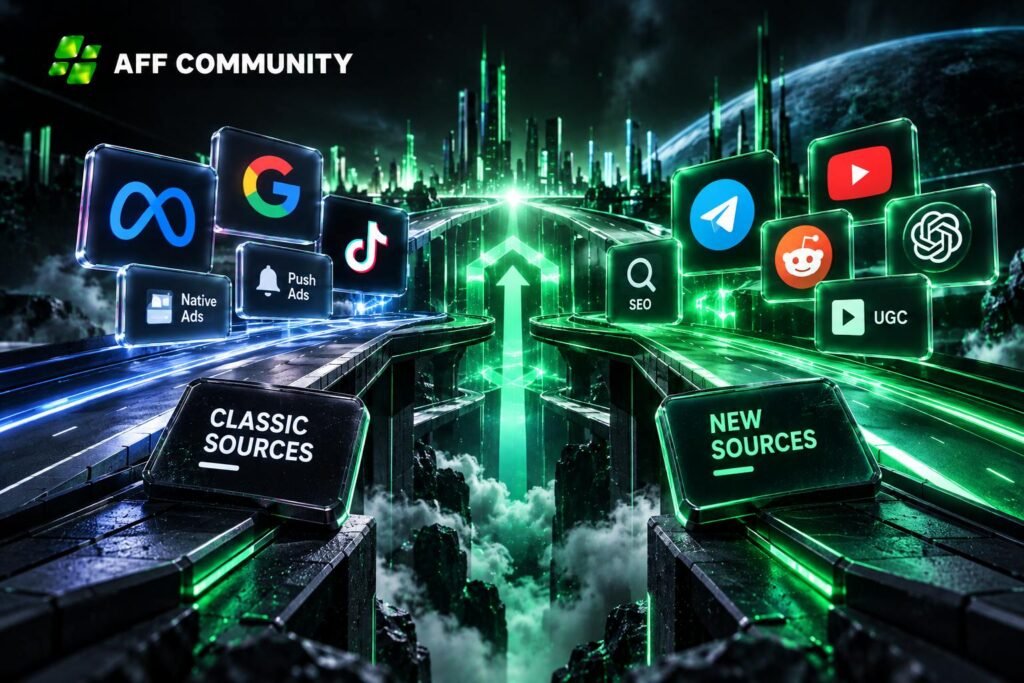
New channels don’t necessarily mean recently launched platforms. Often, they refer to platforms that were previously used only to a limited extent but are now considered a full-fledged part of the media mix.
Reddit and niche communities. Users come to discuss specific topics, compare products, and share experiences. This context can be useful for niche offerings but requires an understanding of community guidelines and a natural approach.
Telegram. Channels, bots, and ad placements allow you not only to attract users but also to build ongoing communication with your audience. The result depends on the topic, the quality of subscribers, and the chosen monetization model.
SEO and AI Search. Organic traffic requires time to develop the website and content, but high-quality content can drive visitors over the long term. AI search introduces a new way for brands to be discovered, though it does not yet guarantee a steady flow of traffic.
Conditional free traffic and short videos. TikTok, Reels, Shorts, and other formats offer the opportunity to gain organic reach without paying directly for each click. However, reach is unpredictable, and content creation requires consistent effort.
We explored in more detail how search is evolving under the influence of neural networks in our article on how AI is changing search results and affecting SEO.
Comparison of sources: what a buyer should choose
| Source | The main advantage | Restriction |
|---|---|---|
| Meta Ads | Rapid Testing and Scaling | Competition, Moderation, Cost |
| Google Ads | Working with Established Demand | Topic restrictions, expensive clicks in competitive niches |
| Advertising Networks | Разные форматы и большой охват | Various formats and wide reach |
| Telegram | Communication and Follow-ups | Dependence on Audience Quality |
| SEO | Long-term organic traffic | Results don't come right away |
| Conditional free traffic and Short Videos | The ability to reach an audience without paying per click | Unpredictable page views and labor costs |
| Reddit and Communities | Access to Targeted Audiences | Trust and adherence to the platforms' rules are required |
Which Is More Profitable: Paid or Free Traffic
Paid traffic allows you to test campaigns faster but requires a budget and constant monitoring of ROI. Freemium traffic reduces direct acquisition costs but requires time for content creation, account development, and audience engagement.
Therefore, we do not recommend evaluating channels based solely on cost per click. Compare the cost of a confirmed conversion, user quality, revenue, and content production costs.
For paid campaigns, it’s important to consider not only CTR and CPC but also the entire conversion funnel. For organic channels, focus on clicks, conversions, and the time it takes to achieve results.
How to Build a Working Mix of Traffic Sources
We recommend starting with one primary and one secondary channel. For example, buy traffic through Meta Ads while simultaneously developing your presence on Telegram or through SEO. Once you start seeing consistent results, you can test new platforms.
When selecting the next traffic source, evaluate three factors:
- Compatibility with the offer. Does the platform have a suitable audience, and does the affiliate program allow this type of traffic?
- Economics. How much does it cost to acquire a user, and what revenue does that user potentially generate?
- Sustainability. Will the team be able to continue working if one channel becomes more expensive or temporarily stops delivering results?
An important principle: don’t apply the same creativity template to all platforms without adapting it. Creative formats, audience behavior, and advertising requirements vary. Each new traffic source requires its own test.
Conclusion
In 2026, traditional sources will still offer opportunities for scaling, while alternative channels help reduce dependence on a single platform. However, a new source does not guarantee cheap traffic or high profits.
We recommend evaluating channels based on conversion quality and overall profitability, rather than popularity. A sustainable strategy is built on diversification, analytics, and the willingness to adapt your approach to the specific characteristics of each platform.

