Why It’s Hard for Solo Media Buyers to Get By These Days

Just a few years ago, affiliate marketing could easily be a one-person operation. The publisher would find an offer on their own, put together a campaign, create ad creatives, set up an ad account, launch campaigns, and gradually start turning a steady profit. The necessary skills could be learned on the job, and small budgets allowed for experimentation without a major infrastructure.
In 2026, this model still exists, but competing with professional media buying teams has become significantly more difficult. The market has changed: the cost of testing has risen, advertising platforms have stricter requirements, and a successful launch increasingly depends not on a single effective piece of creativity but on an entire system of processes.
We don’t believe that solo affiliate marketing is dead. But it’s also not worth romanticizing working alone. Today, an independent buyer has much less room for error, and the cost of each mistake is significantly higher.

The market has become too complex for a single publisher
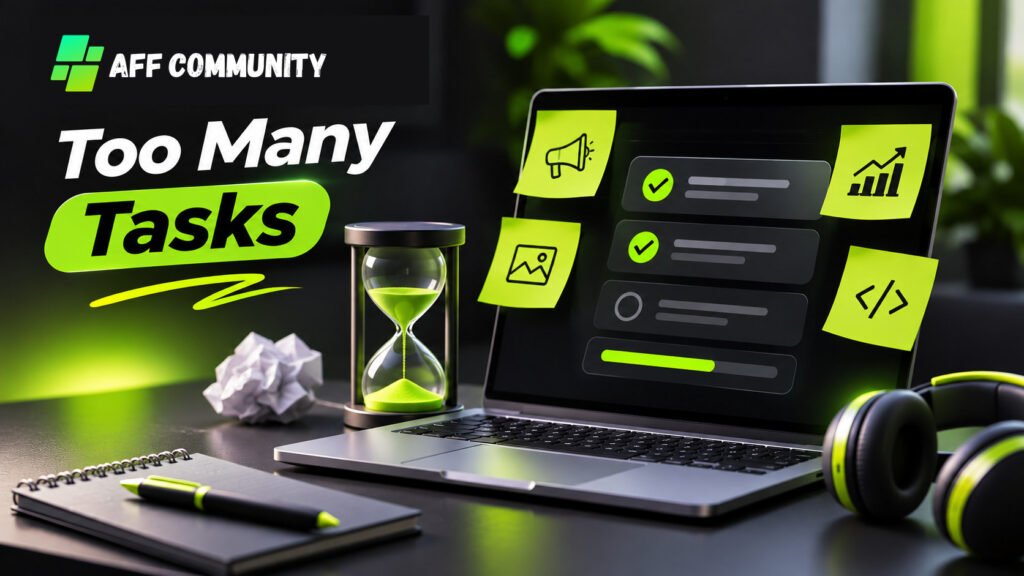
The main problem for a solo publisher is the number of tasks they have to handle on their own.
You need to simultaneously understand traffic sources, monitor moderation, search for and test offers, prepare creativity, build landing pages, manage the technical infrastructure, and analyze statistics. At the same time, each of these areas is gradually becoming a separate specialization.
In a team, tasks are distributed among several people. The webmaster handles purchasing and optimization, the designer is responsible for the visual aspects, the technical specialist handles infrastructure and integrations, and the analyst helps identify growth opportunities.
A solo buyer is forced to switch between all these roles. While they’re dealing with an issue in the ad dashboard, they might miss a change in the statistics. While they’re preparing new forms of creativity, competitors manage to test several of their own ad combinations.
As a result, the limitation isn’t just the budget, but also the amount of time a single person can physically devote to the work.
We’ve already discussed which skills and expectations are important when transitioning to a team-based format in our article on how a publisher can join a media buying team.
Infrastructure is consuming more and more resources
The second problem is the cost of technical infrastructure. For stable operation, it’s not enough to simply fund your ad account and launch a campaign. You need to factor in the cost of accounts, domains, hosting, proxies, anti-detection tools, trackers, and other tools.
For a team, these expenses are spread across several categories and purchase volumes. For a solo publisher, virtually all costs fall on a single source of income.
A particularly unpleasant situation arises when, after several failed launches, you have to rebuild the infrastructure from scratch. An account gets blocked, an ad account is restricted, a domain no longer suits the task and part of the budget is once again spent on restoring the workflow.
We’ve repeatedly pointed out that technical preparation affects not only the ease of work but also the stability of advertising campaigns. A basic set of solutions for organizing such an infrastructure is compiled in our overview of tools for affiliate marketing, anti-detection, and digital fingerprint management.
Testing Costs and Financial Risks Are Rising
One of the most painful issues for independent buyers is working capital.
It’s not enough to have money just for the initial launch. You need to budget for testing multiple ad combinations, consumables, potential account suspensions, payment delays, and retries. Even a promising campaign doesn’t always turn a profit from day one.
A team usually has more options for spreading out risks. One test might fail, but other channels continue to deliver results. For a solo publisher, the situation is often different: if several launches in a row result in a loss, available funds run out quickly.
Cash flow gaps are a separate issue. Money has already been spent on advertising, and leads or deposits have been received, but payment from the affiliate program hasn’t arrived yet. With a small reserve, even a temporary delay can halt ad buying.
Therefore, evaluating a campaign based solely on current ROI isn’t enough. It’s important to factor in infrastructure costs, testing expenses, holding periods, commissions, and the actual speed at which your investment is recouped.
We recommend tracking key metrics separately and not making decisions based on gut feelings. Our guide on which KPIs and metrics are important for publishers to track can help with this.
Competition Has Become a Team Effort
Another factor is the difference in speed. A team can test multiple approaches simultaneously, create dozens of variations in creativity, and reallocate the budget between campaigns more quickly.
A solo buyer is limited by their own resources. They cannot fully handle ad buying, creativity production, technical tasks, and the search for new ad combinations all at once. They have to set priorities, and some areas simply get overlooked.
This is especially noticeable in competitive verticals and expensive GEOs. While a solo buyer is testing a single ad set, a team can test multiple audiences, approaches, and funnel variations. As a result, the team gets data faster and figures out sooner where to allocate the budget.
However, it’s not just about the number of people. Strong teams have built up their own processes, statistics, templates, contacts, and experience working with advertisers. A new solo publisher has to build all of this from scratch.
Moderation and account suspensions hit solo arbitrageurs harder
Ad platforms continue to refine their algorithms for reviewing ads, accounts, and landing pages. Configuration errors, non-compliance with platform requirements, or issues with the advertising infrastructure can lead to a campaign being paused.
For a team, the suspension of a single account or dashboard doesn’t necessarily mean the entire business line has to stop. The team may have other active campaigns and specialists who can restore operations.
For a solo webmaster, the loss of their primary advertising resource sometimes means a few days of downtime or even a complete halt to ad buying. At that point, they not only lose money but also waste time that could have been spent on developing their network.
We’ve covered separately why advertising accounts get suspended and how to mitigate those risks.
It’s important to understand: no service or set of tools can guarantee that you won’t get banned. Sustainability is built on compliance with platform rules, having backup plans for critical processes, and sound risk management.
Burnout a problem that’s often underestimated
When someone works alone, they have virtually no way to properly distribute their workload. After launching campaigns, they need to check metrics, respond to managers, prepare new creativities, troubleshoot technical issues, and plan the next tests.
As a result, the workday easily turns into an endless cycle of tasks. Even when ad campaigns don’t require constant intervention, the buyer continues to monitor metrics and worry about potential performance drops.
The problem isn’t just fatigue. Burnout directly affects the quality of decisions. People start rushing to scale up, notice declining metrics too late, test too many combinations at once, or conversely are afraid to try new approaches.
A team allows you to distribute responsibility and reduce the workload on each individual specialist. Working alone, you have to set your own schedule and learn to stop in time.
Is it possible to make money as a solo arbitrageur today?
Yes. But to do so, you need to give up the idea of being a jack-of-all-trades who handles absolutely every task on their own.
In our view, solo publishers have several viable strategies.
First: Narrow Specialization
Don’t try to work with all sources, verticals, and GEOs at once. It’s much wiser to choose a niche, thoroughly study its audience, advertising tools, offer specifics, and economics.
Second: Delegating Specific Tasks
You don’t have to hire a full-fledged team right away. Design, video editing, technical setup, or specific analytics tasks can be outsourced to trusted freelance specialists. This will allow you to focus on ad buying and decision-making.
Third automating routine tasks
Reports, data collection, expense tracking, issue notifications, and some repetitive operations can be automated. Neural networks also help speed up the creation of creativity options, analyze information, and structure ad campaigns. However, final decisions regarding ad campaigns and budgets must still be based on real data.
Fourth: Financial Discipline
You need to set limits for tests, determine the size of the reserve, and establish conditions for pausing a campaign in advance. You shouldn’t allocate all available capital to a single campaign just because the initial results look promising.
Fifth: Working with Affiliate Networks and Advertisers
Traffic quality, transparent statistics, and an understanding of KPIs are becoming more important than simply the volume of leads. It’s more profitable for a solo buyer to develop stable partnerships and understand the economics of the offer than to constantly switch affiliate networks in search of quick payouts.
Conclusion
It has indeed become harder for solo webmasters to compete with teams. The reason isn’t that independent ad buying has stopped generating revenue, but rather that the demands on specialists and the cost of high-quality work have risen significantly.
Today, it’s not enough to simply find a working partnership. You need to be able to manage a budget, oversee infrastructure, analyze traffic quality, adapt quickly to changes in advertising platforms, and maintain a financial reserve.
We believe that the future of the solo model lies not in trying to replace an entire department, but in smart specialization. A single person with well-established processes, automation, and targeted delegation can certainly remain competitive.
But if you continue to work under the old model where everything relies on a single buyer, a single account, and a single team the risk of being knocked out of the game becomes too high. Affiliate marketing is increasingly becoming a systematic business, and solo operators will have to adapt to this reality.