How to Increase Brand Visibility in AI Responses
Users are increasingly seeking information not only through traditional search results but also by asking questions on ChatGPT, Gemini, and other AI services. Instead of ten links, they receive a ready-made answer with recommendations and sources. If the desired brand is mentioned in the response, the company gains an additional point of contact with its audience even before the user clicks through to the website.
We believe that visibility in AI responses is becoming a distinct area of organic traffic strategy. Let’s explore what you can do to increase the likelihood of your brand appearing in these responses.
1. Create content that answers specific questions
It’s important for AI systems to find information that helps them generate a substantive answer. Therefore, instead of general articles about a product’s benefits, it’s better to publish detailed analyses: who the solution is suitable for, what problems it solves, how it differs from competitors, and what its limitations are.


For example, if a brand offers a tool for webmasters, it’s worth explaining its features, use cases, cost, and integration capabilities. The more specific the content, the easier it is for readers to evaluate the product and for search engines to understand its purpose.
That said, there’s no need to turn every phrase into a separate SEO page. What matters more is the completeness of the answer and the real value it provides to the audience.
2. Demonstrate expertise, not just mention the brand
Simply including the company name in the text isn’t enough. If the brand appears regularly only in promotional phrases, this does not create a convincing information base.
We recommend publishing your own research, case studies, comparisons, and practical guides. Include actual figures, dates, calculation methods, and the context in which the results were obtained. If you cite an expert’s opinion, specify the author and their area of expertise.
Special attention should be paid to the quality of content generated using neural networks. In an article on how to work with AI-generated text without losing quality, we discussed why automated generation without fact-checking and editorial review can undermine trust in the resource.
3. Monitor brand information across different platforms
Imagine that the official website lists one set of terms and conditions, the catalog lists another, and an old publication still contains outdated information. It will be difficult for users to know which information to trust.
That’s why it’s important to maintain consistency in key information: brand names, product descriptions, specifications, prices, contact details, and terms of cooperation. Check not only your own website but also public profiles, catalogs, reviews, and partner publications.
External mentions should be natural and substantive. Buying a large number of identical publications does not guarantee inclusion in AI answers. It’s much more beneficial to get a high-quality mention in content that truly explores the topic and helps the audience make a choice.
4. Don’t Forget About Technical SEO
Optimizing for AI-powered answers doesn’t replace basic website maintenance. If important pages are blocked from crawling, are poorly indexed, or contain duplicates, it’s harder for search engines to find relevant information.
We recommend checking:
- the accessibility of key pages to search bots;
- the correctness of indexing and canonical URLs;
- page load speed and the usability of the mobile version;
- a logical structure of headings and internal links;
- the relevance of content and the absence of contradictions.
Use structured data where it aligns with the page’s content. But don’t expect that a single markup or special file will automatically ensure your brand is mentioned in AI responses.
We discussed the relationship between traditional SEO and optimization for neural network responses in detail in our article on how search results are changing under the influence of AI.
5. Track Mentions and Sources
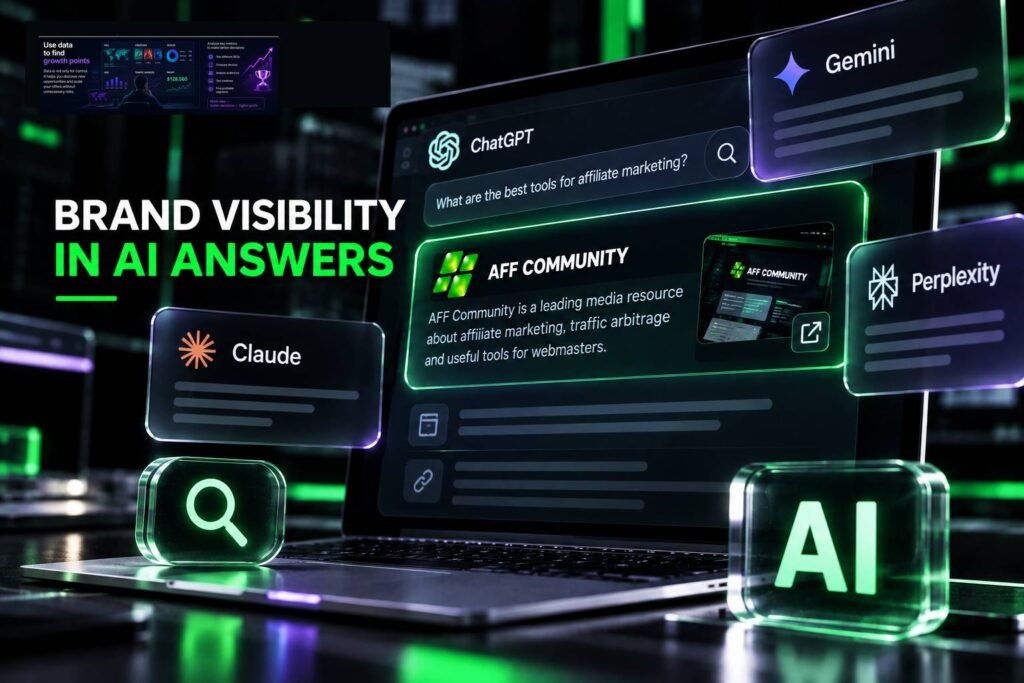
Visibility in AI responses is difficult to assess based solely on website traffic. A user might see a brand in a recommendation, remember its name, and return later via a direct link or a brand-specific search query.
To monitor this, compile a list of typical audience questions and regularly check which brands and sources appear in the answers from various AI systems. For example:
- Which service is best suited for a specific task?
- What tools do experts in a particular niche use?
- How do several competing products differ?
- Which solutions are suitable for a given budget?
Note whether your brand is mentioned, which pages the system links to, and which competitors appear alongside your brand. Keep in mind that answers may vary depending on the wording of the query, region, time, and available sources.
When analyzing organic promotion, it’s also helpful to study approaches to generating consistent SEO traffic. This will help you evaluate AI visibility within the context of your overall audience acquisition strategy, rather than in isolation.
6. Use AI visibility as part of your overall strategy
Don’t completely shift your budget and resources to this new area while abandoning traditional SEO. It’s more effective to develop both approaches: create expert content, improve your website’s technical health, and monitor how your brand is represented in generative responses.
We also recommend studying how audience behavior is changing and what role AI search plays in attracting visitors. Our article on how AI search affects traffic and revenue explores the possibilities and limitations of this approach in more detail.
Conclusion
Increasing brand visibility in AI responses isn’t a set of secret tricks, but rather consistent work on the quality and accessibility of information. You need useful content, proven expertise, consistent company information, and a reliable technical infrastructure.
We recommend starting simple: identify the audience’s key questions, check what answers AI systems are already generating, and improve your own content. Regular monitoring will help you understand which changes truly boost brand recognition and which ones yield no noticeable results.

