How to Build a Keyword Set for Google Ads
In Google Ads, you can quickly blow through your budget if you build your keyword set based on the “the more, the better” principle. High search volume doesn’t guarantee conversions, and broad keywords can attract an audience that doesn’t need your offer at all.
We’ll break down how to build a semantic network for an affiliate marketing campaign, group keywords, and filter out non-targeted traffic before even launching the campaign.
1. Start with the offer, not with keywords
Before gathering a semantic list, you need to understand exactly what you’re promoting, who the offer is suited for, and what action the user should take. Otherwise, you might end up with thousands of search terms that seem relevant based on the words themselves but don’t align with the audience’s intent.

I’d start with four questions:
- What problem does the offer solve?
- Who is the potential user?
- What is the person looking for before converting?
- Which search queries indicate a readiness to take action, and which ones indicate only an interest in the topic?
For example, for a financial management service, search queries like “what is a financial plan” and “financial planning service for businesses” can lead users to different stages of the funnel. The first is more informational, while the second is closer to making a decision.
At this stage, it’s helpful to study the specifics of using Google Ads in affiliate marketing so you can account for the source’s unique characteristics before launching.
2. Build a core set of keywords and expand it
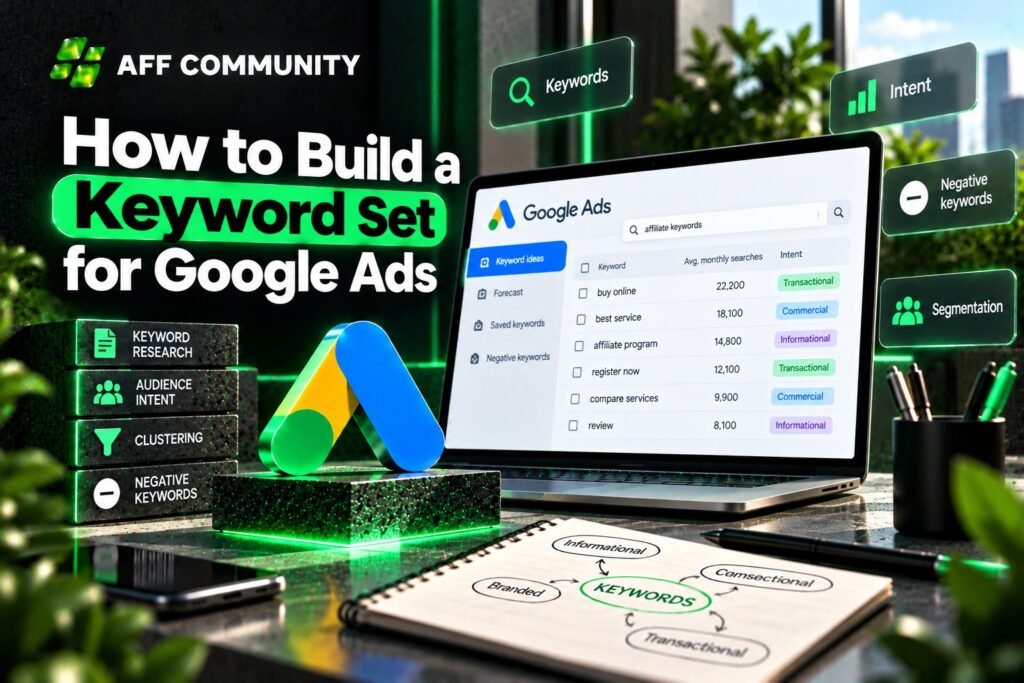
For initial keyword gathering, use Google Keyword Planner, search suggestions, competitor analysis, and data from existing campaigns. If traffic has been generated before, be sure to review actual search queries: they often provide ideas that weren’t on the initial list.
Collect not only the main keywords but also various phrasings:
- the name of the product or service;
- the problem the offer solves;
- comparisons of options and alternatives;
- commercial queries with the intent to buy or sign up;
- long-tail phrases with specifications regarding location, audience, or characteristics.
Don’t add a keyword just because it has high search volume. Evaluate how well the query aligns with your offer, landing page, and call-to-action. A low-volume phrase sometimes attracts a more engaged audience than a broad term with thousands of impressions.
3. Categorize Queries by Intent
After collecting them, don’t upload the entire list to a single ad group. Cluster the keywords based on meaning and user intent.
For example, you can categorize them as follows:
- Informational queries. The user is researching the topic and isn’t yet ready to take action.
- Commercial queries. The user is comparing options, looking for reviews, ratings, or alternatives.
- Transactional queries. There is a clear intent to order a service, sign up, or purchase a product.
- Brand queries. A search for a specific company or product, provided their use is permitted for your campaign.
Select relevant ads and landing pages for each group. If different intents are mixed within a single group, it becomes more difficult to manage relevance and understand which queries actually drive conversions.
4. Don’t forget about negative keywords
Negative keywords help exclude queries for which ad impressions don’t make sense for a specific offer. For example, if you’re promoting a paid service, words like “free,” “download,” or “job openings” may be off-target but only if they truly don’t align with your business model.
Don’t copy someone else’s negative keyword list without verifying it first. The same word in different niches can either filter out irrelevant traffic or block useful traffic.
After launching your campaign, regularly check the Search terms report in Google Ads. It shows the actual search terms that triggered impressions and clicks. You can exclude irrelevant phrases and add promising ones to your semantic group to test them separately.
5. Choose Match Types and Review the Structure
Google Ads uses broad, phrase, and exact match types. They determine in different ways which search queries can trigger an ad.
Don’t assume that exact match always means a literal match, or that broad match automatically yields only irrelevant results. It’s important to monitor actual search queries, results, and bid settings.
At the start, you can separate the most important commercial keywords from broader hypotheses to make it easier to analyze results. Then adjust the structure based on data, not just assumptions.
When working with Google Ads, it’s important to consider not only semantics but also the quality of the entire campaign. We’ve covered separately the mistakes that lead to wasting your budget in Google Ads.
6. Check semantics after launch
Keyword research doesn’t end when you create a campaign. After launch, look at the actual metrics:
- CTR — how well the ad matches the search query;
- CPC — how much each click costs;
- CR — what percentage of clicks converts to the target action;
- CPA and ROI — how much a result costs and whether the ad group is profitable.
If you’re getting clicks but no conversions, don’t rush to expand the core. Check the search queries, how well the ad matches the landing page, the quality of traffic, and whether conversions are being tracked correctly.
For a systematic approach to search queries and keyword grouping, you can also review SEO strategies and principles for building a semantic core. SEO and PPC approaches aren’t identical, but logical grouping by meaning is useful in both cases.
Conclusion
Good semantics for Google Ads isn’t about having the longest list of keywords, but rather a set of queries that match the offer and the user’s intent. First, analyze the offer, gather query options, categorize them by intent, and prepare negative keywords. After launching the campaign, regularly analyze “Search terms” and keep only those that drive high-quality traffic.
We recommend building your keyword strategy as a working system that can be refined based on data. This makes it easier to identify promising clusters, control costs, and scale campaigns without unnecessarily expanding your reach.

