How to Run Traffic to Apps Through Meta
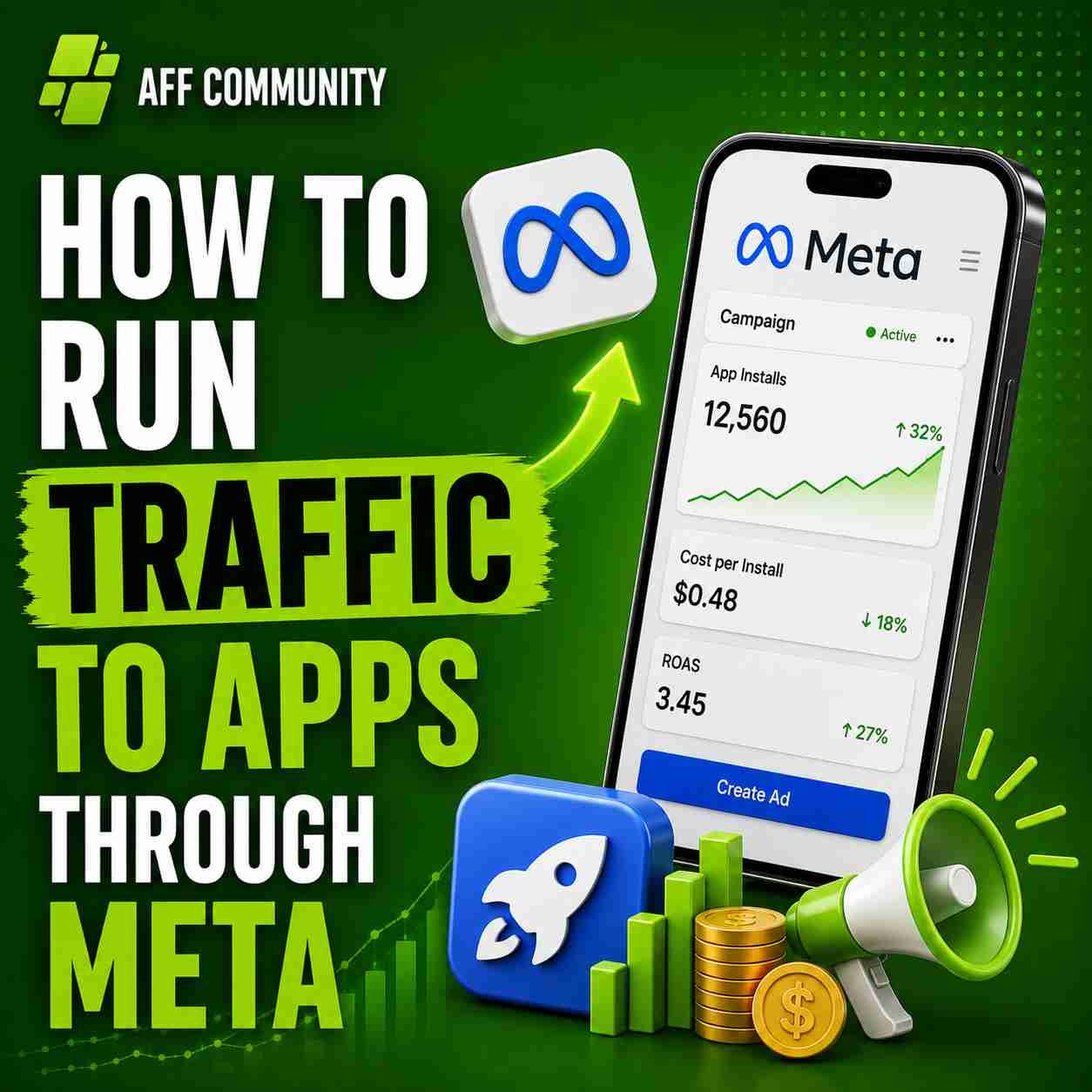
Meta remains one of the primary sources of mobile traffic for publishers. Facebook and Instagram allow you to reach a massive audience, and the platform’s algorithms can independently identify users who are highly likely to install the app or complete a target action.
However, in 2026, the approach to driving traffic to apps via Meta changed significantly. We recommend not starting with the maximum budget, but first properly preparing your offer, tracking, and ad creatives.
What Apps Can You Promote?
On Meta, you can test a wide variety of app offers: utilities, VPNs, finance, gaming, e-commerce, entertainment, and other apps.


At the same time, it’s important to understand in advance which action the advertiser is paying for. This could be an install, registration, deposit, purchase, or another event.
The mere fact of an install does not necessarily mean profit. A user may download the app but not take any action within it. Therefore, before launching a campaign, you need to know the final target action and its cost.
In-app mobile advertising also remains a major source of traffic in its own right. A recent overview of in-app traffic in 2026 examines in detail the main formats, verticals, and specifics of working with a mobile audience.
How to Prepare a Campaign
Before launching, you need to set up event tracking and ensure that analytics correctly record the user’s journey.
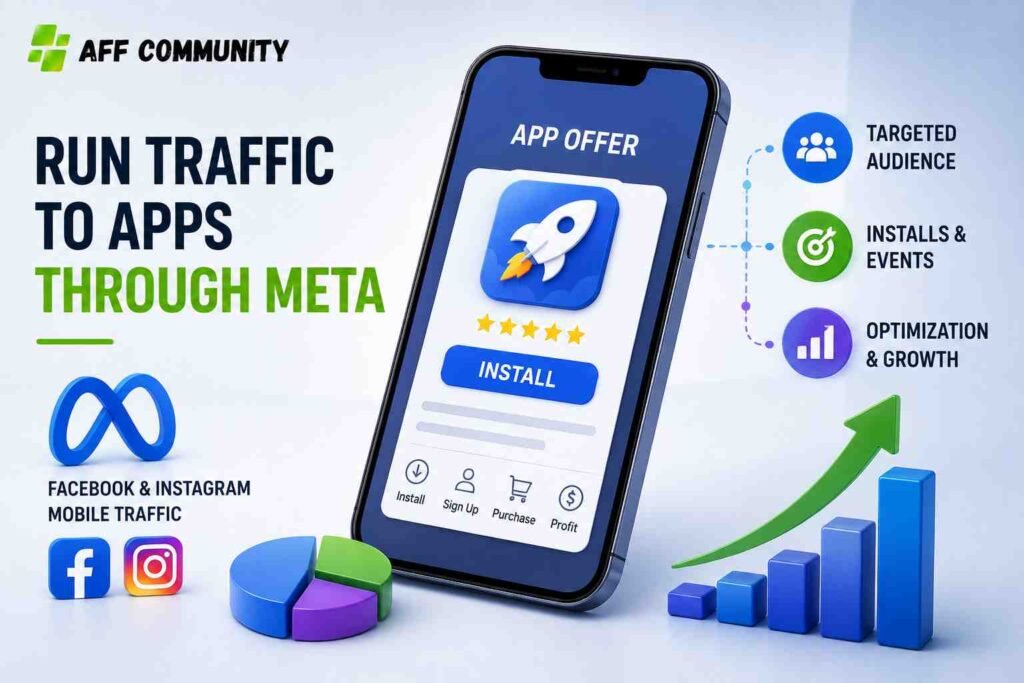
Depending on the offer model, it’s important to track installs, sign-ups, purchases, and other events. Without this, it’s harder for Meta’s algorithm to receive high-quality signals for optimization.
At the start, we recommend keeping the structure simple. It’s better to test a few clear hypotheses than to create dozens of campaigns with small budgets.
Creativity makes a huge difference
When promoting apps, you can’t keep using the same banner ad indefinitely. Users need to quickly understand what the app offers and why it’s relevant to them.
It’s a good idea to test different concepts:
- interface demos;
- short videos;
- problem-solution approaches;
- real-life use cases;
- reviews and social proof;
- dynamic product demos.
At the same time, the same creativity can yield completely different results in different countries. Effectiveness is influenced by auction costs, user habits, and cultural characteristics. This is well illustrated by an analysis of why the same creativity performs differently across different GEOs.
How to Choose GEOs
Don’t automatically start with Tier-1 markets just because the potential payout is higher there.
The key is the ratio of user acquisition cost to the revenue that user generates. In some cases, Tier-2 or Tier-3 markets offer much more attractive economics.
That’s why we recommend testing several markets and comparing them not by CPM or CPI separately, but by the total cost of the target action.
What to Do After the First Conversions
One of the biggest mistakes is increasing the budget too quickly. A few successful installations do not necessarily mean the campaign is ready for scaling.
First, you need to understand:
- which creativity delivers the best results;
- which audience converts;
- which GEO shows consistent profitability;
- which placement brings in high-quality users;
- whether the results hold up as volume increases.
We’ve already covered detailed approaches to scaling Meta Ads without a sharp increase in CPA in a separate article.
Monitor the Quality of Your Infrastructure
When working with Meta, it’s not just the ad account itself that matters. The system takes into account your Business Manager history, payment activity, domains, ad accounts, and campaign quality.
Therefore, before scaling up, you should make sure your infrastructure is running smoothly.
Which Metrics to Track
Don’t evaluate an app campaign based solely on the cost per install. For a comprehensive analysis, you need to look at the entire funnel: impressions → clicks → installs → conversions → revenue → ROI.
A high CTR indicates that the ad is appealing, but it doesn’t guarantee profitability. If users install the app but don’t take the desired action, the problem may lie with the offer itself, the audience, or the product.
That’s why we recommend analyzing ad campaign metrics comprehensively, rather than making decisions based on a single metric.
Conclusion
You can still effectively run traffic to apps via Meta in 2026. But the result depends not on a single ad account setting, but on the entire set of settings.
You need to choose the right offer, set up events, test GEO targeting and creativity, collect statistics, and only then scale the campaign.
For a publisher, the main metric is not the number of installs, but the cost of a high-quality user and the net profit. It is this metric that shows whether the app stack is truly ready for scaling.