Advanced TikTok Ads: Viral Formats

On TikTok, it’s not enough to simply create a visually appealing ad and run it through Ads Manager. The platform is built around content: users scroll through their feed for entertainment, so an ad must blend seamlessly into the familiar viewing experience. The more a video resembles a typical TikTok, the greater the chance that the viewer will stick with it, watch it all the way through, and take the desired action.

We’ll break down which viral formats are worth testing in TikTok Ads, how to adapt them for different offers, and which metrics to track so you don’t confuse cheap views with real effectiveness.

Why Virality Matters for TikTok Ads
Tik tok ads viral formats

A viral video doesn’t necessarily have to rack up millions of views. For a publisher, something else is more important: the video must quickly grab attention, evoke emotion, and nudge the audience toward the next step in the funnel.

That said, organic content and paid advertising serve different purposes. A viral format can be used as the basis for ad creativity, but high reach alone doesn’t guarantee a low-cost lead or a positive ROI. That’s why we recommend evaluating not only views and likes, but also retention, CTR, cost per action, and traffic quality.

UGC: Content That Looks Like a Recommendation

UGC is one of the most effective formats for TikTok Ads. In the video, an ordinary person talks about a product, shares their impressions, or demonstrates how they use the product in everyday life. The video is shot vertically, without complex lighting or studio setups.

Why does this format work? Users see a familiar style of presentation rather than a classic commercial. Instead of a hard sell, you can structure a short story: problem → personal experience → demonstration → conclusion.

For a test run, it’s worth preparing several scenarios:

  • a personal recommendation in the first person;
  • a reaction to a product or service;
  • an answer to a frequently asked question from the audience;
  • an analysis of a common mistake;
  • a demonstration of a specific feature.

The key is not to turn UGC into a fake review. If the creator is sharing a personal experience, it must be genuine, and any claims about the product must be verifiable. To promote creators’ content, consider using Spark Ads, provided the format and usage rights allow it.

POV and Storytelling: Engaging Through a Situation

POV (Point of View) is a video from the user’s perspective that immediately places the viewer in a specific situation. For example: “POV: You’re facing this for the first time…” or “When I realized I’d been doing it wrong all along.”

This approach works like a short story. Viewers recognize a familiar problem and want to see how the story ends. For affiliate marketing, this is an opportunity to highlight the audience’s pain points without a long promotional introduction.

We recommend structuring the script according to a simple outline:

  1. The first few seconds: a recognizable situation or an unexpected hook.
  2. The main part: developing the problem and demonstrating the solution.
  3. The conclusion a takeaway and a clear call to action (CTA).

Don’t drag out the introduction. If the video’s message isn’t clear until the tenth second, part of the audience will have already skipped ahead.

Before/After and Demonstrating Results

The Before/After format relies on visual contrast. Viewers are shown the initial situation, then the process, and finally the result. It’s particularly effective when the result can be demonstrated honestly and clearly.

Instead of an abstract promise like “it’s convenient,” it’s better to show a specific action: how a feature works, what the interface looks like, and how many steps the process involves. A visual demonstration helps explain the offer more quickly than a long voiceover.

But there’s an important caveat here: you must not present staged results as real, promise guaranteed income, or give the impression that every user will experience the same outcome. In sensitive verticals, such claims can lead not only to low-quality traffic but also to moderation issues. To learn how to check traffic quality, read our article at this link.

Reactions, Stitch, and Duet

Reaction videos allow you to build creativity around a context that’s already familiar to your audience. The creator comments on a popular topic, answers a question, or analyzes a situation, and then naturally leads the viewer to the offer’s topic.

You can test three options:

  1. a reaction to a common misconception;
  2. a response to a comment or question;
  3. an analysis of a situation with an unexpected conclusion.

Stitch and Duet aren’t suitable for every advertising scenario: it’s important to consider the availability of the source content, usage permissions, and advertising policies. Don’t just take someone else’s viral video and slap a link to your offer on top of it. It’s better to use the format’s core principle and create your own version with an original script.

Trends, Memes, and Unexpected Opening Shots

A trending sound, a popular editing technique, or a meme can give your video extra context. But copying a trend without adapting it to your offer is a weak strategy. Just because a user watched the video for a laugh doesn’t mean they’re interested in the advertised offer.

We recommend using the trend as a framework, not as the content itself. For example, take a recognizable situation, add a thematic twist, and present a solution within a single short story.

Before launching, check that the audio is up-to-date and that you have permission to use it commercially. For ads, it’s safer to choose materials from the Commercial Music Library or use your own audio track with the necessary rights.

How to Test Viral Creativities in TikTok Ads

One common mistake is running multiple videos that differ only in text or subtitle color. This isn’t a thorough way to test hypotheses. It’s better to vary the presentation format itself: UGC, POV, demonstration, reaction, or storytelling.

For the first test, you can prepare 3–5 noticeably different creativities within a single ad group. This approach aligns with TikTok’s recommendations for diversifying content during the audience research phase. Next, evaluate the results not based on a single metric, but across the entire chain.

MetricWhat this shows is
Hook rate / retention during the first few secondsJust how strong a start
Average watch timeHow long do people watch the video?
CTRTo what extent does the video motivate people to take action?
CPCHow much does a click cost?
CPACost of a Target Action
CR and Lead QualityTo what extent does the traffic align with the goal?

If retention is good but CTR is weak, the video may be entertaining but fails to explain the value of the offer. If there are many clicks but few conversions, check whether the creativity aligns with the landing page, the audience, and the offer itself.

Keep a separate eye on ad fatigue. When CTR and retention start to decline, you don’t necessarily have to completely overhaul the campaign: sometimes it’s enough to update the first few seconds, the storyline, the protagonist, or the visual presentation. But if the audience has already stopped responding to the idea itself, cosmetic tweaks won’t save the campaign.

We’ve covered how to properly test ad creatives in a separate article.

Moderation and Adaptation to the Audience

The viral format doesn’t exempt advertisers from platform requirements. TikTok evaluates not only the ad copy but also the video, audio, landing page, and the advertised product. Therefore, before launching, check whether the selected vertical is permitted in the target GEO, whether the ad copy is formatted correctly, and whether the landing page matches the ad’s content.

We recommend preparing several variations of a single offer in advance. At the same time, there’s no need to disguise a prohibited offer as an entertaining video or try to circumvent moderation. It’s much more sustainable to work with permissible formats and honest communication.

Webmasters can learn the practical nuances of TikTok’s advertising algorithms in this breakdown of how the platform’s algorithms work. And the specifics of adapting ad materials for different platforms are covered in this guide on preparing creativities to meet Meta and TikTok requirements.

If videos are receiving inconsistent reach, it’s worth taking a separate look at how post quality and account restrictions affect content distribution. This is the focus of an analysis of the reasons for declining reach on TikTok.

Additional requirements for ad creatives and platform changes are compiled in an overview of TikTok’s new moderation rules.

Conclusion

Advanced TikTok Ads isn’t about chasing random virality, but rather a systematic approach to formats, storylines, and audience behavior. UGC, POV, storytelling, reactions, demonstrations, and trends offer different ways to capture attention. But you should choose the winner based on conversions and traffic quality, not the number of views.

We recommend building a creative strategy around several independent hypotheses, regularly updating your approach, and scaling only those videos that demonstrate effectiveness across the entire funnel. It is precisely this approach that transforms a viral format from a random hit video into a working TikTok Ads tool.
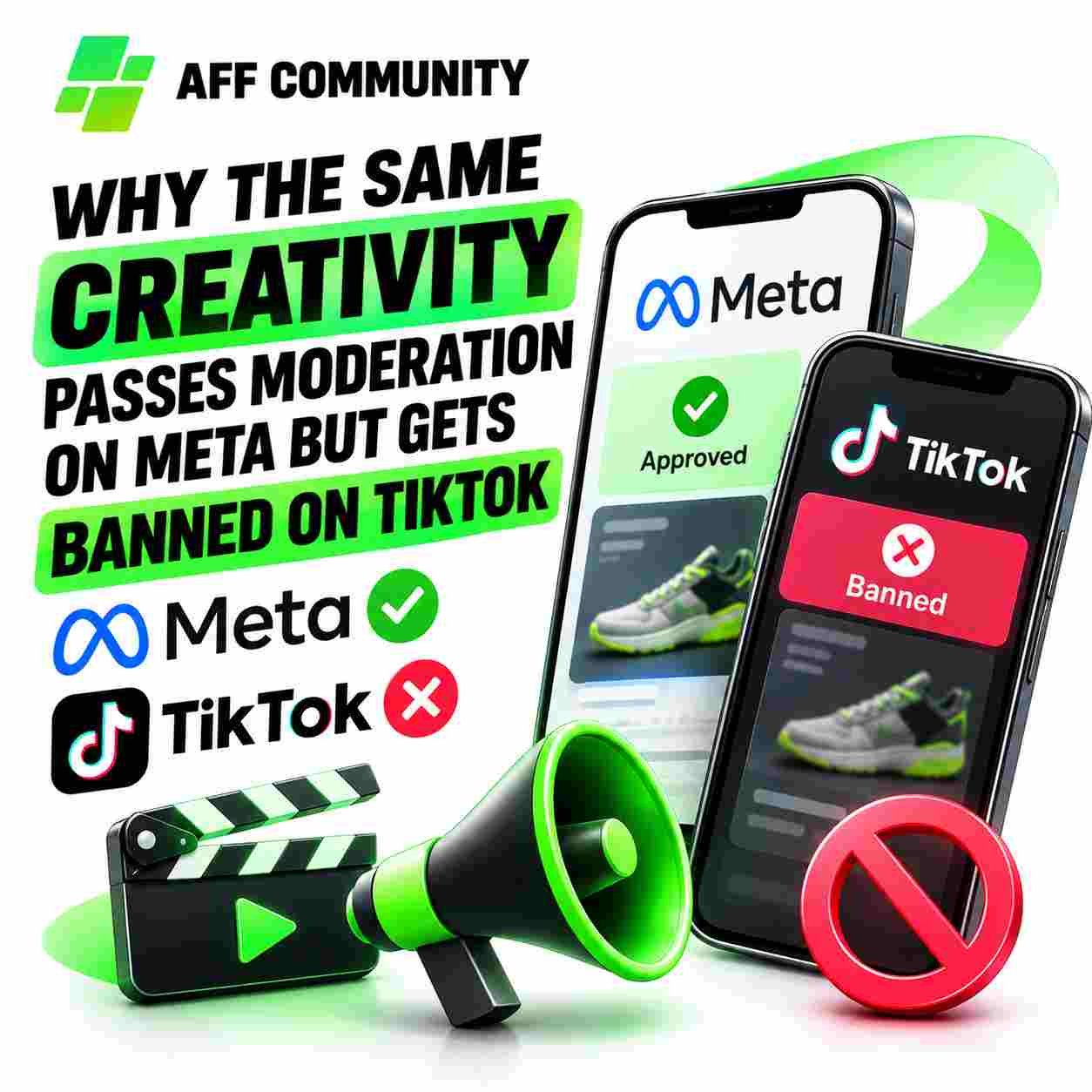
Why the Same Creativity Passes Moderation on Meta but Gets Banned on TikTok

Ad buyers often encounter this situation: the same creativity passes moderation on Facebook or Instagram without issue, but TikTok rejects it almost immediately. This raises a logical question: if an ad has already been approved by one major platform, why does another consider it a violation?

We do not view Meta’s approval as a guarantee of acceptance on TikTok. Each advertising platform has its own rules, review algorithms, and user experience requirements. Therefore, identical creativity can receive completely different outcomes.

Meta and TikTok evaluate ads differently

Ad creativity on Meta and TikTok

The main misconception is assuming that advertising platforms have roughly the same moderation criteria. In practice, not only do the lists of restrictions differ, but so does how platforms perceive the presentation of advertising material.

Meta reviews ads within the context of the advertising ecosystem: it considers the text, image, or video; targeting settings; the landing page; and the characteristics of the promoted product.

TikTok also evaluates the entire advertising chain, but the format of the content itself is of great importance. The platform is geared toward short vertical videos, so a video must meet not only advertising requirements but also users’ expectations for in-app content.

We compared the platforms’ approaches in more detail in an article about how Meta, TikTok, and Google evaluate ad creativities.

Why TikTok Might Reject a Creative Approved by Meta

1. An overly aggressive advertising approach

On Meta, ads with a fairly direct commercial message may be approved if they comply with the rules for a specific category. On TikTok, such an approach sometimes leads to rejection.

For example, a video with bold promises, pushy calls to action, and an emphasis on instant results may come across as manipulative advertising. You should be especially careful when working with financial, medical, and other sensitive verticals.

The problem isn’t necessarily the product itself. The cause could be the wording, the visual demonstration of the result, or the overall impression the ad leaves.

2. Incompatibility with the platform’s format

Creativity that looks good in a Facebook or Instagram feed isn’t always suitable for TikTok. Static elements, videos overloaded with text, low image quality, and unnatural editing can raise red flags during review.

It’s also important to consider technical requirements. For example, TikTok has specific requirements for video length and audio quality. A video with no sound or with speech that’s hard to make out may not pass review.

Therefore, simply copying and pasting a finished ad across platforms isn’t enough. We recommend adapting your content separately for each platform. Practical guidelines for this process are outlined in the article on adapting creativity to meet Meta and TikTok requirements.

3. Issues with Claims and Visual Evidence

One of the most common reasons for rejection is claims that cannot be substantiated. These may include earnings guarantees, promises of quick results, exaggerated product features, or demonstrations of results that create a false impression.

The “before and after” format poses a particular risk. Even if this approach has been used in other ad campaigns, that doesn’t mean it’s allowed on TikTok.

The platform specifically restricts misleading claims and visual techniques. Therefore, before launching a campaign, we recommend reviewing not only the text but also every frame of the video.

4. The creativity doesn’t match the landing page

Sometimes, the video itself doesn’t contain any obvious violations, but the ad is still rejected. The reason becomes clear after visiting the website.

For example:

  • the video showcases one product, while the landing page features another;
  • the promotional promise is missing from the landing page;
  • the terms of the promotion in the ad differ from those on the website;
  • the landing page contains unverified claims or incorrect information.

TikTok checks for consistency between the ad and the landing page. Therefore, we recommend analyzing the entire campaign as a whole, rather than a single video.

The changes to the platform’s requirements are discussed in more detail in our article on TikTok’s new moderation rules.

5. GEO and Restrictions on Advertised Categories

The same creativity may pass review in one country and be rejected in another. This is due to regional restrictions, local laws, age requirements, and the specifics of the advertised category.

This is particularly noticeable in gambling, finance, cryptocurrency, and nutra content. Even if a product is permitted for promotion in a specific GEO, the advertiser must take into account the additional conditions of the specific platform.

When choosing a country for a launch, we recommend checking not only audience availability and traffic costs but also advertising requirements. In some GEOs, the restrictions are so severe that they affect the entire launch strategy. We analyzed such markets in our article on countries with the strictest rules for launching ads.

How to Adapt Your Creativity Before Launching on TikTok

We recommend not submitting an exact copy of an ad that has already been approved by Meta to TikTok. It’s better to conduct a separate review:

  1. Review the text. Remove unverified promises, guarantees of results, and wording that could mislead users.
  2. Check the visuals. Make sure the video doesn’t contain prohibited scenes, questionable comparisons, or third-party logos used without permission.
  3. Adapt the format. Prepare a vertical video with high-quality visuals and clear audio.
  4. Verify the landing page. All specifications, prices, terms, and promises must match the page’s content.
  5. Check the GEO settings. Clarify restrictions regarding the product, audience age, and ad category.

If TikTok rejects an ad, don’t immediately upload dozens of nearly identical variations. First, review the reason for rejection in Ads Manager and identify which element caused the issue. If the decision seems incorrect, you can request a review using the platform’s available tools.

BUTTON – Read also: “How to Prepare Smartphones for Conditional Free Traffic from TikTok”

Conclusion

Passing moderation on Meta does not guarantee automatic approval on TikTok. The platforms have different requirements for ad content, formats, categories, and user experience.

We recommend treating each traffic source as a separate advertising environment. Don’t simply copy a working ad set from one account to another—creativity, copy, and landing pages should be reviewed in accordance with each platform’s specific rules.

This approach doesn’t guarantee approval for every ad, but it helps reduce the number of unjustified rejections, identify problematic elements more quickly, and avoid wasting your budget on endlessly resubmitting the same content.

How has Meta Ads changed following the latest updates?

Yet another round of turmoil at Meta Ads has once again forced advertisers to rethink their usual approaches to launching ad campaigns. In late summer and September 2026, advertisers reported waves of account suspensions, additional reviews, access issues, and unstable performance of the ad management platforms.

We believe the key change isn’t just the increase in the number of bans. Meta is relying more and more on automated systems to evaluate ads and advertiser behavior. Therefore, it’s now important to monitor not only the creativity but also the quality of the entire ad campaign.

Reviews Affect More Than Just Ads

meta ads after shtorm

Previously, an advertiser could have their creativity rejected, make edits, and resubmit it for review. Now, issues can arise at various levels: personal profile, Business Manager, ad account, page, or payment infrastructure.

At the same time, restrictions don’t always mean the same thing. A rejected ad, an identity verification request, an ad account restriction, and a payment error each require different actions.

We recommend first determining exactly which asset is restricted and what reason Meta is citing. Don’t immediately overhaul your entire infrastructure just because of a single notification.

For more effective moderation approval, we recommend using high-quality White pages. 

Creativity must align with the entire offer

Automated ad evaluation is evolving, and algorithms analyze not only images or text but also the overall context of the ad. If creativity promises a result that isn’t backed up on the website, the risk of issues increases.

Therefore, we recommend checking the entire package: ad copy, video, landing page, offer terms, and the actual user experience. Remove unverified promises, misleading wording, and discrepancies between the ad and the product.

We discussed practical principles for evaluating ad materials in our article on how Meta, TikTok, and Google evaluate creativity in 2026.

Algorithms Have a Greater Impact on Ad Delivery

The development of Andromeda and other machine learning systems is changing the approach to ad selection for audiences. It’s important for advertisers not to try to manually control every signal, but rather to provide the algorithm with high-quality input data: clear campaign goals, properly configured conversion tracking, and a variety of creativity tailored to different user needs.

We wrote more about Andromeda’s impact on campaign launches in our article on how the algorithm is changing the rules of Facebook affiliate marketing.

In practice, this means you shouldn’t judge the quality of a campaign based solely on the first few hours of running. Analyze spending trends, the cost per action, and the quality of the leads generated.

Payment issues have become a separate risk

During periods of instability in ad manager performance, advertisers often encounter payment errors and additional verification checks. However, a “Risk Payment” status doesn’t always mean the problem lies solely with the credit card. The cause may be related to payment history, account restrictions, or suspicious activity.

We recommend against haphazardly changing payment methods after every error. First, check the payment status, any available notifications, the advertiser’s details, and any restrictions in your account. If the problem persists, contact official support.

We’ve separately covered the reasons for “Risk Payment” in Meta Ads and how to diagnose such a situation.

Avocado AI and Moderation Automation

In April 2026, the affiliate marketing community was actively discussing Avocado AI amid widespread restrictions. However, it’s important not to confuse industry observations with the officially confirmed reason for each ban: there isn’t enough public data to explain all restrictions using a single model.

The very fact that automated moderation is evolving means that advertisers need to pay more attention to compliance with the rules, the transparency of their offers, and the technical correctness of their websites.

We covered this episode in more detail in an article about what Avocado AI is on Facebook and how it relates to moderation.

How to Adjust Your Work After the Storm

We recommend taking a systematic approach:

  1. Check the reason for each restriction; don’t act blindly.
  2. Monitor the quality of your landing page, the accuracy of links, and whether the ad matches the offer.
  3. Keep a log of launches, rejections, changes, and results.
  4. Analyze payment errors and verification requests separately.
  5. Do not scale up the campaign until you are confident in the quality of conversions and the stability of the campaign’s performance.
  6. If your account is blocked, file an appeal with specific facts and supporting evidence.

Don’t view mass account suspensions as a signal to urgently change all settings or create new accounts. Such actions can make the situation worse, especially if the root cause of the restriction hasn’t been addressed.

Conclusion

Following the latest upheaval, working with Meta Ads requires greater discipline: it’s important to monitor the quality of creativity, the status of your ad infrastructure, payments, and the actual results of your campaigns.

We recommend building your process around diagnostics and analytics, rather than trying to predict the next update. Algorithms change, but compliance with the rules, transparency of your offer, and cost control remain the foundation for sustainable performance.

How to Properly Test Ad Creatives

In affiliate marketing, you can have a good offer, a decent GEO, and a reasonable budget, but still end up in the red. Very often, the problem starts with the ad creativity itself.

We believe that testing creativity isn’t just about running ten random images and choosing the one with the highest CTR. A proper test should show which hypothesis works, for which audience, and how it delivers results.

Don’t Test Everything at Once

One of the biggest mistakes is changing the image, text, headline, CTA, and format all at the same time.

Let’s say the first creativity is a video with UGC, the second is a static image, and the third is a meme. If the third option wins, we don’t actually know what exactly worked.

That’s why it’s better to test individual hypotheses. For example:

  • the same visual but different headlines;
  • the same text but different images;
  • the same idea in both video and static formats;
  • an emotional approach versus a rational one;
  • different CTAs.

This way, you gradually gain an understanding of which elements actually influence the results.

The basic principles are discussed in more detail in the article on ad creatives in affiliate marketing and how to test them.

How Many Variants to Run

We generally don’t recommend starting with either a single creativity or a huge batch of several dozen.

For an initial test, you can prepare 3–5 variants that differ based on specific hypotheses. For example:

  1. Creativity #1 – focuses on the user’s problem.
  2. Creativity #2 – focuses on the benefit.
  3. Creativity #3 – demonstrates the product.
  4. Creativity #4 – uses social proof.
  5. Creativity #5 – uses a more aggressive hook.

This approach provides enough data for an initial comparison without turning the test into a pointless drain on your budget.

Which Metrics to Monitor

CTR is just the beginning of the analysis. A high CTR doesn’t necessarily mean the creativity is good. Users may click actively but fail to take the desired action after landing on the page.

That’s why we look at at least a few metrics:

  • CTR: how well the creativity captures attention;
  • CPC: how much it costs to get a click;
  • CR: how users convert after landing on the page;
  • CPA: how much a conversion costs;
  • ROI/ROAS: how well the ad ultimately pays for itself.

If creativity has a high CTR but an expensive CPA, you can’t simply declare it the winner. It may be effective at attracting a curious but non-target audience.

That’s exactly why it’s helpful to consider conversions and their impact on ad performance when evaluating a campaign.

Don’t pause the creativity too early

Another extreme is pausing the creativity after just a few dozen impressions.

With a small data set, the difference between two variations could simply be a coincidence. That’s why we first determine the minimum amount of data needed specifically for a given campaign, and only then compare the variations.

That said, there’s no need to wait indefinitely either. If creativity receives a sufficient number of impressions and clicks but consistently underperforms on key metrics, it’s better to reallocate the budget.

The winning version needs refinement

Let’s say one version outperformed the rest. That doesn’t mean you should run only that one for a month.

The next step is to generate derivative hypotheses. If a specific hook worked, you can keep it and change the visual. If the visual performed well, test several new headlines.

This way, a single winning creativity can yield a whole group of new variations.

We’ve separately discussed mistakes in creativity design that affect ROI, since even a good test can quickly lose effectiveness due to banner fatigue or improper presentation.

Test for a specific geographic region

Creativity cannot automatically be considered universal. What works well in one geographic area may perform significantly worse in another. Language, cultural context, visual preferences, the level of competition, and user reactions to ad messages all differ.

Therefore, when rolling out a campaign to a new geographic area, we don’t simply copy the old creativity – we run a separate test.

Even within a single campaign, it makes sense to compare the metrics of different audience segments.

What to Do After the Test

After completing the first stage, we divide the creativities into three groups:

  1. Winners: we keep them and start scaling them up.
  2. Promising: We refine them and retest.
  3. Weak: We pause them and stop spending budget on them.

Next comes the second cycle: new visuals, new hooks, new formats, and variations on the working mechanics we’ve already identified.

It’s especially important not to confuse good creativity with a good conversion funnel. If users don’t convert well after clicking, the problem may lie in the next stage of the funnel. Before scaling up, it’s therefore worth checking the quality of the traffic you’re receiving.

How to Avoid Wasting Your Budget on Tests

We recommend determining the following in advance:

  • how much money you’re willing to spend on a test;
  • which metrics you consider key;
  • what CPA is acceptable;
  • under what conditions creativity should be paused;
  • how many variants you’re testing simultaneously.

Another important point: don’t change your strategy in the middle of a test. If today you’re comparing five creative hypotheses, but tomorrow you completely change the audience and budget, it becomes difficult to compare the results.

It is this systematic approach that transforms testing from simply spending a budget into actually gathering data.

Conclusion

Proper testing of creativity isn’t about finding a single pretty image.

We view it as a sequential process: hypothesis → several variants → launch → data collection → comparison → refinement of the winning variants → new test.

The key is to always understand exactly what we’re testing and which metric should confirm the hypothesis.

This is how we gradually build our own library of effective hooks, visuals, and ad mechanics. And over time, this library becomes one of the affiliate marketing team’s most valuable assets.

How to Keep Viewers Engaged for the First 30 Seconds: Video Tips

In short videos, the first few seconds are practically everything. Users scroll through their feeds quickly and aren’t going to wait for the creator to finish a long introduction. If the video doesn’t give viewers a reason to keep watching within the first few seconds, they’ll simply move on.

We constantly see the same mistake: a marketer invests in editing, graphics, and the script, but starts the video too slowly. As a result, a good creative loses its audience before it even gets a chance to present the offer.

Let’s break down how to use the first 30 seconds so that the viewer doesn’t scroll past the video.

The First 2–3 Seconds Are the Most Important

Starting a video with a greeting, a logo, or the phrase “Today I’m going to tell you…” is almost always a bad idea.

You need to immediately give the viewer a reason to stop and watch. This could be a problem, an unexpected result, a controversial statement, a question, or a visual scene that sparks curiosity.

For example, instead of a long explanation, you can show the result right away and then explain how you arrived at it.

In a short video, the logic is simple: first, grab attention; then, spark interest; and only then provide the details.

This technique works especially well in the vertical format. We’ve already discussed how TikTok’s algorithms work and what influences reach – retention and views are directly linked to the video’s further distribution.

Don’t reveal everything right away

One effective technique is to leave a small information gap.

The viewer should get part of the answer but understand that the most interesting part is yet to come. For example, you can show an unusual result and only explain how it was achieved a few seconds later.

This doesn’t mean you should deliberately mislead your audience. On the contrary, if the video’s promise doesn’t match its content, trust quickly plummets.

Therefore, the intrigue should lead to a genuine continuation, rather than being mere clickbait.

First 30 sec make the difference

Use dynamics

The first 30 seconds shouldn’t look like one long, static scene. Changing shots, angles, on-screen text, and visual details helps maintain attention.

At the same time, don’t turn the video into a chaotic jumble of effects. Every shot change should serve a purpose: to highlight a detail, amplify an emotion, explain an action, or guide the viewer to the next stage of the story.

In modern advertising formats, short vertical videos, UGC, and videos demonstrating results work particularly well. You can learn more about these approaches in the analysis of video formats used in traffic arbitrage.

Build your video around a single idea

Another common problem is trying to cram absolutely everything into a single video.

If a video simultaneously explains the product, highlights several benefits, tells the creator’s story, and also tries to include multiple calls to action, the viewer’s attention will wander. We recommend choosing one main idea.

The first few seconds spark interest, the next 10–20 seconds reveal the problem or solution, and the final part guides the user toward the desired action.

This structure is especially useful for large-scale creative testing: you can change a specific element rather than the entire video.

Check retention by stage

It’s not enough to evaluate a video based solely on the number of views.

You need to see at what point the audience starts to drop off. If most users drop off at the 3-second mark, the problem lies at the beginning of the video. If the drop-off occurs at the 10–15-second mark, the narrative may have stopped providing new information.

This way, you can gradually identify weak spots and modify specific segments rather than reshoot the entire video.

It’s also worth noting that the audience gradually grows tired of repetitive approaches. Therefore, even successful creative content can’t be shown indefinitely without changes. In our article on mistakes in creating ad creatives and their impact on ROI, we discussed in detail why the effectiveness of ad content can decline over time.

What to Do in the First 30 Seconds

If we were to simplify the entire process into a practical algorithm, we would use the following sequence:

  • 0–3 seconds: a strong hook and a reason to stop;
  • 3–10 seconds: developing the problem, intrigue, or story;
  • 10–20 seconds: specifics, demonstrating the solution or result;
  • 20–30 seconds: building interest and transitioning to the next step.

That said, there’s no one-size-fits-all script that works equally well for every geographic region (GEO) and industry vertical. One approach might work great on TikTok, while another might be more effective on Reels or in-app.

We recommend not guessing which hook will be more effective, but rather testing several variations of the same script. For example, you can leave the main part of the video unchanged and replace only the first 3 seconds.

The Bottom Line

Holding the viewer’s attention for the first 30 seconds doesn’t start with fancy editing. It starts with understanding why someone should keep watching.

A strong hook, a fast-paced presentation, a single clear idea, continuous plot development, and analysis of drop-off points yield far better results than dozens of visual effects.

That’s exactly why we recommend treating the first few seconds of a video as a separate element of the funnel. If the user doesn’t pause and become interested, they simply won’t make it to the offer.

Why the Same Creativity Performs Differently Depending on the Geographic Area

One of the most common questions we hear is: Why does the same creativity deliver an excellent ROI in one country but completely fail in another? It would seem that the ad platform is the same, the offer is the same, and the landing page hasn’t changed, yet the results differ dramatically.

In practice, this is a completely normal situation. Geography influences virtually every element of an ad campaign: user behavior, traffic cost, the level of competition, perception of design, and even attitudes toward certain colors or wording. That’s why a successful buyer adapts not only the targeting but also the creativity itself.

Different Mindsets – Different Reactions

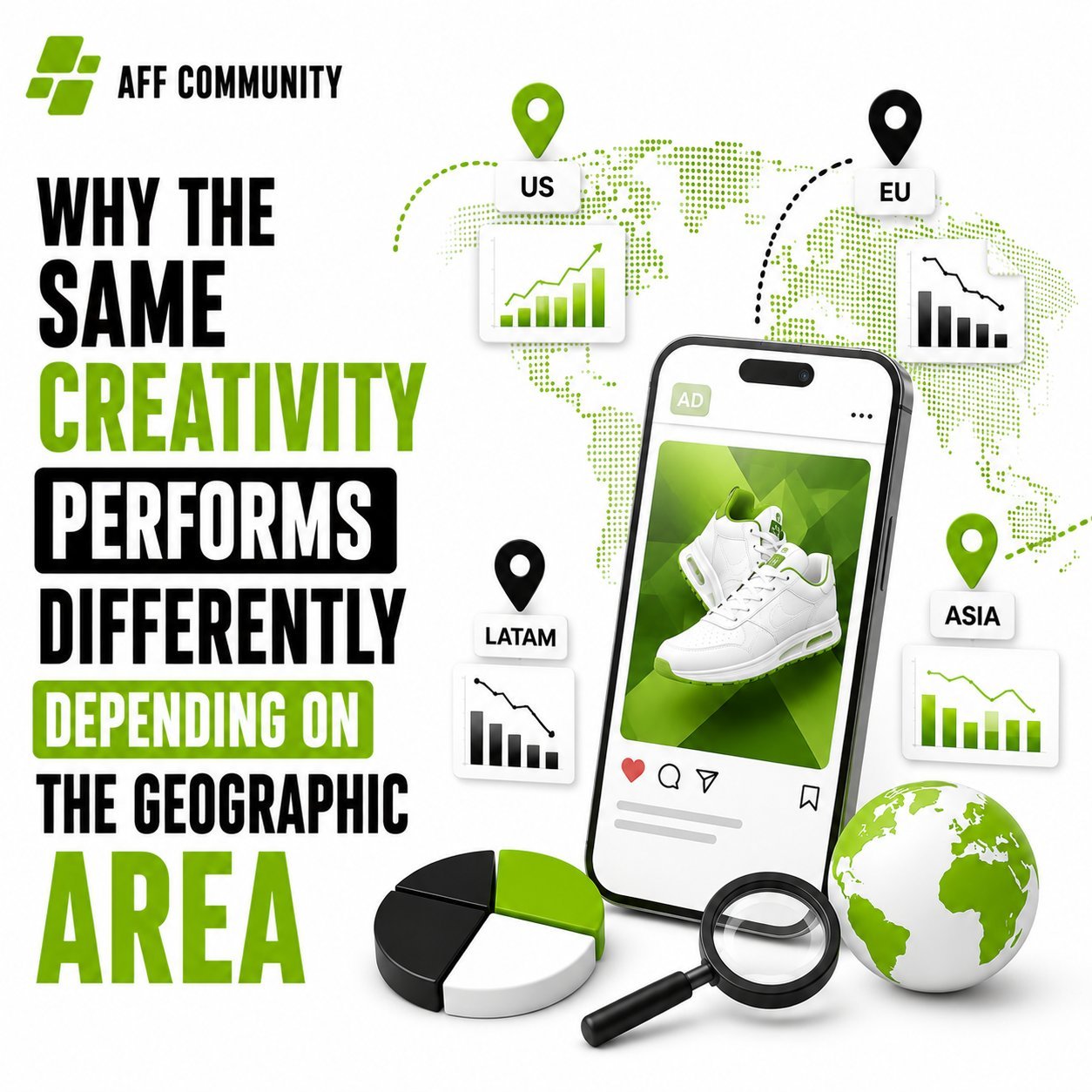
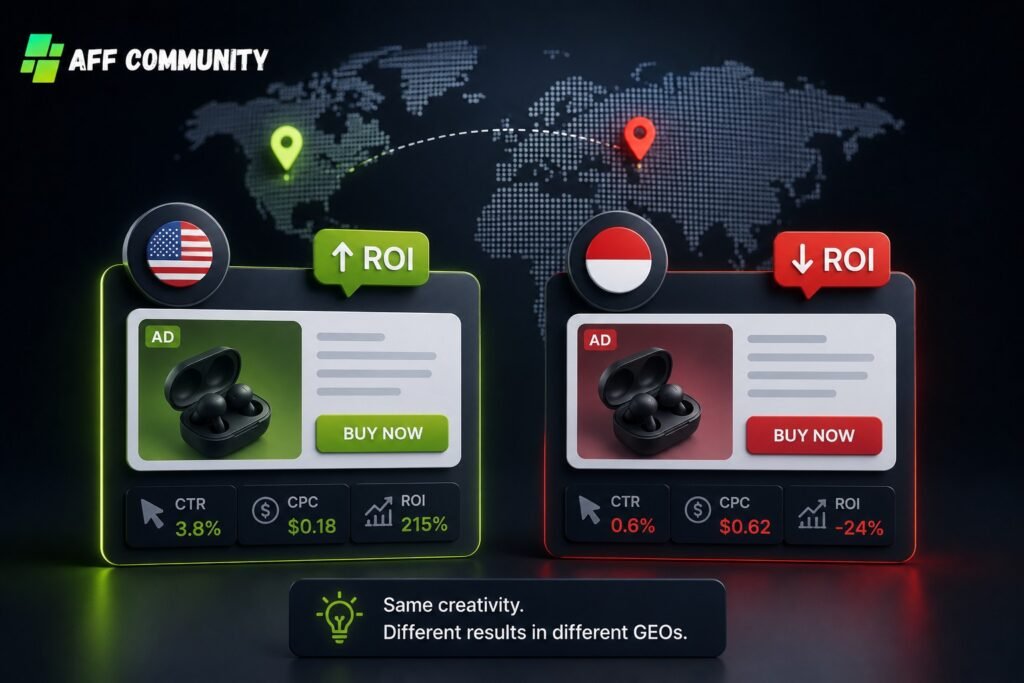
Geo creativity and roi

The first factor influencing ad effectiveness is the audience’s characteristics. For example, aggressive ads with bold promises may work well in some countries but be met with skepticism in others.

In some places, users respond better to emotional stories, while in others they prefer hard facts, figures, and expert arguments.

Therefore, creativity that consistently generates leads in Latin America won’t necessarily yield the same results in European countries. Before launching a campaign, it’s always worth studying the specifics of a particular market and the habits of the local audience.

The Cost of Attention Varies

Even if users behave the same way, ad auctions operate differently. Competition is significantly higher in popular GEOs. Consequently, the following metrics increase:

  • CPM;
  • CPC;
  • and the cost per lead.

Because of this, the same CTR can result in completely different final ROIs. That’s why, when choosing a country, it’s important to evaluate not only the potential payout per offer but also the cost of acquiring a user.

We’ve analyzed a detailed comparison of different country groups here in this article.

Localization Is More Than Just Translation

A common mistake among beginners is to run ad copy through an automatic translator and consider the localization complete. In practice, you need to take into account:

  1. local expressions;
  2. cultural nuances;
  3. popular images;
  4. the typical communication style;
  5. the audience’s local pain points.

Even small changes to the headline can significantly increase the CTR. That’s why top-performing teams rarely use a single, one-size-fits-all creativity across dozens of countries at once.

Different algorithms learn differently

Meta, Google, TikTok, and other advertising platforms analyze user behavior within each market separately. The algorithms evaluate:

  • click-through probability;
  • engagement;
  • view time;
  • conversion;
  • and the quality of interaction with the ad.

If the audience in a specific GEO responds less favorably to an ad, the algorithm gradually reduces the number of impressions or increases the cost per click. Therefore, a successful launch in one country does not guarantee the same result in another.

Competitors also influence the outcome

Another factor is market saturation. In some countries, users see dozens of similar ads every day. Over time, this leads to “banner blindness.”

Even high-quality creativity begins to show weaker results simply because the audience has grown tired of repetitive ads.

That’s exactly why advertisers regularly update their ad materials, test new combinations, and adapt their visual style to each specific country.

One Offer – Different Approaches

We regularly see situations where the same offer is scaled across several countries at once. In these cases, completely different elements are used:

  1. Images.
  2. Headlines.
  3. Calls to action.
  4. Color schemes.
  5. Ad formats.

The reason is simple—users make decisions differently. Therefore, it’s more effective to test several variations for each country than to try to find a single universal creativity.

We discussed in detail how to properly adapt ad creativity for modern advertising platforms in the article at this link.

Analytics helps identify the cause

If your creativity stops working after changing the geographic targeting, don’t rush to create a new one. First, you need to figure out exactly what has changed. We recommend analyzing:

  1. CTR;
  2. CPM;
  3. CPC;
  4. CR;
  5. cost per lead;
  6. user retention.

Very often, the problem lies not with the creativity itself, but with the specifics of the auction or audience behavior.

Conclusion

The same level of creativity almost never yields the same results in different countries. Ad effectiveness is influenced by the audience’s cultural characteristics, the level of competition, auction costs, ad platform algorithms, and local user habits.

We recommend treating each new GEO as a separate market. The better your creativity is tailored to a specific audience, the higher the likelihood of achieving a stable CTR, a good ROI, and the potential to scale your campaign further.

How We Made a $3,420 Profit on a Crypto Offer Using Native Traffic

Crypto in affiliate marketing keeps dying out and then making a comeback. In 2026, the situation is much the same. Major platforms are cracking down on direct advertising for crypto services, and moderation has become stricter, but there’s still money to be made in this vertical. Especially if you approach it not head-on, but through a normal funnel.

This campaign started as a routine test. The team was looking for an offer with a clear monetization model and the ability to run ads through content-based placement. Ultimately, they found an investment platform that paid for a user’s first deposit.

The task was simple: gather cheap traffic, run an article to warm up the audience, and see if there would be real deposits.

Key Information

Vertical: Crypto
Traffic Source: Native networks
GEO: Eastern Europe
Test Period: 18 days

Spent: $1,980
Revenue: $5,400

Net profit: $3,420

What the funnel looked like

Running an ad for a crypto offer is almost always a bad idea. Moderators quickly block such ads, and users rarely make a deposit from a cold click.

So we created a simple content bridge. It was a story-style article about a person who started learning about crypto and found a trading platform.

No big promises. Just an explanation of how the service works and why people started using it for investments.

From the landing page, the user proceeded to registration.

You can find top crypto offers on our website in the “Affiliate Networks” section.

Creativity

For the test, we created several native banners. Visually, they looked like regular news articles.

The main focus was on generating interest in the topic of cryptocurrencies. People were shown a banner with a headline about the growth of the crypto market and the opportunity to start investing with small amounts.

Interestingly, the best results came from the simplest banner with no complex graphics. Sometimes it’s precisely these kinds of creativity that inspire the most trust.

Launch and Test

The first few days involved a standard test. Campaigns were launched with small budgets to assess the cost per click and audience behavior.

Traffic turned out to be quite affordable, and users spent several minutes on the page. This was a good sign that the funnel was working.

The first deposits started coming in as early as the third day after launch.

Where the Problems Lay

The biggest challenge arose with ad moderation. The system rejected certain phrasing, even though the banner contained no direct promises of income.

We had to simplify the texts and remove any hints of quick money. After that, the ads began passing moderation more consistently.

Another issue: some of the traffic was actively clicking but not completing registration. We had to resolve this by refining the text on the landing page.

After the changes, the conversion rate increased by about 20 percent.

Scaling

Once it became clear that the campaign was generating stable deposits, we began gradually increasing the budget.

The most important thing here was not to scale up too abruptly. With a sharp increase in traffic, the cost per click began to rise. Therefore, we scaled carefully, adding new campaigns and creativity.

This allowed us to maintain profitability.

Conclusion

This launch demonstrated a simple truth. Even in the overheated crypto vertical, you can find working combinations if you don’t try to sell the offer directly.

Content placement, low-key creativity, and a careful launch made it possible to drive traffic and convert users into depositors.

Crypto remains a challenging vertical due to moderation, but that’s precisely why there’s still good money to be made in it. Those willing to test funnels and adapt to platform rules continue to find profitable combinations.

Read more affiliate marketing case studies here – https://affcommunity.org/en/blog/?tag_id=365 

Mistakes when creating creativity and how they affect ROI

Creativity is the starting point of the sales funnel. If it does not attract the user’s attention, the subsequent stages (ad text, landing page) are ignored. When viewing their social media feed, users do not have time to analyze ads. Only bright, emotional creativity can stand out from the flow of information. Webmasters are familiar with the situation: a top offer shows zero conversion due to weak creativity.

Impact on ROI

The quality of creativity directly determines the return on investment (ROI). Weak creativity leads to low CTR, high CPC, and ineffective budget spending. It is critical that each creativity corresponds to the strategic KPIs of the campaign — brand awareness, lead generation, or direct sales. Performance analysis should take into account not only CTR, but also metrics relevant to the goals (CPL, CPA, ROAS). This article discusses critical mistakes that can “kill” an advertising campaign.

For more details on how ROI is calculated and what methods allow you to quickly evaluate the effectiveness of advertising campaigns, see the separate article “What is ROI and how to calculate it quickly.”

The gap between creativity and landing page

A typical mistake made by beginners is when the creativity promises one thing, but the landing page shows another. The user feels deceived and leaves the resource. The optimal solution is to fully synchronize the visuals, messages, and color schemes between the creativity and the landing page.

Ignoring the cultural code of the target audience

Symbols, humor, or images that contradict the values of the target audience provoke rejection. What is acceptable in one region may be offensive in another. The creation of creativity should begin with studying the mentality, traditions, and taboos of the target GEO with the help of local experts.

The role of humor and memes as a tool for communicating with the audience deserves special attention, which is discussed in detail in the article “Memes as the language of a generation: how humor became the main weapon of marketers.”

Visual overload

An excess of text, graphics, and colors distracts attention. The user loses focus on the main message. To prevent this from happening, you need a concise design with a clear hierarchy of elements. The text should be concise and readable. Overload reduces conversion, which means that advertising is practically not profitable.

Incorrect localization

Literal translation creates awkward phrasing. Currency errors or unadjusted amounts (e.g., a $1,000 prize for a region with an average salary of $300) undermine trust. The text needs to be adapted by native speakers, taking into account the context and checking financial realities.

Unnatural content

Excessively “glossy” stock images cause distrust. The growing popularity of UGC content (photos/videos from users) confirms the demand for authenticity. Creativity with real people, live emotions, and demonstrations of the product in action increases engagement. The evolution of UGC goes beyond static photos: short video reviews, screenshots of correspondence with support, and stories using the product are becoming effective. Integrating elements of social proof (number of purchases, positive comments) directly into the creativity enhances its credibility.

Rejection of A/B testing

Launching a single option of creativity is unacceptable. It is essential to test 3-5 options with different visuals (photo vs. video), texts (emotion vs. logic), and formats. Analysis of metrics (CTR, CPC) reveals effective solutions.

Creative fatigue

A drop in CTR with an increase in impressions signals that the audience is “getting used to” the ad. Preventive measures include:

  • monitoring the frequency of impressions;
  • regular rotation of the pool of creativity (every 7-14 days);
  • timely updating of texts and visuals.

The exact list of preventive measures is determined individually.

Ignoring market dynamics

Trends, social media algorithms, and competitor activity preclude the long-term use of single creativity. At this stage, the following is required:

  • regular analysis of the effectiveness of materials;
  • monitoring of industry innovations;
  • constant testing of new ideas (even with stable current indicators).

At the same time, optimization for platform algorithms (Meta, TikTok, Google) is a mandatory element of adaptation. Creativity must take into account: optimal aspect ratios for formats (Reels, Stories), relevant sounds, video length (the first 3 seconds are critical), and adaptation for vertical viewing. Regular study of advertising policy updates is a must.

Blind copying

Copying a competitor’s creativity without analyzing the reasons for its success (specifics of USP, target audience, context) leads to failure. To achieve the desired result, successful mechanics must be adapted to the unique conditions of the brand, offer, and target audience, with mandatory testing.

Conclusion

High ROI requires not only visually strong creativity, but also the systematic elimination of key errors: dissonance with the landing page, cultural maladjustment, overload, ignoring tests, and material fatigue. Adaptation to market changes, meaningful borrowing of ideas while preserving the USP, and integration with business goals are critically important. Continuous optimization of creativity based on data saves the budget and determines the success of the campaign.

Ad creativities in affiliate marketing: secrets of creation and testing

Affiliate marketing continues to evolve in 2025, and the key to success remains not only the choice of offer, but also the quality of ad creativities. With growing competition on platforms such as Facebook Ads and TikTok Ads, it is the creativity that determines whether an ad will be shown to the right audience, what CTR it will receive, and how high the conversions will be.

Experienced webmasters say, “Creativity accounts for 70% of a campaign’s success.” And there is some truth to that. You can have an excellent offer, well-chosen targeting, and even an optimized budget, but without strong creativity, all your traffic will “drain to zero.”

In this article, we will analyze which creativities work best in affiliate marketing, which trends will define 2025, and how to properly test hypotheses to come out ahead.

What is advertising creativity and why is it so important?

Advertising creativity refers to an ad as seen by the user:

it can be an image, video, banner, text post, or even a combination of these formats in affiliate marketing.

In affiliate marketing, creativity plays the role of “bait”: it must stand out in the social media feed, attract attention, and motivate the user to click. Without this, the CTR drops, which means the cost of a lead becomes higher.

? It is important to understand that good creativity is not just a beautiful picture. It is a combination of:

  1. Visuals (picture, video, meme, animation);
  2. Headline (short, catchy text);
  3. Offer (call to action, benefit for the customer);
  4. Social proof (reviews, elements of trust).

Creative trends in 2025

The advertising market is changing, and in 2025, several key trends can be identified:

  • Vertical videos. TikTok, Reels, and Shorts are forming a habit of watching fast-paced content. Therefore, the main focus is on short videos up to 30 seconds long;
  • User Generated Content (UGC). Natural, “homemade” videos from ordinary users convert better than professional studio advertising;
  • Memes and humor. Ironic creativity continues to show high CTR, especially on TikTok.
  • Adaptive creativities. Facebook Ads actively promotes dynamic formats, where the system itself tests different combinations of text and images.
  • Interactivity. Stickers, polls, carousels — the more engagement, the cheaper the click.

How to test creativity correctly

A mistake many beginners make is launching dozens of creativity versions at once without analysis. As a result, the budget is wasted, and there are no real conclusions. The correct testing strategy includes:

  1. Launching 3–5 versions of creativity for one audience.
  2. Tracking CTR, CPC, and conversions.
  3. Disabling “leaky” ads within the first 24 hours.
  4. Refining successful hypotheses (changing the headline, button color, presentation).

Where to get ideas for creativity

Even experienced webmasters don’t always come up with creativity from scratch. The main sources of inspiration are:

  • Spy services (for example, Adplexity, SpyOver);
  • Competitors’ ads in TikTok Creative Center or Facebook Ad Library;
  • Webmaster forums and Telegram chats;
  • Trends (memes, popular challenges, news stories).

Mistakes when creating creativity

Even professionals make mistakes. Here are the main ones:

  1. Text that is too long → attention is lost.
  2. Prohibited content (violation of Facebook/TikTok rules).
  3. Design that is too bright or “clickbait” → the audience does not trust it.
  4. Using one creativity for too long → banner blindness.

Conclusion

Creativities in affiliate marketing are the main tool for attracting an audience. In 2025, those who know how to test hypotheses, use new formats, and adapt to advertising platform algorithms will win.

If you want to consistently work in the black, devote at least 50% of your time to developing and analyzing creativity. This is the only way to achieve a high ROI and long-term results.

Memes as a generational language: how humor has become the main weapon of marketers

In a world where users ignore formulaic appeals, humor and self-irony become the keys to audience trust. Why are funny pictures sometimes more effective than millions of advertising budgets? Let’s understand how viral creativity rewrites the rules of advertising companies.

Mechanics of viral promotion

Meme marketing is the art of speaking to the audience in their language. It requires sensitivity to trends and a sense of humor, but with a competent approach it gives results that surpass traditional promotion formats.

Case in point:

Scrolling through your social media feed, you see a banner that reads, “Our shampoo will transform your hair.” You’re likely to scroll past it. But if instead a meme appears: a photo of a man with thick hair and the text – “Washed my hair with this shampoo – now my wife is jealous of the hair dryer”, you’ll smile, give it a like or send it to a friend.

Why it works.

  1. Hidden advertising: content entertains, not sells.
  2. Emotional response: laughter or surprise is more memorable than facts.
  3. Viral effect: users themselves spread what hooks them.

The role of memes in promotion

Companies implement viral content not for the sake of jokes, but to solve specific tasks: increasing recognition, strengthening loyalty, creating an emotional connection with the target audience. A successful meme becomes part of digital folklore, promoting a product without large budgets.

The goals of using memes are:

  • Strengthening trust in the brand;
  • forming an informal dialog with the audience;
  • attracting young people through a language of communication that is close to them;
  • stimulating organic reach without paid promotion.

Contrast with classic advertising

Traditional digital advertising often irritates audiences because it is intrusive and unnatural. Memes, on the other hand, are embedded in the content stream discreetly, and users voluntarily share them. This reduces “ad fatigue” and increases engagement.

Advantages of meme strategy:

  1. High level of engagement with a wide range of audiences.
  2. Naturalness and relevance of content.
  3. Savings on production and placement.
  4. Long-term effect due to virality.

Secrets of developing viral advertising memes

A successful advertising meme is a balance between relevance, topicality and respect for the audience.

How to turn memes into a promotional tool? What nuances should be taken into account for the success of the campaign?

Criteria for choosing a meme

To achieve the desired effect, the key point is the selection of the appropriate format, as well as analyzing the portrait of the target audience: its needs, fears and motivators. In addition, it is important to filter humor through the prism of brand values.

The main guidelines are:

  • adaptation to the target audience – content should resonate with its interests;
  • Link to trends – use only current and discussed topics;
  • clarity of idea – the message should be concise and easy to read in seconds.

Risks and rules of humor in promotion

Laughter increases engagement, but mistakes in presentation can provoke negativity. To avoid failure:

  1. Steer clear ofambiguity – check to see if the joke runs afoul of ethical standards or corporate communication style (ToV).
  2. Avoid highly specialized topics – they are only understandable to a limited audience, which reduces reach.
  3. Keep up-to-date – outdated formats are rejected as “buzzwords”.

How to create a good meme?

For a viral effect, adhere to three principles:

  • recognizability – take popular patterns, characters or quotes that don’t require explanation;
  • brand synergy – combine humor with the company’s key message to reinforce associations;
  • accurate timing– publish content at the peak of the topic discussion, avoiding periods incompatible with humor (e.g., mourning events).

Potential risks of using memes

Memes are a double-edged sword. Their effectiveness depends on audience understanding, ethical boundaries and a brand’s willingness to provide feedback.

When does viral content damage a company’s reputation?

The use of memes can lead to loss of customer loyalty if:

  1. Content is created without analyzing the original meaning and relevance of the meme.
  2. Causes irritation or is perceived as demeaning to certain groups.
  3. Puts the brand in the position of being an object of irony.

Cultural and moral aspects

When creating memes for advertising, it is critical to be guided by the values and traditions of the target audience. A trend popular among teenagers in Europe may be ignored or condemned by Asian users. The difference in perception between generations within the same society plays the same role.

Prohibited topics.

Content that touches on national conflicts, spiritual beliefs and other triggers should be excluded.

Humor localization.

Jokes based on wordplay or local folklore often lose their meaning in translation, becoming absurd or offensive.

How to avoid negative reactions?

Focus group testing.

Before publishing, test reactions to content in a circle as close to the target audience as possible.

Work with local experts.

Engage regional experts – today many of them position themselves as meme marketers.

Analyze other people’s mistakes.

Study examples of unsuccessful advertising campaigns to avoid repeating their scenarios.

Neutrality in humor.

Avoid satire, which can divide the audience into opposing camps.

Read more interesting material on our blog.

Creative in Affiliate Marketing: Why Publishers Need It

The world of internet business is rapidly developing, and attracting new clients is a key component of project success. Affiliate marketing is at the top of the list of proven promotion strategies. The method involves redirecting the flow of visitors from the actual source to another. Successful organization of the process provides a stable income. It is easier to achieve the set goals of attracting and retaining visitors by using quality promotional materials.

The constant competition for customers requires strong solutions, connecting powerful creatives. The first impression of a brand is a key parameter that determines the subsequent actions of the visitor. To make a company memorable, it is important to make a strong impression. Using creatives in affiliate marketing, you can quickly convey the essence of the brand, explain the value of the offer and generate interest. Visual materials motivate to perform certain actions, help to stand out from other companies. And most importantly, they encourage further study of the issue.

Features of creatives in affiliate marketing

Features of creatives in affiliate marketing

In affiliate marketing, “creatives” are understood as visually interesting projects that make you fix your attention. Promotional materials are always designed to attract potential clients. Creatives are produced in various forms: videos, banners, thematic images and other activities. The demand for creative elements is difficult to underestimate. It is the advertising blocks published on the site are considered as the first point of contact with potential customers.

Advertising materials are used in the format of a kind of guide to the distributed goods and services. The presented information should provide a strong and fixed in the memory of the first impression. It is important to transform the essence of the brand as briefly and vividly as possible, to explain the values and relevance of the product, at the same time awakening curiosity in the target audience, the desire to test the opportunity.

Key aspects of promo placement include the ability of the information to demonstrate the competitive advantages of the offer relative to numerous competitor programs. Investing in affiliate marketing creatives is sure to pay off. Thoughtful and catchy promotional materials help create a visual brand identity, allowing you to stand out in a content-filled space. Differentiation often takes on a basic importance when it comes to user engagement. The approach helps to cut through the information noise, gain attention, and then entice with format exclusivity.

Media content helps to build product and company awareness. Consistent connection of colorful, interesting and attention-grabbing blocks serves to consolidate the features of the offer in the minds of possible customers. Targeted work with individual identity helps to increase the visibility of the promoted project. The success of the project increases engagement and trust.

Benefits of promotional materials in attracting new users

Benefits of promotional materials in attracting new users

A working marketing strategy is a guarantee of actively attracting new customers. The key importance in the advertising plan is given to plug-in creatives. This can be flyers, banners, brochures, video creatives. It is important to create visually appealing assets that attract attention, explain the values and benefits of the product, fulfilling the advertising objectives:

  1. Attracting attention. Overcrowding of the market requires offering the target audience a unique product with bright creativity. High-quality promotional materials with eye-catching design and effects are effective. Persuasive and argumentative programs interest potential customers and make them learn more about the product and business.
  2. Information Transfer. The limited format of banners and other products provides increased informativeness. Creatives tell about important features and real benefits and emphasize the unique selling elements of the product. Consumers are provided with maximum information to make correct decisions and understand how the offer will help to satisfy needs or close the problem.
  3. Increased Recognition. Branding serves to create a corporate identity. Logos, colors or taglines – attract and capture attention.
  4. Engaging by connecting emotions. By appealing to the senses, it’s easier to create a connection between the product and the customer.
  5. Call to action. It is important to get the right feedback: contact managers, subscribe to a newsletter, click on a link, make a purchase.
  6. Building trust. Reputable brands with a reliable reputation are always more preferable and in demand.
  7. Helps to stand out in a variety of offers. Working in a highly competitive environment requires the active use of promotional products. It is easier to stand out from competitors by showing the uniqueness of the promoted product or service. It is important to emphasize the strengths, provide convincing arguments for the value of the proposal. Advertising helps position the business, presenting it as the most optimal choice.

Secrets of Converting Gambling Creatives

The gambling industry can be incredibly profitable, especially when you use advanced advertising networks like ADxAD. This platform offers a variety of advertising formats perfect for promoting casinos: banners, native ads, popunders, pushes, Member Area, and Tablinks. Here’s how to design effective creatives to maximize your profits.

Successful Approaches and Creatives in Gambling

Based on our partners’ results, these approaches are proving to be effective in 2024:

  • Emotional Appeal. Vivid emotions inspire confidence and make people believe they can win big. The best format for this is short videos showing a winning combination on most of the screen and a person in the lower corner who can’t contain their joy. It’s crucial that the video synchronizes the winning moment with the person’s reaction to create a believable and emotional effect.
bonus
  • Success Stories. Creatives featuring expensive cars, money, and a luxurious lifestyle attract users’ attention. Texts like “I earned $100,000 in this app” make viewers imagine themselves as successful players, motivating them to download the app.
  • News Report. Creatives styled as news releases appear more credible. Reports of someone winning a large sum are perceived as real events. To create these, use TV news clips, overlay sound, and add text. This approach adds a sense of relevance and truthfulness.
  • Slots Visuals. Visuals of roulette, cards, slot machines, and other casino elements work well in gambling ads. Users associate these images with the chance of winning, making them an essential part of successful creatives.
bonus

Most Effective Creatives for Push Notifications and Popunders

Push notifications and popunder ads are highly converting formats, particularly for gambling promotions. ADxAD offers several options for these formats that work well in low-competition and cost-effective Tier 2 and Tier 3 GEOs. Here are some of the most successful approaches:

  • Jackpots. Creatives featuring an image of a jackpot along with the winning amount tend to attract a lot of users. These types of ads can achieve a CTR of up to 30%, depending on the geo and offer. Seeing large amounts can trigger excitement and the desire to try their luck.
jeckpot
  • Large Welcome Bonus. The bigger the welcome bonus, the better the conversion. Focusing on generous bonuses usually yields excellent results. For instance, a promotion offering 100 free spins and $40 can attract a lot of traffic and maintain a steady flow of users.
  • Free Spins. Offering free spins upon registration is a tried-and-true method for attracting users. You can enhance this by including a free spin directly on the landing page. Ideally, this spin should be a winning one, giving users a bonus that they can claim by registering and making their first deposit. 
  • Promise of Big Wins. Utilize interactivity on your landing page to showcase big wins, prize draws, and special features. A “carousel” format can effectively highlight these aspects, creating excitement and encouraging users to take action.
jeckpot

Useful Tips for Gambling Creatives

To ensure your gambling creatives are as profitable as possible, keep these recommendations in mind:

  • Logo and Icon. Include the casino’s logo or the app’s icon in your creatives. This helps users recognize the brand and builds trust, as they’ll be familiar with the icon when they see it on their smartphones.
  • Creative Format. Opt for square creatives to maximize screen space and increase visibility. This format helps your ad stand out more effectively.
  • Emotional Appeal. For video creatives, add elements that evoke emotion, such as “lucky streamer” moments and push notifications about winnings and account deposits. 
  • Localization. Use the native language of the target GEO. Tools like DeepL can help make translations more natural and free of grammatical errors, which is crucial for building trust.
  • Currency. Display the currency used in the GEO, whether it’s the local currency, dollars, or euros. Make sure to clarify this point before driving traffic to unfamiliar GEOs.
  • Bright Colors. Design creatives with bright, rich shades, carefully selecting colors. Use several contrasting colors optimally to avoid causing user rejection.
bonus
  • Capture Attention Immediately. You have 2-3 seconds to grab the client’s attention. Show the most attractive offer in the first frame. For example, if the casino offers a +500% deposit bonus, make sure it’s visible right away.
  • Preview. A compelling preview is essential for video creatives. It should be bright and intriguing to capture the audience’s interest within the first 3 seconds.

Run several tests to determine which creative works best. ADxAD allows you to try different ad formats and provides deep analytics in real-time, enabling you to optimize your campaigns promptly.

Conclusion

A creative is just the tip of the funnel that users go through. It must align with all stages of the campaign. Study your target audience, analyze successful creatives using spy tools, hone your technical skills, and test extensively. This approach will help you find the optimal combination to boost your income. ADxAD supports you in promoting gambling advertising campaigns, ensuring high conversion rates and a stable traffic flow.