Push Traffic: Is It Still Relevant in 2026?

Push traffic can hardly be called a new tool in affiliate marketing. It appeared on the market many years ago, went through a period of widespread use, and has gradually become a more mature source. But is push traffic still relevant in 2026?

We believe that yes, it is still relevant. However, today it’s no longer just about getting the cheapest clicks possible and launching a single campaign “on a whim.” Results depend more and more on traffic quality, segmentation, and proper optimization.

Why Webmasters Continue to Use Push
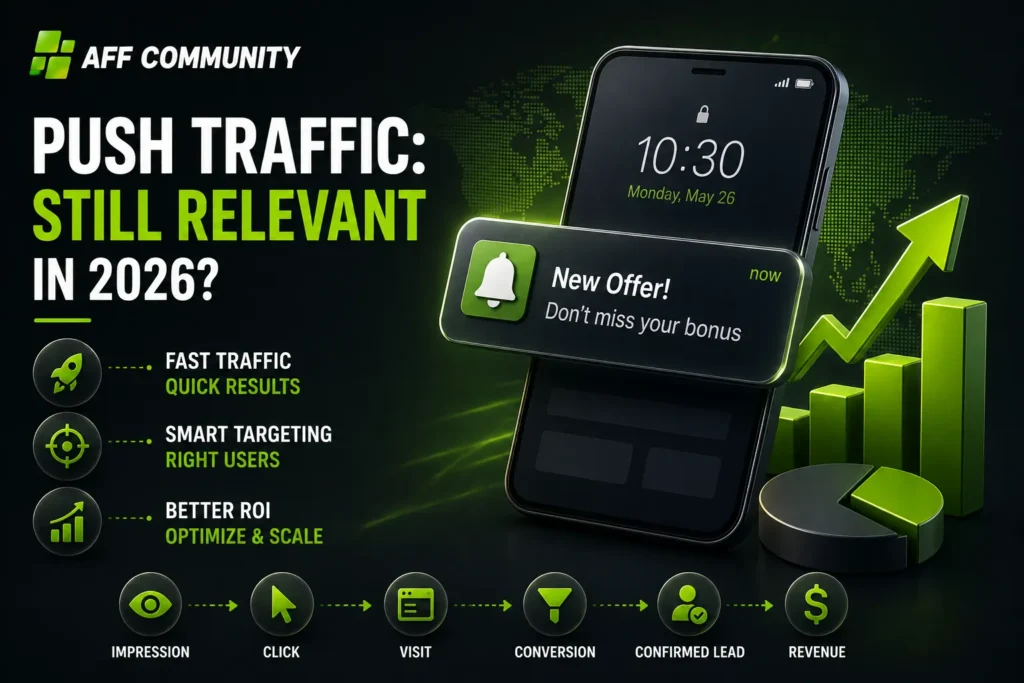
Push traffic still relevant in 2026?

The main advantage of push advertising is the ability to quickly generate a large volume of traffic and gather statistics fairly quickly.

For a webmaster, this is convenient when testing new offers. There’s no need to invest a large budget right away: you can launch several variants, review the initial metrics, and keep only those segments that show potential.

Another advantage is the variety of geographic targets and the ability to work with different purchasing models. Push can be used as a standalone source or as a supplementary element of an advertising strategy.

At the same time, it’s important to understand that a cheap click isn’t an advantage in and of itself. If a user doesn’t match the offer’s target audience, a low cost per click will only deplete your budget faster.

What Has Changed in Push Traffic in 2026

The main change is that competition for high-quality inventory has intensified. Therefore, it is no longer enough to simply choose a network, set a bid, and upload creativity.

We recommend analyzing GEOs, devices, platforms, display times, and user behavior after the click separately.

The choice of ad network is also crucial. In our section on top ad networks for affiliate marketing, you can compare available options and traffic formats, including Push and In-Page Push.

Which verticals are suitable for Push

There is no one-size-fits-all vertical for push. Much depends on the GEO, traffic cost, and the specific offer.

Webmasters use Push ads in gambling, betting, dating, nutra, finance, sweepstakes, and mobile. In some cases, apps where users can perform a targeted action immediately after clicking through also perform well.

When selecting a GEO, we recommend looking beyond just the cost per click. The difference between Tier-1, Tier-2, and Tier-3 can significantly alter the economics of the same ad campaign. We discussed this issue in more detail in our article on the difference between Tier-1, Tier-2, and Tier-3.

Creativity Still Matters

Push ads have very little space to communicate with the user. Therefore, the headline, image, and short text must immediately grab attention and align with the offer.

In 2026, it will be particularly risky to endlessly replicate the same approach. Users quickly get used to a familiar presentation, and metrics begin to decline.

Therefore, when launching a campaign, it’s best to prepare several concepts and test them in parallel. At the same time, you shouldn’t just evaluate CTR. A high click-through rate doesn’t necessarily mean you’re getting high-quality traffic.

How to Evaluate the Effectiveness of a Push Campaign

We wouldn’t recommend making decisions based solely on CTR or cost per click. For a comprehensive evaluation, you need to look at the entire funnel:

impression → click → visit → conversion → confirmed lead → revenue.

If there are many clicks but users are hardly taking the desired action, the problem may lie with the audience, the offer, or the landing page.

Therefore, before scaling up, it’s worth checking the quality of traffic sources and segments separately. In our article on checking traffic quality before scaling up, we discussed in detail which metrics to analyze before increasing your budget.

For financial evaluation, it’s also important to consider several metrics simultaneously. Specifically, CTR, CPM, conversion rate, EPC, and ROI. We’ve written a separate article detailing which metrics are truly important for evaluating a campaign.

Is it worth starting with Push in 2026?

In short—yes, but don’t view it as a source of easy money.

Push notifications remain an interesting tool for testing offers, finding new combinations, and scaling existing campaigns. At the same time, results depend increasingly on analytics and the quality of traffic management.

We would view push notifications as part of a comprehensive media mix, rather than as a standalone “buy cheap clicks” button. The right choice of GEO, segmentation, creativity testing, and constant quality control allow you to understand where this traffic source is truly profitable.

In 2026, Push didn’t disappear—it simply became more demanding for publishers. And for those who know how to work with data, this traffic source remains quite relevant.
Click Fraud: How to Detect

Click fraud is one of those problems in affiliate marketing that’s easy to underestimate. As long as the ad dashboard shows clicks, the CTR looks normal, and the cost per click remains reasonable, it may seem like everything is fine with the campaign.

But then things start to look strange: there are a lot of clicks but almost no conversions, users aren’t staying on the site, and the statistics differ sharply from other traffic sources.

We believe that click fraud should be investigated not when the budget has already been exhausted, but at an early stage. The sooner the advertiser notices an anomaly, the less money they’ll lose to that traffic source.

That said, click fraud isn’t necessarily caused by primitive bots that simply click on ads. Modern click fraud can be significantly more sophisticated and masquerade as normal user behavior.

What Is Click Fraud

Click fraud is the artificial generation of clicks on ads without the user having any genuine interest in the offer.

Click fraud how to detect it

The motives can vary. Some people try to profit from the advertising model, others want to inflate a platform’s metrics, and sometimes competitors intentionally generate low-quality clicks to increase the advertiser’s costs.

For a publisher, the problem is clear: money is being charged for clicks, but users aren’t generating any real value within the funnel.

The most common signs:

  • a large number of clicks without conversions;
  • identical or suspiciously similar sessions;
  • sudden spikes in activity;
  • unusual timing patterns between clicks;
  • suspicious concentration of traffic;
  • a large number of users who immediately leave the page.

However, none of these signs on its own proves fraud. That’s why we always recommend analyzing several metrics at the same time.

Why a High CTR Doesn’t Prove Anything

One common mistake is assuming that a high CTR is a sign of good creativity and high-quality traffic. In reality, CTR only shows how often users click on an ad.

Let’s say a campaign achieved an 8% CTR. At first glance, that’s an excellent result. But if users close the page almost immediately after clicking and don’t take the desired action, there’s nothing to celebrate.

A high CTR can be due to aggressive creativity, accidental clicks, or the specifics of a particular ad placement.

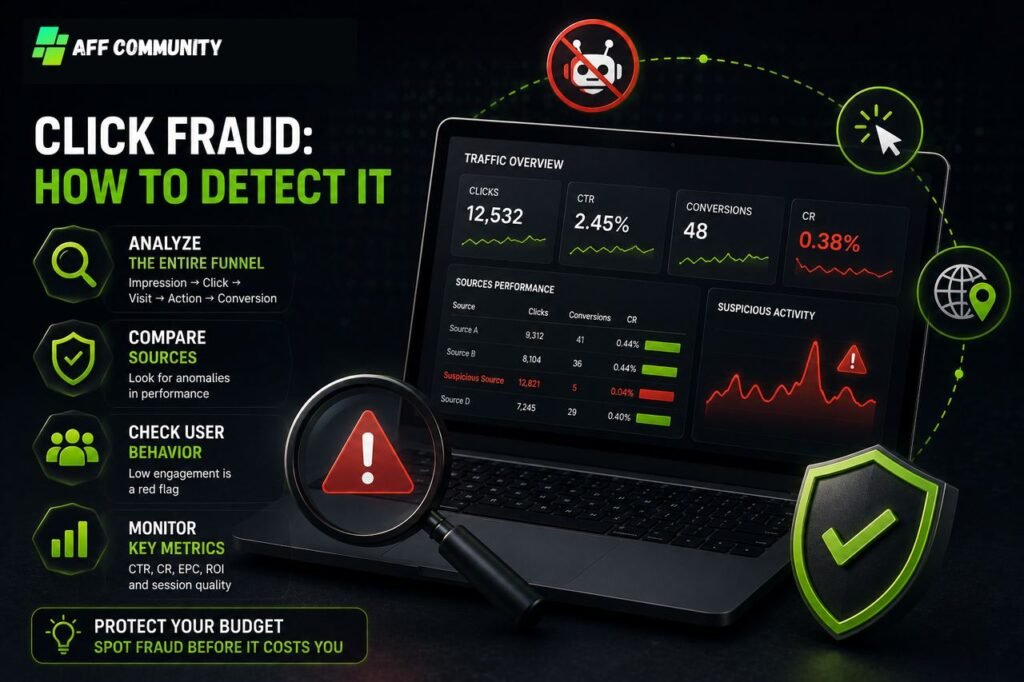
That’s why we recommend looking at the entire conversion path:

impression → click → landing page → interaction → conversion → confirmed action.

If a problem arises between the click and the next stage, you need to look for the cause precisely there.

Compare traffic sources with one another

The easiest way to detect suspicious traffic is to compare it with other sources.

For example, you have three platforms. The first generates 1,000 clicks and 40 conversions. The second generates 900 clicks and 35 conversions. The third generates 1,200 clicks and only 3 conversions. At the same time, the cost per click is roughly the same across all of them.

This result doesn’t automatically mean that the third platform is engaging in click fraud.

Perhaps it has a completely different audience or an ineffective ad placement. But the source definitely warrants further investigation.

We recommend looking not only at the final conversion rate but also at user behavior after landing on the page.

That’s exactly why it’s important to conduct a thorough traffic quality check before increasing your budget, rather than focusing solely on the campaign’s profit. We’ve already covered a useful checklist for this kind of analysis in the article “How to Check Traffic Quality Before Scaling.”

Look at User Behavior

A bot can learn to click, but it’s much harder for it to mimic a normal potential customer.

Therefore, after identifying a suspicious source, you need to see what happens after the click.

Pay attention to:

  1. time on page;
  2. page depth;
  3. number of pages viewed;
  4. actions within the form;
  5. repeat visits;
  6. transitions between funnel stages;
  7. conversion to the target action.

If thousands of users visit the page but virtually all of them leave within a few seconds, that’s a serious red flag.

The situation becomes even more interesting when the statistics from a suspicious source look virtually identical every hour or day.

With a real audience, behavior usually varies. There are peaks in activity, different devices, and various interaction scenarios. Statistics that are too perfect should sometimes be cause for concern.

Check IP addresses, devices, and GEO

Another level of analysis involves technical parameters.

If you have access to the relevant statistics, it’s worth looking at:

  1. IP addresses.
  2. Device types.
  3. Operating systems.
  4. Browsers.
  5. Geolocation.
  6. Click time.
  7. Frequency of repeat actions.

For example, a large number of clicks from a single technical configuration does not in itself prove click fraud. But if the device, IP segment, time of activity, and subsequent behavior all match simultaneously, the likelihood of an anomaly increases.

It is especially useful to compare this data across multiple sources.

If one platform differs significantly from the others in several parameters at once, it should be flagged for further review.

Look for sharp spikes

Click fraud can often be detected by its dynamics.

Suppose a campaign receives roughly the same number of clicks for several days, and then suddenly receives several hundred clicks within 20 minutes.

At the same time:

  • CTR increases sharply;
  • the cost per conversion rises;
  • there’s almost no increase in leads;
  • users barely interact with the website.

This is already a compelling reason to pause and investigate. We advise against making decisions based solely on one hour’s worth of data. First, it’s helpful to compare the spike with historical data and check whether there was an objective reason for it.

For example, the ad platform might have launched an additional placement or changed the distribution of impressions.

Don’t confuse click fraud with a poor audience

This is a particularly important point. Not every low-quality user is a bot. The ad platform may very well be driving real people who are simply not interested in your offer.

As a result, the advertiser sees a lot of clicks, low conversion rates, and immediately concludes that it’s fraud. But the problem may lie in the targeting, creativity, or an incorrectly selected audience.

Therefore, before blocking a traffic source, you must distinguish fraudulent traffic from simply low-quality traffic.

Which metrics to use for verification

We do not recommend basing your anti-fraud analysis on a single metric. You need to look at a combination of metrics.

First and foremost:

  • CTR. Helps you understand how actively users interact with the ad.
  • CPC. Shows the cost per click.
  • CR. Lets you see whether clicks are turning into desired actions.
  • EPC. Helps assess the economic value of traffic.
  • ROI. Shows the final financial result.

But you also need to analyze user behavior and conversion quality. Our resources on “metrics that really matter in affiliate marketing” provide a good guide to the analytics system.

What to Do If You Detect a Suspicious Source

The key is not to keep automatically pouring your budget into it in the hope that the statistics will correct themselves. If a source shows clear anomalies, we recommend:

  1. Record the time period and volume of the suspicious traffic.
  2. Compare it with other sources.
  3. Check technical and behavioral metrics.
  4. Review statistics at the placement and segment levels.
  5. Pause or limit the suspicious source.
  6. Forward the data to the ad network or affiliate networks if further verification is required.

However, do not delete statistics or change settings before you have saved the raw data. Otherwise, it will be much more difficult later to prove exactly what happened.

How to Reduce the Risk of Click Fraud

It is impossible to completely eliminate fraudulent clicks, but the risks can be significantly reduced.

We recommend using:

  • tracking of all ad clicks;
  • separate statistics by source;
  • regular analysis of ad placements;
  • automated rules for suspicious anomalies;
  • anti-fraud tools;
  • conversion quality control.

It’s especially important not to wait for the affiliate networks or ad networks to report the problem on their own.

Modern anti-fraud systems analyze multiple factors simultaneously, including user behavior, device, GEO, and interaction patterns. 

Conclusion

Click fraud cannot be detected by a simple rule like “lots of clicks without leads = fraud.” Real analysis is much more complex.

Our team and I look at several levels simultaneously: the source, dynamics, technical parameters, user behavior, conversion, and the bottom line.

The key is not to confuse fraud with ordinary low-quality traffic. In one scenario, the problem must be solved through anti-fraud measures and blocking the source, while in another, you need to adjust the targeting, creativity, or the campaign itself.

The sooner a webmaster begins analyzing not just the number of clicks, but the quality of each stage of the funnel, the less likely they are to waste a significant portion of their budget on click fraud.

How to Run Traffic Abroad Using Telegram Ads

Telegram has long since ceased to be just a platform for communication. Today, it is a full-fledged advertising ecosystem with an audience of millions that is actively expanding in many countries. We’re seeing more and more advertisers start to use Telegram Ads to promote their offers in foreign markets. With the right strategy, this traffic source can deliver high-quality traffic with high engagement and good conversion rates.

However, working with an international audience has its own unique challenges. Successful campaigns require not only proper ad setup but also an understanding of the specifics of each GEO.

Why Telegram Ads Are Attractive to Webmasters

How to run traffic using Telegram ads

The main advantage of Telegram Ads is access to an active audience that consumes a large amount of content within the messenger every day.

For advertisers, this means several important benefits:

  • high engagement;
  • the ability to target different countries;
  • relatively low competition compared to traditional advertising platforms;
  • extensive scaling capabilities.

In addition, Telegram continues to grow rapidly in Europe, Asia, Latin America, and the Middle East, opening up new opportunities for launching advertising campaigns.

Choose a GEO based on more than just payouts

One of the most common mistakes is focusing exclusively on the size of the offer payout. Before launching a campaign, you need to consider:

  1. Telegram’s popularity in the selected country.
  2. Advertising costs.
  3. Competition.
  4. The audience’s purchasing power.
  5. The advertiser’s requirements.

Sometimes Tier-2 or Tier-3 countries allow you to achieve a significantly higher ROI due to the lower cost per user acquisition.

We’ve provided a detailed comparison of different country groups in this article.

Adapt your creativity to the local audience

Even if the offer is the same, ad materials should take into account the specifics of the particular market.

We recommend adapting:

  1. the language of the ads;
  2. images;
  3. communication style;
  4. calls to action;
  5. examples and local characteristics.

Using generic English-language creativity across multiple countries rarely yields maximum effectiveness. The better the ad aligns with the local audience’s expectations, the higher the likelihood of achieving a high CTR and high-quality conversions.

Choose the Right Landing Pages

Even high-quality creativity can’t make up for a weak landing page. The landing page must meet user expectations, load quickly, and look natural for the selected region.

It’s especially important to consider the requirements of advertising platforms and prepare high-quality white pages in advance if your promotion strategy calls for it. One of the top services on the market right now is Money Safe. Their White pages pass moderation in 99% of cases.

Use the promo code AFFCOMMUNITY to get a 10% discount on White page purchases.

Constantly analyze performance

Telegram Ads, like any other traffic source, requires regular optimization. We recommend tracking the following metrics daily:

  • CTR;
  • cost per click;
  • cost per lead;
  • conversion rate;
  • ROI;
  • metrics for individual GEOs.

Very often, small changes to campaign settings can significantly reduce the cost per user acquisition.

In addition, analyzing statistics helps you quickly identify promising countries for further scaling.

Don’t forget to test new combinations

The Telegram Ads market continues to evolve rapidly. New channels are emerging, user behavior is changing, and ad formats and ad delivery algorithms are being updated.

That’s why successful teams are constantly testing:

  1. New GEOs.
  2. Different audiences.
  3. Multiple variations in creativity.
  4. Various offers.
  5. Alternative landing pages.

It is precisely these ongoing tests that allow you to find profitable combinations before your competitors do.

We discussed in detail how to find new approaches and scale successful campaigns in the article at this link.

Conclusion

Telegram Ads is gradually becoming one of the most promising sources of international traffic. Its large audience, the platform’s ongoing development, and the ability to target virtually any geographic region make it an attractive tool for both experienced webmasters and beginners.

We recommend not limiting yourself to standard approaches. Analyze your statistics, tailor your creativity to specific countries, test different hypotheses, and regularly scale up successful ad combinations. It is precisely this systematic approach that allows you to achieve consistent results when working with an international audience through Telegram Ads.

How to Lower Your Cost Per Click in Google Ads

A high CPC is one of the most common challenges when working with Google Ads. Many webmasters believe that the cost per click depends solely on the level of competition, but in practice, this is just one of several factors. We regularly encounter situations where, after making a few adjustments, we’re able to lower the cost per click by tens of percent without losing traffic volume.

Let’s break down the main ways to lower your cost per click and make your ad campaigns more effective.

Work on Ad Quality

Снижение CPC в Google ads

Google evaluates not only the advertiser’s bid but also the quality of the ad itself. The final cost per click is influenced by the Quality Score, which is determined by several factors:

  • ad relevance;
  • expected CTR;
  • landing page quality;
  • and relevance to the search query.

The higher the Quality Score, the less it may cost to attract a user.

Therefore, we recommend regularly testing new headlines, descriptions, and ad variations instead of constantly raising your bids.

Choose the Right Keywords

One of the most costly mistakes is using overly broad search terms. High-volume keywords are typically highly competitive and result in expensive auctions.

In many cases, it’s more cost-effective to use more precise search queries that indicate high commercial intent on the part of the user.

Additionally, it’s important to regularly update your negative keyword list to avoid paying for irrelevant traffic.

Optimize Your Landing Page

Google analyzes the quality of the page a user lands on after clicking. If the site takes a long time to load, displays poorly on mobile devices, or fails to meet the audience’s expectations, the cost of advertising will gradually increase.

Therefore, you need to pay attention to:

  1. Page load speed.
  2. Ease of navigation.
  3. Content quality.
  4. The mobile version.
  5. Alignment with the ad.

A good landing page not only helps lower your CPC but also increases your overall conversion rate.

Analyze your metrics

Don’t focus solely on the average cost per click. It’s important to understand which keywords, ads, and audiences actually drive conversions. We recommend regularly tracking:

  1. CTR;
  2. CPC;
  3. conversion rate;
  4. bounce rate;
  5. cost per lead;
  6. ROI.

Sometimes a more expensive click turns out to be significantly more profitable than a cheap one if it drives high-quality users.

We discussed working with analytics in detail in this article.

Consider geographic specifics

Ad costs can vary significantly depending on the country. Even identical ads for the same offer can have different CPCs due to competition, user behavior, and auction dynamics.

Before scaling your campaign, we recommend comparing several markets rather than limiting yourself to a single GEO.

Sometimes, less competitive countries allow you to generate nearly the same volume of leads at significantly lower costs.

Test your ads regularly

One of the biggest mistakes is to stick with a single successful ad and not change it for months. Over time, users get used to the creativity, CTR drops, and the cost per click begins to rise.

Even small changes can positively impact campaign performance:

  • new headlines;
  • different images;
  • alternative calls to action;
  • an updated text structure.

Regular A/B tests help maintain a high Quality Score and keep the cost per click at an optimal level.

Conclusion

Reducing the cost per click in Google Ads is the result of a comprehensive approach, not just a single change to ad campaign settings. High-quality ads, well-chosen keywords, an optimized landing page, and continuous analysis of statistics allow you to significantly reduce costs without sacrificing traffic quality.

We recommend not focusing exclusively on the lowest possible CPC. It is much more important to achieve the optimal balance between cost per click, audience quality, and the campaign’s overall profit.

Money Safe Review: White Pages Development Tool for Affiliates

With ad network moderation becoming increasingly complex, the quality of White Pages has become one of the factors that directly affects the stability of ad campaigns. While a few years ago many webmasters used simple, template-based White pages, today this approach increasingly leads to bans, additional reviews, and wasted time.

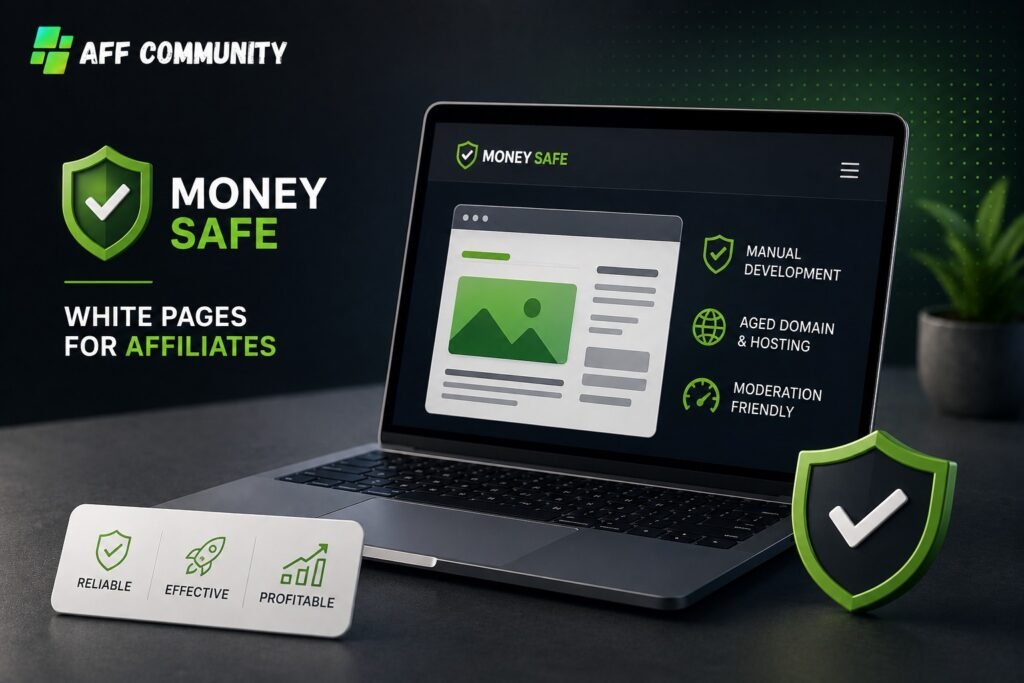
That is precisely why specialized services have emerged on the market that focus on the professional development of White pages. One such solution is Money Safe – tool focused on creating high-quality White Pages for various verticals.

In this review, we’ll examine what Money Safe does, what features the service offers, and in which cases using it is truly justified.

Money safe - top white pages

Who Is Money Safe

Money Safe is a service specializing in the development of White Pages for traffic arbitrage. Unlike typical website builders or template-based solutions, the main focus here is on manually developing White pages tailored to specific tasks.

The service’s team creates White pages using both the WordPress CMS and in HTML format, allowing you to choose an option that suits the specifics of your advertising campaign and the requirements of a particular platform.

This approach results not just in a visually appealing White page, but in a fully-fledged informational website that looks natural to the user and meets absolutely all moderation requirements.

What tasks does the service solve?

White page development has long since ceased to be merely the creation of a single page with text and an image. A modern White Page must simultaneously fulfill several objectives:

  • align with the theme of the advertising campaign;
  • inspire trust in the user;
  • have a logical structure;
  • function correctly on mobile devices;
  • load quickly;
  • include the necessary technical and legal pages.

Creating such a White page requires time and an understanding of the specifics of ad networks. That’s exactly why many teams prefer to delegate this task to specialized professionals.

Money Safe takes full responsibility for White page development, from structure and design to technical configuration.

What Types of White Pages Can You Order?

The service offers two main development options.

White Page on WordPress

This option is suitable for those who need a fully ready-to-use project with the ability to make further edits via the admin panel. The price includes:

  • installation of the WordPress CMS;
  • hosting;
  • a domain with a history;
  • use of the White Page for one year;
  • a multi-page website;
  • a unique template;
  • Cloudflare integration.

This format is particularly convenient for teams that regularly launch new advertising campaigns and want to update content on their own.

HTML White Page

The HTML version is suitable for those who host websites on their own server or use custom infrastructure.

In this case, the client receives ready-made HTML files with a unique design and structure. Hosting and the domain are purchased separately, which provides more freedom when deploying the White page.

The functionality of the White page itself remains just as robust.

Our users can enjoy a 10% discount on White page purchases using the promo code AFFCOMMUNITY.

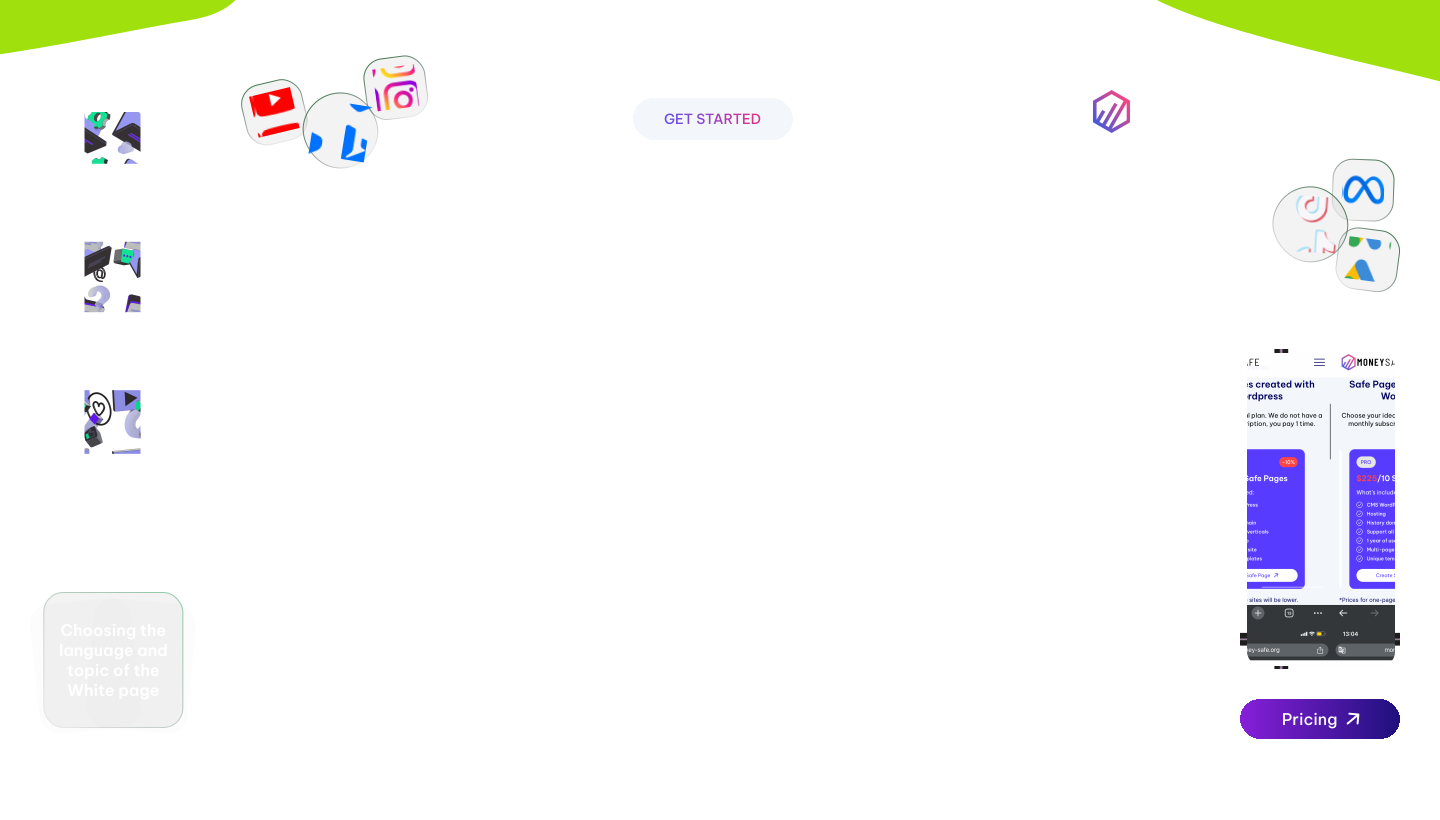
Pricing Overview

Money Safe offers several pricing plans depending on the number of White Pages required.

WordPress HTML Plan

RateWordPressHTML
Starter28 $ for 1 White Page35 $ for 1 White Page
Pro250 $ for 10 White Page315 $ for 10 White Page
Business475 $ for 20 White Page560 $ for 20 White Page

When ordering package plans, a discount applies, making the cost per page significantly lower compared to custom development.

This approach is particularly convenient for teams and agencies that regularly launch new advertising campaigns and prepare their infrastructure in advance.

Advantages of Money Safe

Amid a large number of template-based solutions, the service stands out for several features.

First, development is done manually. This allows for the creation of projects that differ not only in content but also in structure.

Second, the service isn’t limited to a single vertical. White Pages are developed for various industries, so the solution can be used for a variety of tasks.

Another advantage is its comprehensive approach. When choosing a WordPress plan, the client receives a White page that’s practically ready to go, complete with hosting, a domain, Cloudflare configuration, and the option to continue using it for a year.

It’s also worth noting the option to order either a single White page or large packages at once, which is especially convenient for media buying teams.

Who This Service Is For

Money Safe will be useful for those who don’t want to spend time developing a White Page on their own and prefer to focus on launching advertising campaigns.

The service may be of interest to:

  • webmasters working across multiple verticals;
  • media buying teams;
  • ad agency owners;
  • specialists who regularly launch new ad campaigns;
  • those who want a ready-made solution without having to search for designers, front-end developers, and back-end developers.

The service is particularly useful in situations where you need to quickly prepare multiple White pages to scale up advertising campaigns.

Conclusion

In recent years, ad networks’ quality requirements for White pages have increased significantly. Simple, template-based sites are less and less likely to deliver consistent results, and creating a truly high-quality site requires time and technical expertise.

Money Safe offers a comprehensive approach to solving this problem. The service handles the development of White Pages, giving clients the choice between WordPress and HTML, several pricing plans, and the option to order either a single White page or a package of multiple sites.

For webmasters who regularly work with affiliate marketing and value their time, this approach allows them to shorten the preparation phase of advertising campaigns and focus on testing link builds without being distracted by the technical aspects of White Page development.

How to Make Money with HR Offers

Most webmasters associate high payouts with gambling, nutra, or finance. However, there is one vertical that has been growing steadily for many years and is virtually unaffected by seasonality: HR offers.

We believe that the recruitment sector remains one of the most underrated in affiliate marketing. Companies around the world continue to seek employees, recruitment agencies are expanding their candidate pools, and employers are willing to pay for high-quality applications.

With the right approach, the HR vertical can generate a stable income for both newcomers and experienced webmasters.

What Are HR Offers

HR offers in affiliate marketing

HR offers are affiliate programs in which the advertiser pays for actions related to recruiting employees.

The most common actions that are paid for include:

  • a completed candidate application;
  • a job seeker’s registration;
  • a response to a job posting;
  • confirmed employment;
  • completion of an interview.

The payment model depends on the specific employer and country. In some cases, the affiliate receives payment simply for a user’s registration, while in others, compensation is paid only after the candidate starts working.

That is why it is important to carefully review the terms of the affiliate program before getting started.

Why the HR Vertical Is Gaining Popularity

Many countries continue to face a labor shortage in virtually all sectors. Employers are actively investing in attracting new professionals, and HR services are increasing their marketing budgets.

This creates favorable conditions for buyers. An additional advantage is the relatively lenient moderation of advertising platforms.

Unlike gambling, crypto, or finance, job listings are much easier to promote through Google Ads, Meta Ads, TikTok Ads, and other traffic sources.

That’s precisely why many teams use the HR vertical as a stable channel for long-term work.

Which traffic sources work best

There’s no one-size-fits-all solution here. It all depends on the specific offer and geographic region. Most often, the following deliver good results:

  • Google Ads;
  • Facebook Ads;
  • TikTok Ads;
  • SEO;
  • Telegram;
  • native advertising.

Informational articles on job hunting, career growth, resume writing, and interviewing are particularly effective.

Which GEOs Are Considered Promising

The highest demand is usually seen in Europe, North America, and Australia. That said, emerging markets where employers are facing labor shortages also yield good results.

When choosing a country, it’s important to consider:

  1. the level of competition;
  2. cost per click;
  3. average payout;
  4. advertiser requirements;
  5. and the characteristics of the local labor market.

Sometimes, a less popular GEO can yield a significantly higher ROI than overheated Tier-1 countries.

What to Look for When Choosing an Offer

A high bid doesn’t always mean high earnings. Before launching, you need to evaluate:

  1. Candidate requirements;
  2. Application confirmation rate;
  3. Geographic restrictions;
  4. Available traffic sources;
  5. Payment terms.

Additionally, it’s worth clarifying in advance how the advertiser verifies the quality of applications. The more transparent the operating rules are, the easier it is to scale campaigns.

Why analytics are particularly important

In the HR vertical, lead quality plays a huge role. Even a large number of registrations doesn’t guarantee high revenue if most candidates don’t meet the employer’s requirements.

Therefore, you need to constantly analyze:

  • cost per application;
  • approval rate;
  • cost of hire;
  • quality of different traffic sources;
  • effectiveness of individual creativity.

It is precisely by working with analytics that you can gradually increase profits without a significant increase in advertising costs.

We discussed using data for decision-making in more detail in this article.

Scaling requires a systematic approach

After seeing the first successful results, many people start to drastically increase their budgets. But the HR vertical requires gradual scaling.

It’s better to systematically expand the number of GEOs, test new job openings, create additional landing pages, and regularly update ad creatives.

This approach allows you to maintain stable conversion rates even as traffic volumes grow.

Conclusion

HR offers remain one of the most stable verticals in affiliate marketing. Constant demand for employees, a wide range of traffic sources, and relatively lenient moderation make this niche attractive for both beginners and experienced webmasters.

Our team and I recommend not limiting yourself to just the popular verticals. Sometimes it’s the less competitive niches that allow you to reach a stable profit faster, obtain high-quality statistics, and build a long-term growth strategy without constantly fighting for a saturated market.

How to Choose Keywords for White Page

One of the most common mistakes when working with Google Ads is treating White Page as a regular website. Many people start by gathering the most targeted keywords related to cryptocurrencies, investments, or trading, and then wonder why their ad campaign doesn’t pass moderation.

Our team regularly analyzes such cases and can confirm that the logic for selecting keywords for a White Page is completely different.

Let’s consider a typical scenario. The main offer is related to cryptocurrency, while the White Page is themed around team management consulting. In this case, the keywords must align perfectly with the White Page itself, not the offer.

This is precisely what makes the page appear as natural as possible to Google’s algorithms.

Start with the White page’s topic, not the offer

Relevant keywords for white page

The first mistake is trying to subtly add cryptocurrency-related queries to the White page’s text.

Google analyzes not only the page’s content but also the site’s overall theme. If a user lands on a page about team building but finds dozens of words like crypto, bitcoin, investment platform, or digital assets within it, the algorithms quickly detect this mismatch.

As a result, the likelihood of additional scrutiny increases significantly. Therefore, the semantics must fully align with the consulting topic.

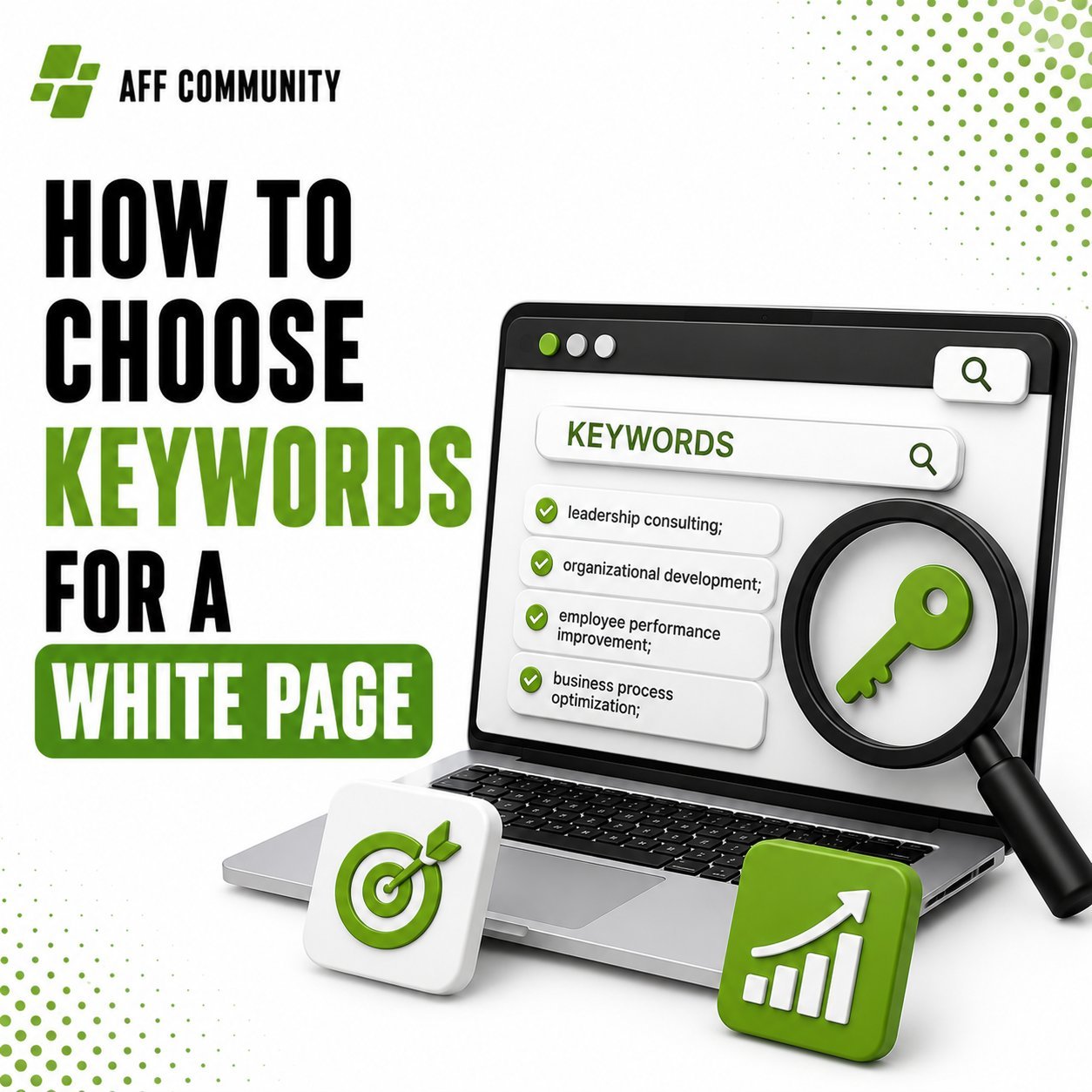
For example, you can use the following keywords:

  • team management consulting;
  • leadership consulting;
  • organizational development;
  • employee performance improvement;
  • business process optimization;
  • management strategy;
  • executive coaching;
  • business transformation;
  • leadership skills;
  • corporate consulting.

Such keywords look completely natural for a White page.

Use informational search queries

We recommend making the White page as similar as possible to an expert article or a consulting firm’s blog. Informational search queries are ideal for this. For example:

  • how to build a high-performing team;
  • leadership mistakes;
  • employee engagement strategies;
  • improve business efficiency;
  • project management best practices;
  • business growth consulting;
  • effective communication in teams.

Such keywords help create a natural structure for the White page. This approach is much better received by Google’s algorithms.

Don’t try to disguise crypto

Some webmasters use vague references:

  • digital finance;
  • modern investments;
  • wealth technology;
  • online earnings.

It may seem like these terms are safer. In practice, however, Google perfectly understands semantic connections. If the entire article is dedicated to team management, such insertions look artificial.

We recommend avoiding any terms that could be associated with crypto, investments, or financial products altogether.

A White Page should exist as a completely standalone piece of expert content. Only then does the likelihood of successful moderation become significantly higher.

Money Safe specializes in the high-quality development of White pages. It’s the best solution currently available on the market. You can learn more about the service here. And use the promo code AFFCOMMUNITY to get a 10% discount.

Page structure also matters

It’s not enough to simply choose good keywords. Google evaluates the entire page as a whole.

It’s important to include:

  • a logical H1;
  • topic-relevant H2 and H3 headings;
  • an FAQ section;
  • internal links;
  • images;
  • articles;
  • real contact information;
  • an “About Us” page;
  • a Privacy Policy and Terms of Service.

The more a White Page resembles a real corporate website, the higher the level of trust.

Use long-tail keywords

Instead of high-frequency keywords, it’s better to focus on long-tail semantics. For example:

  • how to improve leadership skills in business;
  • management consulting for growing companies;
  • business team development strategies;
  • employee productivity consulting;
  • organizational growth planning.

Such queries look much more natural and allow you to create high-quality, expert content.

In addition, long-tail queries help avoid an excessive concentration of repetitive keywords.

Don’t forget about user value

Today, Google Ads evaluates more than just the presence of keywords. Its algorithms analyze whether a page truly answers the user’s question.

If the content appears useful, contains practical recommendations, examples, and a clear structure, the level of trust in it is significantly higher.

That’s exactly why a White Page should be a full-fledged article, not just a collection of phrases. 

Check the entire setup

Even a perfectly written White Page doesn’t guarantee successful moderation. Google analyzes the user’s entire journey:

  • the ad;
  • campaign keywords;
  • White Page content;
  • the domain;
  • the site’s technical condition;
  • post-click behavior.

If even one element looks suspicious, the likelihood of a ban increases significantly. That’s exactly why experienced advertisers work not on a single page, but on the entire infrastructure simultaneously.

We discussed in detail how modern Google algorithms evaluate ad materials before launching campaigns in this article.

Conclusion

When working with Google Ads, the White Page should align not with the offer, but with its own subject matter.

If you’re using a page about team management consulting, the entire semantics, structure, and content should look as if it were the website of a real consulting firm.

It is precisely this approach that significantly increases your chances of successfully passing moderation and reduces the risk of additional reviews by Google, while preserving the operational infrastructure needed for further scaling of your ad campaigns.

How to Increase ROI Without Increasing Your Budget

Most webmasters believe that to grow profits, you need to constantly increase your advertising budget. The logic seems obvious: more investment = more traffic = higher revenue.

But my team and I regularly see cases that prove the opposite. Some teams spend thousands of dollars a day and barely break even, while others, with the same expenses, gradually increase their ROI by optimizing existing campaigns.

In practice, profit growth is far from always linked to a budget increase. More often than not, it starts with improving the quality of the ad-link combination.

Don’t Scale a Loss-Making Campaign

ROI without budget

The most common mistake is trying to compensate for a low ROI with additional spending.

If a campaign is already showing weak results, increasing the budget almost never fixes the situation. First, you need to figure out which element is performing worse than the rest. It could be:

  • creativity;
  • the audience;
  • the offer;
  • the landing page;
  • or the traffic source.

Only after addressing the weak link does it make sense to consider scaling up. That’s exactly why skilled webmasters start by analyzing statistics, not by increasing the budget.

Focus on conversion

Even a small increase in the conversion rate (CR) can significantly boost the overall ROI—without changing your ad spend at all.

Conversion depends on many factors:

  • page load speed;
  • landing page quality;
  • how well the offer meets user expectations;
  • a clear call to action.

Sometimes changing just one element of the page is enough to increase total profit by tens of percent. That’s exactly why experienced teams regularly test different landing page variations.

Update your creativity before metrics start to drop

Many webmasters only start looking for new creativity after a noticeable drop in CTR. In practice, you need to act much sooner.

Any audience gradually gets tired of seeing the same ads. The longer the same creativity is shown, the higher the likelihood of CPM increasing and conversion rates decreasing.

That’s why strong teams prepare several new options in advance and regularly update their ad materials. This allows them to maintain high performance without increasing costs.

Analyze Your Audience

Another way to increase ROI is to eliminate ineffective traffic. Very often, one segment of the audience generates the bulk of the profit, while another simply drains the budget.

That’s why it’s important to regularly analyze:

  1. age;
  2. gender;
  3. devices;
  4. placements;
  5. interests;
  6. GEO.

After disabling underperforming segments, the overall effectiveness of the campaign can increase significantly even without additional investment.

This is precisely why segmentation remains one of the most underrated optimization tools. You can read more about this in the article at the link.

Monitor lead quality

A high number of conversions does not always mean high revenue. If an ad campaign attracts low-quality users, the advertiser may lower the rate at which it approves applications, reduce payouts, or even terminate the partnership altogether.

Therefore, it’s essential to analyze not only the cost per lead but also its quality. In many cases, reducing the volume of low-quality traffic boosts the final ROI much more significantly than attracting new users.

Work with numbers, not emotions

Another mistake is making decisions based on intuition. Any change to an ad campaign should be data-driven.

Before pausing a campaign or testing a new hypothesis, it’s worth answering a few questions:

  1. Why has the CTR changed?
  2. At what stage is the conversion rate dropping?
  3. Which audience segment has stopped generating profit?
  4. How has the EPC changed?
  5. What changes occurred after the latest adjustments?

It is precisely this approach that allows you to gradually increase campaign effectiveness without increasing costs.

Useful recommendations for working with analytics and scaling can be found in this article.

Continuous optimization is more effective than constantly increasing the budget

Professional teams rarely rely solely on increasing spending. They are constantly looking for small improvements:

  1. A 5% increase in conversion rate.
  2. A 10% decrease in CPM.
  3. A slightly higher CTR.
  4. A slightly better approval rate.

Ultimately, it’s the sum of these small changes that leads to a significant increase in ROI. This approach requires more analytics but delivers much more stable results over the long term.

Conclusion

You can increase ROI without increasing your advertising budget. In many cases, optimizing creativity, audiences, landing pages, and analytics yields significantly greater results than simply scaling up spending.

That’s exactly why top webmasters focus not on spending more, but on ensuring that every dollar invested generates maximum profit.

How Much Money Does a Beginner Need to Get Started in Affiliate Marketing

One of the most common questions we receive at AffCommunity always goes like this: “What kind of budget do I need to start doing affiliate marketing?”

Some people claim that $100 is enough, while others say you need several thousand dollars. Because of this, beginners get the impression that it’s impossible to break into the industry without a large amount of capital.

In reality, there’s no one-size-fits-all amount.

The size of your starting budget depends on the vertical, traffic source, your experience, and how effectively you can manage risks. That said, what matters far more than the amount on your card is understanding how that money will be used.

The main expense is testing

beginners in affiliate marketing

The biggest mistake made by beginner publishers is expecting their very first campaign to turn a profit right away. In practice, initial budgets are almost always spent on testing.

You need to test:

  • several pieces of creativity;
  • different audiences;
  • several offers;
  • various launch strategies.

It’s these tests that help you find a winning combination.

If you view your initial expenses as an investment in finding a profitable combination—rather than as guaranteed income—your attitude toward your budget immediately becomes more realistic.

What Else Does the Money Go Toward Besides Advertising

The advertising budget is far from the only expense.

A beginner may also need:

  • an anti-detection browser;
  • proxies;
  • a domain;
  • web hosting;
  • a tracking tool;
  • White page;
  • infrastructure supplies.

Of course, you won’t need all of this from day one. But as your volume grows, expenses will gradually increase. That’s exactly why we recommend understanding the structure of your future costs in advance, rather than calculating only the cost of ad campaigns.

If you’re just starting to set up your operational infrastructure, it’s helpful to review affiliate marketing service guides at this link.

Can You Start with $100?

Yes, you can. But it’s important to understand the limitations. A budget like this is usually only enough for initial tests. If the campaign combination turns out to be unsuccessful, you won’t have the opportunity to quickly run retests.

Therefore, with limited capital, it’s especially important to be as careful as possible when selecting the offer, audience, and traffic source.

Beginners should avoid trying to test dozens of combinations at once. It’s much more effective to test each idea gradually and analyze the results.

The Optimal Budget for the First Month

If we’re talking about a more comfortable start, most beginner webmasters feel much more confident with a budget of around $500–$1,000.

This is enough to:

  • test several combinations;
  • collect statistics;
  • draw conclusions;
  • conduct follow-up tests.

At the same time, you shouldn’t pour your last bit of money into ad campaigns. Any advertising budget should be viewed as an investment with potential risks.

That’s exactly why experienced teams always plan their expenses in advance and set aside a reserve for additional tests.

Don’t Try to Scale Up Right Away

Very often, after their first profitable campaign, beginners try to drastically increase their budgets. This is precisely when most ad combinations start to lose effectiveness.

It’s much better to gradually increase your ad spend while analyzing changes in each key metric.

Money Can’t Replace Experience

We regularly see two contrasting situations. One webmaster comes in with a $3,000 budget and loses almost everything in a few weeks.

Another starts with $300, carefully tests ad groups, analyzes statistics, and gradually achieves a stable profit.

The difference isn’t in the size of your budget. It lies in your approach to the work.

It’s precisely the ability to analyze the numbers, pause ineffective campaigns in a timely manner, and seek out new ad combinations that ultimately generates profit.

That’s why it’s worth investing not only in advertising but also in your own knowledge.

If you’re just choosing your first affiliate program, we recommend first understanding the principles behind selecting one. You can find detailed information in the article at this link.

Focus on the system

The most common mistake beginners make is the desire to make their first big money as quickly as possible.

But professional affiliate marketing works differently:

  1. A working system is created.
  2. Reliable tools are selected.
  3. Analytics are set up.
  4. An understanding of the economics of the funnel develops.

And only after that does scaling begin. It is precisely this approach that allows you to gradually transition from small launches to stable volumes.

BUTTON – We recommend reading the article “How to Build an Affiliate Marketing Team and Succeed

Conclusion

You don’t need thousands of dollars to get started in affiliate marketing. You can begin with a relatively small budget, as long as you understand that your initial expenses are an investment in learning and finding a viable traffic source combination.

What matters most isn’t the size of your initial capital, but a systematic approach, sound analytics, and a willingness to constantly test new hypotheses.

It is precisely these factors that, over time, allow you to turn a small advertising budget into a full-fledged, stable source of income.

How to Run Telegram Ads

Telegram has long since ceased to be just a messaging app. In 2026, it is one of the fastest-growing advertising platforms, allowing you to attract a high-quality audience for virtually any digital vertical. Telegram Ads are used particularly actively by publishers, SaaS service owners, crypto projects, educational platforms, and affiliate media.

Our team believes that Telegram Ads isn’t a replacement for Facebook or TikTok, but rather a separate traffic source with its own rules. Those who try to run ads using the same strategies they’re used to from Meta often burn through their budget quickly.

How to Launch a Successful Campaign

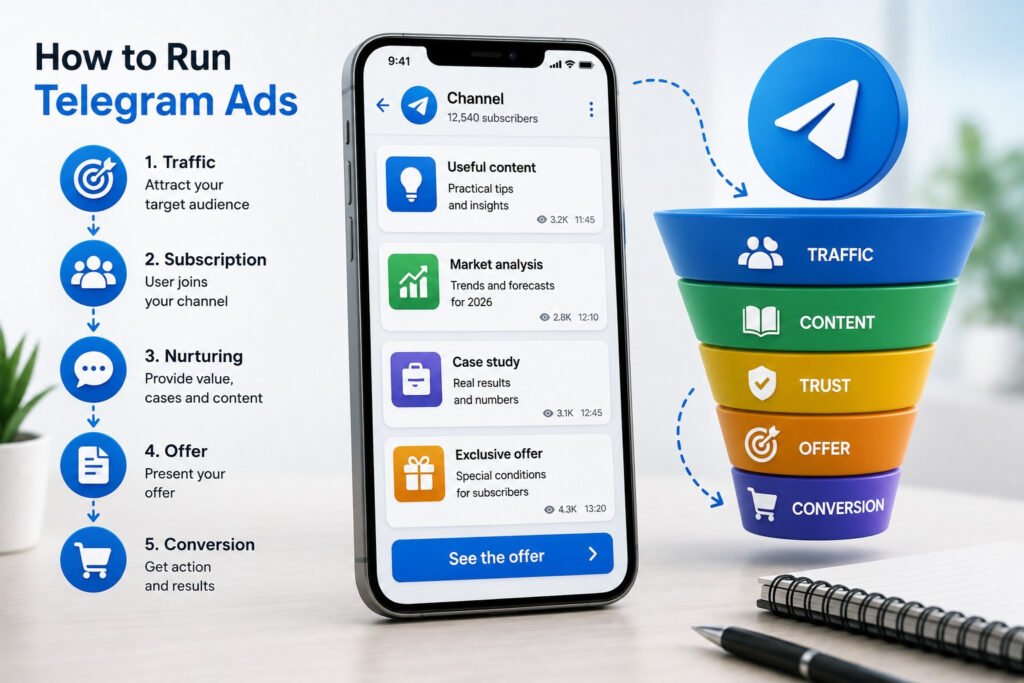
The main mistake beginners make is directing users straight to an offer. On Telegram, this model rarely yields maximum effectiveness.

How to run telegram ads

A much more effective approach is a sequence where the ad first directs the user to a channel or a mini-funnel, and only then does the user gradually become familiar with the content, case studies, and the offer.

This builds trust, and as trust grows, so does the final conversion rate. Essentially, Telegram Ads is a tool for attracting an audience, not for making instant sales.

Choosing the Right Channel

Many people focus all their attention on the ad itself, forgetting where the user ends up after clicking.

If the channel looks empty, posts are published irregularly, and the content consists solely of ads, most new subscribers will quickly leave.

That’s why it’s important to prepare the channel itself before launching a campaign. The channel should already contain useful materials, analyses, case studies, and posts that can retain the new audience.

It is precisely this approach that allows you to gradually turn subscribers into customers.

Don’t copy ads from Facebook

One of the most common mistakes is using the same ad copy as on Meta. The Telegram audience behaves differently.

Aggressive sales tactics and grandiose promises don’t work as well here. Instead, expertise, practical value, and concrete numbers resonate much better.

Users need to understand why they should subscribe right now. That’s why good ads often sell not the product itself, but interest in the content.

Analytics Are More Important Than Cost Per Click

Many people evaluate Telegram Ads solely based on CPC. But experience shows that it’s much more important to analyze audience retention:

  1. How many people are still in the channel after a week?
  2. What percentage reads the posts?
  3. How many subscribers click through to the offer?
  4. It is precisely these metrics that reveal the true effectiveness of a campaign.

It’s no coincidence that top-performing teams analyze the entire funnel rather than individual metrics. The approach to optimizing traffic and increasing conversions is discussed in detail in this article.

Telegram Ads as a Long-Term Asset

The main advantage of Telegram is that subscribers remain within your ecosystem.

While interaction in traditional advertising often ends with a single click, here users continue to see new posts, case studies, and useful content.

Each new post becomes an additional touchpoint with your audience. That’s why the cost of acquiring a subscriber begins to pay off significantly better over time than the cost of a typical ad click.

Why Telegram Ads Will Grow

Competition on Facebook and Google continues to intensify, the cost of traffic is rising, and moderation is becoming increasingly strict.

Against this backdrop, Telegram remains a platform with high user engagement and a high-quality audience.

With the right strategy, Telegram Ads can bring in not only subscribers but also a long-term stream of leads.

We’ve covered in detail how to use Telegram’s new advertising features at this link.

Conclusion

Telegram Ads isn’t a tool for quick sales, but an effective way to build your own audience.

The higher the quality of the content within the channel, the greater the likelihood that the subscribers you attract will eventually become regular readers and customers.

That is precisely why, in 2026, Telegram is becoming one of the most promising platforms for affiliate marketing teams that focus on long-term growth rather than just one-time conversions.

How to Create Clickbait Content and Whether You Should Use It

Sensational headlines, provocative images, and strong intrigue—all of these instantly grab attention. Such content spreads rapidly, sparks discussion, and often elicits a strong reaction from the audience. That is precisely why clickbait remains a popular tool in affiliate marketing and marketing.

However, risks lurk behind the rapid growth in metrics. Let’s examine how clickbait works, when it’s worth using, and what nuances are important to consider.

What Is Clickbait and How Does It Work

Clickbait is a content format whose primary goal is to attract attention and generate clicks.

This type of advertising relies on emotions and triggers. A user sees a headline or visual that sparks interest, surprise, or even shock—and clicks the link to learn more.

You can spot clickbait by these signs:

  • sensational and intriguing headlines;
  • exaggerated or unrealistic promises;
  • provocative images;
  • featuring famous people;
  • emphasizing quick results (“in 5 minutes,” “effortless”).

The main goal is not to explain the essence, but to grab attention. That is why this approach works well at the traffic acquisition stage. You can read more about creating such headlines here.

Advantages of the clickbait approach

Clickbait is widely used because it delivers quick results on key metrics.

Main benefits:

  • high CTR—users click more often because of the intrigue;
  • rapid traffic growth;
  • standing out among similar ads;
  • high engagement—comments, discussions, debates.

This type of content easily breaks through “banner blindness” and grabs attention even in an overloaded feed.

Disadvantages of clickbait

Despite a high CTR, clickbait doesn’t always lead to actual profit.

Cons of the approach:

  1. A high click-through rate doesn’t guarantee conversions.
  2. Decreased brand trust when expectations are not met.
  3. Risk of being blocked by ad platforms.
  4. Negative reactions from the audience.

If a user clicks on a link and doesn’t get what was promised, it leads to disappointment and damages the brand’s reputation.

Main Types of Clickbait Content

There are several common formats that are used most frequently.

Sensational headlines

Created with an emphasis on intrigue and exaggeration. These can be claims of quick results, unusual facts, or supposedly sensational news.

False or distracting elements

A detail is added to the banner that raises questions but has no relation to the main point. This prompts the user to click out of curiosity.

Fake news

Content that mimics a news format. It often elicits a strong reaction but also quickly leads to complaints and blocks.

Use of well-known personalities

Photos of celebrities or public figures are used to build trust. The user associates the product with authority.

Content with elements of fear

Disturbing topics are used: diseases, threats, disasters. This triggers an emotional reaction and encourages clicks.

Surveys and “giveaways”

Formats like “take a survey and win a prize.” Often used for data collection, but they generate distrust.

18+ content

Provocative images and topics attract attention, but almost always carry a high risk of being blocked.

Mystical and unusual topics

Stories about unexplained phenomena, mysteries, and strange events. Even skeptical users often click out of curiosity.

In which niches does clickbait work best

Clickbait is particularly effective in topics where the target audience is prone to emotional decisions.

Health and appearance

Promises of quick results, improved well-being, or better looks attract attention. People are looking for simple solutions to complex problems.

Gambling and betting

Topics like winnings, bonuses, and easy money are perfect for clickbait. Users respond eagerly to such offers.

Finance and investments

Content about making money, new income streams, and investments sparks interest. Especially if it’s presented as a simple and accessible path to profit.

Relationships and Dating

Topics related to personal life always resonate. Users click through in search of advice and solutions to their problems.

In these niches, clickbait helps quickly grab attention, but requires careful use. You can read more about creativity here.

When to Use Clickbait

Clickbait is effective when the goal is to drive traffic and increase reach.

It works well for:

  • testing creativity;
  • quickly grabbing attention;
  • boosting brand awareness;
  • reaching a cold audience.

However, when working toward long-term results, it’s important to maintain a balance. An interesting analysis of similar mechanics through memes. 

When clickbait can backfire

If the main focus is on sales and trust, aggressive clickbait can work against you.

Problems arise when:

  1. Expectations don’t match reality.
  2. The user feels deceived.
  3. The content elicits a negative reaction.
  4. The platform limits impressions or blocks ads.

In such cases, it’s better to use softer and more honest wording.

Conclusion

Clickbait is a tool that can deliver quick results but requires careful use.

It helps attract attention, increase traffic, and stand out from competitors. However, if used incorrectly, it erodes trust and can lead to account suspensions.

The optimal strategy is to combine clickbait with more neutral content.

Striking a balance between intrigue and honesty allows you not only to attract users but also to retain them, turning traffic into real profit.

Countries with the strictest rules for launching advertising

In 2026, the problem will no longer be how to find a link. The problem will be where it can be used normally. There are countries where regulations are so strict that even a careful offer may not pass moderation or quickly attract a wave of complaints.

This is not just about the rules of advertising platforms. In many countries, pressure comes from the state. And platforms simply cut everything with a margin to avoid fines.

Germany

Germany is one of the most difficult geos for finance and nutra.

Financial offers are checked particularly strictly. Any wording that could be interpreted as a promise of income will result in blocking. Nutra with claims of quick results is almost non-existent.

Personal data is a separate issue. If the landing page is poorly designed from a legal standpoint or it is unclear how user information is used, there may be problems not only with advertising, but also with the domain.

United Kingdom

In recent years, the UK has significantly tightened its control over financial advertising. Cryptocurrency, investments, trading — constant checks and frequent rejections.

Even neutral creativity is cut if the algorithm sees a risk to the user. Appeals are difficult. Plus, there is high competition and expensive traffic. Mistakes here are costly.

France

France takes a strict approach to medical topics and supplements. You cannot freely write about therapeutic effects, weight loss, joint restoration, and so on without serious restrictions in the wording.

The audience actively complains about advertising. This quickly affects the quality of the account. Even if the moderation team has approved the ad, the link may be disabled due to complaints.

United States

The United States is a large market, but pressure from regulators has increased. Gambling, cryptocurrency, and medicine are constant risk areas.

Moderation has begun to analyze not only the text of the ad, but also the entire user journey. If the landing page looks aggressive or misleading, a ban can come after launch.

Plus, there is high sensitivity to complaints. One careless level of creativity can lower the trust of the entire account.

Australia

Australia strictly regulates gambling and financial products. Even legal offers undergo complex verification. It is difficult to scale up, and partnerships are unstable.

What this means for webmasters

The higher the level of consumer protection in a country, the less room there is for aggressive marketing. In rich countries, regulators actively control advertising, and platforms play it safe.

Tier-1 is no longer about easy money. It’s about working with legally clean landing pages, neat creativity, and long periods of running accounts. Mistakes are costly.

If you work in gray verticals, it’s easier to look towards less regulated markets. But even there, you can’t rely on three-year-old schemes — everyone’s algorithms are global.

In 2026, you need to choose geo not only based on the rate and solvency of the audience. You need to consider the risk of blocking, the complexity of moderation, and the stability of operation. Sometimes a calm market yields more profit than an expensive and tightly controlled one.