How to Monetize Users After They Install the App

Installing the app is just the beginning of the funnel, not the end goal. A user might download the app, open it once, and never return. That’s why in mobile affiliate marketing, we look not only at the cost per install (CPI), but also at how much revenue the acquired audience generates after the first launch.

Let’s break down which monetization models you can use, how to increase user value, and which metrics to track to avoid operating at a loss.

Key App Monetization Models

1. In-app advertising. Suitable for games, utilities, entertainment services, and other products with an active audience. You can use banners, interstitial ads, native ads, and rewarded video—ads where users receive an in-game reward for watching them.

The key is to choose the right format and frequency of ad displays. If ads pop up at every turn, users will close the app more quickly. As a result, potential ad revenue may increase, but user retention will suffer.

2. In-app purchases. Users pay for additional features, virtual items, in-game resources, or enhanced capabilities. This model is particularly relevant for games and apps where there is clear added value.

3. Subscriptions. These are suitable for VPNs, educational services, fitness apps, AI tools, and other products used on a regular basis. Here, it’s important not just to get the first payment, but to convince the user to renew their subscription.

4. Affiliate offers. The app can direct an interested audience to relevant products and receive payment for a specific action. This could be registration, a purchase, or signing up for a service, depending on the terms of the offer.

In practice, we recommend not choosing a model based solely on the potential payout. You need to consider the app’s niche, audience behavior, and user acquisition costs.

How to Earn More After Installation

1. Optimize the First-Time Experience

The first few minutes after installation are especially important. If a user doesn’t understand how the app works or what value it provides, they may never return.

We recommend simplifying the onboarding process, removing unnecessary registration steps, and showcasing the product’s core feature as quickly as possible. The faster a user receives their first value, the more likely they are to continue using the app.

2. Increase retention

Monetization is directly linked to how long a user remains active. If the audience returns daily, the app has more opportunities to display ads, sell subscriptions, or offer additional features.

To achieve this, use personalized recommendations, helpful push notifications, activity bonuses, and reminders about unfinished tasks. But notifications should be useful – not just constant spam.

3. Segment your audience

Not all users are equally valuable. Some open the app just once, others return regularly, and still others are willing to pay.

That’s why we recommend segmenting your audience by activity level, acquisition source, behavior, and actions taken. For each group, you can test different offers: free features, subscriptions, ads, or special purchase terms.

Working with target actions requires constant analysis—we discussed how to evaluate funnel performance in more detail in our article on advertising conversions.

4. Don’t Overload the Product with Ads

The maximum number of ad impressions doesn’t always mean maximum profit. If ads interfere with the app experience, the likelihood of uninstallation increases.

It’s better to test ad frequency, placements, and formats separately. For example, rewarded video may be better received than a forced video, since the user chooses whether to watch it or not.

At the same time, it’s important to consider not only ad revenue but also changes in retention following the introduction of new formats.

5. Optimize the Entire Funnel

We recommend analyzing the user’s journey from installation to the first conversion and subsequent purchases. If a user installs the app but doesn’t register or complete a purchase, increasing the ad budget won’t solve the problem.

In such cases, it’s worth reviewing the onboarding process, app speed, user interface, and whether the product meets the audience’s expectations. Practical approaches to improving this process are discussed in the article on optimizing traffic processing and increasing conversion rates.

Which Metrics to Track

To evaluate post-install monetization, we recommend looking at several metrics simultaneously:

  • D1, D7, and D30 retention – the percentage of users who returned after 1, 7, and 30 days.
  • ARPU – average revenue per user over a selected period.
  • LTV – expected revenue from a user over the entire duration of their activity.
  • CPI – cost per install.
  • Conversion Rate – the percentage of users who completed a target action.
  • ROI – return on investment in audience acquisition.

The set of metrics depends on the monetization model. For an ad-supported app, engagement and ad revenue are particularly important; for a subscription-based app, conversion to payment and renewals are key; and for an affiliate offer, the percentage of users who complete a paid action is crucial.

Simply collecting metrics isn’t enough – it’s important to compare them against one another. In our analysis of key advertising campaign metrics, we explained why a single figure doesn’t provide a complete picture of effectiveness.

How to Scale Monetization

You shouldn’t sharply increase traffic acquisition if the app hasn’t yet proven its viability. First, you need to test several user cohorts, compare their retention and revenue, and then assess whether user acquisition pays off within the desired timeframe.

Once you see stable results, you can test new GEOs, ad formats, and audience segments. At the same time, you must ensure that volume growth does not compromise user quality.

We discussed this approach in more detail in an article on data-driven scaling of affiliate marketing campaigns.

Conclusion

Post-install monetization involves a systematic approach to user behavior, not simply adding ads or paid features. For an app to generate more revenue, you need to retain your audience, choose the right monetization model, and regularly analyze the results.

We believe that the key metric is not the number of installs per se, but rather the revenue a user generates over time. That is precisely why an effective strategy starts with a high-quality product, continues with analytics, and scales only after the business model has been validated.
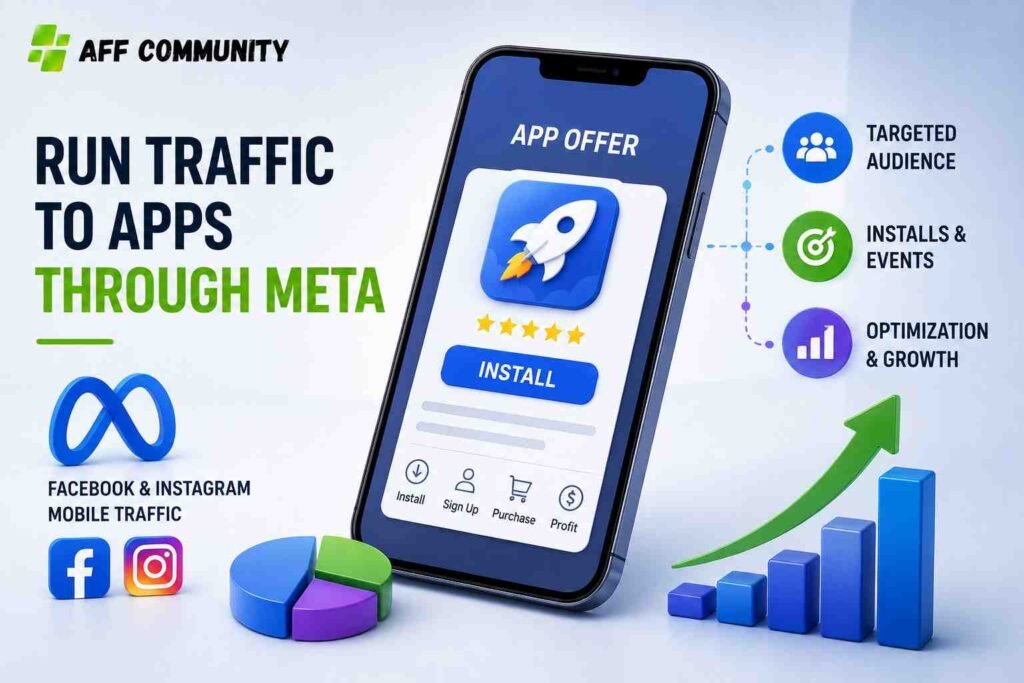
How to Run Traffic to Apps Through Meta

Meta remains one of the primary sources of mobile traffic for publishers. Facebook and Instagram allow you to reach a massive audience, and the platform’s algorithms can independently identify users who are highly likely to install the app or complete a target action.

However, in 2026, the approach to driving traffic to apps via Meta changed significantly. We recommend not starting with the maximum budget, but first properly preparing your offer, tracking, and ad creatives.

Run traffic to apps through meta

What Apps Can You Promote?

On Meta, you can test a wide variety of app offers: utilities, VPNs, finance, gaming, e-commerce, entertainment, and other apps.

At the same time, it’s important to understand in advance which action the advertiser is paying for. This could be an install, registration, deposit, purchase, or another event.

The mere fact of an install does not necessarily mean profit. A user may download the app but not take any action within it. Therefore, before launching a campaign, you need to know the final target action and its cost.

In-app mobile advertising also remains a major source of traffic in its own right. A recent overview of in-app traffic in 2026 examines in detail the main formats, verticals, and specifics of working with a mobile audience.

How to Prepare a Campaign

Before launching, you need to set up event tracking and ensure that analytics correctly record the user’s journey.

Depending on the offer model, it’s important to track installs, sign-ups, purchases, and other events. Without this, it’s harder for Meta’s algorithm to receive high-quality signals for optimization.

At the start, we recommend keeping the structure simple. It’s better to test a few clear hypotheses than to create dozens of campaigns with small budgets.

Creativity makes a huge difference

When promoting apps, you can’t keep using the same banner ad indefinitely. Users need to quickly understand what the app offers and why it’s relevant to them.

It’s a good idea to test different concepts:

  • interface demos;
  • short videos;
  • problem-solution approaches;
  • real-life use cases;
  • reviews and social proof;
  • dynamic product demos.

At the same time, the same creativity can yield completely different results in different countries. Effectiveness is influenced by auction costs, user habits, and cultural characteristics. This is well illustrated by an analysis of why the same creativity performs differently across different GEOs.

How to Choose GEOs

Don’t automatically start with Tier-1 markets just because the potential payout is higher there.

The key is the ratio of user acquisition cost to the revenue that user generates. In some cases, Tier-2 or Tier-3 markets offer much more attractive economics.

That’s why we recommend testing several markets and comparing them not by CPM or CPI separately, but by the total cost of the target action.

What to Do After the First Conversions

One of the biggest mistakes is increasing the budget too quickly. A few successful installations do not necessarily mean the campaign is ready for scaling.

First, you need to understand:

  1. which creativity delivers the best results;
  2. which audience converts;
  3. which GEO shows consistent profitability;
  4. which placement brings in high-quality users;
  5. whether the results hold up as volume increases.

We’ve already covered detailed approaches to scaling Meta Ads without a sharp increase in CPA in a separate article.

Monitor the Quality of Your Infrastructure

When working with Meta, it’s not just the ad account itself that matters. The system takes into account your Business Manager history, payment activity, domains, ad accounts, and campaign quality.

Therefore, before scaling up, you should make sure your infrastructure is running smoothly.

Which Metrics to Track

Don’t evaluate an app campaign based solely on the cost per install. For a comprehensive analysis, you need to look at the entire funnel: impressions → clicks → installs → conversions → revenue → ROI.

A high CTR indicates that the ad is appealing, but it doesn’t guarantee profitability. If users install the app but don’t take the desired action, the problem may lie with the offer itself, the audience, or the product.

That’s why we recommend analyzing ad campaign metrics comprehensively, rather than making decisions based on a single metric.

Conclusion

You can still effectively run traffic to apps via Meta in 2026. But the result depends not on a single ad account setting, but on the entire set of settings.

You need to choose the right offer, set up events, test GEO targeting and creativity, collect statistics, and only then scale the campaign.

For a publisher, the main metric is not the number of installs, but the cost of a high-quality user and the net profit. It is this metric that shows whether the app stack is truly ready for scaling.

How to use PWA applications on different geos without spending too much?

According to a survey, every three out of four non-English speakers would like to make online purchases using an interface in their native language. Therefore, buyers should not run PWA app translations into only one language – English. If you do so, a large part of the potential target audience will be lost to you.

For example, let’s take the Indonesian gambling market, estimated at sixty-odd billion dollars. English is spoken by only five million people in this Asian country, while its total population reaches two hundred and eighty two million citizens. With an English-speaking PWA apps, you can reach a very small portion of this GEO. With this example, the importance of localizing apps into local dialects to reach the target audience as much as possible becomes clear.

You don’t have to pay for a translator to translate your landing page and program into English. Do it another way, more profitable and convenient. Let’s consider it in more detail.

What exactly should be localized in PWA apps?

You should translate all the text except for the title. Localization of casino names is usually not required, players search for them using their original names. But online listings, user reviews, text descriptions should be placed in the language that is native to the player, so that they do not look questionable. So what parts of the app are subject to mandatory adaptation?

Description

According to statistics, more than half of users do not use English-language online resources for shopping. Of all the texts placed on the landing page, the largest is the product description. It immediately becomes visible to users. Localization of the description provides increased trust from users and raises the place of apps in the search engines. In the placed text for this purpose should specify the most popular keys and provide answers to the most common questions asked by users: how to deposit an account, whether the site runs a loyalty program and tech support, what entertainment is available in the casino and so on.

You can compose a description with the help of ChatGPT. In this case, the cost of paying for the newsletter is quite justified. You will need several versions of detailed descriptions in the same language. Simply list the keywords and details you need, and then specify how many times the text needs to be rewritten.

Once you have the translated texts, paste them into the PWA apps. Manually inserting them is quite time-consuming. In this case you will have to open and edit the texts and then save them. If the application was ordered from a programmer, you will need a document that indicates its name, the place on the landing for the text, the translations themselves. The process of correction also requires money and time. It is easier and faster to do everything yourself with the help of a designer. Using PWA Group, a buyer can assemble apps to work by himself. Once you have created the right number of templates in different languages, you can then insert them with just one click.

Reviews

Before making a purchase, most modern users familiarize themselves with reviews. To make them more accessible, you should translate the language of the players so that they don’t have to use a translator. You can use a neural network for translation. You can also do things the other way around. Simply go to the landing page, using the PWA applications of other buyers, find the reviews and copy them, then slightly modify and adapt them in the builder.

When using neural network, the reviews turn out unnatural, many users notice it right away.

Push mailing

An important stage of the work on making apps is to set up push notifications, through which users receive notifications on their devices to return and make a deposit. To make the text contained in the notifications understandable to the recipients, they should be translated into the language of players. The push notifications can be written manually or with the help of ChatGPT. Neural network is usually used by beginners, while experienced users prefer to compose a newsletter themselves.

Having generated a newsletter, you will have to implement it in apps by configuring the necessary parameters. To do this, you can rewrite the application code yourself or entrust this process to its developer, paying him for the work done. If you want to save time and financial resources, you can build apps and mailing list in the constructor. With the help of the constructor you can create any number of templates in different languages, compose a mailing text, specify under what conditions it will be sent to users. Thanks to the simple interface of the constructor, even those buyers who do not know the basics of programming can do it.

Top Advertising grids with push-newsletters look here.

Conclusions

To maximize conversion rates as much as possible, you should translate into both the main language of the geo and the existing dialects. This approach will ensure that you attract the maximum amount of traffic.

Translate texts using ChatGPT into different dialects, compose descriptions, user reviews, properly prepare messages. You can also use artificial intelligence to analyze target audience queries, which will save you even more time and effort.

You can add a ready translation to your app with the help of PWA Group’s builder. Use this handy software tool to build an application yourself without paying for the services of a programmer and translator, customize all its elements, and translate them into the language you need.

How to proceed if the PWA apps are not converting

Webmasters mistakenly think that in order to make a profit you need to set up PWA and proceed to connecting an offer. Only then you can engage in buying traffic. It is necessary to optimize PWA in order to recoup financial investments. It is necessary to understand the work of the application in detail and learn the peculiarities of PWA functioning. The webmaster should know why there is no necessary conversion from apps. From this article, you will learn a lot of useful information about apps conversion.

Factors contributing to app conversion

Suitable design, proper push newsletter setup, low weight of the app-all these increase the conversion rate. A lot depends on the listed factors. Customization of each element has characteristic features.

Design customization

Neutral design is used by those specialists who are afraid of banning. As a result, a standard variant is obtained, and customers do not see full information. Users do not see the entire range of slots, jackpots and other details. Apps does not attract the attention of users because it does not differ from hundreds of other options.

Storrs is not used to host PWA apps, so you don’t have to worry about being blocked. Players and ludomaniacs like the aggressive app design. Such a design will catch the player’s eye and keep his attention. A ludomaniac will appreciate a bright picture, a large assortment of offers, and then install the app.

Customizing push-newsletters

Personalized push-mailing will be the best option in the app. Buyers often forget about personalized mailing and give preference to standard notifications. This approach contributes to the fact that the conversion rate of the PWA app falls. An experienced webmaster will be able to independently write the notification text and customize the regularity of sending messages. Users receive a personalized mailing with notifications and start playing on the gadget at a convenient time.

Minimal weight of PWA app

Apps with low weight download quickly and take up little space in the gadget. WebView and classic apps up to 30 MB take up quite a lot of memory space. PWA-applications do not exceed 1 MB, so the programs are downloaded as fast as possible. In African countries, users pay up to 20 dollars for 1 GB of Internet. Not all users will be able to afford to download classic apps on a regular basis. Webmasters have an increased chance of getting a lead using PWA.

PWA apps are not converting

Ways to increase conversion

Useful tips will help the webmaster with a small budget to raise the conversion rate. One should stick to such tips:

  1. Optimize PWA performance. When using high quality images, the speed of downloading the application decreases. The PWA downloads quickly, but then the user has to wait a long time for the interface to load. The user may not come back again after uninstalling the application. To fix the problem, you need to reduce the file size. With the help of PWA Group, the webmaster will be able to specify the exact size of apps and set the quality of creativity. In a short period of time, the specialist will select the “golden mean”.
  2. Attractiveness of the offer for a particular GEO. Different factors affect the conversion rate in a particular region. This is the format of the casino, the range of games, the availability of some payment methods. Crypto-casinos can not be advertised in those regions in which digital currencies are not popular. Do not hope for high conversion rates if users in a certain GEO can not make deposits. In such cases, even the most experienced specialist will not be able to increase conversion rates.
  3. Tests and data analysis. The webmaster needs to know which elements of the funnel are not working effectively. Different targeting settings will allow you to test several bundles at once. You can safely run the entire budget on a suitable bundle. Modern tests on GEO will be maximally effective.

Conclusion

The main factors affect the conversion rate of apps. These are push-posts, the design of the apps, as well as its weight. Ludomaniacs will definitely not like dim and voluminous images, monotonous messages. Users will be scared off by the heavy weight of apps, long interface loading.

Creativity, PWAs and the landing page should be well combined with each other. Optimization of the analytics system, testing strategies in different regions will lead to the desired result. Bayer will be able to pick the most effective bundle to use.

Attention should be paid to the reasons for low conversion rates. Not always the reasons depend on apps. If players download the PWA app and go through registration, but do not make a deposit, there will be no conversion. In just a few minutes in a special constructor you can create a functional application and customize the mailing list. Then the specialist moves on to running the first tests. Testing allows you to find and eliminate the cause of low conversion without large financial investments.
