How to Avoid a Risk Payment in Meta Ads

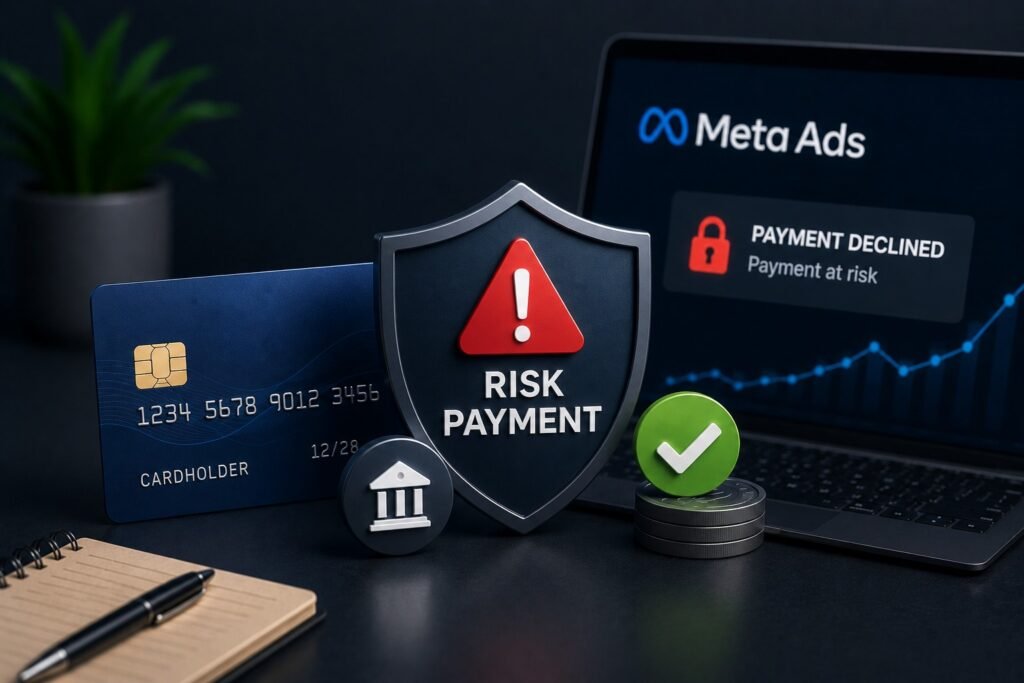
One of the most unpleasant notifications any webmaster can see in Meta Ads is Risk Payment. It usually appears out of the blue: payments stop going through, ad campaigns are paused, and the ad account is flagged for further review.

Our team regularly encounters these situations, and we can say one thing for certain: in most cases, a “Risk Payment” doesn’t happen by accident. It’s the result of Meta’s anti-fraud system flagging your payment activity or infrastructure as potentially risky.

It’s important to understand that the problem is rarely related solely to your credit card. Meta analyzes dozens of factors simultaneously, so you need to address the entire system, not just a single issue.

Why “Risk Payment” Appears

Meta uses its own algorithms to assess the risk of each financial transaction. When a payment is attempted, the system analyzes:

  • Business Manager history;
  • card payment history;
  • the device used to log in;
  • the IP address;
  • advertising activity;
  • the number of previous rejections;
  • and the account’s behavior since creation.

If several of these indicators appear suspicious at once, the likelihood of triggering a “Risk Payment” significantly increases. Therefore, an error doesn’t always mean the problem is specifically with the card.

Payment diclined in meta ads

Don’t Switch Cards After the First Error

The most common reaction is to immediately remove the card and add a new one. In practice, this approach often only makes the situation worse.

Meta can clearly see when an advertiser is constantly changing payment methods. If, within a short period, several cards from different banks, countries, or with different BINs are linked to a single Business Manager account, it looks like an attempt to bypass internal checks.

It’s much safer to figure out the cause of the error than to endlessly change your payment details.

By the way, we discussed in detail in this article how bank card BINs affect the operation of advertising platforms and why different cards go through moderation differently.

Business Manager Trust Plays a Huge Role

Many people underestimate the impact of Business Manager itself. Even a high-quality bank card doesn’t guarantee a successful payment if the Business Manager regularly violates the platform’s rules.

Meta evaluates the history of ad campaigns, the number of blocked accounts, the quality of ad creatives, payment discipline, and many other factors.

The more consistently Business Manager operates, the less likely you are to face additional reviews.

That’s exactly why strong teams devote just as much attention to developing their infrastructure as they do to finding profitable ad combinations.

BUTTON – We recommend reading the article “What Affects Business Manager Trust

Don’t ignore the importance of running your infrastructure

Another reason for a “Risk Payment” flag is attempting to work with large budgets right away.

A new ad account, a Business Manager account that’s just been created, and the very first campaign worth several thousand dollars look suspicious. Meta’s algorithms expect more natural behavior.

That’s why experienced advertisers first gradually run their infrastructure:

  1. They add employees.
  2. Verify the domain.
  3. Run small ad campaigns.
  4. Build a positive payment history.

Only then do they begin scaling up. It is precisely this approach that significantly reduces the likelihood of a Risk Payment.

We discussed in detail how to properly run your ad infrastructure in the article at this link.

Monitor the quality of your ad campaigns

Many people believe that Meta’s payment system has nothing to do with ad quality. In practice, the opposite is true.

If Business Manager regularly has ads rejected, runs questionable creativity, or violates advertising policies, the trust level gradually decreases.

As a result, additional reviews begin to affect not only the ads but also the payment side of the account.

That’s exactly why high-quality White Pages, proper ad creatives, and careful handling of moderation become an important part of the overall strategy.

Stability is more important than constant change

The more chaos there is within the infrastructure, the higher the likelihood of triggering internal reviews:

  • frequent device changes;
  • new IP addresses;
  • logging in from different countries;
  • constantly switching payment methods;
  • creating a large number of ad accounts.

All of this generates additional risk signals. Professional teams, on the other hand, strive to stabilize their operations as much as possible.

They use a consistent infrastructure, avoid sudden changes, and gradually increase their ad budgets. It is precisely this behavior pattern that appears most natural to Meta’s algorithms.

It’s no coincidence that modern Facebook algorithms are increasingly focused on a comprehensive assessment of the advertiser rather than on individual actions. This process was discussed in detail here.

What to Do If a “Risk Payment” Flag Has Already Appeared

If the error has already appeared, don’t panic. Don’t immediately link five new cards or create dozens of new Business Manager accounts.

It’s much more effective to check your entire infrastructure:

  • payment history;
  • Business Manager status;
  • ad campaign quality;
  • device and IP stability;
  • and whether the card is linked to the right ad account.

Most often, the problem lies in a combination of factors, not in any single element.

Conclusion

A “Risk Payment” is not a random error, but a signal that Meta has detected an elevated level of risk.

You can only avoid such restrictions by taking a comprehensive approach: use a high-quality payment infrastructure, gradually run your Business Manager, follow the platform’s rules, and avoid triggering unnecessary red flags.

It is precisely stability, consistency, and careful management of the infrastructure that allow strong affiliate marketing teams to operate for months without serious payment issues and to scale their ad campaigns with confidence.

Bank Card BINs: What They Are and How They Affect Payments

Virtually every publisher has encountered a situation at least once where one bank card successfully processes a payment for an advertising account, while another receives an error, is declined, or is subject to additional verification. Many attribute this solely to the card’s balance or the issuing bank.

But in practice, it all starts much earlier—with the BIN.

Our team regularly receives questions about why cards of the same type behave completely differently when paying for Facebook Ads, Google Ads, or other advertising platforms. This is largely due to BINs, which have long been one of the factors used to evaluate payment transactions.

What Is a BIN

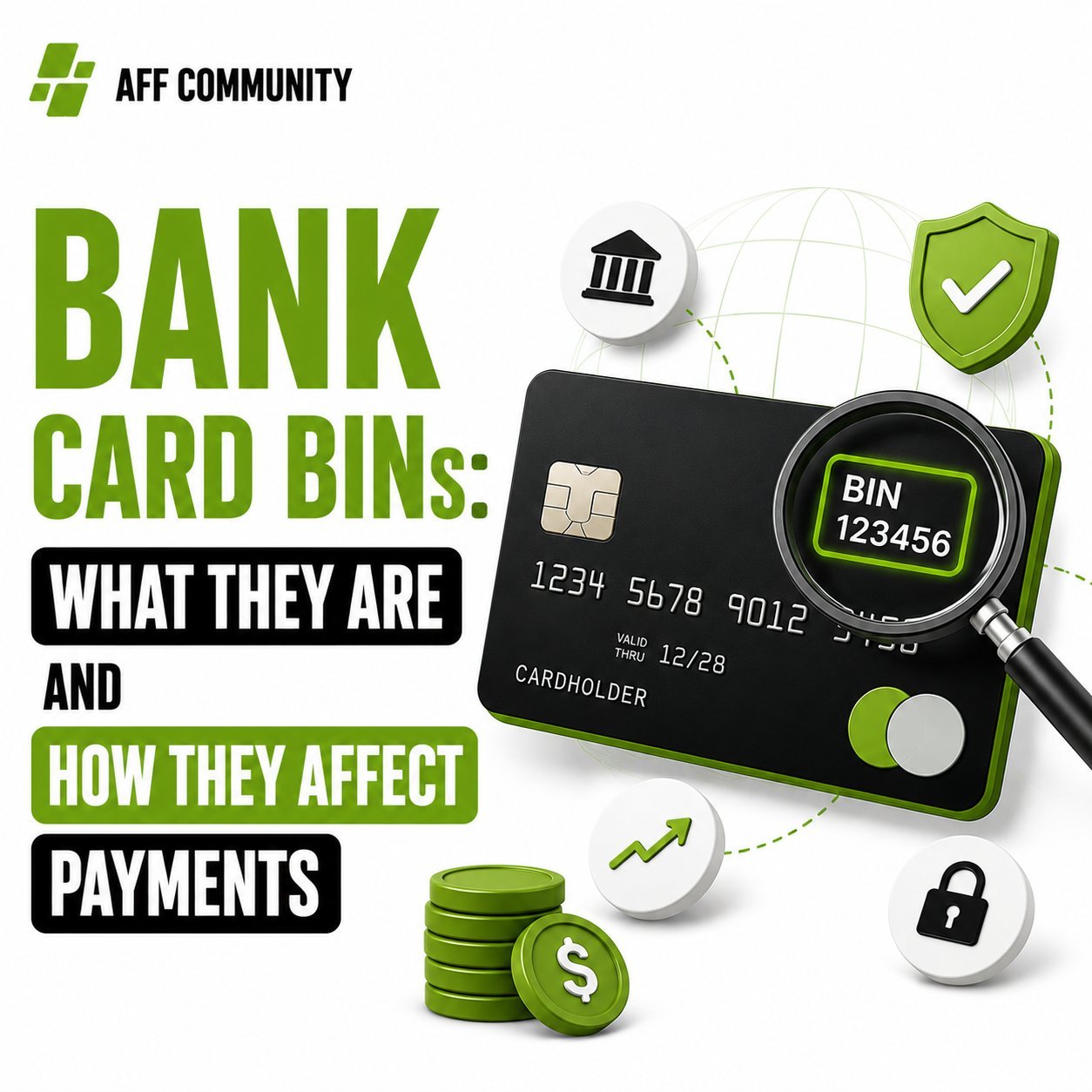
A BIN (Bank Identification Number) is the first few digits of a bank card, which the payment system uses to determine key information about the card.

It is the BIN that reveals:

  • which bank issued the card;
  • the payment system (Visa, Mastercard, and others);
  • the country of issue;
  • the card type (Debit, Credit, Business, Prepaid);
  • and sometimes the product category.

When an advertising platform receives a payment request, it analyzes not only the transaction itself but also the BIN’s characteristics. Essentially, even before the funds are debited, the system already has a basic understanding of the card.

Why is the BIN important for publishers?

Many believe that Meta or Google check only whether the payment was successful. In reality, modern anti-fraud systems analyze significantly more parameters.

If a BIN regularly appears in suspicious transactions, mass account registrations, or a large number of declined payments, the trust level for such cards gradually decreases.

This does not mean automatic blocking. But the likelihood of additional checks increases. This is especially noticeable when working with a large number of ad accounts.

BUTTON – We recommend reading the article “Running an Ad Account Step by Step: How to Prepare Your Account

Not all BINs are equally suitable for advertising

There is a huge variety of banking products on the market. Some cards are designed for everyday purchases. Others are intended for corporate expenses. Still others are issued as virtual or prepaid cards.

Advertising platforms treat these categories differently. For example, widespread use of the same type of virtual BINs can attract additional attention from anti-fraud systems.

This is precisely why professional teams take a meticulous approach to selecting payment infrastructure and regularly test various options.

The BIN is just one part of the bigger picture

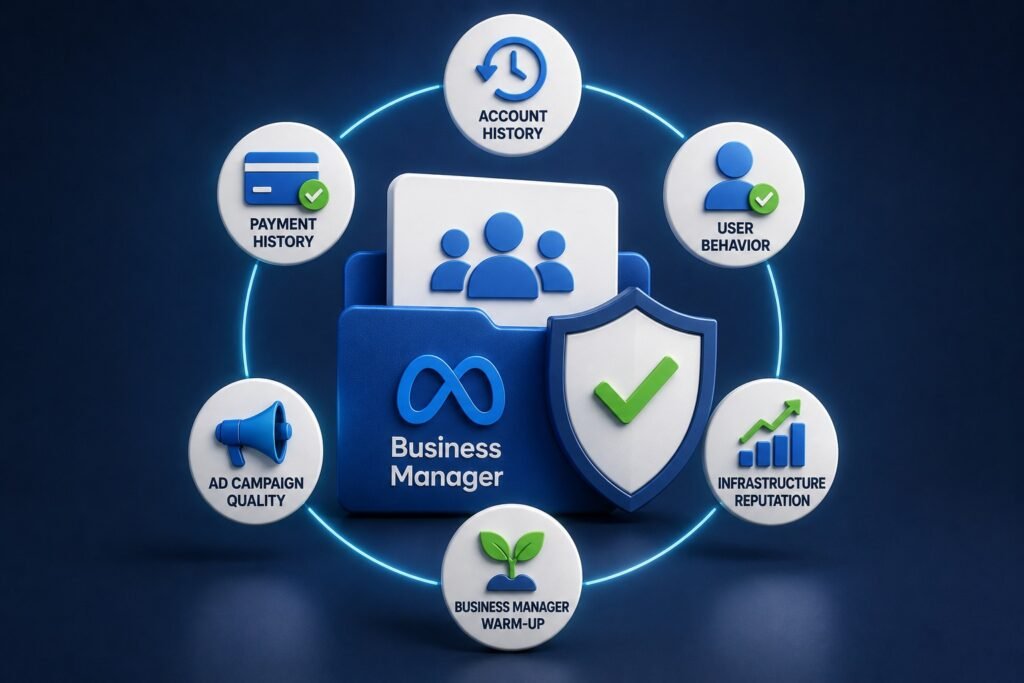
A common mistake among beginners is trying to attribute all problems solely to the card’s BIN. In practice, the platform analyzes many more factors:

  1. Business Manager history.
  2. Ad account age.
  3. User behavior.
  4. IP address.
  5. Device.
  6. Payment history.
  7. Ad campaign quality.

All these signals are evaluated simultaneously. That’s why even a good BIN can’t compensate for errors in the rest of the infrastructure.

We discussed the factors affecting Business Manager trust in detail in this article.

Why You Shouldn’t Constantly Switch Cards

At the first sign of trouble, many people start endlessly switching payment methods. This approach rarely yields results. Frequent card changes can, in and of themselves, appear suspicious to the advertising platform’s algorithms.

It’s much more important to find a stable payment infrastructure and use it consistently.

It is precisely this consistency that more often than not has a positive impact on the overall trust score.

How to Reduce the Risk of Rejections

It’s impossible to completely eliminate payment issues. But you can significantly reduce the likelihood of errors.

To do this, it’s important to:

  • use high-quality banking products;
  • avoid changing cards unnecessarily;
  • maintain a stable infrastructure;
  • avoid a large number of failed payments;
  • monitor your Business Manager’s reputation.

Additionally, it’s important to remember that the payment aspect is closely linked to the quality of the entire advertising infrastructure.

Even a perfectly selected BIN won’t save a campaign if the advertising account regularly violates the platform’s rules.

BIN and Modern Anti-Fraud Algorithms

Every year, advertising platforms are increasingly using machine learning to analyze financial transactions. The algorithms don’t evaluate a single card, but rather a combination of dozens of signals.

The BIN has become one element of the overall risk assessment system. That’s precisely why it’s no longer enough to simply select the “right” card.

You need to build your entire infrastructure in such a way that it appears as natural as possible to the platform’s algorithms.

The article at this link provides a detailed explanation of how Meta’s modern algorithms analyze advertiser behavior and make decisions.

Conclusion

A bank card’s BIN does indeed affect how you work with advertising platforms, but it cannot be considered in isolation from the entire infrastructure.

Successful affiliate marketing teams take a comprehensive approach: they use high-quality payment solutions, maintain a good Business Manager trust score, comply with platform rules, and minimize suspicious activity.

It is precisely this approach that allows them to encounter payment restrictions much less frequently and scale their ad campaigns with confidence.

What Affects Business Manager Trust

Business Manager (BM) has long been the backbone of most affiliate marketing teams that run traffic through the Meta ecosystem. It is within BM that ad accounts are created, payment methods are set up, employee roles are assigned, and the entire infrastructure is managed.

However, many webmasters still believe that Business Manager trust depends solely on its age.

Our team constantly sees examples to the contrary. A young BM can perform significantly more reliably than an older one if it’s set up correctly from the start. Conversely, a BM that’s been around for years can be subject to restrictions after just a few missteps.

Therefore, trust is the sum of many factors, not a single specific metric.

Account History

The first thing Meta’s algorithms look at is the Business Manager’s history.

If a Business Manager has been used for a long time without violations—with no mass bans, suspicious payments, or constant changes in ownership—its trust level gradually increases.

Business Manager history

Accounts where new ad accounts are regularly created, dozens of rejected campaigns are launched, and infrastructure changes occur constantly look very different.

Such activity automatically increases the risk level. This is precisely why experienced teams strive to manage Business Manager as carefully as possible from the very first days of its existence.

Payment History

One of the most underrated factors is the quality of your payment history. Meta analyzes not only successful payments but also canceled transactions, refunds, debit errors, and suspicious financial activity.

Frequent card changes, constant payment declines, and the use of questionable payment methods negatively impact the system’s trust in you.

For this reason, proper billing management becomes part of the overall strategy for building trust in your Business Manager.

User Behavior Within Business Manager

Meta analyzes not only ads but also the actions of the administrators themselves. If Business Manager is constantly accessed from different devices, countries, or browsers, the system begins to perceive such activity as potentially dangerous.

Therefore, large affiliate marketing teams pay close attention to the stability of their operational infrastructure.

They use proven anti-detection browsers, fixed digital fingerprints, and high-quality proxies. This helps reduce the number of suspicious signals detected by Meta’s algorithms.

A list of the best anti-detection browsers is available on our website at this link.

Ad Campaign Quality

Many believe that the rejection of a single ad does not affect Business Manager trust.

In practice, things are much more complicated.

If campaigns that violate the rules are regularly launched within Business Manager, a large number of ads get rejected, and ad accounts are blocked en masse, trust gradually declines.

This is especially true for gray-area verticals.

That’s why strong teams pay close attention to creativity preparation, White Page quality, and compliance with platform requirements even before launching ads.

Run Business Manager

Creating a BM and immediately launching large-scale campaigns is one of the most common mistakes.

A new Business Manager should gradually build up its history:

  1. Adding employees.
  2. Connecting a domain.
  3. Setting up business information.
  4. Creating your first ad campaigns with small budgets.

This sequence looks much more natural to Meta’s algorithms. That’s why it’s important to run proper warm-up during infrastructure preparation.

The detailed process of gradually building trust in ad accounts is explained in this article.

The Reputation of the Entire Infrastructure

It’s important to understand that Meta doesn’t evaluate Business Manager in isolation. The system analyzes the entire ecosystem.

  • domains;
  • pixels;
  • ad accounts;
  • Facebook Pages;
  • payment methods;
  • user accounts.

If one of these elements is regularly subject to sanctions, it can negatively impact the other associated entities as well.

This is precisely why professional teams view the infrastructure as a single mechanism, where every detail influences the overall level of trust.

Conclusion

Business Manager trust cannot be earned in a single day. It is built gradually through consistent performance, high-quality infrastructure, a clean payment history, and compliance with platform rules.

In 2026, it is precisely this comprehensive approach that allows teams to keep their Business Managers active longer, scale ad campaigns faster, and encounter account suspensions much less frequently.

That’s why strong affiliate marketing teams invest not only in finding new ad combinations but also in developing their own infrastructure, understanding that high Business Manager trust is one of the most important assets when working with Meta Ads.

The Best Scaling Strategies in Meta Ads

Virtually every publisher has faced the same situation. A campaign shows excellent ROI on a test budget, passes the initial learning phases, and starts generating a steady profit—but as soon as the budget is increased, the campaign’s performance begins to deteriorate rapidly.

Our team regularly encounters cases like this. Scaling in Meta Ads has long since ceased to be a simple matter of increasing the daily budget. The algorithms have become significantly more complex, and mistakes at this stage are much more costly than failed tests.

That’s why successful scaling today is a distinct skill that requires no less attention than finding new audience segments.

Don’t scale your campaign too early

The most common mistake is trying to increase the budget immediately after receiving the first conversions. Even if the campaign is showing a good ROI, that doesn’t mean the algorithm has fully trained itself yet.

Facebook requires a sufficient volume of high-quality events to consistently find the right audience.

scaling in meta ads

If you start sharply increasing the budget prematurely, the algorithm reverts to the learning phase, and the cost per lead can increase severalfold.

This is precisely why experienced advertisers first achieve stability and only then begin scaling.

Vertical scaling doesn’t always work

The simplest way to increase traffic volume is to gradually raise the daily budget. However, this approach most often leads to a rise in CPM and a decline in results.

It’s much safer to increase the budget in small increments, typically by 15–20% per day. This approach allows the algorithm to adapt without significantly disrupting the auction.

If you need to increase volume sharply, it’s better to use other methods.

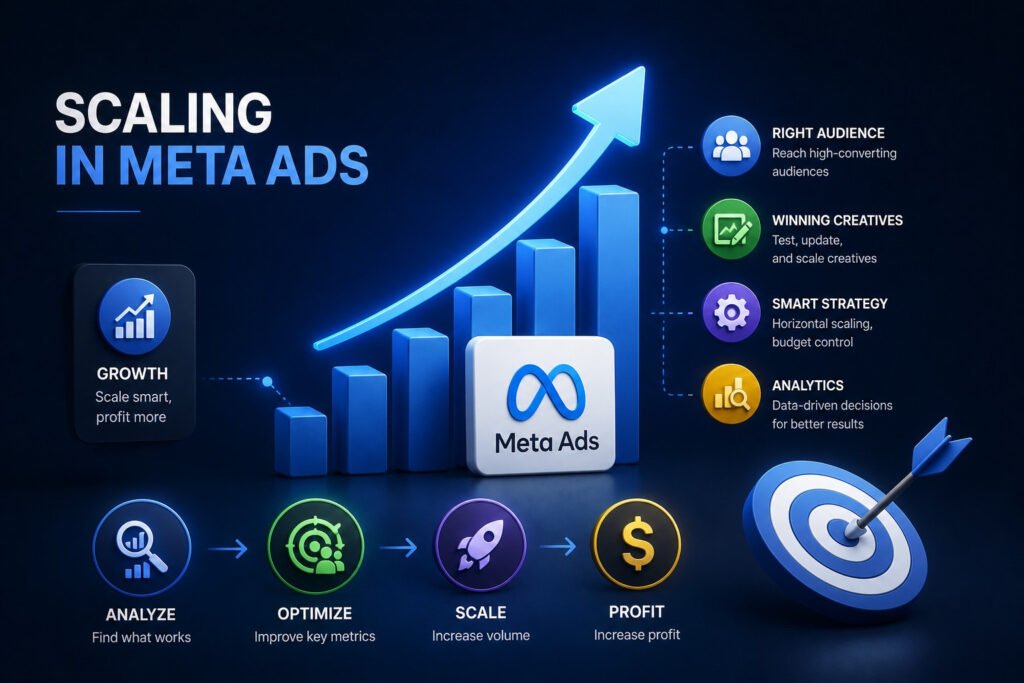
Horizontal scaling is often more effective

In many cases, creating multiple active campaign groups works significantly better than increasing the budget of a single campaign. Teams launch duplicate campaigns with different audiences, creativities, or placements.

This approach reduces the load on a single ad algorithm and allows you to generate additional traffic without a sharp increase in traffic costs.

Horizontal scaling performs particularly well in competitive verticals such as Gambling, Nutra, and Finance.

At the same time, it’s important to regularly update ad creativity, since creativity is most often the cause of declining performance when traffic volumes are high. This issue was discussed in detail in this article.

Watch for signs of ad set burnout

Even a perfectly scaled campaign won’t work indefinitely. Over time, the audience begins to burn out, CTR drops, CPM rises, and conversion rates gradually fall.

If you don’t notice these changes in time, you could lose a significant portion of your profit.

That’s exactly why strong teams analyze key metrics daily and prepare new creativity, audiences, and advertising approaches in advance.

Scaling Starts with Analytics

One of the most underrated parts of the process is working with data. Many webmasters make decisions based on intuition. But with large budgets, the cost of a mistake becomes too high.

Before each scaling stage, you need to understand:

  • which audience delivers the best CPA;
  • which creativity maintains a high CTR;
  • which placements yield the cheapest conversions;
  • which ad combinations are already starting to lose effectiveness.

It is precisely detailed analytics that allows you to scale profits, not expenses.

It’s no coincidence that many teams build their processes around systematic data analysis. This approach is discussed in detail in the article at this link.

Meta’s algorithms continue to evolve

Many scaling tips that worked two or three years ago no longer deliver the same results today.

Meta is increasingly using machine learning. The system automatically redistributes the budget among audiences, tests new user segments, and makes decisions faster than a human.

Because of this, manual intervention in campaigns should be kept to a minimum. The advertiser’s task today is not constant manual tweaking, but rather the proper preparation of high-quality input data for the algorithm.

Conclusion

By 2026, scaling in Meta Ads will no longer be a matter of increasing the budget. Successful teams scale the system, not the campaigns.

They prepare new creativity in advance, regularly update their audiences, analyze every metric, and give the algorithms enough time to learn.

It is precisely this approach that allows them to increase traffic volumes without a sharp rise in CPA and maintain profitability even in highly competitive environments.

Step-by-step guide to running an advertising account: how to prepare your account

One of the most costly mistakes made by newcomers to affiliate marketing is attempting to run aggressive ad volumes on a brand-new account straight away. A user creates an account, links a card, and tries to run through their budget from day one, as if the account had already been running for several months.

In 2026, this approach rarely ends well. Advertising platform algorithms have long since learnt to distinguish natural behaviour from attempts to scale up rapidly. That is precisely why it is necessary to run an account properly before it is launched, and this has now become part of the infrastructure, rather than an optional precaution.

And this applies not only to Facebook. Similar principles apply to both Google Ads and TikTok Ads.

Why the system runs, even

From the advertising platform’s perspective, a new account is an unknown entity. The system does not know who the account owner is, how they will operate, what traffic they plan to purchase, or how safe it is to interact with them.

Therefore, the first few days after creating an account effectively become a trust assessment phase.

This is precisely where many people make a mistake. Instead of gradually building up activity, advertisers start creating adverts en masse, changing billing details, connecting new devices, and launching campaigns in high-risk verticals. Afterwards, they are surprised by the restrictions.

Incidentally, the mistakes that lead to problems with advertising accounts even before scaling have already been discussed in detail in this article.

Stage one: building a normal history

The warm-up phase does not begin with launching adverts. First, the account must look like a regular advertiser.

In practice, this means a completed profile, correct payment details, a clear account structure, and no suspicious activity.

A great many webmasters underestimate this stage. It seems as though it achieves nothing. But it is precisely these small details that build initial trust.

In affiliate marketing, people tend to look for complex schemes, although problems often arise simply because of a lack of a systematic approach. This point has already been discussed separately here.

Stage two: initial advertising activities

The next mistake is to launch complex ad campaigns immediately after creating an account. Standard practice looks different.

First come simple campaigns with small budgets. Their aim is not to make money, but to demonstrate clear and predictable behaviour to the system. At this stage, there is no need to try to squeeze out maximum ROI.

On the contrary, it is better to focus on stability. Many experienced teams treat their initial campaigns as an investment in the account’s future performance.

Stage three: gradually increasing activity

The biggest problem for most beginners is impatience. The first conversion appears. The first profit appears, and immediately you want to increase the budget several times over.

It is at this very moment that many accounts start to attract undue attention from the algorithms.

Growth should look natural. The advertising platform is much more relaxed about gradual scaling than about sudden budget increases. This principle works in virtually all traffic sources.

Incidentally, the very logic of scaling campaigns and finding stable growth points has already been discussed in detail at the link.

Why running doesn’t save a poor infrastructure

It’s important to understand: running isn’t a magic button. If you’re using problematic consumables, unstable proxies, poor White pages, unsuitable profiles or a weak technical infrastructure, even a perfectly run account can face bans.

That is why strong teams usually view running as part of an overall system.

This includes accounts, virtual cards, infrastructure, anti-detect browsers, proxies, high-quality White pages and the quality of the traffic itself.

The main mistake made by most webmasters

Almost all problems stem from the desire to speed up the process. A person sees that the account is working and starts to drastically increase budgets, change ad groups, add new GEOs and run several campaigns simultaneously.

From the platform’s perspective, such behaviour looks unnatural. This is precisely why many accounts last only a few days, even though they could have run for months.

Conclusion

In 2026, running an advertising account remains an essential part of working with virtually any traffic source. Not because it guarantees the absence of bans.

But because a properly run account gains more trust from the platform and allows for smoother scaling.

In affiliate marketing, speed has long ceased to be the deciding factor. Today, predictability, consistency, and an understanding of what constitutes normal advertiser behaviour from the algorithms’ perspective are far more important.

Facebook Ads Error: “Country with Trade Restrictions” — What It Means, How to Avoid It, and Why the BIN Code Matters

In 2024–2025, Facebook significantly tightened its payment verification policies. More and more advertisers are encountering the error “Country with trade restrictions” when linking a card to Business Manager. In this article, we explain what this error actually means, how it relates to the card’s BIN code, why Facebook may request a tax number, and what you can do to prevent getting blocked and protect your ad accounts.

What Does the “Country with Trade Restrictions” Error Mean?

This error appears when trying to add a payment method to an ad account. Facebook rejects the card, citing that the issuing country is under trade restrictions. This can be confusing: the card may be functional and in USD or EUR, yet still gets rejected.

This typically happens when:

  • the card’s BIN code points to a high-risk or sanctioned region (e.g., Kazakhstan, Russia, Belarus);
  • the ad account and card are registered in different GEOs (e.g., account set to Poland, card issued in the Philippines);
  • the payment provider is unknown or lacks sufficient trust signals;
  • Similar cards have previously been flagged for abuse or high chargeback rates.

Important: Facebook may block a BIN range entirely based on prior abuse, even before a transaction is attempted.

What is a BIN Code and How Facebook Uses It

A BIN (Bank Identification Number) is the first 6–8 digits of a card. It reveals the issuing country, bank, and card type (debit, prepaid, etc.). Facebook and other platforms (like TikTok and Google) cross-check this BIN during card submission.

Some mistakenly believe a valid VISA/MasterCard will always be accepted, but Facebook uses BIN-specific blacklists and trust scores.

How BIN affects:

  1. BINs from unstable regions may be globally blocked.
  2. Fintech-issued BINs may lack transaction history, lowering trust.
  3. BINs determine features like 3D Secure support or auto-billing availability.

? With Pay2.House, you can pre-select the BIN region when issuing a card (EU, UA, PL, LT), increasing your chances of successful verification. Cards are 3D Secure-ready and Business Manager-compatible.

Why Facebook Asks for a Tax Number (TIN)

A TIN (Taxpayer Identification Number) is required in some GEOs and scenarios:

  • high monthly ad spend;
  • suspicion of commercial activity under a personal profile;
  • the card’s BIN is tied to countries with tax reporting regulations (Poland, Germany, USA);
  • ads are run in verticals like finance or subscriptions.

If you provide an invalid or fake TIN, your ad account can be restricted. In countries like the US, France, and Spain, Facebook cross-references TINs with national databases.

Tips:

  1. Don’t register as a business unless necessary;
  2. Avoid using someone else’s TIN — it can result in a permanent block across all related accounts;
  3. If you’re a legitimate advertiser, prepare your documents in advance.

How to Avoid the Card Restriction Error

To minimize your risk:

✅ Use cards with stable and trusted BINs. Services like Pay2.House let you choose the BIN region and issue multiple cards quickly.

✅ Align your proxy, browser fingerprint, and card region. Avoid mismatches (e.g., Lithuanian card, Vietnamese proxy, German account).

✅ Don’t add the card immediately. Let the ad account “warm up” for 24–48 hours with organic behavior.

✅ Manually enter card details from a clean browser session. Don’t use autofill or switch devices mid-session.

✅ Make sure the card supports 3D Secure — cards from Pay2.House do.

✅ If the card fails, don’t retry immediately. Multiple failed attempts increase the chance of being flagged.

Also:

  • use anti-detect browsers with separate profiles;
  • match browser timezone, language, and region to the card’s GEO;
  • disable unstable VPN extensions that can rotate IPs.

What to Do if the Card Fails

When a card is rejected:

  1. Check its BIN via tools like binlist.net or bincheck.io.
  2. Issue a new card with a different BIN (Pay2.House allows instant reissuance).
  3. Try from a different proxy or fingerprint profile.
  4. Create a new ad account under the same Business Manager and try again.
  5. Use a fresh IP (e.g., 4G modem) or device for submission.

Bonus Tips

  • enable 2FA in your Facebook account to boost credibility;
  • avoid adding multiple cards in a row — three declines may trigger a lockout;
  • prefer static dedicated proxies over rotating ones;
  • if you work in a team: each buyer should have their own isolated payment and profile setup.

Final Thoughts

The “Country with trade restrictions” error is not a bug — it’s Facebook’s fraud prevention mechanism. In 2025, a functioning card is no longer enough: you need a fully aligned payment infrastructure.

That means building a system where every element — card BIN, proxy IP, fingerprint, ad behavior — works in sync.

Tools like Pay2.House give you an edge: the ability to choose BIN regions, issue unlimited cards, manage budgets, and pass payment verification smoothly.

To stay competitive, stop chasing workarounds and start investing in structure. A well-built setup saves you time, money, and stress — and keeps your ad accounts alive and scaling.

FB algorithms in 2025

Every publisher should know how Facebook algorithms work in 2025 and how to properly set up advertising campaigns to achieve project goals. The updated platform system dictates new rules that must be taken into account by everyone who interacts with FB Ads.

How Facebook algorithms have changed

Facebook algorithms have undergone significant changes: the advertising campaign optimization process has become longer. Previously, the first results in the form of audience response appeared after a few hours, but today it takes at least 2-3 days to adapt a campaign.

Reasons for the changes

According to analysis, Facebook’s artificial intelligence has become more “attentive.”

It processes large amounts of data, studies complex user behavior patterns, and forms a target audience in stages over the first 24 hours. Experts note that premature adjustments can disrupt the algorithm learning process.

Stages of advertising campaigns

Launching an advertising campaign includes several main stages:

  1. 1-2 days of work with minimal investment. It is recommended to launch an advertising campaign with a small budget. The purpose of this stage is to allow the algorithm to collect enough data about the target audience. Experts emphasize that changes in settings without good reason can harm effectiveness.
  2. Monitoring the main indicator — CTR. CTR (click-through rate) remains the main benchmark at the start. If the values are normal (1% or higher for most niches), the campaign should be left in the learning phase without intervention.
  3. Avoid hasty edits. Experts advise against adjusting settings in the first few hours or days after launch. Facebook’s algorithms independently search for the target audience, and this takes time.
  4. Low CTR is a signal to stop. If after a day the CTR remains below the niche average or drops sharply, experts recommend stopping the campaign and testing alternative creativities.

Analysts note that success now depends on patience and data analysis. Research shows that Facebook algorithms are more effective at finding relevant audiences when the learning process is not interrupted.

Quick take

Facebook’s algorithms have gotten more complex and demanding lately. You’ll only get stable results by staying cool, focusing on key metrics, and launching campaigns in stages. Messing with the process early on can hurt performance, so it’s important to trust the system and not rush to get results.

How Facebook Ad Library works

Facebook Ad Library opens up a wide range of opportunities for marketers to study the competitive landscape and optimize their own campaigns. This tool allows not only to view the advertising creativity of competitors, but also to study in detail their target audience, budgets and formats used. Thanks to this information, specialists can identify trends, find non-standard solutions for presenting their products on the market and adjust existing strategies. Facebook Ad Library becomes an excellent assistant for those who seek to increase the return on their advertising investments and maximize results.

In addition to Facebook itself, the library covers other platforms such as Instagram and Messenger. This makes it an indispensable tool for comprehensive research of competitor activity and provides a comprehensive view of which promotional channels are most effective in a particular niche.

What Facebook’s advertising tools are designed for was told to AffCommunity. Go here and read the material.

Features of Facebook Ad Library

By studying the advertising strategies of competitors, you can assess their advantages and disadvantages, as well as familiarise yourself with new ad formats. This gives you the opportunity to adapt your own advertising strategy to changing market conditions and achieve better results.

Benefits of using an advertising library:

  • Understanding the market.
  • Learn which advertising messages work best in your niche.
  • Optimizing advertising budgets.
  • Allocate budget to the most effective formats and promotional channels.
  • Improving Creativity.
  • Create more attractive advertising materials.
  • Adaptation to your target audience.
  • Segment your audience more precisely and offer them relevant offers.

Key features of Facebook Ad Library:

  • Keyword Search.
  • Find ads related to your niche.
  • Target Audience Analysis.
  • Determine your audience’s socio-demographic profile and preferences.
  • Campaign Performance Comparison.
  • Compare the results of your campaigns with those of your competitors.

Search for fresh ideas

Exploring the campaigns of market leaders in the Facebook Ads library is a deep dive into the competitive landscape. By studying the creativity of successful brands and influencers, you can identify effective marketing strategies, current trends and unique techniques. This approach will allow you to create original promotional materials and predict the further development of your niche.

Visual content and creative texts are powerful tools to create interest on social media. By monitoring your competitors’ advertising campaigns, you can get an idea of the most effective visual solutions and text formats used. Keyword searches will allow you to assess which materials work best for your competitors and which advertising approaches are the most effective in the long term.

Increase the effectiveness of your ad campaigns

By using Facebook’s ad library, marketing professionals can optimize their own ad campaigns and maximise return on investment. By looking at data on how users interact with different ad types, ad messages can be personalized to specific audience segments, increasing the likelihood of conversion.

With precise keyword searches, you can quickly find relevant examples of creativity and see which ads are active and attracting the most attention. With transparent information, you’ll be able to adjust your campaigns to increase productivity and ROI.

Create an account and get access to the vast Facebook Ad Library database.

Why Facebook Ad Library is indispensable for advertisers

With Facebook Ad Library, you have the opportunity to optimize your advertising strategies through data analysis. The service provides space for researching and comparing different advertising campaigns, which helps you to quickly adapt to changes in market conditions.

Thanks to analytics tools, Facebook Ad Library gives you the opportunity to understand which solutions and approaches demonstrate the best results. By studying performance metrics, advertisers can identify the most successful advertising materials and use them as a basis for further development of campaigns.

In addition, the platform provides data on geographic and demographic targeting, which is extremely useful when optimising advertising efforts to suit the target audience. By analysing texts, videos and other elements of advertising campaigns, webmasters can develop more effective strategies based on current user preferences.

6 most popular tools for running traffic on Facebook

Facebook, despite the difficulties of moderation, continues to serve as one of the main sources of traffic. This online resource allows you to use various third-party tools: proxy servers, anti-detection browsers, services for analytics, special uniqueizers and so on. Webmasters also get the opportunity to use other tools that help them to increase the output from Facebook advertising campaigns.

Read reviews and testimonials of the top affiliate marketing tools at https://affcommunity.org/en/tools/.

What are Facebook advertising tools for?

With their help, webmasters optimize and automate the process of advertising campaigns management, solve some point tasks.

The use of FB advertising tools makes it possible to simplify the following processes:

  1. Optimization. With the help of these Facebook tools, you can analyze the results of your advertising campaigns and improve them using automated solutions. Applying them, you will very quickly identify a sharply increased rate per click, detect low conversion, you can quickly make the necessary changes.
  2. Analytics, reporting. You will be able to monitor key metrics of your advertising campaigns online. This will give you the opportunity to quickly adjust the strategy used: test new creativity, reallocate the budget, change the target audience, etc.
  3. Design, copywriting. Highly effective AI-tools can not only create texts, but also modify them for a specific target audience, GEO or traffic sources. This will ensure the generation of more creativity, make it possible to select the most successful versions of advertising campaigns and do it more accurately and quickly than when working manually.
  4. Planning. With the help of smart planning tools you will be able to correctly identify the target audience, automate the process of preparing an advertising campaign, distribute the advertising budget in the most efficient way. This will help you optimize your work and minimize the percentage of errors made when processing data manually.

Top 6 tools

With Facebook’s easy-to-use AI-powered advertising tools, you’ll make your ads more effective and optimize your spend.

TapClicks

This cloud-based online service integrates with various advertising channels and generates all the data from them into a common reporting system for the periods the user needs.

Having collected data from different platforms (Facebook, TikTok, Google Ads, etc.), it connects them in a common dashboard. Thanks to this, webmasters are able to monitor the results of their advertising campaigns in one place.

Customers.ai.

Using this software, webmasters set up retargeting for visitors to their sites. The service identifies users with the help of AI. To improve advertising campaigns targeting, it helps webmasters to recognize visitors’ names, phone numbers, email addresses, etc. It can also be used to analyze the audience – learn the customer’s path, assess their intentions on the site, behavior on various landing pages, and get the necessary demographic information.

Madgicx

This is a powerful AI-tool that provides a lot of opportunities for optimization. With its help, you can not only get analytical data, but also suggestions for specific actions that help improve account performance and make advertising more effective.

The service uses artificial intelligence to help you identify the best and worst creativity at different stages of the funnel.

Funnel

A highly effective tool that allows you to automate analytics and the process of data collection. Its use will be maximally useful for webmasters working with several advertising platforms at the same time. Integrates with five hundred sources, including advertising platforms, social networks, CRM-systems, and various analytical tools. The ability to collect all company data in one place makes it easier for webmasters to analyze and monitor. This service also allows webmasters to automatically generate reports and send them.

SharpSpring

Using this service makes it possible to automate the retargeting of Facebook ads. In it, a webmaster can perform audience segmentation by different criteria: time of visiting an online resource, behavior on it, etc.

RevealBot

With the help of this tool, you can automate the process of managing your advertising campaigns in Google and Facebook, prepare automated reports, automate strategies, bids.

Conclusion

To optimize your work with Facebook, you can use different ways. The fastest, most convenient of them is the use of third-party advertising tools that provide optimization of routine, time-consuming processes: reporting, data analysis, planning, design, copywriting and so on.

If you believe that you are doing a great job yourself, try testing the above tools. Once you’ve done this, you’ll see how much easier your work has become and how your income has increased.

What are the most common mistakes webmasters make when setting up Facebook advertising campaigns?

Inexperienced webmasters make certain mistakes that often lead to wasted budget. Launched ads can fail to pass moderation, or not bring the expected results. To avoid this, it is important to know the typical mistakes and ways to correct them.

Typical mistakes of webmasters

5 Typical mistakes that webmasters make

Wrongly chosen promotion goal

This mistake can only be made by beginners who do not know how to correctly define the goal – conversions or lead generation. When launching CPA/CPL advertising, conversions are necessary. If it is launched through an app, the goal is its installation. Using the same creativity all the time is undesirable. In this case, users may have negative emotions that can make advertising less effective.

Demonstration of very similar or identical creativity can lead to the fact that at a certain point the ad will stop being clicked. There will be a situation where some people have already seen it, and others are simply not interested in it. Therefore, to the placement of videos and pictures should be used different approaches. The most profitable creativity should be poured until their use will not stop paying off. At the same time, it is important to test other methods in parallel, so as not to be left without traffic later.

Customization for different types of devices is not performed

You can see this by customizing ads at the ad set level. Facebook demonstrates which play set format will best display an uncropped image. Always take into account exactly what devices you wish to get traffic from.

Poor budget management

Advertisements are launched for the sake of increasing revenue, so budgets should be selected properly. In some cases, Facebook sells a lead or purchase on large budgets more expensive than on small budgets, because at the initial launch it does not know which audience will convert. Its search should be done on small budgets, which can be increased as the application or pixel learns. However, the audience can be “missed” at any budget. It is important to control that the cost of a purchase or a lead is not higher than the price at which payments are made.

Lack of audience segmentation

When launching an advertising campaign, be sure to take into account your target audience – its age, gender, language, education level, location, interests, and so on. Otherwise, you risk reaching users who don’t want to convert, or face a situation where the advertiser won’t be willing to accept traffic.

Using a personal Facebook account

Some newbies use their account to launch an advertising campaign. This is a mistake, launching a serious bay should be done from a well-farmed account. By deciding to use a personal account, you run the risk of losing it. Instead, it is wise to use a Business Account, within which you can create up to 5 advertising accounts. It is advisable to link different payment methods to different accounts. In this case, you will avoid having all accounts blocked if one account is banned

Conclusion

Nowadays, launching an ad campaign is more problematic than its management. Previously, webmasters would optimize ad campaigns, look for new ideas and creativity and create a profitable bundle out of it all. Nowadays, Facebook has started to frequently change the algorithms used and perform regular updates. This has caused a lot of problems in areas where there were none before.

Because of this, webmasters have to struggle with launch, testing new approaches when the old ones have become ineffective and no longer produce the desired results.

In order to set up a proper launch, it is important to understand which accounts can be used, as some of them are capable of crashing en masse during run accounts or white offer launch. Stick to the above tips during your launch. If everything goes well during the Run phase, start testing your approach.

Optimizing affiliate marketing with Facebook Reels

Facebook Reels is an innovative format of short videos that is rapidly gaining popularity among users of the social network. This tool opens wide prospects for affiliate marketing specialists, especially in the field of cryptocurrency products and services.

Key features of Facebook Reels

Facebook Reels are vertical videos that occupy the full screen of the user’s device. They are integrated into the organic feed between regular videos. Key features:

  • interactivity: users can comment, save and share the commercials;
  • multi-platform: content is displayed in different sections of Facebook, including Stories, Watch and the main News Feed;
  • Direct access: the ability to go directly to the creator’s profile from the video.

It is important to note that Facebook officially authorizes the use of Reels to promote a number of cryptocurrency products. This includes exchanges, trading platforms, crypto wallets, and mining hardware and software.

Types of Facebook Reels ads

Types of Facebook Reels ads

  1. Static banners: placed at the bottom of the video.
  2. Interactive Stickers: can be placed in any part of the video.
  3. Post-loop Reels: short looping videos with an ad insert at the end of the video.

Tools for creating effective content in Facebook Reels

The platform provides a number of built-in tools to optimize the process of creating promotional content:

  • Remix: a feature that allows you to create new Reels based on existing videos;
  • Draft system: the ability to save and later edit unfinished projects;
  • built-in video editor: a set of tools for processing and editing video materials;
  • audio library: an extensive collection of music tracks and sound effects;
  • carousel of graphic ads: the ability to show several images in one ad block;
  • AI targeting: artificial intelligence-based system for precise target audience identification;
  • AR advertising : integration of advertising materials in augmented reality format.

Strategies to maximize the effectiveness of Facebook Reels in affiliate marketing

To maximize the results of Facebook Reels advertising campaigns, it is recommended to follow the following strategies:

  1. Creating emotionally rich and engaging video content.
  2. Utilizing immersive filming techniques and proper framing to enhance visual impact.
  3. Integrating relevant music tracks and utilizing modern visual effects.
  4. Optimizing the sales funnel by reducing the number of intermediate stages.
  5. Experimenting with different video formats and content types to determine the most effective approaches.

Also on our blog you can read “How to run traffic on Telegram and achieve success

Recommendations for optimizing your work with Facebook Reels

Recommendations for optimizing your work with Facebook Reels

  • Analyze statistics and performance metrics of your advertising campaigns on a regular basis;
  • Follow platform updates and adapt your strategies quickly;
  • Study successful cases of other advertisers and adapt their experience to your needs;
  • conduct A/B testing of various elements of advertising materials;
  • Use automation tools to optimize your content creation and distribution processes;
  • strike a balance between creativity and informativeness in your advertising materials;
  • take into account the peculiarities of information perception in the short video format when developing advertising concepts.

Conclusion

Facebook Reels is a powerful tool for affiliate marketing, especially for cryptocurrency products. Thanks to a wide range of built-in features and high user engagement, this platform opens up new opportunities for effective promotion of various offers.

To achieve optimal results in affiliate marketing through Facebook Reels, you should constantly experiment with different video formats and content types, analyzing the effectiveness of each approach.

Farming Facebook accounts for affiliate marketing: effective strategies for 2024

Facebook affiliate marketing continues to be a lucrative field, despite the constant tightening of the social network’s policies. The main problem for affiliate marketing specialists is the mass blocking of accounts. To work effectively with Facebook and achieve high ROI, it is necessary to take a competent approach to creating and warming up accounts. In this article, we will consider the key aspects of Facebook account farming for successful affiliate marketing.

Theoretical basis of account farming

Facebook account farming is the process of creating and developing profiles that are as similar as possible to the accounts of real users. The main purpose of this process is to gain the trust of the moderation system and avoid being blocked when launching advertising campaigns.

Key principles of farming Facebook accounts include:

  1. Gradual filling of the profile with relevant content.
  2. Imitation of typical activity of an ordinary user.
  3. Strict adherence to the limits on various actions in the social network.
  4. Warming up the account for at least 2–3 weeks before launching the first advertising campaign.
  5. Use of unique IP addresses and browser fingerprints for each account.

It’s important to realize that Facebook is constantly improving its algorithms for detecting fake accounts, so farming methods must also constantly adapt.

Varieties of Facebook accounts

Varieties of Facebook accounts for affiliate marketing

There are different types of Facebook accounts used in affiliate marketing. Each of them has its own advantages and disadvantages:

  1. Brute Accounts:
    • description: Hacked accounts of real users;
    • advantages: They have a long history of activity and a high level of trust;
    • disadvantages: High risk of blocking, ethical issues of use.
  2. Accounts with logs:
    • description: Obtained through phishing attacks or malware;
    • advantages: Access to real accounts with history;
    • disadvantages: Very low reliability, the owner can regain access at any time.
  3. Leased accounts:
    • description: Temporarily used accounts of real people;
    • advantages: High reliability, proven history of use;
    • disadvantages: High rental costs, need to carefully check usage history.
  4. Farm accounts:
    • description: Accounts specially created and warmed up for affiliate marketing purposes;
    • advantages: Full control over the account, possibility of long-term use;
    • disadvantages: Require considerable time for quality warm-up, high risks in case of low-quality farming.

When choosing the type of accounts to work with, you should take into account the specifics of the advertised offers, budget and long-term goals of the arbitration campaign.

More information about RDP accounts can be found in this article.

Methods to increase the “life span” of Facebook accounts

Methods to increase the “life span” of Facebook accounts

To maximize the effectiveness of Facebook accounts in affiliate marketing, you should apply the following strategies:

  1. Quality Primary Farm:
    • Strict adherence to all Facebook rules and restrictions;
    • gradual filling of the profile with a variety of content over 2–3 weeks;
    • Accurately mimicking the behavior of a real user, including periods of inactivity.
  2. Completing Facebook Blueprint training courses:
    • Increases the level of trust the system has in the account;
    • demonstrates interest in the legal use of advertising tools.
  3. Proper technical settings:
    • Regularly logging out of the account to mimic natural behavior;
    • use of proxy servers corresponding to the declared geolocation of the account;
    • use of anti-detect browsers to mask the digital footprint.
  4. Adherence to rules when creating promotional materials:
    • Refusing to use clickbait headlines and aggressive creatives;
    • Creating ads that comply with Facebook’s policies.
  5. Completing identity verification:
    • significantly increases the level of trust in the account;
    • gives you access to the expanded functionality of the advertising cabinet.
  6. Gradual increase of advertising budgets:
    • Starting with minimal budgets ($2-5 dollars per day);
    • smooth increase of expenses without sudden jumps.
  7. Launch of “white” offers at the initial stage:
    • advertising of authorized goods and services reduces the risks of early blocking;
    • allows you to accumulate a positive history of advertising campaigns.
  8. Regular monitoring of the account status:
    • tracking of ad quality indicators;
    • timely response to warnings from Facebook.

Using these methods can significantly increase the life of accounts for affiliate marketing and increase the effectiveness of Facebook.

Conclusion

Farming Facebook accounts is a critical element of the work of an affiliate marketing specialist. Qualitatively prepared and warmed up accounts allow launching advertising campaigns stably and significantly reduce the risk of blocking. The key factors of success in this area – patience, strict adherence to the rules of the platform and constant adaptation of strategies to the changing algorithms of Facebook.

It is important to remember that account farming methods must be constantly improved, as Facebook is continuously improving its systems for detecting unwanted activity. Affiliate marketing professionals need to regularly update their Facebook knowledge and skills to stay competitive in the market.

With the right approach to farming Facebook accounts and following all the recommendations, it is possible to build a reliable account base for long-term and profitable traffic from this social network. This will allow webmasters to focus on optimizing ad campaigns and scaling successful strategies without the distraction of constantly dealing with account lockout issues.