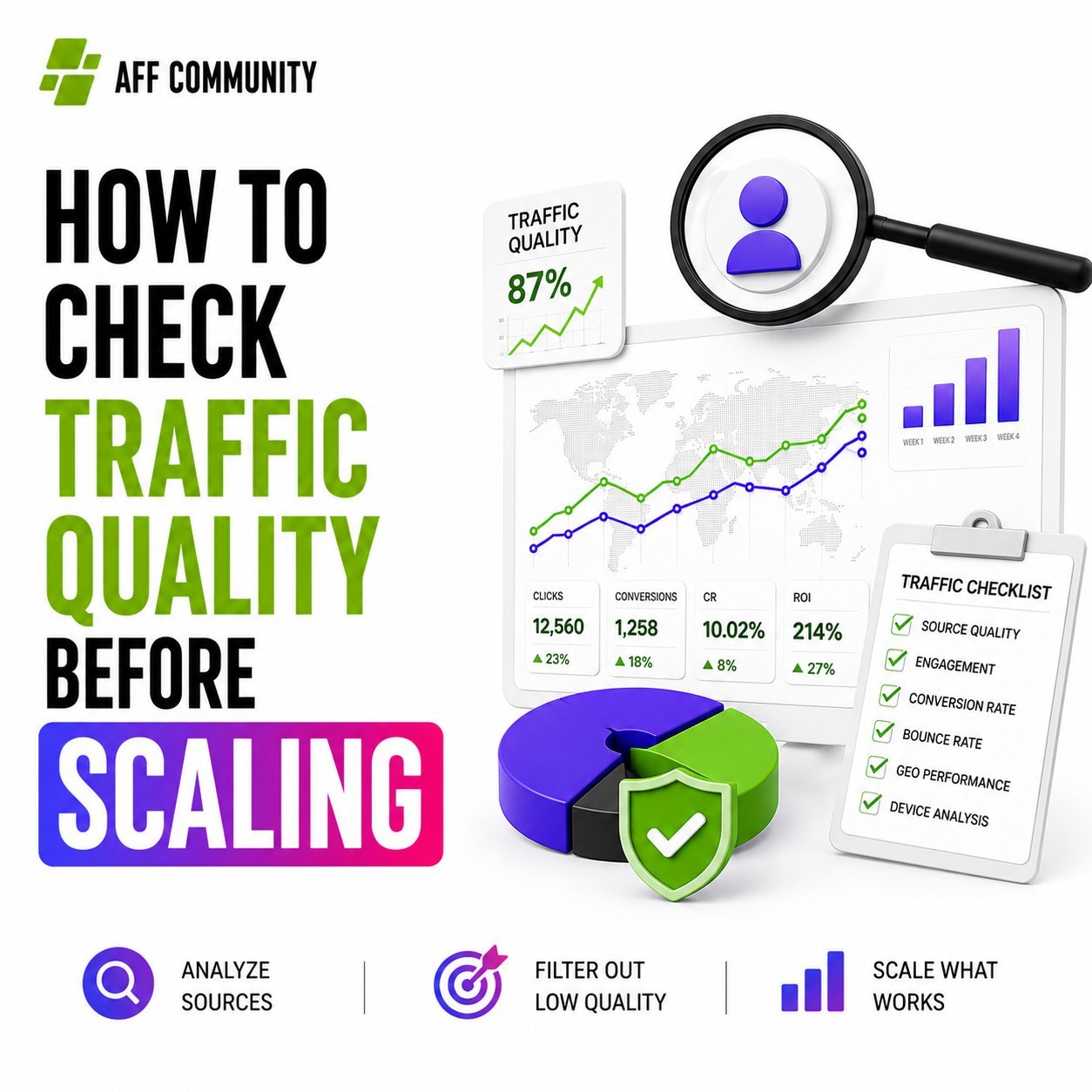
How to Check Traffic Quality Before Scaling

The most dangerous moment in affiliate marketing doesn’t begin when a campaign starts losing money. It’s much worse when it’s showing good results, and based on that, the buyer decides to drastically increase the budget.

At low volumes, virtually any campaign can appear profitable. A few successful days, a couple of strong levels of creativity, good conversion rates—and it feels like you’ve struck gold. But after increasing the budget, the numbers suddenly start to decline.

We encounter these situations regularly. And almost always, there’s one reason: before scaling, they only checked profitability, but not the quality of the traffic itself.

That’s why, before significantly increasing your budget, you need to evaluate not only the ROI but the entire chain from the first click to the final conversion.

Don’t just look at ROI
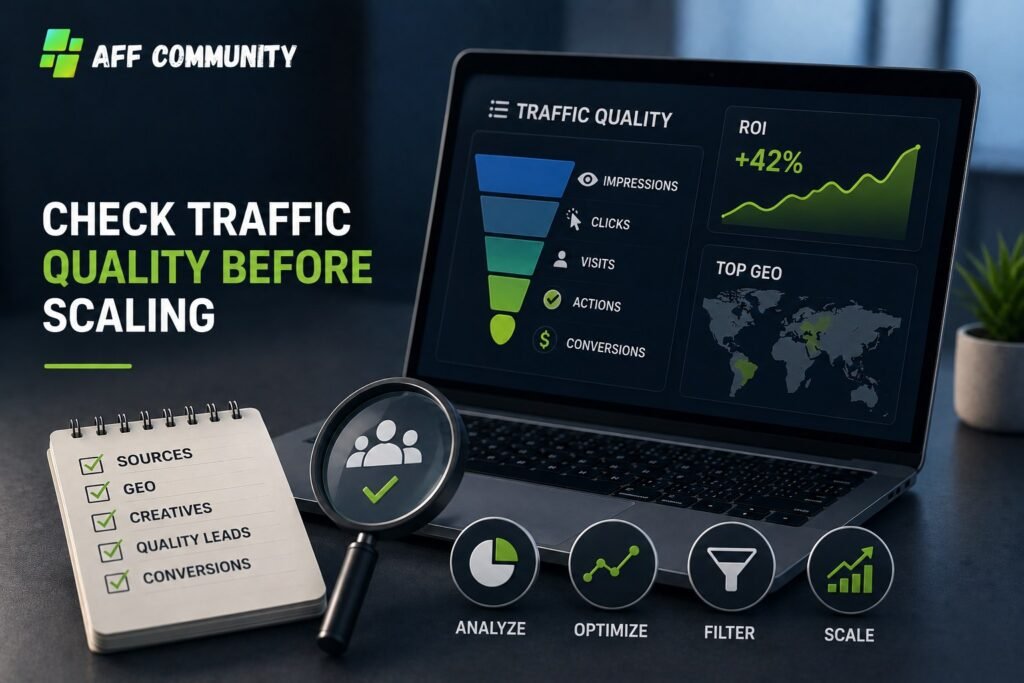
Check traffic quality

ROI is an important metric, but on its own, it tells you almost nothing about the quality of the audience.

Let’s consider a campaign that shows a 40% ROI. At first glance, everything looks great. But upon closer inspection, it may turn out that:

  • most of the leads come from a single source;
  • conversions are based on a small volume;
  • user quality is gradually declining;
  • some of the traffic doesn’t reach the target action;
  • the results are driven by just one or two pieces of creativity.

If you increase the budget for such a campaign several times over, the whole setup could quickly fall apart.

That’s why, before scaling up, we recommend looking at several metrics simultaneously. A good breakdown of the key KPIs can be found in this article about which metrics are truly worth tracking in affiliate marketing.

Analyze traffic at different levels

Traffic quality cannot be determined by a single metric. You need to gradually dig deeper into the statistics. First, look at the source, then at the GEO. After that—device, placement, audience, creativity, and individual segments.

For example, an ad network might show an average ROI of 30%, but upon further analysis, it turns out that half of the sites are operating at a loss, and only a few sources are generating the bulk of the profit.

In this situation, scaling up the entire campaign is risky. It’s better to identify the strong segments and gradually increase the budget specifically there.

See what happens after a click

Traffic quality becomes particularly evident once a user moves to the next stage of the funnel.

A high CTR doesn’t necessarily mean the audience is interested in the offer. A user may actively click on an ad but then close the page, fail to fill out a form, or fail to take the desired action.

That’s why it’s important to compare metrics at different stages:

impression → click → visit → action → confirmed conversion.

If there’s a sharp drop at any stage, that’s where you need to look for the problem.

Sometimes the issue lies not with the traffic source, but with the landing page or user flow. We discussed in detail how to identify such weak spots in our article on optimizing traffic flow and increasing conversions.

Check Lead Quality

Another mistake is assuming all conversions are equal. For affiliate networks, ten applications may seem better than five. But if only two out of ten applications are confirmed, while four out of five are, the real picture will be completely different.

Therefore, before scaling up, you need to look not only at the number of leads but also at what happens to them afterward.

It’s especially important to compare user quality by:

  1. geo;
  2. sources;
  3. ad platforms;
  4. creativity;
  5. audience types.

If one segment consistently generates cheap but low-quality leads, scaling it up will only compound the problems.

Look for anomalies in the statistics

High-quality traffic usually follows a certain pattern of behavior. If a huge number of clicks suddenly appears from a single source, an unusually high CTR, or a sharp spike in conversions, this isn’t necessarily a cause for celebration.

Sometimes such changes are related to the platform’s specific characteristics or low-quality ad inventory.

You should analyze the situation particularly carefully when the numbers look too good compared to other sources.

To do this, it’s helpful to compare statistics over time rather than looking only at today’s results.

We recommend analyzing at least several time periods: day-over-day, week-over-week, and results following a budget change.

Test the ad set before increasing spending

Before scaling up, it’s helpful to go through a comprehensive checklist. Ask yourself:

  1. Do I understand where the profit is coming from? If the answer is no, it’s too early to scale up.
  2. Do I understand which segment is delivering the best results? If not, break down the statistics first.
  3. Are the metrics stable? Three successful days don’t necessarily mean the ad set has proven its effectiveness.
  4. What will happen when you increase the volume? If you don’t understand how scalable your audience is, increasing the budget turns into an experiment at your own expense.

Use spy services for additional verification

Even before scaling up, it’s helpful to see what your competitors are doing.

Spy services let you study advertising approaches, creativity, and the ad combinations they use. This doesn’t provide a ready-made answer as to which source will be profitable specifically for you, but it helps you see the big picture of the market.

For example, if a particular approach has been widely used by competitors over a long period of time, this can serve as an additional signal for analysis.

And if virtually no one is testing the segment you’re interested in, that’s also a reason to consider why that might be the case.

We’ve compiled a selection of spy tools for this type of analysis in a separate article at this link.

Don’t confuse random success with high-quality traffic

One of the most costly mistakes is mistaking a fluke for a pattern. Let’s say a campaign generated several low-cost conversions in a row. The publisher triples the budget, and then doubles it again.

After that, the cost per lead rises, the conversion rate drops, and the ROI gradually turns negative. What happened? It doesn’t necessarily mean the traffic source has deteriorated.

Perhaps the initial result was simply based on a small sample that didn’t reflect the real picture.

That’s exactly why scaling should only begin after accumulating a sufficient amount of data.

The more data you collect, the easier it is to distinguish a trend from a random spike.

Monitor Quality After Scaling

Even if the preliminary check is passed, this doesn’t mean you can stop analyzing the campaign after increasing the budget.

On the contrary, the first few hours and days after scaling require particularly close monitoring.

You need to compare the new metrics with the statistics from before the budget increase. If, after scaling:

  • CPM increases;
  • CTR declines;
  • conversion cost rises;
  • lead quality drops;
  • user behavior changes.

Don’t automatically assume that you need to increase the budget even further. Sometimes the right decision is to pause, return spending to the previous level, and figure out the cause.

Conclusion

Before scaling up, it’s important to check not only how much revenue the campaign is generating, but also why it’s generating that revenue.

We follow a simple principle: you shouldn’t scale based on a pretty number in your dashboard, but rather on a clear and predictable system.

If you know which traffic source delivers high-quality traffic, which geos and segments perform best, which levels of creativity attract interested users, and where the weak spot in the funnel is, increasing your budget becomes a manageable process.

But if all your profit depends on a few random conversions, scaling turns into a lottery.

That’s why the best time to increase your budget isn’t when a campaign is simply showing a profit, but when you can explain where that profit came from and whether you can replicate it with a larger volume of traffic.
Fraud in In-App Advertising: How to Protect Your Budget

In-app advertising continues to gain popularity, and as traffic volumes grow, so does the number of fraudulent schemes. We regularly receive questions from publishers who can’t understand why their ad campaigns are generating a large number of clicks but virtually no conversions.

In many cases, the problem is specifically related to fraud. Unscrupulous traffic sources can quickly “drain” an advertising budget, creating the illusion of activity without any real value for the advertiser. Therefore, protection against fraudulent traffic has become an essential part of working with in-app advertising.

What Is Fraud in In-App Advertising

Fraud in in-app advertising

Fraud refers to any invalid or artificially generated interactions with ads that do not reflect the behavior of real, interested users.

In practice, this can include:

  • automated clicks;
  • artificial app installs;
  • attribution source spoofing;
  • low-quality incentivized traffic;
  • other methods of obtaining payments without genuine audience interest.

The main problem is that, on the surface, such statistics may look quite convincing until you begin analyzing traffic quality.

Early Signs of Fraudulent Traffic

Fraud can be identified based on a combination of several factors. Most often, you should pay attention to:

  • an unusually high CTR;
  • a large number of clicks without conversions;
  • sharp spikes in traffic volume;
  • an abnormally short time spent interacting with the app;
  • identical behavioral metrics among a large number of users.

If such signs appear immediately after connecting a new traffic source, you should carefully check the quality of that source.

We discussed in detail which metrics to analyze first in this article.

Don’t Rely Solely on the Number of Clicks

One of the most common mistakes made by beginners is evaluating a campaign based solely on cost per click or traffic volume.

In practice, it’s much more important to analyze users’ subsequent behavior. We recommend tracking:

  1. conversion;
  2. audience retention;
  3. cost per lead;
  4. ROI;
  5. and the quality of post-installation events.

These metrics are what allow you to determine whether a traffic source is bringing in real users or just burning through your budget.

Constantly analyze ad placements

Even within a single ad network, traffic quality can vary significantly. Therefore, after launching a campaign, you need to regularly compare the performance of individual placements.

If a particular source consistently shows poor results, it’s best to disable it and reallocate the budget to higher-quality placements. This approach helps gradually increase overall ROI and reduce losses.

High-quality creativity also helps

At first glance, it may seem that creativity has nothing to do with fraud prevention. In fact, well-crafted ads are more likely to attract an interested audience and allow ad network algorithms to optimize impressions more effectively.

Additionally, high-quality ad creatives have a positive impact on CTR and overall conversion rates.

We discussed the principles of creating modern ad creatives in this article.

Choose Reliable Ad Networks

Not all in-app platforms monitor the quality of their inventory with the same level of care.

Before launching a new campaign, it’s worth researching the ad network’s reputation, the available analytics tools, and its capabilities for filtering out suspicious traffic.

Working with trusted partners does not guarantee the complete absence of fraud, but it significantly reduces the likelihood of incurring major budget losses.

Conclusion

It’s impossible to completely eliminate fraud in in-app advertising, but its impact can be significantly reduced. Regularly analyzing statistics, monitoring the quality of ad platforms, evaluating user behavior, and working only with reliable sources help preserve your advertising budget and improve campaign effectiveness.

We recommend treating the fight against fraud as an ongoing process. The more carefully you analyze data and the faster you respond to suspicious changes, the higher the likelihood of maintaining campaign profitability, even with large volumes of mobile traffic.

In-App Traffic in 2026: A Global Overview

Just a few years ago, many viewed in-app traffic as a supplementary source of users. Today, the situation has changed dramatically. Billions of people spend time in mobile apps every day, and ad networks have learned to effectively monetize this audience.

We’re seeing that by 2026, in-app traffic has firmly established itself as one of the key traffic sources for publishers. With the right approach, it allows you to acquire large volumes of users, test various verticals, and scale profitable ad combinations without the intense competition typical of traditional Meta or Google auctions.

What Is In-App Traffic

In-app traffic in 2026

In-App traffic refers to ads displayed within mobile apps. A user launches a game, opens a utility app, uses a weather service, or accesses any other app and sees an ad.

Depending on the platform, various formats are available:

  • banners;
  • interstitials;
  • rewarded video;
  • native ads;
  • playable ads;
  • video ads.

The main advantage of this type of traffic is the massive mobile audience in virtually every country around the world.

Which verticals perform best

Despite the versatility of this traffic source, certain verticals show significantly better results. First and foremost, these include:

  1. Mobile apps.
  2. iGaming.
  3. Betting.
  4. Utility.
  5. VPN.
  6. Finance.
  7. E-commerce.

That said, a lot depends on the ad network and the specific geographic region. For example, in the gambling sector, In-App has long been considered one of the most promising verticals thanks to its ability to generate large volumes of mobile traffic.

Why In-App Continues to Grow

The main reason is a shift in user behavior. People are spending more and more time in mobile apps rather than in a browser.

Consequently, advertising budgets are gradually shifting to follow the audience. An additional advantage of In-App is the variety of ad networks available.

Ad buyers can test dozens of platforms, compare traffic costs, and find less competitive auctions.

This is precisely what allows for high-quality traffic volumes even in popular verticals.

Key Considerations for Creativity

For in-app advertising, it’s not enough to use the same ads as in Facebook Ads. User behavior within an app is different.

Most often, attention spans are limited to just a few seconds. Therefore, creativity must capture the user’s interest as quickly as possible. The following work best:

  1. short videos;
  2. product demonstrations;
  3. dynamic opening seconds;
  4. clear calls to action.

It is precisely the quality of the ad creativity that often determines the final cost per user acquisition. The approach to adapting creativity for modern advertising platforms is discussed in detail in this article.

How to Choose a GEO

Many beginners immediately start working with Tier-1 markets, hoping to get the highest-paying conversions. But In-App advertising allows you to scale successfully even in less competitive countries.

In many Tier-2 and Tier-3 markets, the cost of traffic is significantly lower, and the size of the mobile audience continues to grow rapidly.

That’s why, before launching a campaign, you need to evaluate not only the potential payout but also the cost per user, competition, and the specifics of the target market.

Analytics Is Becoming the Key Tool

Working with In-App is practically impossible without constantly analyzing statistics. You need to track:

  1. CTR.
  2. CPM.
  3. CR.
  4. Cost per install.
  5. Lead cost.
  6. User retention.

Even small changes in individual metrics can significantly impact the final ROI. That’s why successful teams analyze data daily and regularly disable underperforming platforms, replacing them with new traffic sources.

We discussed in detail how to make decisions based on analytics in the article at this link.

What’s Next for In-App

We believe that the importance of in-app traffic will continue to grow. Ad networks are actively implementing machine learning algorithms, refining targeting, and offering new formats for user engagement.

At the same time, competition is intensifying, which means that the teams that test new hypotheses faster than others, work with analytics, and regularly update their creativity will come out on top.

Conclusion

In 2026, in-app traffic remains one of the most promising sources for webmasters. The massive mobile audience, the variety of ad formats, and the ability to work across different verticals make it an effective tool for both testing new combinations and scaling successful campaigns.

Our team and I are confident that a systematic approach, high-quality creativity, and competent data analysis are what allow us to maximize the potential of in-app advertising, regardless of the chosen region or vertical.

Reddit as a traffic source for publishers

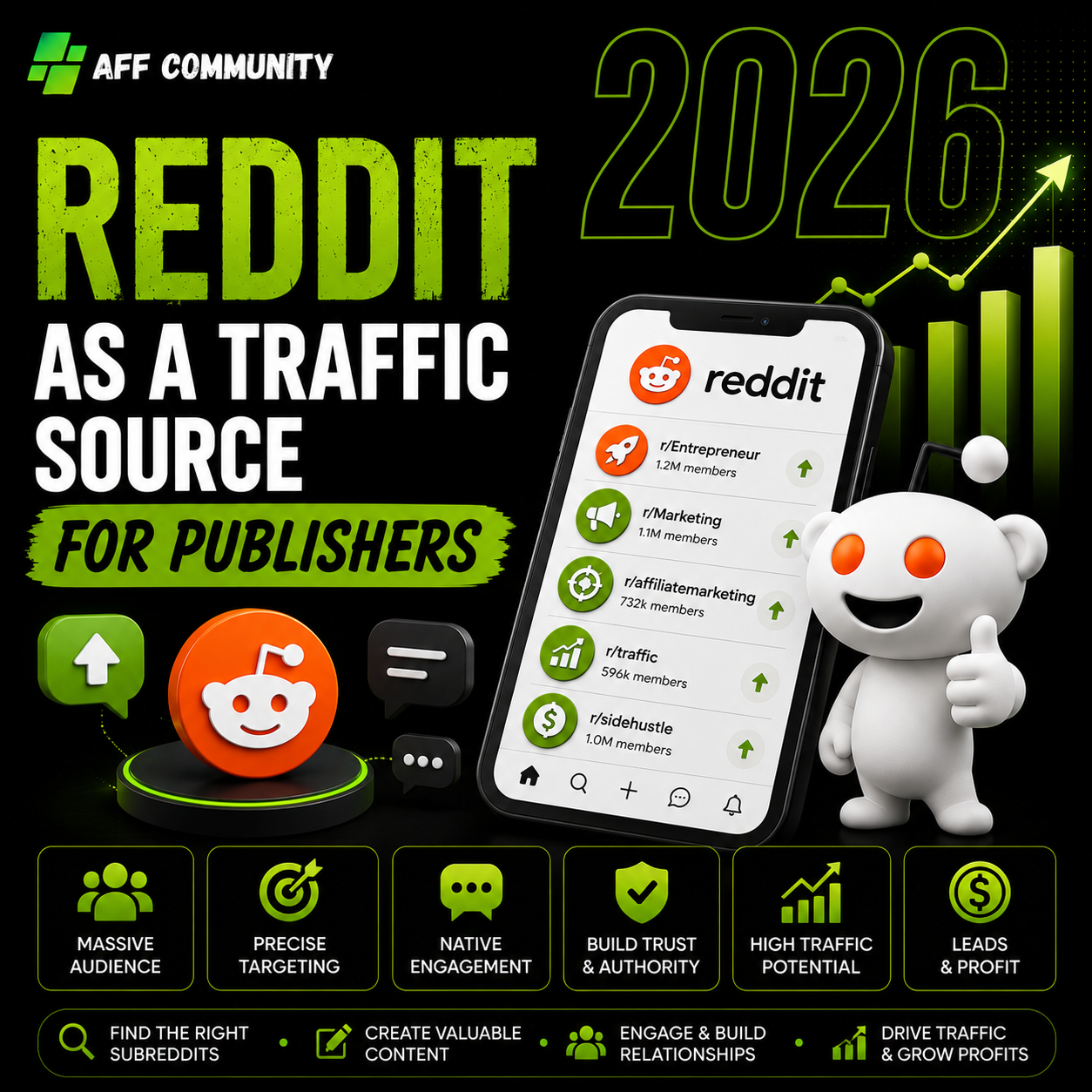
When it comes to traffic sources, most publishers immediately think of Facebook, TikTok, Google Ads, Bing or Telegram. But there is one source that has remained underestimated by many webmasters for years – Reddit.

Our team regularly observes how Reddit serves as a source of both free and freemium traffic for a wide variety of verticals. The platform performs particularly well in the SaaS, crypto, finance, AI services, apps and various digital products niches.

The main difference between Reddit and most social media platforms is that its audience doesn’t go there for entertainment, but to seek information, solutions to problems and recommendations.

This is precisely why using Reddit effectively can generate very high-quality traffic.

Why Reddit works differently

The main mistake beginners make is to view Reddit as just another social network. In practice, it is a vast community of themed forums.

Each subreddit operates according to its own rules. Each audience has its own interests. Every community is quick to spot direct advertising.

That’s why the classic ‘post a link and get traffic’ approach hardly works here. Reddit users value expertise, usefulness and real-life case studies.

The more value the audience gets, the more likely it is that a post will start attracting views and discussions.

Which verticals work best on Reddit

Reddit performs best in areas where people are actively seeking advice and recommendations.

The following work particularly well:

  • SaaS services;
  • AI tools;
  • financial products;
  • crypto projects;
  • mobile apps;
  • educational products.

That said, success depends directly on understanding the audience.

It is no coincidence that user segmentation remains one of the most important factors when working with any traffic source. This issue was discussed in detail in this article.

Content sells better than links

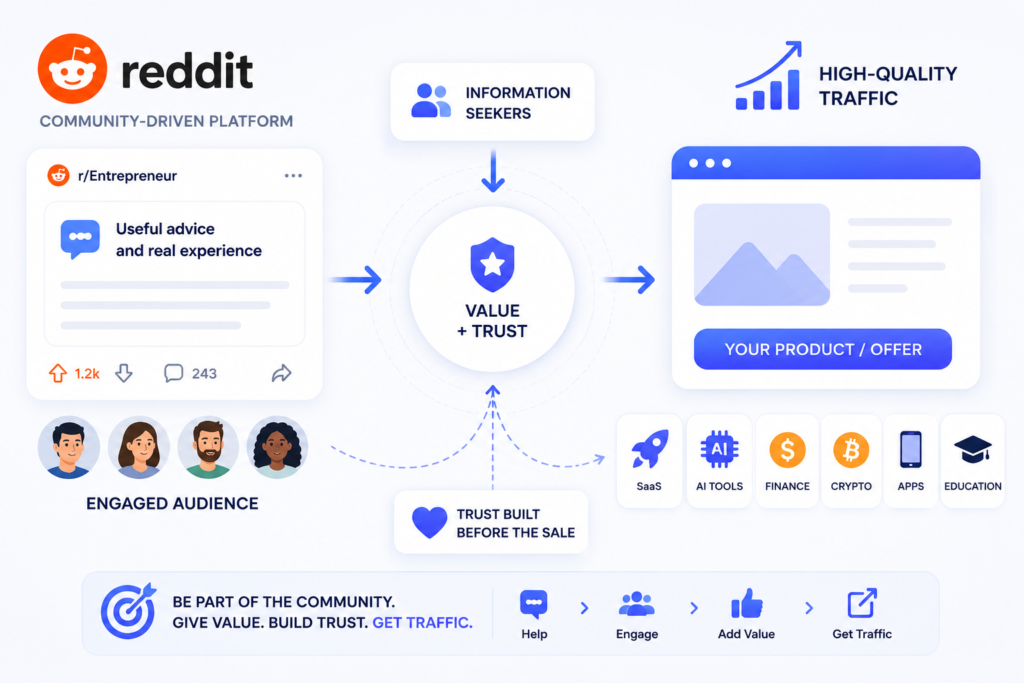
One of the most interesting features of Reddit is that it is often the content itself, rather than links, that drives engagement. A helpful comment can generate more clicks than a promotional post.

A detailed analysis of an issue can attract thousands of views without a single call to action. This is precisely why many webmasters use Reddit as a tool to run their audience.

First, the user gains something of value. Then they start to take an interest in the author. And only then do they click through to the website or product.

This approach is very similar to modern content marketing strategies, where trust is built before the sale. 

Reddit and SEO

Many people overlook another advantage of the platform. Reddit posts regularly feature in Google’s top results.

For a large number of search queries, Reddit pages compete with major media outlets and corporate websites. Therefore, activity within the community can bring not only direct traffic from the platform but also additional visibility in search engines.

This is particularly noticeable following the rise in popularity of user-generated content and forum sites in search results.

Incidentally, the impact of changes to search algorithms and new approaches to website ranking has been analysed in detail at this link.

The main mistake made by webmasters

Most failures on Reddit stem from trying to sell too soon. Users quickly spot advertising. Subreddits remove spam. Accounts face restrictions. That’s why strong teams operate differently. They become part of the community. They publish useful content. They answer questions. They take part in discussions.

And only then do they begin to gently guide the audience towards their products. Essentially, Reddit requires a long-term approach and building trust.

This is precisely why aggressive promotion tactics rarely yield good results here.

Why Reddit will become more important

By 2026, competition on traditional advertising platforms will continue to grow. The cost of traffic is rising. Moderation is becoming stricter. Algorithms are getting more complex.

Against this backdrop, platforms with high audience engagement are becoming particularly valuable.

Conclusion

Reddit can hardly be called a straightforward source of traffic. It requires time, an understanding of the audience and a systematic approach to content.

But this is precisely why many webmasters underestimate its potential.

Those who know how to build trust within communities and create genuinely useful content gain access to a high-quality audience that is becoming increasingly difficult to reach through traditional advertising channels.

Pinterest is a source of conditionally free and paid traffic

There is a lot of traffic on social media and search engines. These sources can be utilized, but they need to be supplemented with other resources. Specialists study X trends, work with TikTok, and look for other sources of Conditional free traffic. We offer readers something even more interesting. In the new material, we will tell you how traffic from Pinterest works.

What is Conditional free traffic can be read in this article.

The most interesting things about Pinterest

Such a social network offers users stock photos. In the social network you can find photos on any subject: beauty, interior, auto and others. Visually appealing content is published on Pinterest, and pictures are given more attention than in Facebook. The audience behavior resembles the target audience on TikTok, when users quickly view content.

The main difference between Pinterest and other social networks is that the audience is looking for content on specific topics. It is possible to separate your target audience in the shortest possible time. It is on Pinterest that users find something interesting and new for themselves.

Types of promoted content

Pinterest is included in the category of classic stocks, but it offers users different content options. These types are:

  1. Carousels. Multiple photos are posted in one post, just like Instagram.
  2. Pins or static photos. Photos are shown to users in the feed. The photo is seen even by people who are not subscribed to the account.
  3. Photo Collection. 1 collection includes small pictures and 1 large photo.
  4. Videos. Videos are played automatically.
  5. Ideas. Such a category provides an interactive format with text content, photos and videos. Users like similar posts, due to which the webmaster can improve the engagement of his audience.
  6. Apps. With the help of posts, you can promote new or already working applications.

How to promote offers

Pinterest social network can be an option to get Conditional free traffic, as well as a source of paid content. Both options have got their own characteristic features.

Conditional free traffic

Here, the webmaster will have to publish posts from different accounts and in large volumes. It will take a lot of time to get conditionally free traffic, but you don’t need money to achieve results.

Publishing quality and diverse content should be regular. Only with this approach, your target audience will be interested in photos or videos. The plan of action is simple: users search for photos and then pay attention to your ads.

Pinterest gives traffic for white verticals, and the result depends on the work of search algorithms. The platform allows you to work with merchandise and some other directions.

Features of getting paid traffic

If this option suits you, then start by creating your own business account and advertising campaigns. Then go about setting up the targeting, specify the cost of services, add relevant creativity and links. Pinterest users will see the most important information.

Be careful when working with paid traffic. Problems and difficulties arise when working with gambling themes. The rules of the platform are spelled out so that users can not expose prohibited content or engage in fraud. Such rules apply to Google as well.

Working with target audience in different verticals

Understanding your target audience is Pinterest’s main advantage over other traffic sources. People go to search networks to solve some issues. Similarly, Pinterest works in the same way. If a user is looking for an effective weight loss product, he/she will find all the necessary information on the social network and can solve the problem.

Pinterest is mostly visited by women of different ages, so the platform can be used to promote the product. Gamble is published in small volumes, because women are not very interested in this topic. It will take a lot of effort to promote themed offers. In addition, you will have to disguise such offers.

On Pinterest, other topics have recently appeared. These are cryptocurrency and dating. In the direction of dating you can work, and for the promotion of crypto you will have to search for suitable links for a long time.

Much attention is paid to the quality of creativity. It is not recommended to use low-quality videos. Pinterest users will like visually appealing content rather than cropped videos.

For Conditional free traffic, it is recommended to publish a maximum of 3 posts per day. This number of posts shows that there is a real person working with the content on the platform. A live account is what works most effectively on Pinterest.

More affiliate networks with top offers, look here.

Conclusions

Pinterest is one of the most suitable traffic sources, but it is not hyped in affiliate marketing. The popular platform gives a lot of opportunities for Conditional free traffic. Explore this traffic source carefully if you want to get even more profits.

Conditional free traffic on Snapchat

When discussing Conditional free traffic channels, webmasters most often emphasize TikTok. However, Snapchat remains a less popular but effective alternative.

Snapchat users actively interact via private messages, share photos, videos and time stories, which forms a high level of audience engagement. This feature is successfully used by affiliate marketing specialists, converting Conditional free traffic into profit.

Snapchat: analyzing the potential

This platform remains promising for advertising projects, despite its lower popularity compared to Facebook, Instagram or Twitter. The effectiveness of the service is confirmed by millions of dollars of investment from businesses and stable growth of the audience, the main segment of which is young people.

Key advantages of the platform:

  1. Target audience.
  2. The daily reach of advertising exceeds 500 thousand views, and the dynamics of user growth is 27% per year. According to forecasts, by 2027 Snapchat’s audience will reach 700 million people.
  3. Low competition in the CIS.
  4. The platform is popular mainly in Western countries, which reduces competition among webmasters in the Russian-speaking segment.
  5. Mechanics for virality.
  6. Lenses, filters and promotion algorithms allow new accounts to quickly gain thousands of views without budget investments.
  7. Payable traffic.
  8. The main audience is users from top GEOs (USA, Europe), which increases monetization potential.

These factors make Snapchat a profitable channel for testing creativity and scaling affiliate marketing, especially in niches with low competition.

Content publishing

Snapchat operates exclusively on mobile devices. Publishing is only available through smartphones or Android emulators.

If you are going to run traffic on this platform, it is recommended to use several profiles to reduce risks – this will protect income when one of them is blocked.

The mechanism of attracting traffic is similar to TikTok: working funnels can be adapted to Snapchat, but taking into account the specifics of the platform (interface, audience, moderation). For example, for dating and adult offers, marketers create fake profiles with attractive photos of girls and videos, and then redirect users through intermediate pages to webcam services or smartlinks.

Key principles of working with content

When planning promotion on Snapchat, take into account the specifics of the platform:

  1. Shadow Blocking System
    Hidden blocking affects the entire account, not individual publications. Use unique video content to protect your profile. You can check duplicates recognized by the platform in your browser: such materials are marked with an icon with a crossed-out eye.
  2. Prioritize video format
    Despite the support of both photo and video, the maximum response is provided by short clips. This format holds the audience’s attention better.
  3. Technical requirements
    Direct publishing is only possible via the mobile app. An Android emulator (e.g. BlueStacks) is required to work with a PC.
  4. Account launch strategy
    Preliminary activity (“run”) is not necessary – a high-quality video can gain tens of thousands of views regardless of the registration date.

Recommendations for publications:

  • to add a video to your profile, use the “Sent to” button ;
  • to make the material appear in the general feed, send it to Spotlight;
  • add relevant hashtags – this will make it easier for your target audience to find your content.

The first data is displayed 40-60 minutes after uploading. The amount of coverage is determined by the creativity and quality of the video, not by the “age” of the account or activity history.

The platform features a simple interface, making it easy to customize your publications. Focus on creating original videos – this is the main tool for engaging your Snapchat audience.

Work with targeted GEO

To pinpoint audiences from a specific region (e.g. Germany) when working from Ukraine, tools that change the digital footprint will be needed. If using a PC, a VPN, Android emulator, GPS correction software, and an anti-detect browser are needed. On a smartphone, the algorithm is simpler.

Setup for mobile devices:

  1. Install VPN application and GPS spoofing program.
  2. Remove the SIM card and disable geolocation in settings.
  3. Enable VPN by selecting the target country’s server.
  4. Clear cache and app store data (AppStore/Google Play).
  5. Install Snapchat, create an account from scratch, specifying the desired region in the profile.

Work via computer:

  • Install Android emulator;
  • Install VPN through the emulator and activate it by selecting the required GEO;
  • launch the anti-detect browser to hide the device settings;
  • log in to Snapchat through this browser by registering a new profile with the target region.

Important:

  1. Disabling geolocation and removing the SIM card reduces the risk of real location.
  2. Anti-detect browser masks digital fingerprints, preventing accounts from being blocked.
  3. Regular cache clearing eliminates the accumulation of data associated with previous sessions.

Following these steps will ensure correct redirection of traffic without technical errors.