How to Find Niche Combinations Before Others and Reap the Rewards

In affiliate marketing, almost all the money is made right when a niche combination first appears. While no one knows about it yet, traffic is cheap, there’s no competition, and ROI is high. As soon as the topic goes mainstream, margins drop and the competition heats up.

So the question isn’t how to find a niche. The question is how to find it before everyone else.

Where do new niches come from?

Niches don’t appear out of nowhere. Usually, it’s a combination of three factors: a new offer, a change in the traffic source, or audience behavior.

For example, a new product or service is launched. The first ones to start running campaigns on it make the most money. After a couple of weeks, everyone else jumps in, and the niche dies.

The same thing happens when a platform rolls out updates. For example, TikTok’s algorithms change, and old forms of creativity stop working, but new formats start delivering cheap traffic.

Find the best offers at this link.

Look where the crowd hasn’t arrived yet

Most webmasters run campaigns on the same old sources. Meta and Google are already oversaturated platforms.

If you want to find profitable niches earlier, you need to look further afield. New formats, new platforms, new approaches.

We’ve compiled the top ad networks in our selection.

Often, a trend first appears in one place and then spreads across the market. Whoever got there first is the one who made money.

Analyze ads, don’t just copy them

Many people go to Spy services, find creativity, and simply copy it. This is almost always a losing strategy.

A different approach works: you need to understand why creativity resonates. What’s its angle, what emotion does it tap into, and which audience segment does it hook?

Once you understand the mechanics, you can create your own versions and adapt them for other geos or sources.

Test hypotheses quickly

You don’t find the right combinations on the first try. You discover them through testing.

But it’s not just about testing—it’s about doing it quickly. The faster you test ideas, the higher the chance of finding something that works before others get there.

A delay of even a few days can cost you your entire margin.

Monitor audience behavior

Sometimes a combination emerges not because of the offer, but because of a shift in people’s interests.

For example, a surge in interest in a specific topic, news, or trends. If you notice this in time, you can jump in with the right offer.

Such trends often aren’t obvious, but they yield good results.

Why most people are late to the game

The main reason is that people start acting only after they see others achieving results.

A case study emerges, it’s analyzed, and only then does the crowd start getting into the topic. By this point, the connection has already been partially exhausted.

Those who make money act earlier—when there are no case studies or a clear picture yet.

We periodically compile case studies on our blog, where we analyze successful campaigns for various offers and geos; you can read them HERE.

Conclusion

Unobvious combinations aren’t about luck. They’re about speed and experience.

If you constantly monitor the market, test hypotheses, and aren’t afraid to dive into new topics, you’ll find such combinations regularly.

In affiliate marketing, it’s not the one who found the perfect combination who wins. It’s the one who did it first.

Monetization on Instagram in 2026: A Complete Guide to Making Money

The average person can have several sources of income on Instagram at once. It all depends on what exactly they’re selling or showcasing, and why they’re on this social network in the first place.

What Monetization Options Does Instagram Offer?

There are various ways to make money on Instagram. You can become a popular blogger (influencer) and get paid for your attention. Or you can build a full-fledged business—selling your own products or offering services.

Let’s say a person creates their own content: shoots videos, writes posts. Then these methods are available to them:

  • the more attention they attract, the more they earn;
  • charging for ads on their profile;
  • collaborating with various brands;
  • selling their services (if they’re, say, not just a blogger, but a designer, fitness trainer, or psychologist);
  • creating UGC content—this is when brands pay them for videos (this is currently quite lucrative: for example, money comes in through Reels);
  • uses affiliate programs within Instagram.

More details on ways to make money are covered here.

If a person already has their own business (online store, services), revenue comes from sales through Instagram Shops (a storefront right in the app), through direct messages (DMs), or when people go from Instagram to the website.

How to make money on Reels

Instagram Reels is a very trendy format right now. These are short videos that grab your attention from the very first second, play in rapid succession, and don’t last long. For example, someone runs a page for their clothing store. In Reels, they showcase items, put together outfits, and create curated collections. And if they have an expert or educational blog, they film a segment titled “Smart Things in Simple Words.” It is Reels that will have the strongest impact on Instagram revenue in 2026.

Popular bloggers often film lifestyle videos on a wide variety of topics in Reels. This also includes UGC, advertising for all kinds of brands, and earning through CPA programs.

The thing about Reels is that they have their own separate feed on the social network. Views there grow very quickly. By filming a video about their product, a person attracts a live audience for free (without investing in advertising) and encourages people to visit the website and buy the product.

If a person runs a personal blog, they can also grow and gain followers. Then, such a blogger starts receiving various offers for collaboration and earning money.

Another interesting way to earn money through Reels is CPA programs. That is, an influencer receives a percentage of the sale when promoting other people’s products through an affiliate program. They post their link, people click on it and make a purchase, and they get paid.

What Instagram Shops Offer

Now let’s talk about the most convenient way to sell—Instagram Shops. This is a store located right inside the app.

How to set up a store on Instagram step by step?

To set up a store on Instagram, you need to do the following:

  1. Verify that your business complies with Meta’s guidelines.
  2. Make sure this feature is available in your country.
  3. Sell physical goods.
  4. Comply with Meta’s commerce policies.
  5. Have an Instagram Business Account and a Facebook Page.
  6. Switch from a personal profile to a business account: go to “Settings” > “Account” – “Switch to a Professional Account,” select “Business,” and fill in all fields: name, address, website, and contact information.
  7. Create a product catalog via Meta Commerce Manager: click “Create Catalog,” add products manually or via another store (e.g., Shopify), and select “Pay via Instagram” to sell directly within the app.
  8. Link your Instagram and Facebook accounts: on Instagram, go to “Settings” > ‘Business’ > “Connect Facebook Page”; in Facebook Business Suite, verify that everything has synced.
  9. Apply for access to Instagram Shopping.
  10. Enable the shopping feature after approval by selecting the desired catalog.
  11. Start adding product tags: in posts, Reels, or Stories, tap “Tag Products,” then select products from the catalog.

After completing all these steps, the store becomes visible to shoppers.

How to create ads that get people to buy right away?

To drive sales quickly, you need to:

  • create “Shopping” ads in Ads Manager;
  • select the ‘Actions’ objective – “Catalog Sales”;
  • test different audience segments, try A/B tests and dynamic ads.

These tips will help you run ads the right way.

So what’s the bottom line?

Making money on Instagram in 2026 is totally possible. But you need to choose the right method and get started before it becomes outdated. It doesn’t matter if you run a personal blog, a store page, or sell your own courses. There are many different aspects to making money on Instagram in 2026, and the cool thing is that you can earn money simply through your followers’ genuine interest, without spending a dime on ads.

Simple Tips for Beginners

A beginner doesn’t need to have thousands of followers right away. Many brands are happy to work with micro-influencers because they have an engaged and trusting audience. But before trying to make money, you should decide on a niche. If you love cooking, start a food blog. If you’re into tech, do gadget reviews. The narrower the topic, the easier it is to find your audience and companies willing to buy ads.

Don’t try to do everything at once. It’s better to choose one or two formats—such as Reels and affiliate links—and master them. Once your income becomes stable, you can try something else—open a shop, sell your services, or participate in CPA programs.

It’s very important to respond to comments and engage with your followers. Instagram’s algorithms recognize activity in discussions and show such profiles to a larger audience. Plus, loyal followers are more likely to buy what a blogger recommends.

And if your first attempts didn’t bring in any money—don’t get discouraged. Monetization on Instagram rarely takes off in just a couple of weeks. You need to be patient, see which posts perform best, and gradually improve your content. Over time, a steady income will definitely come.

What are spy services in arbitration and why are they needed?

In traffic arbitrage, there is a strict axiom: “He who tests everything from scratch pays for mistakes with his own wallet. He who analyzes the market pays for a spy service subscription.” In 2026, as ad network algorithms have grown smarter and competition for users more aggressive, Spy services have evolved from auxiliary software into a mandatory element of a media buyer’s tech stack.

In this article, we will break down how “spies” work, why they are worth the money, and how to squeeze the maximum value out of them without becoming a “copy-paster.”

1. Anatomy of a Spy Service: How They See the Invisible

A spy service is a complex software suite operating at the intersection of Big Data and anti-fraud bypass technologies. To provide you with a library of millions of ads, the service solves three tasks:

  • Data Collection: The service maintains massive account farms or rents residential proxies worldwide. Bots mimic real human behavior: they “scroll” Facebook feeds, watch TikTok videos, and visit publisher sites looking for native ads. To an ad network, this bot looks like a regular user from, say, Italy or Vietnam, which is why it is shown relevant ads.
  • Bypassing Cloaking: Affiliates often use cloaking—a technology that shows moderators a “white” (compliant) site while showing real users the actual offer (e.g., gambling or nutra). Advanced spy services can pierce through these filters, saving the final landing page seen by the customer for you.
  • Indexing and Search: All collected information—images, videos, texts, links, buttons—is indexed. This allows you to search for ads by keywords, advertiser domain, or even image hash.

2. Why an Affiliate Needs a Spy: 5 Levels of Depth

Most beginners use a spy service at 10% capacity. Let’s break down the utility you can extract at different stages of work.

  • Level 1: Finding “Hot” Offers. Instead of interrogating an affiliate manager with “What’s converting right now?”, you open the spy and set filters for a specific vertical (e.g., E-commerce or Finance). If you see 500 unique ads for the same product launched in the last 3 days, the offer is trending.
  • Level 2: Analyzing Approaches. An “approach” is a marketing angle. For example, a weight loss product can be advertised through:
    • Medical approach: An interview with a doctor.
    • Relatable approach: “A neighbor lost 10 kg in a week.”
    • Shock content: Strange ingredients that spark curiosity. A spy service shows which “angle” is currently resonating most with the audience.
  • Level 3: Technical Funnel Breakdown. Professionals don’t just look at the image; they look at the “bundle”: Creative + Pre-landing + Landing page. A spy allows you to download the code of a competitor’s pre-lander. You can study the scripts they use: countdown timers, wheels of fortune, or fake comments.
  • Level 4: Volume Assessment. If an ad is running on 15 different accounts by the same buyer (visible through similar creatives and domains), it means the bundle is scaling. This is a signal that there is significant traffic volume and profit in this niche.
  • Level 5: Saving on Tests. The average test for a single hypothesis on Facebook costs $50–$200. By using a spy, you cut out obviously losing options (which no one runs for long) and focus on those that have already proven their viability.

3. Classification of Tools by Traffic Sources

The arbitrage market is segmented, and spy services follow this logic.

  • Social Networks (Facebook): While many popular services have existed here for a long time, the market has been replenished with local and faster solutions like Spy.house. These services are critical for Nutra, Gambling, and E-commerce. They show not just the ad itself, but also engagement levels (likes, shares), helping evaluate “virality.”
  • TikTok: The specificity of TikTok lies in the short lifecycle of a creative. Almost all services monitor ads in real-time. In TikTok, it’s vital to see which audio tracks and visual effects are currently at the top, as the platform’s algorithms reward trendy content.
  • Native Advertising (Taboola, Outbrain, MGID): Native ads are the “teasers” on news portals. There is a wide selection of services here; it all depends on user preference. They allow you to see exactly which publisher sites an ad is running on, enabling you to immediately compile Black- or White-lists.
  • Push Notifications: The push market is unique. In almost every service, you can track push chains and how headlines change depending on the time of day or the user’s GEO.

4. How to Distinguish “Gold” from “Junk”: Working with Filters

If you simply click “Search,” you will drown in a sea of test launches that are burning budgets. A proper filtering strategy looks like this:

  1. Sorting by Lifespan: The most important parameter. Set the filter to see ads that have been running for at least 7–10 days. If an ad is active that long, it’s profitable.
  2. Sorting by Traffic Volume/Impressions: Allows you to find the “heavy hitters.”
  3. Excluding Brands: To avoid seeing ads from major corporations (Nike, Amazon), filter by keywords or categories. Arbitrage creatives are usually more aggressive and direct.
  4. Domain Search: If you find one competitor landing page, enter their domain into the search. You will often discover a dozen other bundles from the same buyer.

5. Ethical and Practical Side: Copy or Adapt?

This is the ultimate question in arbitrage. There are two approaches:

The “Copy-Paste” Approach You download someone else’s creative and landing page and launch them on your account.

  • Pro: Speed.
  • Con: Ad platforms (especially Facebook and Google) have “fingerprinting” systems. A copy of someone else’s creative can lead to an instant ban or suppressed reach. Additionally, the audience might already be “burnt out” (tired of seeing that specific image).

The “Uniquization” Approach (Recommended) You take the idea from the spy service but recreate the content.

  • Change the color scheme and fonts.
  • Record new voiceovers or change the music.
  • Use different triggers in the text.
  • Clean file metadata. This allows you to enter the auction with a “clean” creative that the system views as original, but which is based on already proven mechanics.

6. The Cost Factor: Is the Investment Worth It?

Prices for high-quality spy services start at $100 and can go up to $500 per month. For a solo affiliate, this may seem like a significant sum. However:

  • One failed “shot in the dark” test costs $100.
  • A spy service allows you to see the test results of thousands of other people for that same $100.
  • To save money, many use “Group Buys,” though services actively fight this by blocking accounts.
  • Alternatively, you can use a service like Spy.house, which offers plans starting from $29 and provides a 7-day free trial.

7. 2026 Trends in Spy Technologies

The tools are not standing still. Today we see:

  • AI Integration: Spies are starting to analyze creative effectiveness using neural networks, suggesting which design elements work best.
  • Comment Analysis: Automatic collection of negative feedback under competitors’ ads so you can make your product “better” in the eyes of the user.
  • Deep Mobile App Analysis: Tracking not just the ads, but also app store rankings and internal funnels (in-app events).

Summary

Spy services in 2026 are not just a way to peek at your neighbor. They are a tool for professional market analysis that significantly shortens the path from idea to first profit.

Main Advice: Use the spy as an inspiration library and an analytical database, not as your sole source of creatives. In arbitrage, the winner is the one who takes a working model and adds 20% uniqueness to it.

How to promote an affiliate marketing blog

Starting a blog about affiliate marketing is not a problem. Nowadays, every other media buyer thinks that you can just write articles and traffic will come from search engines. In practice, the opposite is true: the niche is overheated, there is a lot of information, but only a few people actually read it.

It’s a big mistake to think that writing a couple of articles about links or cases is enough. Only systematic promotion works in the affiliate marketing niche. Otherwise, the blog will remain just a personal archive of articles.

Google search no longer gives quick results

Promotion through search works, but slowly. Competition is high: old media, CPA portals, and large blogs have long occupied the main queries.

To get traffic from Google, articles must cover specific queries. Not general topics like “what is affiliate marketing,” but more narrow ones:

  • moderation issues;
  • analysis of advertising sources;
  • baiting tools;
  • real cases.

Such articles gather less traffic, but bring in the right audience.

Telegram — the main source of audience

For affiliate marketing media, the main flow of readers now comes from Telegram.

People rarely search for articles directly. They read them via links from channels, chats, and collections.

That’s why most successful affiliate marketing blogs have a combination of:

website + Telegram channel. We are sharing our Telegram chat network with you – https://t.me/addlist/HVkhCPEGSjhmNGI6

The channel provides quick traffic, while the blog remains the content base.

Reposts in thematic chats

Many people underestimate chats. But that is where the main audience of webmasters is.

If an article is really useful, people start reposting it. Sometimes one successful piece of content can be shared across dozens of chats.

It is important to write in such a way that people want to send the text to their friends. Dry theory is not suitable for this.

Collaborations with other channels

Mutual PR works well in the affiliate marketing niche. Channels recommend each other, publish selections of useful blogs, and do joint reviews.

This is one of the fastest ways to gain a new audience. But it only works if the content is really strong. No one will advertise weak blogs.

Case studies work best

The most widely read format in affiliate marketing is real case studies. People want to see numbers, mistakes, and tests.

But it’s important to show more than just the result. The process itself is more interesting: how the connection was found, where the budget was spent, what had to be changed.

Such texts are much more readable than abstract advice.

Content must be regular

If a blog is updated once a month, it will not grow. Search engine algorithms do not like this, and the audience simply forgets about the site.

In the affiliate marketing niche, the normal rhythm is several articles per month. They do not have to be huge texts. The main thing is that they are useful.

Conclusion

Promoting an affiliate marketing blog is not a story about a single source of traffic. Usually, a combination works: search, Telegram, reposts in chats, and recommendations from other channels.

The most important thing is to write about real things. In this niche, people quickly understand where the text is written by someone with experience and where it is simply a retelling of other people’s articles.

Countries with the strictest rules for launching advertising

In 2026, the problem will no longer be how to find a link. The problem will be where it can be used normally. There are countries where regulations are so strict that even a careful offer may not pass moderation or quickly attract a wave of complaints.

This is not just about the rules of advertising platforms. In many countries, pressure comes from the state. And platforms simply cut everything with a margin to avoid fines.

Germany

Germany is one of the most difficult geos for finance and nutra.

Financial offers are checked particularly strictly. Any wording that could be interpreted as a promise of income will result in blocking. Nutra with claims of quick results is almost non-existent.

Personal data is a separate issue. If the landing page is poorly designed from a legal standpoint or it is unclear how user information is used, there may be problems not only with advertising, but also with the domain.

United Kingdom

In recent years, the UK has significantly tightened its control over financial advertising. Cryptocurrency, investments, trading — constant checks and frequent rejections.

Even neutral creativity is cut if the algorithm sees a risk to the user. Appeals are difficult. Plus, there is high competition and expensive traffic. Mistakes here are costly.

France

France takes a strict approach to medical topics and supplements. You cannot freely write about therapeutic effects, weight loss, joint restoration, and so on without serious restrictions in the wording.

The audience actively complains about advertising. This quickly affects the quality of the account. Even if the moderation team has approved the ad, the link may be disabled due to complaints.

United States

The United States is a large market, but pressure from regulators has increased. Gambling, cryptocurrency, and medicine are constant risk areas.

Moderation has begun to analyze not only the text of the ad, but also the entire user journey. If the landing page looks aggressive or misleading, a ban can come after launch.

Plus, there is high sensitivity to complaints. One careless level of creativity can lower the trust of the entire account.

Australia

Australia strictly regulates gambling and financial products. Even legal offers undergo complex verification. It is difficult to scale up, and partnerships are unstable.

What this means for webmasters

The higher the level of consumer protection in a country, the less room there is for aggressive marketing. In rich countries, regulators actively control advertising, and platforms play it safe.

Tier-1 is no longer about easy money. It’s about working with legally clean landing pages, neat creativity, and long periods of running accounts. Mistakes are costly.

If you work in gray verticals, it’s easier to look towards less regulated markets. But even there, you can’t rely on three-year-old schemes — everyone’s algorithms are global.

In 2026, you need to choose geo not only based on the rate and solvency of the audience. You need to consider the risk of blocking, the complexity of moderation, and the stability of operation. Sometimes a calm market yields more profit than an expensive and tightly controlled one.

How publishers can save money in 2026

Affiliate marketing is essentially a field of commerce that deals with clicks and advertising. As in regular commerce, it is important to spend less on purchases in order to increase profits. Many beginners spend a lot of money on tools: browsers, proxies, analytics — and end up losing a significant portion of their income. However, you can achieve the same result for less money if you approach the choice of functionality wisely.

Newbies often don’t understand that affiliate marketing is not only about launching campaigns, but also about managing expenses. Unlike traditional professions, where salaries are fixed, here income directly depends on the difference between costs and results. Therefore, even a small budget optimization can turn an unprofitable campaign into a profitable one — without changing the creativity or the target audience.

Why people are afraid to save money

Some webmasters are afraid to save money: they think that cheap tools will inevitably lead to poor results. But this is not always the case. For example, a disposable cheap proxy can indeed let you down, but a reliable shared proxy from a trusted provider is a perfectly workable and reasonable option. The main thing is to be able to distinguish between real savings and stinginess. Savings are when you get 95% of the functionality for 40% of the price. Stinginess is when you save on something that directly affects security, stability, or conversion.

In fact, the fear of saving is often associated with inexperience. Beginners are not yet able to evaluate the quality of tools and therefore choose “the most expensive ones, which means the most reliable ones.” Over time, when you understand which features are really important (for example, proxy stability or API support in the browser) and which are just marketing “bells and whistles,” your choices become more informed.

How much do beginners usually spend?

If you don’t optimize your expenses, tools can cost between $200 and $300 per month. This is a typical amount for beginners and those who don’t yet keep track of their budget. It usually includes:

  1. Anti-detect browser – $50–60 (needed to prevent websites from blocking accounts).
  2. Proxy – $50–70 (without them, traffic is easily tracked and blocked).
  3. Consumables (accounts, email services, etc.) – $30–50.
  4. Analytics and neural networks – $50–100 (help analyze and improve campaigns).

At the same time, many of these services remain almost unused. For example, in a package of 100 profiles, only 10–15 are actually used. Or analytics is connected, but no one draws conclusions from it. Such “dead” costs are the main enemy of profit. A simple monthly audit helps to find and remove everything unnecessary.

Proven ways to reduce costs

There are several effective ways to reduce costs in affiliate marketing.

Joint purchases

You can team up with other webmasters and split the cost of, for example, Spy services or proxies. This makes the tools significantly cheaper. For example, $20 divided between three people comes to $7 per person. The main thing is to find reliable partners.

Special offers and promo codes

Many services regularly offer discounts, especially for new users, partners, or through special links. Sometimes you can get a discount of up to 50%. It is worth keeping an eye on newsletters and promotions in professional chat rooms.

Teamwork

By joining an affiliate marketing team, you can use common tools—browsers, proxies, analytics—for free or for a nominal fee. This is especially beneficial for beginners: the tools are cheaper, and you gain experience faster. Experienced affiliate marketers have the opportunity to collaborate flexibly—for example, on a single project or for a limited time. In other words, today, an affiliate marketing team is a direct path to profit.

Registering as an advertiser

Some advertising networks offer discounts or free access to tools to those who register as advertisers. This could be free analytics, a discount on proxies, or anti-detection. It is important to read the terms and conditions carefully.

The main thing is not to save, but to optimize

In the end, saving money is not about greed, but about the wise allocation of resources. With the right approach, you can reduce your spending to $100 per month or even less. And the money you save can go towards launching new campaigns or scaling up.

The most important thing is to maintain a balance: don’t skimp on the essentials, but at the same time, don’t overpay where you can get by cheaper. Beginners should start with one or two methods, test them, and gradually improve their strategy.

By the way, many successful publishers started with a minimal budget: it was their ability to count money that helped them grow. In this niche, it is rare for those who spend the most to win. More often, those who spend smarter win.

What is a crypto salary in simple terms

Today, everyone should know what a cryptocurrency salary is, who it is suitable for, and what pitfalls there are. After all, by 2026, many people in the IT and affiliate marketing sectors will have forgotten about regular cash and fiat money: their income will be measured exclusively in digital money.

What does it mean to get paid in cryptocurrency?

It means that instead of regular yuan, dollars, or euros, a person is paid with digital money that is stored in a special electronic wallet. Most often, it works like this:

  1. A person is paid part or all of their salary in cryptocurrency, for example, in USDT (digital dollar) or bitcoins.
  2. They may be paid a bonus or incentive in such digital assets.
  3. The money goes directly to their personal crypto wallet.

To avoid a situation where today’s crypto salary is worth one amount and tomorrow’s is completely different, so-called “stable coins” are often used. They are pegged to the regular dollar, and their price hardly changes.

Who usually pays this way and to whom?

This method of payment is popular in modern digital spheres, where teams often work from different corners of the world. It is mainly used by:

  • IT companies and technology startups;
  • projects related to blockchain, cryptocurrency, and Web3;
  • companies in the field of online gaming, internet advertising, and marketing;
  • businesses where employees live in different countries.

The main advantage here is speed and convenience. Money can be sent to anyone, anywhere in a matter of minutes, without having to deal with international bank transfers.

Cryptocurrency payments are particularly popular in niches where the main income is directly related to digital assets and online traffic. In such projects, crypto is not only a means of payment but also part of the business model. To better understand how earnings are generated in these areas and where the money comes from, it is useful to understand the methods and options for earning money using cryptocurrency traffic.

Is this legal? What do different countries say?

It all depends on the country where the recipient of the money lives. In some places it is allowed, while in others it is not or there are restrictions. Here’s how it looks in some countries:

  1. United States and Canada. It is possible to receive a digital salary, but you will have to pay taxes on your income after converting the amount into local currency.
  2. Europe. It is often possible to pay freelancers, but full-time employees still need to have their main salary stated in euros.
  3. Ukraine. The official salary under an employment contract must be paid in hryvnia. Cryptocurrency can be used to pay bonuses or pay external contractors (freelancers).
  4. UAE and Singapore. These countries are loyal to cryptocurrency, allowing such payments under contract.

Important conclusion: before agreeing on such payment, be sure to check the laws of the recipient’s country.

What problems and risks can there be?

There is a downside to this convenient method. The main difficulties you may encounter are:

  • it is not legal everywhere. In many countries, it is not possible to officially pay salaries in cryptocurrency according to the employment record book;
  • the exchange rate may fluctuate. If, for example, you are paid in bitcoins, by the time of conversion to fiat, you may receive less real money;
  • Complications with taxes and reporting. Taxes must be paid on such income. If you get confused about the exchange rates on the payment date, you may make a mistake in your tax return and be fined.
  • Technical and contractual nuances. Sometimes the transfer fee is high. And if the contract does not specify all the terms of payment, disputes may arise.

In other words, before making your first transaction and signing a contract with a cryptocurrency, you should study all the possible pitfalls, potential problems, and complications.

The risks increase especially when a person receives income from niches with high volatility and complex financial instruments. In such cases, it is important to understand how profits are generated, when income is fixed, and what the final amount depends on. For example, consider what binary options are: definition, features, entry algorithm, where errors in calculations and timing can cost a significant portion of income.

How to pay with crypto but minimize risks?

Smart companies have found ways to take advantage of crypto payments while reducing potential problems. Here are their main methods:

  1. Specify the salary in dollars or euros in the contract, and then transfer the equivalent in a stable cryptocurrency (for example, USDT).
  2. Use cryptocurrency for payments to freelancers, rather than to core staff.
  3. Work through special payment services that help you get everything right and calculate correctly.
  4. Specify in as much detail as possible in the agreement how the amount is calculated, who pays taxes, and how.

Each company can develop its own algorithm that is convenient for it.

Where is this already working? Real-life examples

This practice is no longer theory, but reality for many businesses. Most often, this is done by:

  • international IT companies, in order to pay programmers from other countries quickly and without unnecessary commissions;
  • blockchain startups, which pay part of their salaries with their own digital tokens;
  • marketing agencies that work with a large number of foreign partners and freelancers.

Thus, cryptocurrency is a modern and flexible tool, especially for working with international teams. But in order to use it successfully, it is important to understand local laws in advance and think through all the conditions.

In many such companies, cryptocurrency is used not only for payments, but also as the main tool for working with traffic and advertising campaigns. The choice of platforms and channels for attracting an audience directly affects the stability of income for employees and contractors. Therefore, it is important to understand which channels are considered the most effective and secure. In this context, it is worth studying the 5 best sources for working with the crypto vertical, which are most often used by international teams.

Mistakes when creating creativity and how they affect ROI

Creativity is the starting point of the sales funnel. If it does not attract the user’s attention, the subsequent stages (ad text, landing page) are ignored. When viewing their social media feed, users do not have time to analyze ads. Only bright, emotional creativity can stand out from the flow of information. Webmasters are familiar with the situation: a top offer shows zero conversion due to weak creativity.

Impact on ROI

The quality of creativity directly determines the return on investment (ROI). Weak creativity leads to low CTR, high CPC, and ineffective budget spending. It is critical that each creativity corresponds to the strategic KPIs of the campaign — brand awareness, lead generation, or direct sales. Performance analysis should take into account not only CTR, but also metrics relevant to the goals (CPL, CPA, ROAS). This article discusses critical mistakes that can “kill” an advertising campaign.

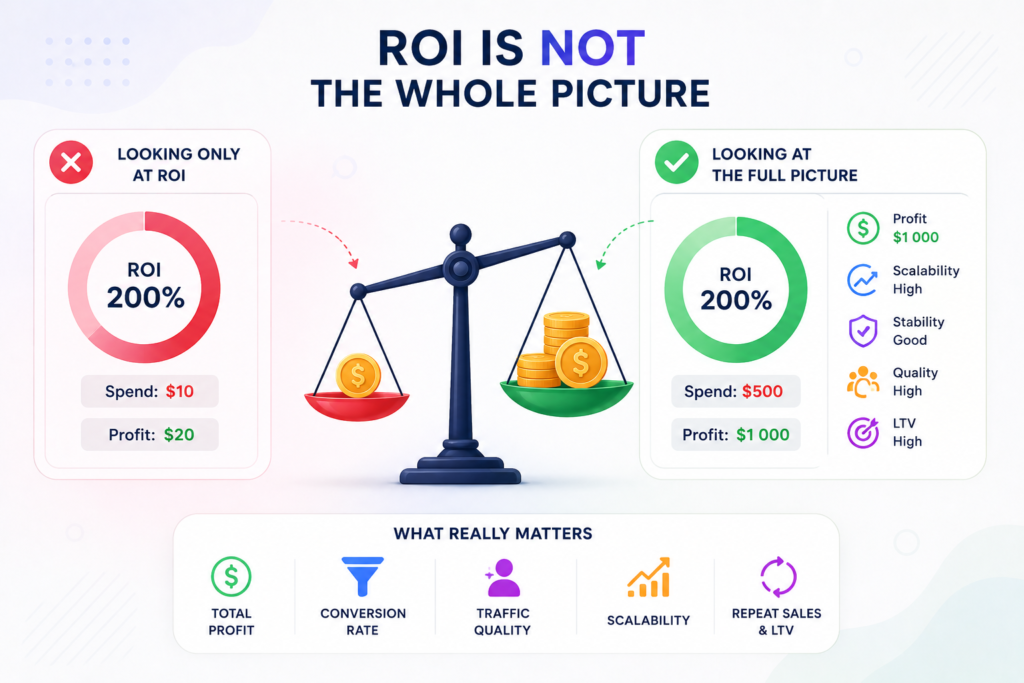
For more details on how ROI is calculated and what methods allow you to quickly evaluate the effectiveness of advertising campaigns, see the separate article “What is ROI and how to calculate it quickly.”

The gap between creativity and landing page

A typical mistake made by beginners is when the creativity promises one thing, but the landing page shows another. The user feels deceived and leaves the resource. The optimal solution is to fully synchronize the visuals, messages, and color schemes between the creativity and the landing page.

Ignoring the cultural code of the target audience

Symbols, humor, or images that contradict the values of the target audience provoke rejection. What is acceptable in one region may be offensive in another. The creation of creativity should begin with studying the mentality, traditions, and taboos of the target GEO with the help of local experts.

The role of humor and memes as a tool for communicating with the audience deserves special attention, which is discussed in detail in the article “Memes as the language of a generation: how humor became the main weapon of marketers.”

Visual overload

An excess of text, graphics, and colors distracts attention. The user loses focus on the main message. To prevent this from happening, you need a concise design with a clear hierarchy of elements. The text should be concise and readable. Overload reduces conversion, which means that advertising is practically not profitable.

Incorrect localization

Literal translation creates awkward phrasing. Currency errors or unadjusted amounts (e.g., a $1,000 prize for a region with an average salary of $300) undermine trust. The text needs to be adapted by native speakers, taking into account the context and checking financial realities.

Unnatural content

Excessively “glossy” stock images cause distrust. The growing popularity of UGC content (photos/videos from users) confirms the demand for authenticity. Creativity with real people, live emotions, and demonstrations of the product in action increases engagement. The evolution of UGC goes beyond static photos: short video reviews, screenshots of correspondence with support, and stories using the product are becoming effective. Integrating elements of social proof (number of purchases, positive comments) directly into the creativity enhances its credibility.

Rejection of A/B testing

Launching a single option of creativity is unacceptable. It is essential to test 3-5 options with different visuals (photo vs. video), texts (emotion vs. logic), and formats. Analysis of metrics (CTR, CPC) reveals effective solutions.

Creative fatigue

A drop in CTR with an increase in impressions signals that the audience is “getting used to” the ad. Preventive measures include:

  • monitoring the frequency of impressions;
  • regular rotation of the pool of creativity (every 7-14 days);
  • timely updating of texts and visuals.

The exact list of preventive measures is determined individually.

Ignoring market dynamics

Trends, social media algorithms, and competitor activity preclude the long-term use of single creativity. At this stage, the following is required:

  • regular analysis of the effectiveness of materials;
  • monitoring of industry innovations;
  • constant testing of new ideas (even with stable current indicators).

At the same time, optimization for platform algorithms (Meta, TikTok, Google) is a mandatory element of adaptation. Creativity must take into account: optimal aspect ratios for formats (Reels, Stories), relevant sounds, video length (the first 3 seconds are critical), and adaptation for vertical viewing. Regular study of advertising policy updates is a must.

Blind copying

Copying a competitor’s creativity without analyzing the reasons for its success (specifics of USP, target audience, context) leads to failure. To achieve the desired result, successful mechanics must be adapted to the unique conditions of the brand, offer, and target audience, with mandatory testing.

Conclusion

High ROI requires not only visually strong creativity, but also the systematic elimination of key errors: dissonance with the landing page, cultural maladjustment, overload, ignoring tests, and material fatigue. Adaptation to market changes, meaningful borrowing of ideas while preserving the USP, and integration with business goals are critically important. Continuous optimization of creativity based on data saves the budget and determines the success of the campaign.

How to build an AI team for affiliate marketing in 2026

The topic of using neural networks in affiliate marketing is becoming increasingly relevant. For this reason, every webmaster should understand how to go beyond disparate tools and create a comprehensive AI team capable of automating and significantly speeding up the workflow.

AI team vs. conventional use of neural networks

The main difference is in the systematic approach. Instead of using neural networks on a case-by-case basis, AI is used to build a coordinated system with clear processes. Its key elements include:

  • general analytics and a working pipeline. The system analyzes what worked, which simplifies scaling and improving results. The pipeline, built on templates and APIs, allows you to automate routine operations;
  • prompt database. All successful prompts (requests to AI) are stored in a structured form with an indication of the offer, target audience, channel, and result. This becomes a valuable knowledge base;
  • filtering system. Each creativity and offer undergoes a basic check against templates and selection based on metrics, allowing only promising options to remain.

Together, these elements transform disparate experiments with neural networks into a manageable pipeline. Analytics and pipelines ensure reproducible success, the prompt database eliminates the need to reinvent the wheel every time, and the filtering system saves time on manual selection by passing only the strongest hypotheses forward.

Roles and Tasks of the AI Team in 2026

An effective AI team is built on the distribution of roles, where each virtual “employee” performs their function:

  1. Prompt specialist (AI creator). Formulates tasks for AI, writes and tests prompts, adapts them to different formats, cleans up results, and collects working templates in a database for training.
  2. Visual generator. Responsible for creating and adapting creativity (images, videos) for different GEOs and audiences. Works in tools such as Midjourney and Runway, quickly cloning working templates.
  3. Creative analyst. Analyzes performance: which prompts and creativities worked and which did not, identifies patterns. Based on this, forms recommendations on what to scale and what to archive.
  4. Automation configurator (Integrator). Connects various AI tools into a single automated pipeline. Does not create creativity manually, but ensures the smooth operation of the generation and loading system.
  5. AI Team Lead. Manages the entire system. Determines which tasks to automate and which to leave to manual control, configures workflows and pipelines, maintains a knowledge base, and controls scaling.

It is important to understand that these “roles” are often performed by one or two real specialists. However, the functional division of tasks is necessary for clarity of processes. The interaction of these roles resembles the work of a conveyor belt: from idea and text (prompting) through visuals and assembly to analysis of results and continuous optimization of the entire cycle.

For specialists who are just planning to join a team, it is useful to figure out in advance how to get into the arbitration team.

Skills and tools for productive work

To implement this model, you will need to master several key areas:

Prompting and working with templates

This is the ability to formulate requests to AI in a clear and structured way. The work also includes collecting and systematizing successful prompts into templates for cloning. This is a fundamental skill for the entire team. Without understanding how to “talk” to the neural network, even the most sophisticated pipeline will produce mediocre results. Investing time in learning the basics of prompting and creating your own template library pays off many times over in terms of the speed and consistency of creativity.

Visual production with AI

The tools used are: Midjourney/DALL-E (image generation), Runway (video editing), CapCut/Descript (final editing). It involves adapting visual templates to the styles of different social networks and GEOs, automating the workflow, and using AI voiceovers. This area is responsible for “packaging” the idea. Modern AI tools allow you to create dozens of unique visuals in a matter of hours, which previously required days of work by a designer or editor. The key task is not just to generate an image, but to ensure a consistent style that matches the brand of the offer and the expectations of the local target audience.

Creativity analytics

Its tools include Google Sheets, Airtable, and Looker Studio. The team is responsible for a detailed analysis of creativity effectiveness (CTR, tone, etc.) to form clear conclusions and instructions for the team. Analytics is the engine of scaling. Without it, the work of the AI team turns into blind content generation. Properly configured dashboards and metrics systems allow you to quickly understand how your audience will respond to a particular level of creativity. They also help weed out ineffective hypotheses, redirecting resources to promising areas.

Building automation

First, any process is tested and debugged manually, and only then is it automated. The sequence is: prompt/generation/refinement/testing/implementation in the pipeline. Attempting to automate a raw, untested process will only reinforce errors and lead to a loss of resources. Successful automation is always the final stage, the crowning achievement, when there is already a proven template for action that only needs to be entrusted to the machine. Integrations via Make, Zapier, or custom scripts connect disparate tools into a living organism that independently creates, tests, and reports.

Creating an internal knowledge base

This is necessary for quickly onboarding new team members and standardizing processes. Checklists, guides, and instructions for key stages of work are used for this purpose. The knowledge base is the DNA of any AI-based team, ensuring its stability and growth. It records accumulated experience, best practices, and solutions to complex problems, transforming individual knowledge into institutional knowledge. This allows you to maintain efficiency when scaling and provides clear algorithms for action to everyone involved in the process, from newbies to team leads.

These and other tools for working with an AI team simplify affiliate marketing at any stage.

Conclusion

Today, artificial intelligence is a potential team member. A well-structured AI team in affiliate marketing leads to faster processes and increased efficiency. The key to success is not to completely replace humans, but to create a well-coordinated system where AI takes over the routine tasks and the publisher focuses on strategy and control. Starting with the development of basic roles and processes, a specialist will be able to create a powerful tool that will change the approach to work.

Choosing and using tools for email campaigns email automation work?

Email automation is a programmed sequence of emails. Messages are sent by robots according to predefined triggers and times. Marketers create a series of emails, setting up autonomous interaction with the audience. The technology takes care of greetings, order confirmations, thank you notes, reminders about abandoned shopping carts, and announcements of new products. The result: an influx of interested customers, strengthened buyer trust, and increased loyalty.

A significant number of tasks are solved without the involvement of employees. The introduction of automation ensures constant contact with the customer base without manual intervention. The consequences: increased productivity, minimization of errors, freeing up time for strategic tasks, and an overall increase in efficiency. Below are additional arguments for implementing specialized software.

Selecting the optimal email tool: a practical guide

The variety of solutions on the market requires a clear understanding of your goals. Specific tasks determine the choice of platform. The algorithm for selecting a service consists of several steps.

Step 1: Clear goals

Without clear KPIs, choosing a service is meaningless. Examples of real business tasks:

  • reducing customer churn rate;
  • building relationships with a new audience;
  • improving customer experience (CX);
  • increasing retention rate.

The wording affects the search: the functionality of platforms varies greatly. A list of goals eliminates unsuitable options, saving the team’s budget and time.

In fact, ignoring this goal-setting stage guarantees ineffective investments. At the same time, it is worth focusing on priority types of communication:

  • launch transactional emails (confirmations, delivery details);
  • implement drip campaigns to run them on leads;
  • use various email newsletters for brand news;
  • find combined solutions for complex scenarios.

Otherwise, you may end up with irrelevant functionality and lose a lot of money during its implementation/launch.

Step 2: Type of mailings

When implementing specialized software, it is important to know the priority communication format:

  • transactional emails: order confirmations, delivery details, password resets (require specialized services);
  • drip chains (drip campaigns): for lead generation, product promotion, running the audience;
  • Mass marketing mailings: brand news, announcements, blog updates (a basic feature of most platforms);
  • Combined solutions: for complex scenarios.

To implement a comprehensive approach, you need a universal service that includes all types of mailings.

Step 3: Critical functionality

Before analyzing the market, it is worth compiling a checklist of essential features:

  1. Template library: speeds up the creation of professional emails (layout/design adaptation to the brand).
  2. A/B testing: comparison of the effectiveness of different versions of emails (headlines, CTA, content).
  3. HTML editor: code editing for custom solutions.
  4. Multichannel: integration with messengers (Telegram, WhatsApp) for a unified funnel.
  5. Mailing limits: number of emails per month.
  6. Technical support: speed and quality of response.
  7. Drag-and-drop builder: required if you don’t have programming skills.

The actual list of features is determined by the specifics of the project: it can be compiled individually at the start.

We also recommend that you familiarize yourself with the overview of  tools for marketing and communications automation.

Step 4: Create a test group

When automating mailings, it is worth gathering employees with experience in email marketing. The team should include people who understand the budget, technical requirements, and specifics of the platforms. This applies to both full-time and freelance specialists.

Step 5: Shortlist of solutions

You can jointly compile a list of suitable services.

Selection criteria include alignment with goals and the availability of critical features. Each platform should be accompanied by notes on key capabilities, unique features, pricing (availability of a free plan), and pros/cons.

Step 6: Practical testing

When testing a specific tool, use free trials to check:

  1. Create a test contact database.
  2. Write an email from scratch/adapt a template.
  3. Add multimedia (videos, images, PDFs).
  4. Test the builder (ease of use of the interface).
  5. Check reporting (opens, clicks, conversions).
  6. Record a screencast of the process for team evaluation.

It is advisable to test several solutions recommended by the team. The analysis of the leading platforms in the next section will help you narrow down the list.

Step 7: Start with free plans

If in doubt, you can start with free plans. This minimizes the risks when learning a new tool. Most services (Mailchimp, Sender, Sendinblue) offer free quotas.

Choosing a platform requires analyzing dozens of parameters. Next, we will provide an objective analysis of the top solutions for email automation, comparing them in terms of pricing policy, depth of functionality, interface convenience, quality of analytics, and integrations.

A detailed review will help you choose a solution tailored to the specifics of a particular project. Making a final decision without a detailed, structured comparison of all alternatives based on key parameters exposes your business to the unjustified risk of overpaying or functional insufficiency. Choosing a platform that best meets the company’s current operational needs, budget constraints, and strategic ambitions, with a clear understanding of the path to future scaling, is the essence of a balanced approach.

Ad creativities in affiliate marketing: secrets of creation and testing

Affiliate marketing continues to evolve in 2025, and the key to success remains not only the choice of offer, but also the quality of ad creativities. With growing competition on platforms such as Facebook Ads and TikTok Ads, it is the creativity that determines whether an ad will be shown to the right audience, what CTR it will receive, and how high the conversions will be.

Experienced webmasters say, “Creativity accounts for 70% of a campaign’s success.” And there is some truth to that. You can have an excellent offer, well-chosen targeting, and even an optimized budget, but without strong creativity, all your traffic will “drain to zero.”

In this article, we will analyze which creativities work best in affiliate marketing, which trends will define 2025, and how to properly test hypotheses to come out ahead.

What is advertising creativity and why is it so important?

Advertising creativity refers to an ad as seen by the user:

it can be an image, video, banner, text post, or even a combination of these formats in affiliate marketing.

In affiliate marketing, creativity plays the role of “bait”: it must stand out in the social media feed, attract attention, and motivate the user to click. Without this, the CTR drops, which means the cost of a lead becomes higher.

? It is important to understand that good creativity is not just a beautiful picture. It is a combination of:

  1. Visuals (picture, video, meme, animation);
  2. Headline (short, catchy text);
  3. Offer (call to action, benefit for the customer);
  4. Social proof (reviews, elements of trust).

Creative trends in 2025

The advertising market is changing, and in 2025, several key trends can be identified:

  • Vertical videos. TikTok, Reels, and Shorts are forming a habit of watching fast-paced content. Therefore, the main focus is on short videos up to 30 seconds long;
  • User Generated Content (UGC). Natural, “homemade” videos from ordinary users convert better than professional studio advertising;
  • Memes and humor. Ironic creativity continues to show high CTR, especially on TikTok.
  • Adaptive creativities. Facebook Ads actively promotes dynamic formats, where the system itself tests different combinations of text and images.
  • Interactivity. Stickers, polls, carousels — the more engagement, the cheaper the click.

How to test creativity correctly

A mistake many beginners make is launching dozens of creativity versions at once without analysis. As a result, the budget is wasted, and there are no real conclusions. The correct testing strategy includes:

  1. Launching 3–5 versions of creativity for one audience.
  2. Tracking CTR, CPC, and conversions.
  3. Disabling “leaky” ads within the first 24 hours.
  4. Refining successful hypotheses (changing the headline, button color, presentation).

Where to get ideas for creativity

Even experienced webmasters don’t always come up with creativity from scratch. The main sources of inspiration are:

  • Spy services (for example, Adplexity, SpyOver);
  • Competitors’ ads in TikTok Creative Center or Facebook Ad Library;
  • Webmaster forums and Telegram chats;
  • Trends (memes, popular challenges, news stories).

Mistakes when creating creativity

Even professionals make mistakes. Here are the main ones:

  1. Text that is too long → attention is lost.
  2. Prohibited content (violation of Facebook/TikTok rules).
  3. Design that is too bright or “clickbait” → the audience does not trust it.
  4. Using one creativity for too long → banner blindness.

Conclusion

Creativities in affiliate marketing are the main tool for attracting an audience. In 2025, those who know how to test hypotheses, use new formats, and adapt to advertising platform algorithms will win.

If you want to consistently work in the black, devote at least 50% of your time to developing and analyzing creativity. This is the only way to achieve a high ROI and long-term results.

What you need to know about the Travel vertical

Travel services are very popular and suitable for people of all ages. Every year, this area of arbitrage becomes more and more relevant. Webmasters do everything possible to prevent accounts from being blocked. Travel services are a “white” vertical that allows you to earn money. Advertising is not subject to blocking and is considered a good option for affiliate marketing. We consider affiliate marketing in combination with popular travel services.

Travel vertical: what is it?

The travel niche is directly related to offers intended for tourists. The vertical promotes well in various traffic sources, which can be called its main advantage. This popular vertical is well suited for affiliate marketing. Experienced buyers and promising beginners work with it.

Travel has not only advantages but also some weaknesses. We will discuss the main “buts” of the vertical below.

“Buts” and possible difficulties in travel

Webmasters make a profit using this widespread vertical. What determines stable success in this area? Several key aspects influence success.

The instability of travel

People travel, but not all destinations are popular. The world of travel is also affected by visa restrictions, crises, and even viral diseases. Under such circumstances, the demand for travel and flights quickly decreases. The situation is reminiscent of working with fraud traffic, where the outcome is unpredictable. You can read more about what fraud is and how to detect it here.

Seasonal destinations

During the holiday season, tourists travel to popular destinations. In their work, publishers focus on the seasonality of travel. This topic is studied carefully, after which offers can be promoted and high-quality traffic can be run.

Competition in the “premium” segment

The premium segment refers to certain niche destinations. The average or high travel check, and the demand is very active. The premium segment includes travel insurance, hotel accommodation, and air travel.

Solo webmasters, like inexperienced publishers, have to put in a lot of effort to break into the premium segment. High competition means that you can’t make even the slightest mistake. You can use affiliate marketing and alternative options. These include offers for transport rental, transfer organization, and more.

Traffic limits

Travel affiliate programs prohibit the use of branded advertising. Standard traffic sources used in “white” offers are also prohibited. Mobile traffic and contextual advertising are also prohibited. Limits and prohibitions depend on the terms and conditions of the specific affiliate network.

Popular offers

“White” offers can be safely used in the travel industry. These offers are intended for a solvent audience with a high level of income.

Apartment booking

Travel will not be successful without comfortable accommodation. Tourists are looking for options for booking hotels, apartments, or simply rooms. This area can be worked with.

Ticket purchases

In the travel vertical, tickets are the most common category. Travelers book tickets every day to see even more interesting places. Both airline tickets and intercity tickets are sold.

Travel insurance

Travelers take care of their insurance to avoid potential problems. The trip will be comfortable, vivid, and unforgettable. The demand for travel insurance is constantly increasing.

Organization of excursions

Individual and standard excursion programs are suitable for tourists. All excursions are designed to allow travelers to explore the sights of the area. Travel excursions are a profitable and popular category. You can set up affiliate marketing for this niche to generate a steady profit.

Features of GEO for travel offers

Tier-1 countries provide good profits in affiliate marketing. The Tier-1 region includes EU countries, the US, and some other countries. However, competition is also high: local companies invest significant budgets in promotion. To withstand the competition, webmasters should implement comprehensive strategies.

Competition is also high. Companies with large advertising budgets offer their services in local markets. It will be difficult for novice publishers to compete with such companies.

Conclusion

The travel vertical is suitable for all webmasters. This area is popular and allows you to set up “white” advertising correctly. During the travel season, ROI will be high, which webmasters will definitely appreciate. During periods of active storms, the travel vertical can be an interesting additional source of income.