Sales Funnels via Telegram

A few years ago, Telegram was used primarily as a platform for publishing news and communicating with subscribers. Today, the situation has changed. For many webmasters, Telegram has become a full-fledged part of the sales funnel, where the user progresses from their first encounter with the product to the desired action.

Our team is increasingly seeing that a well-designed Telegram sales funnel yields higher conversion rates than directly running offers to users. The reason is simple: users don’t make a decision right away, but only after several interactions with the content.

Why Direct Sales Are Less Effective

The main mistake beginners make is trying to sell from the very first post. A person joins the channel, sees an ad post, and immediately receives a link to the offer.

In most cases, this approach yields mediocre results.

It’s much more effective to first provide value to the user: a case study, an analysis, a guide, or practical advice. Once the audience begins to trust the author, the likelihood of conversion increases significantly.

This is precisely why many successful teams build content funnels rather than limiting themselves to standard advertising.

What Makes Up a Working Funnel

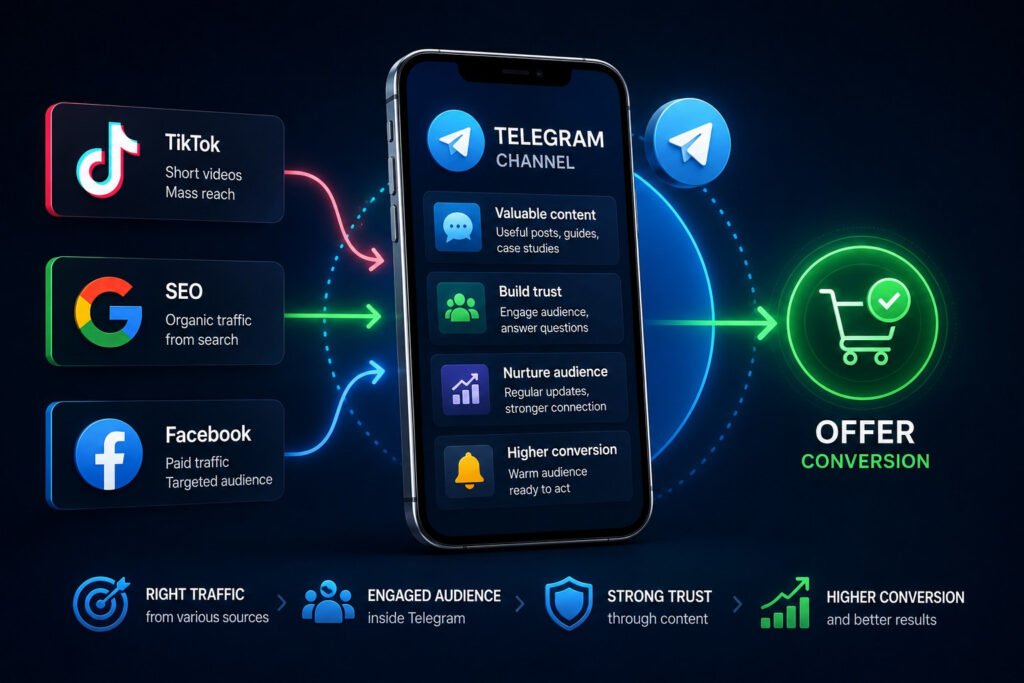
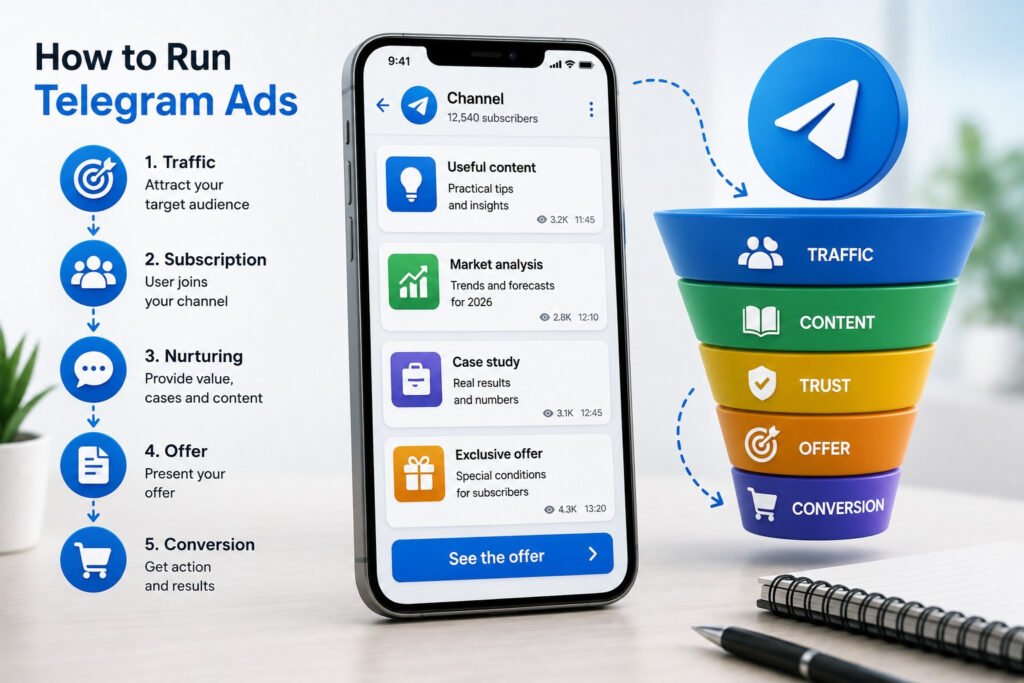
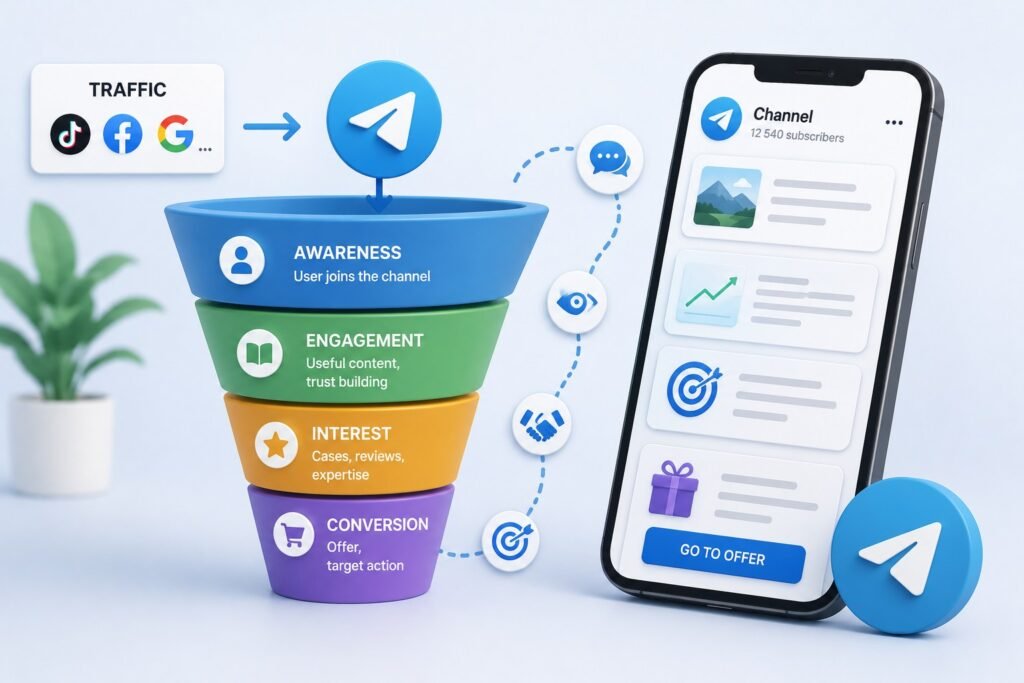
A classic Telegram funnel begins by driving traffic from an external source—TikTok, Facebook, SEO, or ads within Telegram.

After subscribing, the user receives a series of helpful posts, gets to know the author’s expertise, studies case studies, and only then moves on to the offer.

This approach significantly increases audience engagement and reduces the number of random leads. This model works particularly well in complex verticals where people need time to make a decision.

Content Is the Key Tool for Running the Engagement Campaign

Awareness in telegram

On Telegram, success doesn’t go to those who post the most ads. It goes to those who consistently create valuable content.

Practical guides, in-depth analyses, market insights, and real-world case studies gradually build trust with the audience.

That’s exactly why strong media projects pay close attention to the quality of their content. We discussed the role of content in a project’s long-term development in detail in this article.

The higher the level of trust, the easier it is to monetize subscribers down the line.

Why It’s Important to Analyze Each Stage

Even a good sales funnel requires constant optimization. It’s not enough to just count the final sales.

It’s important to understand how many users read posts all the way through, how many click on links, and at what stage audience loss begins. Only comprehensive analytics allow you to identify weak spots and gradually increase conversion rates.

Conclusion

Telegram has long since ceased to be just a regular messaging app for communication.

Today, it’s a full-fledged tool for building sales funnels, allowing you to run your audience, build trust, and achieve higher-quality conversions.

That’s precisely why more and more affiliate marketing teams view Telegram not as an additional traffic source, but as a vital part of their own ecosystem. We’ve discussed in detail which traffic sources work most effectively for Telegram at this link.

The Best Metrics for Evaluating a Campaign

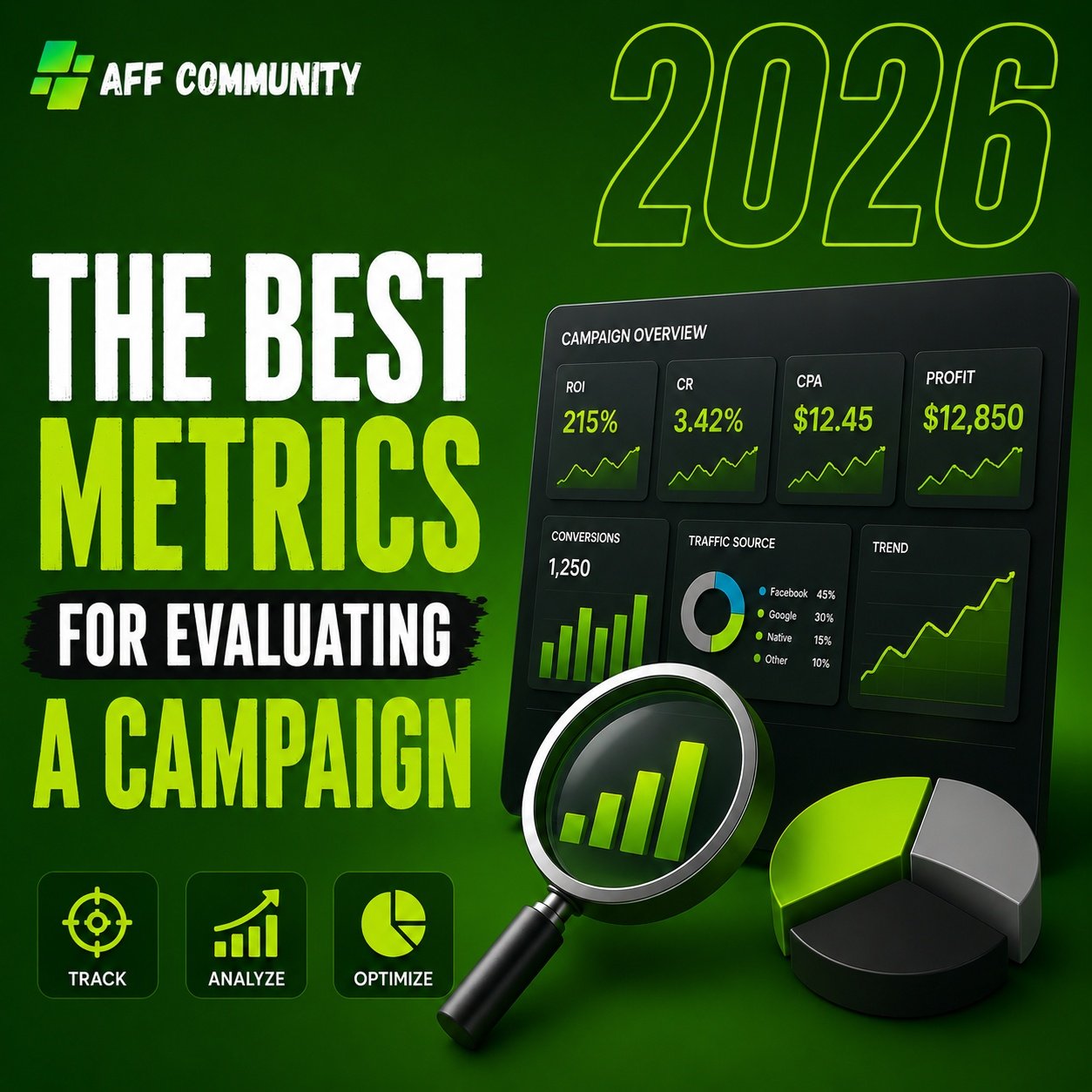
One of the most common mistakes among beginners in affiliate marketing is focusing solely on profit or ROI. If a campaign is in the black, everything is fine. If it’s in the red, it’s time to pause it. In practice, things are much more complicated.

Our team regularly encounters situations where a seemingly profitable campaign gradually fizzles out, while a promising one is shut down too early due to incorrect data analysis.

That’s exactly why skilled webmasters evaluate not just one metric, but a whole set of indicators.

ROI—An Important, but Not the Most Important, Metric

Virtually every publisher starts their analysis with ROI. This makes sense. The metric allows you to quickly understand the effectiveness of your investments.

But the problem is that ROI only shows the final picture. It doesn’t explain the reasons behind the result. That’s why relying solely on it is risky.

A campaign might show a good ROI at small volumes and completely fall apart after scaling up.

CTR Shows the Strength of the Creativity

When it comes to the early stages of analysis, CTR remains one of the most useful metrics. It helps you understand how well an ad captures the audience’s attention.

A low CTR often indicates problems with the creativity, the offer, or the presentation. A high CTR doesn’t guarantee a campaign’s profitability, but it almost always indicates that the ad is generating interest.

That’s precisely why experienced buyers start their optimization efforts with the ad creatives.

It’s no coincidence that the impact of creativity on the effectiveness of ad campaigns remains one of the industry’s key topics. This issue was discussed in detail in this article.

metrics in affiliate marketing

Conversion Rate Indicates Traffic Quality

After a click, the next stage of the funnel begins. Here, conversion plays a crucial role. It helps determine how well the audience aligns with the offer.

If the CTR is high but there are no conversions, the problem usually lies beyond the ad itself. For example:

  • a poorly designed landing page;
  • an unsuitable offer;
  • an error in audience segmentation.

Therefore, it’s practically impossible to analyze a campaign without evaluating conversions.

CPM helps assess the effectiveness of ad spending

In many verticals, CPM is one of the first indicators of future problems. A rise in the cost per impression often signals high competition, audience issues, or a decline in creativity.

However, many webmasters only notice CPM when the ad campaign has already started losing money.

Strong teams monitor this metric constantly—especially in competitive niches like gambling, crypto, and finance.

EPC and Lead Quality

If you’re working through affiliate programs, you can’t ignore EPC. This metric helps you understand the true value of each click.

Two campaigns may generate the same number of leads but yield completely different profits. Additionally, it’s important to consider the quality of the leads themselves.

Poor-quality traffic may temporarily show good numbers but can quickly lead to a drop in the ability to approve requests and a deterioration in relations with the advertiser.

Therefore, monitoring audience quality becomes an essential part of a webmaster’s job.

The approach to evaluating traffic quality is discussed in detail at this link: https://affcommunity.org/kontrol-lidov-kak-ne-pereplachivat-za-odin-i-tot-zhe-trafik/

Metrics Only Work Together

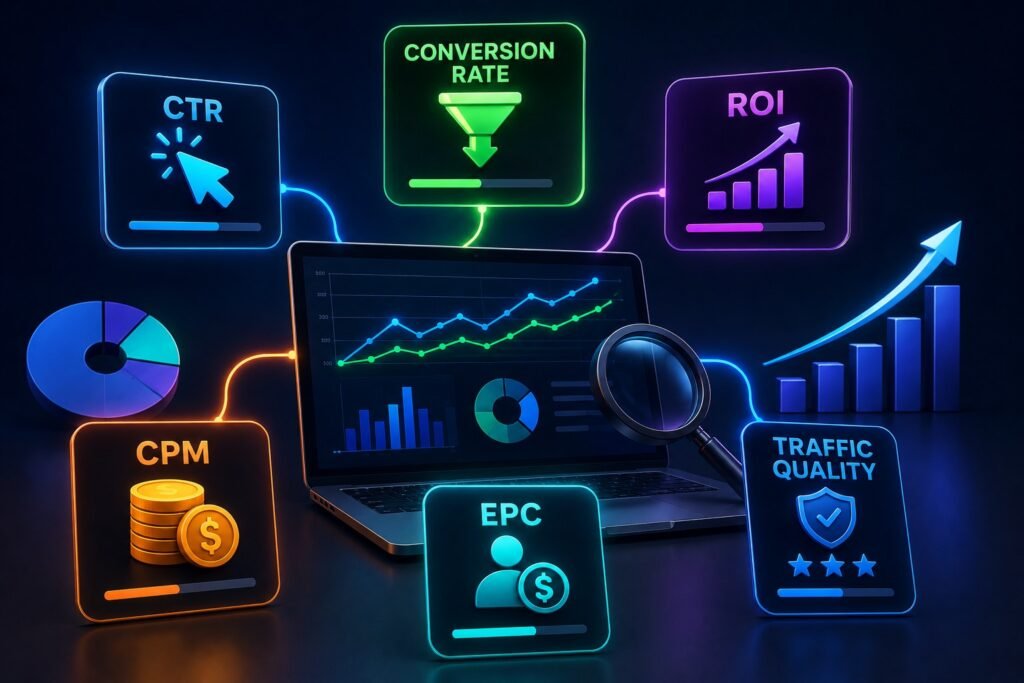
The main mistake made by novice webmasters is looking for a single, universal metric. In practice, no such metric exists: CTR indicates interest, conversion shows audience relevance, and CPM reflects the auction environment. ROI demonstrates the final result.

It is precisely the combination of these metrics that enables you to make the right decisions. That’s why strong teams analyze the entire funnel as a whole, rather than individual numbers in reports.

Conclusion

In 2026, the winners won’t be the webmasters who know how to run ads, but those who know how to interpret data correctly. ROI remains an important metric.

But truly effective decisions are made only when CTR, CPM, conversion rate, EPC, and traffic quality are analyzed simultaneously.

It is precisely this approach that allows you to identify profitable combinations before your competitors and scale them without any unpleasant surprises.

How to Lower CPM in Competitive Niches

High CPM is one of the main challenges for webmasters working in gambling, crypto, adult content, and other overheated verticals.

When the cost per thousand impressions starts to rise, many immediately look for new accounts, switch payment providers, or try to find a different GEO.

But our team and I constantly see the same mistake: most advertisers try to address the symptoms rather than the root cause.

In practice, a high CPM isn’t always related to the niche itself. Very often, the problem lies within the ad campaign.

Algorithms look at more than just the bid

Many beginners believe that CPM is determined solely by competition in the auction. In reality, ad platforms evaluate dozens of additional factors:

  1. Creativity quality.
  2. Audience engagement.
  3. CTR.
  4. Account history.
  5. User behavior after interacting with the ad.

If the algorithm deems an ad useful to the audience, the cost per impression is often significantly lower than the market average.

This is precisely why the quality of ad creativity directly impacts the overall cost-effectiveness of the campaign. We’ve analyzed the impact of creativity on ad performance in detail in this article.

Targeting the wrong audience almost always increases CPM

One of the most costly mistakes is using targeting that’s too broad or too obvious. Virtually all competitors use similar settings. As a result, the auction heats up, and the cost per impression begins to rise. This happens particularly often in the gambling and finance sectors.

Strong teams try to find less competitive audience segments and test additional interests.

Sometimes even a small change in the audience can significantly lower CPM without sacrificing traffic quality.

Creativity directly influences the cost per impression

In many verticals, it’s not the one who pays the most who wins, but the one who best holds the user’s attention. If a user pauses their feed, interacts with the ad, and shows interest, the algorithms begin to view the ad more positively.

Lower CPM

This allows you to get more impressions for the same amount of money. This is precisely why experienced webmasters constantly update their ad creatives and test new approaches.

By the way, the specifics of adapting creativities to the modern requirements of advertising platforms were discussed in detail in this article.

Don’t ignore the new algorithms

In 2026, advertising algorithms are increasingly relying on machine learning. Old methods of setting up campaigns are becoming less effective.

Many approaches that delivered results a couple of years ago may now only increase the cost of traffic. This is especially noticeable on Meta.

Algorithm changes directly affect auction costs, ad distribution, and ad performance.

Ignoring such changes often leads to a rise in CPM, even with good creativity and a high-quality audience.

Testing Is Cheaper Than Constant Scaling

Another common mistake is trying to solve the problem with money. If CPM is rising, many simply increase their budget. This might work in the short term.

But in the long run, this approach rarely proves effective. It’s much more beneficial to regularly test new angles, audiences, creativity formats, and approaches to presenting the offer.

It’s no coincidence that many teams achieve the best results precisely through optimization, rather than by constantly increasing spending. This process is discussed in detail at this link.

Conclusion

It’s possible to lower CPM in a competitive niche even without changing the vertical or traffic source.

Most often, four factors yield results:

  • high-quality creativity;
  • the right audience;
  • an understanding of the platform’s algorithms;
  • and continuous testing of new hypotheses.

That is precisely why strong affiliate marketing teams focus not only on increasing their budget but also on the effectiveness of every impression. In the long run, this approach almost always proves more profitable than simply increasing spending.

Will SEO still be around in 5 years’ time?

Every time a new technology appears on the internet, the same predictions start doing the rounds: SEO is dead.

This was the case after the emergence of social media. Then after the rise of video content. Later, following TikTok’s surge in popularity. Now, artificial intelligence and AI search are being cited as the main threats to SEO.

Our team and I regularly come across these kinds of discussions. But if we look at the situation objectively, it becomes clear that SEO won’t be going anywhere in five years’ time. The only thing that will change is the very model for generating search traffic.

Why do many people think SEO is dying?

The main reason is the development of AI systems. Today, a user can ask ChatGPT, Gemini or another assistant a question and receive a ready-made answer without visiting a website.

At first glance, this does indeed look like a threat to traditional search. Owners of content-based websites, who have been attracting an audience via Google for decades, are particularly concerned.

SEO won't disappear

However, the problem runs much deeper. Artificial intelligence does not generate information on its own. It still requires high-quality data sources.

This is precisely why the future of SEO is closely linked to the development of AI search. This process was analysed in detail in our article at the link.

Search won’t disappear, it will change

Today, many users are already starting to receive answers via AI interfaces. But this does not mean a move away from websites.

On the contrary. The more automatically generated content there is, the greater the value of high-quality sources of information.

Search engines still need expert articles, research, case studies and analytics. Without them, AI simply won’t be able to generate high-quality answers.

This is precisely why strong content-driven projects continue to be an important part of the internet ecosystem.

A website’s authority is becoming more important than keywords

In the past, many SEO specialists focused on semantics and technical optimisation. Today, a resource’s trustworthiness, expertise and reputation are becoming increasingly important.

Search engines are beginning to assess not only individual pages, but also the overall authority of a project.

Projects that manage to become authoritative sources of information will reap the benefits regardless of the search format.

Brands will grow faster

One of the main trends in recent years has been the growth in branded traffic. Users are increasingly searching for specific websites, services and media outlets that they trust.

This is particularly noticeable in competitive niches where there is an overwhelming amount of information. People are starting to focus not only on the subject matter but also on the source.

This is precisely why building brand recognition is becoming a vital part of modern SEO. The impact of brand recognition on organic traffic is discussed in detail in this article.

AI will not replace high-quality content

There is another popular myth: that neural networks will completely replace human authors. In practice, we are seeing the opposite happen. The volume of content is indeed growing.

But alongside this, the demand for expertise and genuine knowledge is also growing. Superficial texts are gradually losing their value. Content based on first-hand experience, research and unique data is becoming increasingly sought after.

What will SEO look like in five years’ time

In all likelihood, in five years’ time, SEO will be much broader in scope than it is today. The focus will not be limited to Google alone.

There will be a need to take into account AI search, generative responses and new formats for interacting with users.

But the fundamentals will remain the same:

  1. High-quality content.
  2. Website authority.
  3. A strong brand.
  4. Value for the audience.

It is precisely these factors that will continue to determine a project’s success, regardless of what the search interface looks like.

Conclusion

SEO won’t disappear in five years’ time. The tools will change, the algorithms will change, and the ways of generating traffic will change.

But people’s need for high-quality information will remain.

This means that websites which create useful content and build trust with their audience will continue to receive organic traffic from both search engines and new AI platforms.

Why many people calculate ROI incorrectly

ROI is one of the most popular metrics in affiliate marketing. Virtually every buyer checks this figure daily and makes decisions based on it. The problem is that a huge number of webmasters calculate ROI incorrectly.

Our team regularly comes across situations where a campaign appears profitable at first glance, but upon closer inspection turns out to be loss-making. Or, conversely, a promising campaign is paused too early due to erroneous conclusions.

This is precisely why understanding ROI is more important than the calculation formula itself.

Why a high ROI doesn’t always mean a profit

The most common mistake made by beginners is to focus solely on the ROI percentage. Let’s consider two campaigns. The first generated a profit of $20 against costs of $10. The ROI was 200 per cent.

The second generated a profit of $1,000 against costs of $500. The ROI was also 200 per cent.

Top roi result

On paper, the figures are identical. But for a business, the value of these campaigns is completely different. This is precisely why experienced webmasters always look not only at ROI, but also at profit volume, scalability and the stability of results.

Often, the pursuit of an impressive percentage leads to the loss of truly strong campaigns.

The small sample size fallacy

The second problem arises when analysing an insufficient volume of data. Many people run a test, get a few leads and immediately draw conclusions. In the long run, such decisions often prove to be flawed.

A campaign might show an excellent ROI on the first $50 of the budget and completely fall apart once scaled up.

Or, conversely, it might only start turning a profit once the algorithms have completed their learning phase. This is precisely why, when analysing advertising campaigns, it is important to consider the statistical significance of the data, rather than individual successful or unsuccessful results.

Many people forget to factor in actual costs

Another classic mistake is to consider only the advertising budget. In practice, costs often turn out to be significantly higher.

The following should be included in calculations:

  1. account costs;
  2. anti-detection browsers;
  3. proxies;
  4. trackers;
  5. creativity costs;
  6. payment system fees;
  7. White pages;
  8. team labour costs.

If you only take the advertising budget into account, the ROI may appear significantly better than the actual situation.

This mistake is particularly noticeable in large teams, where infrastructure costs make up a significant proportion of expenditure.

ROI does not reflect audience quality

Very often, webmasters assess effectiveness solely on the basis of lead cost and return on investment.

However, there are metrics that ROI does not take into account. For example:

  • lead quality;
  • approve rate;
  • repeat sales;
  • customer retention;
  • LTV.

Therefore, two campaigns with the same ROI can generate completely different profits for the advertiser.

It is no coincidence that experienced teams pay close attention to analysing the audience and its behaviour. The impact of user segmentation on the effectiveness of advertising campaigns was discussed in detail in this article.

Scaling changes the maths

One of the most frustrating situations for any webmaster is a successful test that stops working after scaling. The reason is simple.

As volumes increase, the metrics begin to change:

  1. The cost of traffic rises.
  2. Competition increases.
  3. CTR decreases.
  4. Audience quality deteriorates.

As a result, ROI begins to fall gradually. This is precisely why a successful test does not guarantee successful scaling.

Why you shouldn’t focus solely on ROI

In practice, strong webmasters use several metrics simultaneously. ROI remains an important metric, but it is by no means the only one.

The following are also analysed:

  • profit volume;
  • conversion rate;
  • cost per lead;
  • traffic quality;
  • scalability of the campaign.

It is precisely the combination of these factors that enables well-informed decisions to be made.

We’ve already explained why optimising the sales funnel and working on conversion rates often have a greater impact on profit than attempts to improve a single metric – you can find out more via the link: https://affcommunity.org/en/optimizing-traffic-processing-and-increasing-conversion/ 

ROI and the Age of Automation

By 2026, the situation will become even more complex. Advertising platform algorithms are increasingly making decisions independently.

As a result, publishers must analyse not only the final metrics but also the reasons behind any changes in them.

Those who understand the factors that make up their profit gain a significant advantage over those who focus solely on the ROI figure in their reports.

Conclusion

ROI remains one of the most important metrics in affiliate marketing, but on its own this figure rarely reflects the full picture. A high ROI does not always mean high earnings. A low ROI does not always mean a poor campaign.

That is why professional teams analyse not just a single figure, but the entire system of metrics as a whole.

It is precisely this approach that enables them to make the right decisions and scale profitable campaigns without any unpleasant surprises.

What is AEO (Answer Engine Optimisation) and why is it important for webmasters?

For the past 20 years, internet marketing has been heavily reliant on search engines. If someone needed an answer to a question, they would open Google, type in a query and select one of the websites from the results. But in 2026, the situation began to change rapidly.

More and more users are asking for information directly from ChatGPT, Gemini, Claude and other AI systems. Instead of a list of links, people receive a ready-made answer. It is against this backdrop that a new term has emerged – AEO (Answer Engine Optimisation).

Many believe this is just another buzzword. But we can see that changes are already taking place right now.

For website owners, affiliate marketing and content projects, understanding AEO is gradually becoming just as important as understanding SEO once was.

What is AEO in simple terms

If SEO helps a website appear in search results, then AEO helps it become a source of answers for artificial intelligence.

AEO for affiliates

When a user asks a question to a neural network, the model analyses a vast amount of material and generates a final answer. The higher the quality, the more structured and useful the content, the greater the likelihood that it will be used as a source of information.

Essentially, the battle is no longer just for a place in search results. Now we have to fight for a place within the neural network’s response. And this fundamentally changes the approach to content creation.

Why webmasters should pay attention to AEO

At first glance, it might seem that this is a story exclusively for SEO specialists. In practice, it’s much more interesting. Most affiliate marketing media relies on informational traffic.

Users regularly search for:

  • how to run TikTok campaigns; 
  • which offers are currently relevant;
  • which anti-detection tools to use;
  • which GEOs work best;
  • how to run ads under the new conditions.

If neural networks start providing answers to these questions, it means that a new audience is gradually emerging there. And the sooner content adapts to such changes, the greater the chances of retaining traffic in the future.

How AEO differs from classic SEO

Many people try to view AEO as a replacement for SEO. In reality, this is a mistake. We believe that in the coming years, both approaches will operate in parallel.

SEO still helps to generate search traffic. AEO helps content appear in AI-generated answers. But the requirements for content are indeed changing.

Whereas previously it was possible to rank highly by using a large number of keywords, today the quality of the answer plays an increasingly important role.

Incidentally, the impact of artificial intelligence on search results and the changes already taking place in SEO are discussed in detail in this article.

What kind of content is best suited for AEO

Practice shows that neural networks favour content that helps users find an answer to a question quickly. The following work best:

  1. step-by-step instructions;
  2. error analyses;
  3. tool comparisons;
  4. service reviews;
  5. expert guides.

At the same time, superficial texts are gradually losing their value.

The more specifics, examples and practical experience the material contains, the higher the likelihood of it being used as a source. This is precisely why in-depth expert articles gain an additional advantage.

Why websites remain important

Some experts are already predicting the death of SEO. We consider such statements to be premature. In practice, neural networks still need data sources. They do not create information out of thin air.

They need high-quality articles, research, reviews and expert materials. That is why strong content projects remain in demand.

What’s more, high-quality content gains added value because it starts working across several audience acquisition channels at once.

What this means for affiliate marketing media

New opportunities are opening up for affiliate marketing websites. Whereas previously the battle was solely for rankings on Google, now there is another avenue for growth. Content is beginning to compete for inclusion in AI system responses.

Content that addresses specific audience queries and offers practical value works particularly well.

In essence, many principles of high-quality content marketing are becoming even more relevant.

Incidentally, the importance of creating expert content and the impact of content quality on a project’s long-term growth are discussed in detail at this link.

How to prepare for the AEO era

In our view, strong projects should already be doing several things:

  1. Publish expert content. 
  2. Regularly update old content.
  3. Include more practical advice and real-world experience.
  4. Build the site structure around the audience’s questions.
  5. Improve internal linking between articles.

The last point is particularly important, as a logical structure helps both users and algorithms to better understand the project’s content.

Conclusion

AEO is not a replacement for SEO, but its logical evolution. Users are increasingly getting answers via artificial intelligence, which means content projects have to adapt to the new rules.

But the good news is that the fundamentals remain the same. The sites that succeed are those that create high-quality content, help their audience solve real-world problems, and become an authoritative source of information in their niche.

It is precisely these projects that will receive traffic from both search engines and new AI platforms in the coming years.

How to Use Data for Scaling in Arbitrage

One of the most costly mistakes in arbitrage is scaling based on gut feelings. A campaign delivers a few profitable days, the first positive numbers appear, and the team starts drastically increasing budgets. A week later, the metrics collapse, the cost per lead rises, and profit turns into a loss.

We see situations like this all the time. And almost always, the problem is the same: scaling was based not on data, but on gut feelings. In 2026, this approach is working less and less effectively.

Competition is growing, ad platform algorithms are getting more complex, and the cost of testing continues to rise. That’s why today you shouldn’t scale up when “it seems like the campaign is working,” but when the numbers confirm growth potential.

Data reveals what the naked eye can’t see

Very often, an arbitrageur evaluates a campaign based on a single metric. For example, they look only at ROI. But a profitable campaign can hide serious problems: CTR is falling, CPC is rising, audience retention is deteriorating, and traffic quality is declining.

use data to find growth points

With a small volume, this may go unnoticed. But after scaling up, such problems quickly start turning into losses.

That is exactly why, before increasing budgets, it is important to look not at a single metric, but at the whole picture.

You should scale what you can explain

There is a simple rule. If you don’t understand why a campaign works, scaling it is risky. Let’s imagine a scenario. A campaign is showing excellent ROI. But at the same time, it’s unclear which specific creative is driving results. It’s unclear which audience converts better. There’s no understanding of which funnel elements impact the final profit.

In this case, any budget increase turns into a lottery. Strong teams first identify the reason for success, and only then begin scaling.

Working with segments drives more growth than increasing the budget

Many people think that scaling is simply increasing the daily limit. In practice, things look different. Experienced media buyers start breaking down the data: They look at different GEOs.

  1. Analyze devices.
  2. Compare age groups.
  3. Test individual creatives.

Very often, it turns out that one segment of the audience generates the majority of the profit. That’s where the main budgets are then directed.

This approach allows for much more stable growth than simply increasing ad spend.

Use data to find growth opportunities

Data isn’t just for monitoring. It helps identify new opportunities. For example, a campaign is performing well in one GEO.

It makes sense to test neighboring countries with similar audience behavior. Or another example: one creative format is showing a high CTR. That means it’s worth testing new variations of this approach.

This is exactly how strong teams gradually expand their working combinations without sudden jumps or unnecessary risks.

We’ve already discussed the approach to finding new directions and working hypotheses in detail at the link.

Why scaling breaks down

In practice, most problems don’t start because of bad data. The problem is that it’s interpreted incorrectly.

For example, a combination shows positive results for three days in a row. This isn’t enough to draw serious conclusions. Or consider another scenario: a single creative accidentally performs well on a small traffic sample. After scaling up, the results deteriorate sharply.

That’s why it’s crucial to distinguish between statistical noise and genuine patterns. The more data is collected, the more accurate the decisions become.

Automation is becoming essential

When traffic volumes start to grow, manual analysis becomes too slow.

That is why teams are increasingly using trackers, CRMs, BI systems, and automated reports. The faster a team receives data, the faster it can respond to market changes.

The faster a team receives data, the faster it can respond to market changes. Many processes that were previously done manually in spreadsheets are now automated through trackers, reports, and internal analytics systems. It is especially important not just to collect statistics, but to be able to interpret them correctly and identify problem areas within the funnel. The approach to traffic quality control and data management is discussed in detail in this article – https://affcommunity.org/en/lead-tracking-how-to-avoid-overpaying-for-the-same-traffic/ 

Data helps you stop in time

This is one of the most underrated benefits of analytics. Most affiliate marketers use data only to identify growth opportunities.

But it’s just as important to notice a decline in performance in time. Often, the right decision isn’t to increase the budget, but rather to pause the campaign and figure out the reasons for the drop.

That’s exactly why analytics helps not only to earn more, but also to lose less.

Conclusion

In 2026, scaling will depend less and less on intuition and more and more on data. The better an arbitrage specialist understands their audience, creatives, funnel, and traffic sources, the safer and more effective growth becomes.

That’s why strong teams don’t scale budgets. They scale their understanding of why their campaigns work.

How to Become a Team Lead in Affiliate Marketing

Many people enter the world of affiliate marketing with a single goal: to learn how to consistently run campaigns at a profit. But over time, some webmasters reach the next stage of growth. It’s no longer just about running campaigns yourself, but about building processes and managing people.

This is usually how the path to becoming a Team Lead begins.

But here it’s important to understand one thing: a good buyer doesn’t automatically become a good Team Lead. That’s a different job.

Why the ability to run traffic alone isn’t enough

A strong Team Lead is responsible for more than just the numbers.

They must understand how to delegate tasks, identify the team’s weaknesses, and spot problems early on. While a buyer is responsible for their own team, a Team Lead is responsible for the overall result.

This becomes especially noticeable when scaling up. As long as the team consists of 2–3 people, a lot is kept together by verbal agreements. But when designers, farmers, several buyers, and a constant stream of tests come into play, everything starts to fall apart without processes.

We’ve already discussed why systematic work begins to influence results more than individual successful launches—we covered this in more detailin this articlehttps://affcommunity.org/kpi-i-metriki-kotorye-nuzhno-otslezhivat/

A Team Lead must know how to work with people

One of the most common mistakes made by novice Team Leads is trying to control absolutely everything:

  1. Reviewing every piece of creativity.
  2. Logging into every account.
  3. Monitoring every campaign.

As a result, the Team Lead simply gets bogged down in day-to-day operations. A good Team Lead builds processes so that the team can work consistently even without constant supervision.

team lead of affiliates

Moreover, it is precisely transparency and a clear system within the team that often become the main drivers of growth.

Analytics is becoming more important than buying traffic

Many web specialists want to become team leads right after a few successful campaigns. But a high ROI doesn’t automatically make someone a leader.

The role of a Team Lead requires a deeper understanding:

  1. where the team is falling short;
  2. which campaigns scale worse than others;
  3. where the money is going;
  4. where weaknesses are emerging.

Continuous learning never goes away

A common mistake among new team leads is the belief that they can stop learning once they’ve reached a certain point. In practice, the opposite is true. The higher the level of responsibility, the more you need to understand the market:

  1. New traffic sources.
  2. New approaches.
  3. Changes in moderation.
  4. New campaign formats.

We’ve already discussed why finding new solutions is gradually becoming an essential part of growth in affiliate marketing—we covered this in more detail in the article at the link.

Conclusion

Becoming a Team Lead in affiliate marketing isn’t just about the title. It’s a transition from the “I know how to run campaigns” level to the “I know how to build a system” level. And more often than not, it’s not the strongest buyers who grow.

Those who grow are the ones who know how to combine people, processes, and analytics into a single working mechanism.

Spy services for affiliate marketing: a comprehensive analysis

Looking at the affiliate marketing market in 2026, one thing is clear: the days when affiliate marketing opportunities were stumbled upon by chance are long gone.

Competition has intensified across virtually all verticals. New offers appear daily, and the cost of testing continues to rise. That is precisely why, today, more and more teams are using Spy services not as an additional tool, but as a fully-fledged part of their working infrastructure.

We regularly see the same pattern. Newcomers try to find arbitrage opportunities manually, spend weeks on tests and ultimately reach the same conclusions that experienced teams arrive at in a matter of hours using a high-quality Spy service.

But it’s important to understand one thing here. A spy service doesn’t show a ‘make money’ button. It shows the direction where someone is already making that money.

What is a spy service in practice

Put simply, it’s a competitive intelligence tool.

The service collects adverts, creativity, landing pages, pre-landing pages, ad bundles and data from various traffic sources. The publisher gets the chance to see what other teams are launching right now, which approaches last longer than the rest, and which GEOs are starting to be flooded with traffic.

This is precisely why strong media buying teams use spy tools even before launching their adverts. First comes market analysis. Then hypotheses. And only after that, testing.

We’ve already covered in detail how to find working approaches before your competitors do, and why blindly copying rarely yields results – we discussed this further in this article.

Which spy services are currently used most often

There are dozens of solutions on the market, but far from all of them actually help in your work.

One of the best-known tools remains AdPlexity. Many use it to analyse native advertising, push traffic, mobile campaigns and specific verticals. The service allows you to view competitors’ active campaigns, study pre-lands and find connections for specific GEOs.

For Facebook and Instagram, many continue to use AdSpy. Its main strength lies in its vast database of adverts and the ability to analyse active approaches by interests, offers and regions.

Also popular are AdHeart, Spyteg, SpyOver and a whole range of specialised solutions for specific traffic sources. We have already compiled a selection of services and tools for competitor analysis — you can find out more HERE.

The main mistake made by beginners

Virtually all novice webmasters use spy tools in the same way. They find a competitor’s advert. They copy the creativity and launch it. They blow their budget. The problem is that spy tools show the market, not a ready-made campaign.

If an advert has been running for several weeks or months, this is a signal to pay attention to the mechanics, not a reason to create an exact clone.

What’s more, most advertising platforms have long since learned to rank blatant copies of popular creativities lower.

That’s why experienced buyers analyse not the video itself, but the structure:

  1. what pain point is being addressed;
  2. what offer is being promoted;
  3. what the funnel looks like;
  4. which audience is engaging with the content.

How to find new GEOs using spy

One of the most underrated features is the analysis of new markets. Very often, large teams start testing new countries long before they start being discussed en masse in chat rooms and Telegram channels.

If you regularly monitor advertising activity via spy tools, you can spot an increase in the number of launches in a specific region even before the niche becomes oversaturated. This is exactly how many publishers find promising areas before the mainstream market.

We have already shown how to evaluate new markets and which countries many teams are focusing on in 2026 – we discussed this in more detail in this article via the link.

Why a single Spy service isn’t enough

A very common mistake is hoping that a single tool will cover all your needs. In practice, strong teams use several solutions at once:

  1. Spy shows the adverts.
  2. The tracker shows the figures.
  3. Anti-detect helps manage the infrastructure.
  4. Proxies handle the technical side.
  5. Analytics helps with decision-making.

Only when used in combination do all these tools start to deliver real benefits.

What has changed in 2026

The spy service market itself has become significantly more complex. Whereas previously it was enough to look at a few competitors’ ads, today you have to analyse far more factors:

  • ad lifespan;
  • creativity variations;
  • changes in presentation;
  • localisation for different GEOs;
  • funnel structure.

Furthermore, many teams have started actively using AI to generate new creativity variations. As a result, the rate at which adverts are updated has increased significantly.

Therefore, spy services today are no longer just a tool for copying. They are a tool for analysing trends.

Conclusion

Spy services have long been an essential part of affiliate marketing. They help save budget, find working hypotheses more quickly, and understand where the market is heading. But it is important to remember the main point. It is not the Spy service itself that makes money. It is the ability to correctly interpret the data it displays that makes money.

This is precisely why strong teams use Spy services not to search for a ‘magic formula’, but to make more accurate decisions before launching traffic.

Fraud Protection in Affiliate Marketing: What Actually Works in 2026

In 2026, fraud has become one of the main challenges facing affiliate marketing. And it’s not just advertisers who are suffering – webmasters themselves are affected as well.

While many used to turn a blind eye to junk traffic, platforms and affiliate networks have now started to scrutinize lead quality more closely. And the problem is no longer limited to simple bots.

Today, everything falls under the umbrella of fraud:

  • motivated traffic;
  • click fraud;
  • fake registrations;
  • duplicates;
  • low-quality leads.

And if you don’t control this from the start, you can quickly lose your accounts, payouts, and good relationships with affiliate networks.

Why fraud has increased

The main reason is market overheating.

Traffic is getting more expensive, competition is growing, and many are trying to “pad the numbers” to stay in the black. Because of this, advertisers have started paying closer attention not to the quantity of leads, but to their quality.

This is especially noticeable in nutra, crypto, and gambling sectors. There, they’re now checking practically everything: depth of engagement, repeat visits, user behavior, and even the time between a click and registration.

We’ve already discussed how traffic behavior is analyzed and why some campaigns start to drop off even with normal volume – we covered this in more detail here.

How fraud is detected today

In the past, it was enough to filter out obvious bots. Now, systems look much deeper. The following are analyzed: user behavior on the page, repetition of actions, device, location, time of activity, and even movement patterns within the funnel.

If the traffic looks “inactive”, it’s quickly spotted. Moreover, the problem is often not outright fraud, but poor audience quality. We’ve already written that many webmasters lose money precisely because of improper handling of the link chain and traffic source – we discussed this point in detail in the article at the link.

What Really Helps Protect You

In 2026, fraud protection is no longer just a single service, but an entire system.

Professional teams use anti-detection browsers, proxies, trackers, filtering of suspicious clicks, and dedicated analytics on user behavior. It’s especially important to track where junk traffic comes from and at what stage the anomaly begins.

Where people most often go wrong

The main mistake is thinking that fraud only affects the advertiser. In practice, the website itself is the first to suffer. If an affiliate network detects suspicious activity, they may: cut payments, send the traffic for re-verification, or completely close the account.

The second mistake is a lack of analytics. Many focus only on ROI and fail to notice that lead quality is gradually declining.

And the third problem is blind scaling. When a campaign is ramped up rapidly without verifying traffic quality, the risk of fraud increases exponentially.

By the way, we’ve also already discussed typical mistakes in working with ads and traffic in detail in this article.

What’s Next

Anti-fraud systems will continue to become more sophisticated, especially on the part of major platforms and advertisers. In the coming years, the market will shift even more toward traffic quality, behavioral analytics, and long-term engagement with users.

That is precisely why the winners right now aren’t those who run the most traffic, but those who can maintain consistent quality.

We have noted more than once that affiliate marketing is gradually shifting from “running traffic” to full-fledged work with analytics and audience behavior. We also wrote about this in the article – https://affcommunity.org/en/affiliate-marketing-through-google-ads-in-2026-working-approaches-and-real-risks/ 

Conclusion

Fraud protection in 2026 is already a fundamental part of affiliate marketing. If you don’t monitor traffic quality, you can lose everything much faster than you think.

These days, the winner isn’t the one who found a “gray-area scheme,” but the one who knows how to work carefully, analyze the numbers, and understand what a normal user looks like inside the funnel.

How to Go from Beginner to Pro in affiliate marketing

Almost everyone gets into affiliate marketing with one goal in mind: to make money fast. They see case studies, numbers, and success stories. In reality, it all starts differently: with confusion, setbacks, and a ton of questions.

And this is where many drop out. Because the real path in affiliate marketing isn’t about quick money, but about gradually building experience.

Stage One: Chaos and Trying to Grasp the Basics

At the start, you don’t have a system. You’re just experimenting. You read articles, watch videos, launch your first campaigns. Most often, you lose money. That’s normal. No one gets past this stage without it.

The main goal here isn’t to make money, but to figure out:

  • how traffic works;
  • what a campaign is;
  • where the money actually comes from.

If your foundation is shaky, things will only get worse. So it’s better to fill in the gaps right away. The basics are covered here.

Stage Two: The First Working Combinations

After dozens of tests, things start to click. The first profitable days appear, even if they’re small. Here’s the key point: don’t jump ahead—lock in the result.

Understand why the funnel worked. What exactly worked—creativity, the audience, the offer. Many people make a mistake at this stage and simply go looking for something new without figuring out the old one.

If you don’t understand metrics and numbers, you won’t be able to scale—so it’s best to cover this point separately, for example in this article.

Stage Three: A Systematic Approach

Once you have that understanding, the real work begins. You’re no longer testing everything haphazardly. There’s a clear logic:

hypothesis → test → analysis → scale

At this stage, stable combinations emerge. It’s not just a fluke, but a repeatable result. At the same time, you start to understand the market better. Where is the market overheated, where can you still enter, which approaches are dying out, and which are just emerging.

This is exactly where the understanding comes that you need to find new combinations before others do.

Stage Four: Scale and Money

From here on, everything comes down to scale.

You’re no longer working alone. New accounts, budgets, and sometimes a team come into play. More tools and processes come into play.

Stability is key here. It’s not about a single successful launch, but a steady stream of campaigns that deliver results.

And almost always at this point, you realize you can’t rely on a single source. That’s why serious webmasters start diversifying their traffic; you can check out some options here.

What Sets a Pro Apart from a Beginner

The difference isn’t in secret traffic sources.

Pros:

  1. test quickly;
  2. understand the numbers;
  3. don’t panic during drops;
  4. see where the problem lies;

Beginners often act on emotion. One setback and that’s it—change the niche, change the offer, try to start over.

A pro simply looks for where the funnel broke and fixes it.

Conclusion

The path in affiliate marketing isn’t a single leap, but a process.

First chaos, then the first results, then a system, then scale.

And the faster you move from “trying everything” to understanding exactly what you’re doing, the faster the money comes in.

In affiliate marketing, there’s no “become a pro” button. There’s only experience, which you gain through trial and error.

How to Choose a Vertical in Affiliate Marketing and Avoid Losing Money Right from the Start

The most common question among beginners is where to run campaigns. Nutra, gambling, crypto, e-commerce… it seems like there’s a “most profitable” vertical out there. In reality, there isn’t one.

There is a vertical that suits you. And if you don’t get into it from the very beginning, you can just burn through your budget, even with decent ad networks.

Don’t start with where there’s more money

The logic of “they pay more there, so I’ll go there” usually ends in a loss.

Crypto and finance offer big payouts, but they come with complex moderation, expensive traffic, and high competition. It’s hard to break into that space without experience; we’ve covered this in more detail here.

If you’re still looking toward crypto, first check which affiliate networks offer decent terms—you can find a list at this link.

Gambling can be lucrative, but it requires an understanding of the funnel and working with traffic quality. If you have no experience, it’s easier to start with more straightforward niches and then move on from there.

Keep an eye on your budget

This is something people rarely think about.

If your budget is small, there’s no point in diving into expensive traffic sources and complex niches. Testing there is costly, and mistakes quickly eat up your money.

With a smaller budget, it’s easier to go for cheaper traffic and niches where you can get feedback faster.

If you’re not sure where to get traffic, check out the available ad networks—they’re listed here.

Consider what kind of traffic you want to work with

Some people feel more comfortable working with social media, others with search, and others with push notifications.

Different verticals work best with different traffic sources.

For example, visual offers and native approaches perform well on Facebook. Search works best for demand-driven campaigns, where the user is already looking for a solution.

If you choose a vertical that doesn’t align well with your traffic source, it will be more difficult. Especially if you don’t understand how creativity is structured—you can find an analysis here.

Plus, a lot now depends on tools—trackers, anti-detect browsers, proxies. These tools are essential. You can view the list of services here

Interest in the topic is also important

This is often underestimated.

If you’re not interested in the topic at all, you’ll burn out quickly. Affiliate marketing involves constant testing, tweaking, and analysis.

When you have even a basic understanding of the product or audience, it’s easier to work. You find ideas for creativity and funnels faster. By the way, many people give up because of unrealistic expectations and myths.

Don’t jump between verticals

Many people make a mistake: if it doesn’t work out in a week, they switch niches. As a result, they have no understanding of what works in any vertical.

It’s better to choose one direction and dig deeper into it. Understand the audience, creativity, and the funnel. Only then should you draw conclusions. And only after that should you add new affiliate networks and offers.

Here’s the reality

There’s no such thing as a perfect vertical. Every one has money in it, and every one has its problems.

The difference lies in how willing you are to deal with these problems: moderation, traffic cost, funnel complexity.

Conclusion

Choosing a vertical isn’t about finding the “most profitable niche.” It’s about finding a balance between:

  1. your budget;
  2. traffic source;
  3. and your level of experience.

If you hit that sweet spot, your chances of turning a profit are much higher.

And then it’s business as usual in affiliate marketing—tests, mistakes, and gradually figuring out what actually works.