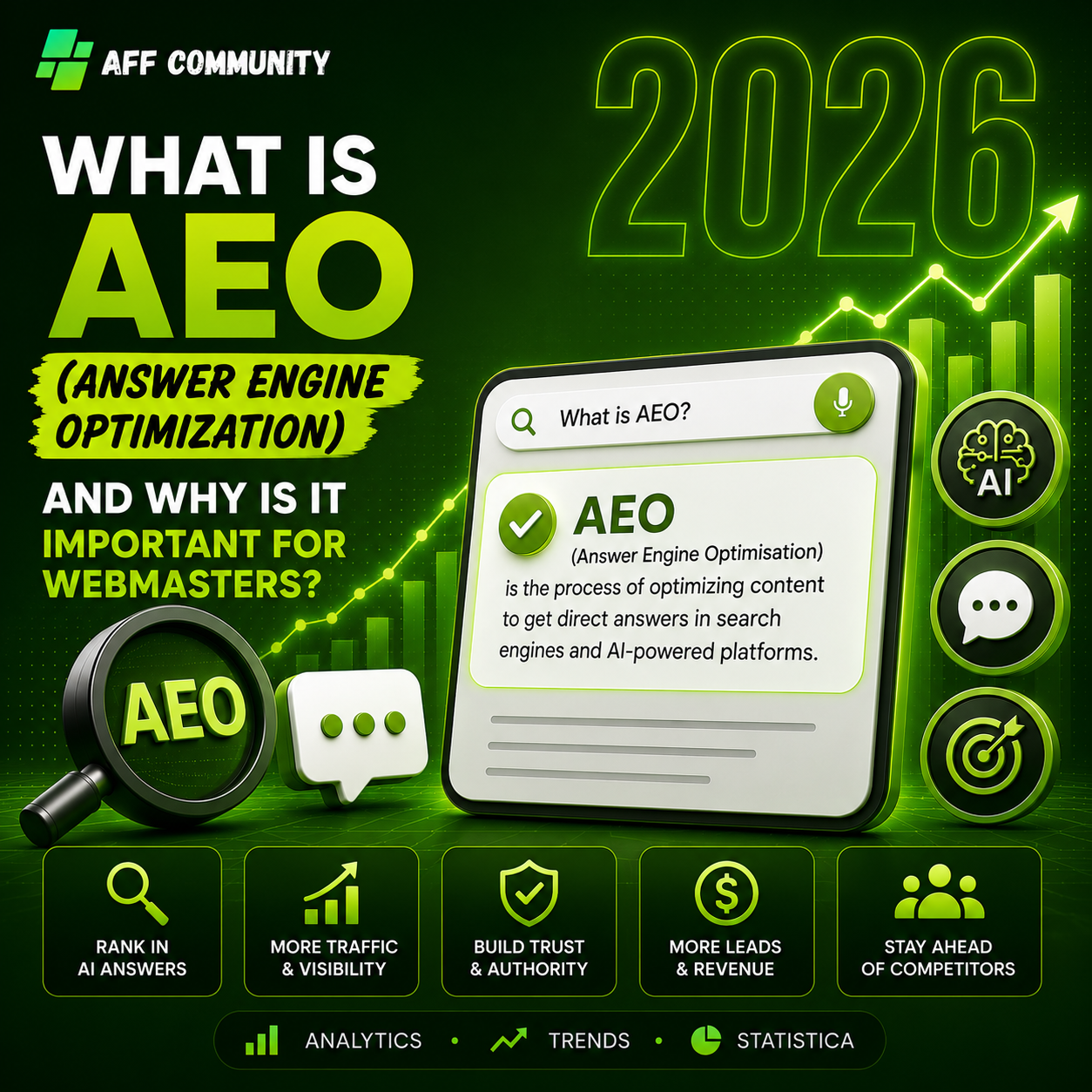
What is AEO (Answer Engine Optimisation) and why is it important for webmasters?

For the past 20 years, internet marketing has been heavily reliant on search engines. If someone needed an answer to a question, they would open Google, type in a query and select one of the websites from the results. But in 2026, the situation began to change rapidly.

More and more users are asking for information directly from ChatGPT, Gemini, Claude and other AI systems. Instead of a list of links, people receive a ready-made answer. It is against this backdrop that a new term has emerged – AEO (Answer Engine Optimisation).

Many believe this is just another buzzword. But we can see that changes are already taking place right now.

For website owners, affiliate marketing and content projects, understanding AEO is gradually becoming just as important as understanding SEO once was.

What is AEO in simple terms

If SEO helps a website appear in search results, then AEO helps it become a source of answers for artificial intelligence.
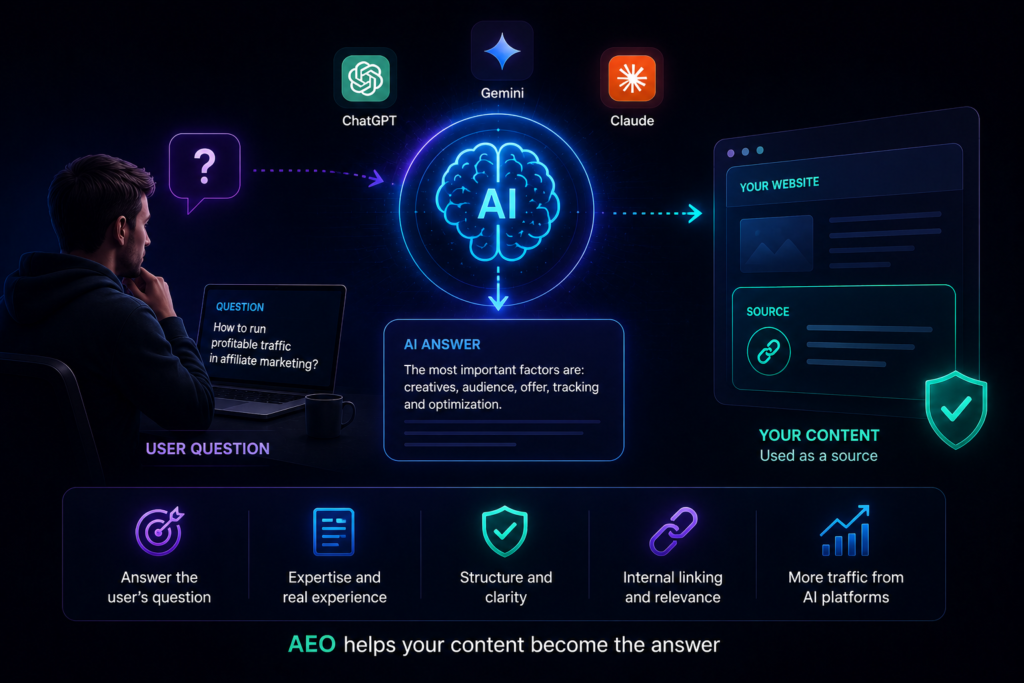
AEO for affiliates

When a user asks a question to a neural network, the model analyses a vast amount of material and generates a final answer. The higher the quality, the more structured and useful the content, the greater the likelihood that it will be used as a source of information.

Essentially, the battle is no longer just for a place in search results. Now we have to fight for a place within the neural network’s response. And this fundamentally changes the approach to content creation.

Why webmasters should pay attention to AEO

At first glance, it might seem that this is a story exclusively for SEO specialists. In practice, it’s much more interesting. Most affiliate marketing media relies on informational traffic.

Users regularly search for:

  • how to run TikTok campaigns; 
  • which offers are currently relevant;
  • which anti-detection tools to use;
  • which GEOs work best;
  • how to run ads under the new conditions.

If neural networks start providing answers to these questions, it means that a new audience is gradually emerging there. And the sooner content adapts to such changes, the greater the chances of retaining traffic in the future.

How AEO differs from classic SEO

Many people try to view AEO as a replacement for SEO. In reality, this is a mistake. We believe that in the coming years, both approaches will operate in parallel.

SEO still helps to generate search traffic. AEO helps content appear in AI-generated answers. But the requirements for content are indeed changing.

Whereas previously it was possible to rank highly by using a large number of keywords, today the quality of the answer plays an increasingly important role.

Incidentally, the impact of artificial intelligence on search results and the changes already taking place in SEO are discussed in detail in this article.

What kind of content is best suited for AEO

Practice shows that neural networks favour content that helps users find an answer to a question quickly. The following work best:

  1. step-by-step instructions;
  2. error analyses;
  3. tool comparisons;
  4. service reviews;
  5. expert guides.

At the same time, superficial texts are gradually losing their value.

The more specifics, examples and practical experience the material contains, the higher the likelihood of it being used as a source. This is precisely why in-depth expert articles gain an additional advantage.

Why websites remain important

Some experts are already predicting the death of SEO. We consider such statements to be premature. In practice, neural networks still need data sources. They do not create information out of thin air.

They need high-quality articles, research, reviews and expert materials. That is why strong content projects remain in demand.

What’s more, high-quality content gains added value because it starts working across several audience acquisition channels at once.

What this means for affiliate marketing media

New opportunities are opening up for affiliate marketing websites. Whereas previously the battle was solely for rankings on Google, now there is another avenue for growth. Content is beginning to compete for inclusion in AI system responses.

Content that addresses specific audience queries and offers practical value works particularly well.

In essence, many principles of high-quality content marketing are becoming even more relevant.

Incidentally, the importance of creating expert content and the impact of content quality on a project’s long-term growth are discussed in detail at this link.

How to prepare for the AEO era

In our view, strong projects should already be doing several things:

  1. Publish expert content. 
  2. Regularly update old content.
  3. Include more practical advice and real-world experience.
  4. Build the site structure around the audience’s questions.
  5. Improve internal linking between articles.

The last point is particularly important, as a logical structure helps both users and algorithms to better understand the project’s content.

Conclusion

AEO is not a replacement for SEO, but its logical evolution. Users are increasingly getting answers via artificial intelligence, which means content projects have to adapt to the new rules.

But the good news is that the fundamentals remain the same. The sites that succeed are those that create high-quality content, help their audience solve real-world problems, and become an authoritative source of information in their niche.

It is precisely these projects that will receive traffic from both search engines and new AI platforms in the coming years.
Video content vs text-based SEO: which will drive more traffic in 2026

Over the last few years, the content market has effectively split into two camps. Some are convinced that the future belongs exclusively to video. TikTok, Reels, Shorts and other formats have captured the audience’s attention, and users increasingly prefer to watch rather than read.

Others continue to invest in SEO, develop websites and create in-depth expert content that consistently generates search traffic for years.

We regularly witness this debate. And the main question usually sounds the same: which is more profitable to develop in 2026: video content or text-based SEO?

The answer is not as obvious as it seems at first glance.

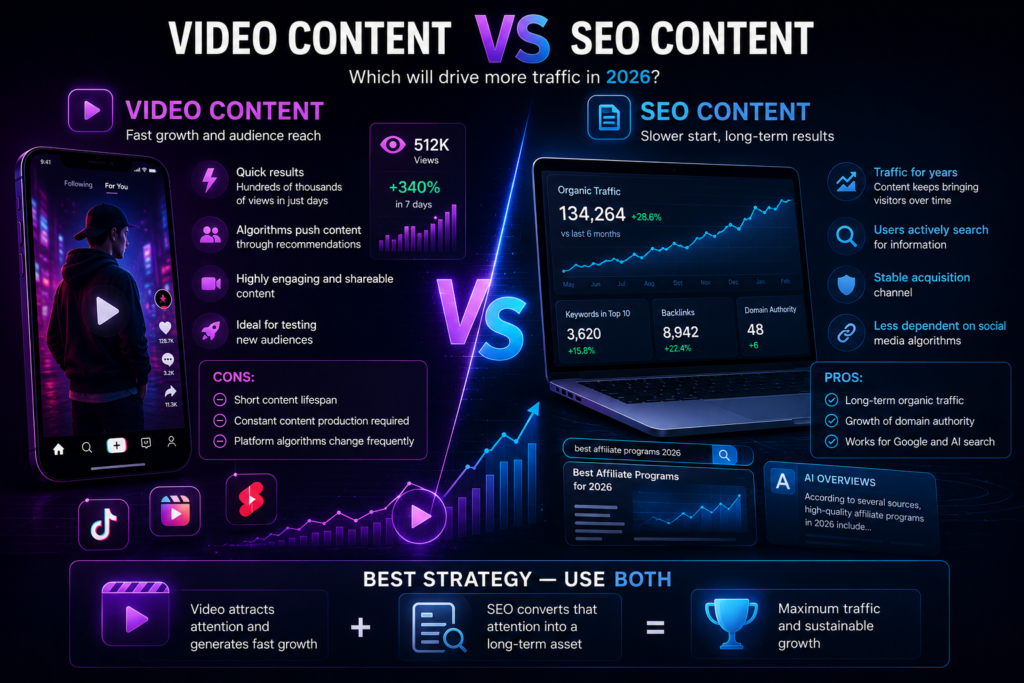
Why video is growing faster right now

Video has one huge advantage. It grabs attention faster. Users don’t need to search for, read or analyse anything. The algorithms themselves display the content in the recommendations feed.

That’s why a good video can rack up hundreds of thousands of views in just a few days.

This is particularly noticeable on TikTok, where new accounts can achieve significant reach almost from their very first posts.

At the same time, the algorithms themselves continue to actively promote high-quality video content. We have already examined in detail which factors influence the spread of videos and why some videos get millions of views whilst others go unnoticed — we discussed this in more detail in this article.

But video has a serious drawback. It very quickly becomes outdated.

video content and SEO content

The main problem with video

Most videos have a short lifespan. Even successful content often stops driving traffic after a few weeks or months.

Algorithms switch their focus to new posts. The audience burns out. New trends emerge. As a result, you have to constantly create new content.

This is precisely why many projects become dependent on the regular production of videos. Stop producing them, and you lose reach. Stop publishing, and you start losing your audience.

SEO works more slowly, but for longer

With text content, the situation is the opposite. Yes, a good article rarely garners tens of thousands of views in the first few days after publication.

However, high-quality material can generate search traffic for years. This is particularly relevant for affiliate marketing, marketing, SEO, crypto and other niches where users regularly search for answers to specific questions.

This is precisely why many major media projects continue to invest heavily in SEO, even amidst the rise of video platforms.

Artificial intelligence enhances the importance of text

Interestingly, the development of neural networks has not killed SEO, as many experts predicted; on the contrary, ChatGPT, Gemini and other AI systems are increasingly using high-quality articles as a source of information.

Because of this, expert content gains additional value. Websites are starting to receive traffic not only from Google, but also from AI search.

We have already discussed in detail how artificial intelligence affects search results and why website owners should take these changes into account right now — we covered this in more detail here.

Essentially, a good piece of content starts working across several audience acquisition channels at once.

Where is it easier for a webmaster to make money?

If we’re talking purely about the speed of getting results, video usually wins out. Through TikTok, Reels or Shorts, you can quickly test hypotheses, find a new audience and get initial results.

But if the goal is to create a long-term asset, SEO looks far more reliable. Every published article becomes part of the site’s overall structure.

Over time, such content begins to reinforce each other through internal linking, backlinks and accumulated domain authority.

The best option is to combine both approaches

In practice, the most successful projects stopped choosing between video and SEO long ago. They use both tools simultaneously. Video helps to quickly attract a new audience.

A website helps retain that audience and generate stable search traffic. For example, a TikTok video can garner tens of thousands of views and drive users to a website where detailed reviews, case studies and expert content are already available.

This approach allows you to reap the benefits of both formats at once.

We have already discussed how content helps increase traffic volumes and why different acquisition channels reinforce one another – you can find out more by following the link.

Conclusion

By 2026, the question will no longer be ‘video or SEO’. Video provides speed. SEO provides stability.

Video helps to quickly capture the audience’s attention. SEO allows you to turn that interest into a long-term asset.

That is why the best results today are achieved by projects that use both approaches simultaneously and build an ecosystem where content works across multiple platforms at once.

How to Generate Consistent SEO Traffic in 2026

One of the main challenges facing any media or affiliate marketing project is reliance on paid traffic. Today, you run an ad—you get clicks. You stop the ad—no traffic. SEO works differently.

Well-optimized search traffic can drive clicks for months and even years after a piece is published. That’s exactly why, in 2026, more and more teams are starting to invest not only in paid traffic but also in organic traffic. But simply writing an article isn’t enough anymore.

Content must fully address the search query

The main mistake is writing just for the sake of it. Search engines have long since learned to recognize when content is superficial. If a user clicks on a search result and doesn’t get an answer, the ranking gradually drops.

That’s why content that actually helps users solve their problems is winning out right now. The following types work especially well:

  • analyses;
  • guides;
  • case studies;
  • comparisons;
  • practical experience.

We’ve already shown in detail how the structure of SEO promotion works and why simply adding keywords stopped working a long time ago—we covered this in more detail at the link.

Internal linking has a bigger impact than it seems

Many people underestimate internal links. In practice, they’re what help distribute page authority and increase page depth. But here’s the key point: links must be logical.

If an article about Telegram links to Telegram, it works. If an article about creativity suddenly leads to a random topic, it’s almost useless.

We’ve already covered how to properly boost pages with links and why site structure directly impacts organic growth—we covered this point here.

SEO links

Consistency is still key

Many expect results after just 5 articles. But SEO almost never works quickly. It’s important for search engines to see that the project is evolving.

One article a month can yield results, but steady growth usually comes when content is published regularly. Moreover, a system of clusters works better than chaotic content.

When one article reinforces another. When a topic is explored in greater depth. When users stay on the site longer.

Don’t forget to update old content

In 2026, it’s not just new content that wins. Updated content often grows faster.

New data, fresh trends, current figures—all of this helps maintain rankings.

This is especially true for affiliate marketing, where approaches are constantly changing.

Conclusion

Consistent SEO traffic doesn’t happen by accident. It’s built on three things:

  1. useful content;
  2. proper structure;
  3. systematic work.

This is exactly what will start to outperform the “write an article and forget about it” approach in 2026.

Will AI Search Steal Your Traffic or Boost Your Profits?

Everyone is talking about “AI Search” these days: AI SEO, GEO, AEO—the names vary, but the concept is the same. Opinions are divided, however. Some are convinced that traditional SEO no longer works and should be abandoned. Others believe that nothing has changed and that we can continue using the old methods. The truth, as usual, lies somewhere between these two positions.

The search landscape is changing rapidly. The core principles of SEO are still relevant, but new traffic sources are emerging—along with new ways to waste your budget if you don’t understand how the system works. You can read more about what AI search is in this article.

Let’s break down the key misconceptions and see what really influences traffic and conversions.

Myth 1: “GEO is just SEO under a different name”

Reality: The foundation is similar, but the mechanics differ—and this directly affects ROI.

While classic SEO focuses on promoting pages in search results where the user clicks a link, AI search works differently. Here, it’s not about ranking on Google, but about appearing in the response generated by the neural network. The user may not even visit the site—they receive information directly within the ChatGPT interface or other AI services. Consequently, the goal changes. Now, the priority isn’t to rank at the top, but to ensure your offer appears in the AI’s response.

This requires a different approach:

  • a focus on information accuracy;
  • clear and understandable wording;
  • alignment with the user’s query;
  • trust in the source.

If your content makes it into the AI’s response, you gain access to a warm audience. If not, that traffic goes to your competitors.

Myth 2: “AI will figure it out on its own as it gets smarter”

Reality: AI depends on the quality of the data. If the data is poor, the result will be poor too.

Large language models do not possess “understanding” in the conventional sense. They operate on probabilities and utilize the sources available to them.

If information about an offer is scattered across different sites and contradicts itself, the system may:

  1. Display outdated terms and conditions.
  2. Confuse the product with another.
  3. Combine incompatible data.

This leads to a loss of traffic and a decrease in conversion rates. Even a single landing page with incorrect information or an outdated satellite site can influence the AI’s final response.

To avoid this, it is important to:

  • synchronize data across all platforms;
  • keep information up to date;
  • eliminate contradictions.

The cleaner the information field around the offer, the more accurately the AI will display it.

Myth 3: “Tools for analyzing AI visibility are useless”

Reality: They are still imperfect, but they provide a competitive advantage.

Services that track AI visibility help you understand:

  1. Which search queries trigger the offer.
  2. Which competitors appear most frequently in the results.
  3. Where reach is being lost.

While most continue to operate through familiar channels like Facebook and Google, there is an opportunity to test new approaches. Optimizing content for real user queries in AI provides access to low-cost traffic, as competition in this area is still low. Those who start using such tools before others will be able to secure advantageous positions before the market becomes oversaturated.

Myth 4: “External mentions are no longer important”

Reality: mentions have become even more significant than before.

AI systems rely on data from authoritative sources:

  • review sites;
  • directories and aggregators;
  • forums and discussions;
  • databases.

If information about an offer appears on such platforms and is consistent, trust in it increases. If the data is scattered or contradictory, AI gives preference to other sources. Today, a single high-quality mention on an authoritative platform can be more valuable than dozens of old-style links.

This directly impacts the results:

  1. Trust increases.
  2. The likelihood of appearing in search results grows.
  3. The cost of user acquisition decreases.

Myth 5: “Search engines will stay the same as before”

Reality: They will remain, but the way information is consumed is changing.

The classic model with link results is gradually being supplemented by new formats:

  • ready-made answers without redirecting to a website;
  • brief summaries of information;
  • automated actions without user involvement.

Now, users can get the information they need directly within the AI interface without visiting a website at all.

This changes the familiar funnel. Previously, the flow looked like this:

ad → click → landing page → action

Now it has transformed into:

query → AI response → possible click

It is no longer the click itself that matters, but the presence in the response.

Myth 6: “AI search is just a new form of spam”

Reality: Spam doesn’t last long, while high-quality content delivers consistent results.

Yes, you can quickly create a large number of template pages and temporarily drive traffic. But such approaches quickly lose their effectiveness. AI systems actively filter out low-quality content. Learn more about how AI content affects rankings: https://affcommunity.org/en/ai-content-and-google-ranking/

What works consistently:

  1. Accurate and verifiable data.
  2. Up-to-date information.
  3. Structured content (lists, tables, answers to questions).

It’s better to create fewer pages of high quality than to scale up low-quality content.

This approach delivers:

  • more stable traffic;
  • less competition;
  • better conversion rates.

Myth 7: “SEO and AI search are unrelated”

Reality: These are complementary tools.

SEO is responsible for basic visibility:

  1. Indexing.
  2. Site structure.
  3. Resource authority.

AI optimization is responsible for:

  • correct display of information;
  • citation in search results;
  • alignment with user queries.

In practice, an effective strategy includes:

  1. SEO for search engines.
  2. Optimization for AI.
  3. Monitoring all mentions of the offer.

This allows you to generate traffic from multiple sources simultaneously.

Conclusion

AI search does not replace SEO, but complements it. The core principles remain: high-quality content, clear structure, and reliable sources.

But new requirements are added:

  • data accuracy;
  • consistency of information;
  • presence in authoritative sources;
  • adaptation to AI responses.

For affiliate marketing, this means:

  • the emergence of a new traffic channel;
  • the opportunity to reduce acquisition costs;
  • the need to control information about the offer.

Those who adapt to the new conditions faster will gain an advantage. The rest will gradually begin to lose traffic and lose ground.

How does artificial intelligence affect search engine algorithms?

By 2027, online search will change because of AI. People will click on fewer links in search results because neural networks will immediately show the answer directly in the search engine or chat. Already today, 60% of queries do not require visiting websites, and this share will continue to grow.

What is happening?

The situation in internet promotion has changed dramatically. Previously, the main goal was to get into the top 10 on Google so that the user would click on the link, but now it is important to appeal not to people, but to the AI search engine algorithm itself.

You need to create content of such high quality that AI will choose your site as a source and cite it, giving the user an instant answer. This approach—AI SEO—is already yielding impressive results: some companies are seeing a nearly sixfold increase in traffic from AI, and such investments are paying off better than the old methods.

Why is this important?

Ignoring this trend could lead to real financial losses. Experts believe that up to 25% of potential traffic, which is now generated through smart assistants such as Perplexity or Google Gemini, could be irretrievably lost. The rating system itself is also changing: the main indicator of success is no longer the number of clicks, but the citation rate — how often and for what queries AI uses content from your resource as a source. This is the new currency of the digital world. Ranking algorithms have also evolved: they give clear priority to sites with live reviews, unique research (first-party data), and expert opinion, recognizing template and useless content.

What to do? A simple action plan

There is no need to panic, but you need to take systematic action. To adapt to the new realities, you just need to consistently follow a few key steps that will rebuild your website to meet the requirements of AI search.

  1. Check visibility. The very first step is diagnosis. You need to understand whether artificial intelligence can already see you. To do this, use special services that analyze whether Google AI Overviews or ChatGPT cite content from your pages and for which specific queries.
  2. Change your approach to content. The old tactic of “filling in keywords” is useless. You need to create content that provides a comprehensive answer to the user’s question. Write in simple language, structure the information using subheadings, lists, and question-and-answer blocks. Be sure to back up your statements with verified data, statistics, and examples.
  3. Test and monitor. The world of AI SEO is changing rapidly.
  4. You can’t find one perfect formula and use it for years. Experiment with formats and headlines that sound more natural and conversational. It’s important to set up analytics (for example, in Google Analytics 4) to track traffic from AI sources separately and understand what content works best, and then scale up the successful experience.

Many teams are already building processes where AI is not a source of ready-made text, but a tool for accelerating and expanding capabilities. But in order not to lose ground and stay at the top of search results, it is important to understand not only what the neural network does, but also how to work with AI texts so that they are useful to both people and search engines. Check out the practical recommendations in the article How to work with AI texts to stay at the top — they will help you build a competent editing and optimization process.

This plan is not a one-time action, but the basis of a new long-term strategy. Implementing it will allow you not only to stay afloat, but also to actively attract a new type of target audience that trusts the answers of smart assistants.

What to avoid? Common mistakes

On the path to adaptation, many people make similar mistakes that negate all their efforts. These often arise from the desire to use old, familiar methods in new conditions. Here is a list of the main pitfalls to watch out for:

  1. Publishing raw AI text. Posting content that is entirely generated by a neural network without thorough review and editing is the fastest way to failure. Search engines are learning to recognize such material and mark it as low-value, which leads to a loss of ranking.
  2. Ignoring structure. If a page is a solid block of text without clear semantic blocks, it will be extremely difficult for an AI algorithm to extract a clear answer from it. The absence of a structure (FAQ, How-to, tables) sharply reduces the likelihood of being cited.
  3. Spamming keywords. Smart algorithms, such as BERT, analyze meaning and context rather than word density. Meaningless repetition of the same phrases no longer works and can be perceived negatively.
  4. Writing without expertise. The most valuable asset right now is unique experience, data, and opinion. Content that contains nothing but a retelling of well-known facts is of no interest to either AI or the end user.

By avoiding these mistakes, you can significantly increase the chances of your site becoming a trusted source of information for artificial intelligence, and through it, for thousands of potential customers.

How to win in the new reality

The era of passively waiting for clicks from search engines is coming to an end. The time has come for active participation in shaping the answers that AI assistants give to users – AEO. The winner is the one who thinks one step ahead and creates a content partnership with algorithms. The optimal strategy is a hybrid: use the speed and scalability of AI to create drafts and basic structure, but be sure to bring in human expertise to verify facts, add unique insights, and bring in real-world experience.

Thus, the key task for 2026 and beyond is to stop measuring success solely by the number of articles and positions. We need to start measuring it by the quality and usefulness of the information that artificial intelligence finds and approves. It is worth starting this transformation today, as it will help not only to adapt to change, but also to gain a significant competitive advantage in the new digital ecosystem, where traffic is controlled by algorithms.

SEO in media: is the format really no longer effective?

Since 2025, webmasters have been recording a significant drop in search traffic. Analytics service statistics demonstrate this trend. The key factor behind these changes has been the introduction of intelligent AI responses in search engines.

Artificial intelligence now analyzes website content and generates ready-made answers directly on the search results page. This reduces the need for users to go to the original resources, which is especially noticeable in the information segment.

The new reality requires a rethinking of approaches to content and SEO. The focus is shifting to expert materials, quality information, and adaptation to generative search algorithms. Web resources need to offer unique value that cannot be replaced by AI responses.

Media and innovation

Media resources that were mainly focused on SEO were most affected by these changes. Projects without their own community and those that relied on copywriting rather than unique content proved to be particularly vulnerable. There are not many active sites with truly original content in the affiliate marketing niche. At the same time, there is virtually no culture of open exchange of experience in the media sphere, which complicates adaptation to new realities.

As for projects with a permanent audience, the situation is somewhat better here. Thanks to the community, original content, and regular visitors who come to the site directly, the decline is noticeable but not catastrophic. Nevertheless, this does not negate the fact that investments in SEO in recent years have largely been ineffective.

What is an SEO strategy? Useful recommendations for increasing traffic from search engines can be found in this article.

It is interesting to note that AI responses appear much more frequently in mobile search results. This is probably due to the assumption that mobile users are less inclined to explore several websites and prefer to get a ready-made answer right away.

Brief conclusion

Overall, these developments pose serious challenges for webmasters. Search engines essentially use third-party content for their answers, thereby reducing the motivation to create high-quality content. In the future, there may be some kind of compromise, such as an “show AI answer” button that is optional rather than default. But for now, the situation looks worrying for those who have relied heavily on search traffic and have not managed to build a live audience.

How AI has transformed search results: what is AEO, and can it replace SEO?

Classic SEO is undergoing a major transformation. Just a couple of years ago, getting to the top of search results required minimal effort: all you needed was an article with relevant keywords and a couple of links. Although this opportunity has partially remained, a new reality has emerged in parallel. In this reality, artificial intelligence independently decides what information to show first.

Today, users turn not only to Google Search, but also to AI Overviews, ChatGPT, Copilot, and Perplexity. This shifts the focus from SEO to AEO — a new approach to content creation. Its goal is not just to get into the search results, but to become part of the answer generated for the user.

SEO vs. AEO: the key difference

Classic SEO aims to get clicks from organic search through keywords, meta descriptions, links, and relevance. AEO optimizes content so that it becomes a source for the answer that the user sees directly in the AI assistant interface, bypassing the usual results. Examples: AI Overviews in Google (generative response + sources), Copilot in Bing (hybrid search and generation), ChatGPT with web access (answers with links). Research shows that today, about 65% of search queries end without clicks, as a brief AI response is sufficient for the user.

How AI selects sources

The success of AEO depends on the ease of processing AI content. Models use an approach that combines data from the internet with their own knowledge. The selection of sources for citation is not a random process; it is subject to specific criteria that developers build into algorithms. The most significant factors are:

  • clear structure: subheadings, formatting;
  • conciseness: preference for short answers (2-3 sentences);
  • relevance: new content has priority;
  • authority: AI more often cites sources with well-structured, understandable content.

Understanding these criteria is the first step towards creating content that AI systems will consider reliable and worthy of inclusion in their response.

New performance indicators

Whereas CTR (click-through rate) used to be the main factor, it is now critically important to get into the AI response itself. AI often does not show an explicit link, limiting itself to text and a source icon. Even being in the top 3 in organic search does not guarantee clicks. This requires a revision of success metrics. The focus is now on indicators directly related to how actively AI uses content as a source of useful information:

  • frequency of appearance in AI Overviews or Copilot responses;
  • mentions of the brand/domain in responses (even without a click);
  • position as a source.

These metrics are becoming the main indicators of visibility in the new paradigm. Specialized monitoring tools are already emerging that can analyze how successfully content is integrated into the ecosystem of generative AI responses, confirming their importance.

Creating content for AI output

Recommendations for adapting content are based on analysis of practice and research. A striking example is the work of Lauren Wells Medley (Director of Channels and SEO), who studied 3,000 citations in Google AI Overviews. Her analysis revealed key patterns to consider:

  1. 32% of citations are structured lists.
  2. AI prefers short paragraphs with clear answers.
  3. Including the year in the title increases the chances.
  4. The peak of citations is in the first 2-3 days after publication.
  5. Frequent sources: YouTube, Wikipedia, LinkedIn.

This data is not just interesting — it forms the basis for a practical strategy for creating content focused on AI citations.

Key optimization principles

Based on the identified patterns and understanding of how AI works, specific recommendations have been formulated for authors and optimizers:

  1. Answer at the very beginning. A clear, concise answer to the main query — right in the introduction, then details.
  2. Structure. Use subheadings (H2-H3), short paragraphs, clear formatting.
  3. Semantic markup. Add Schema.org for better AI understanding.
  4. Facts instead of slogans. Clear facts and examples are more valuable than marketing phrases.
  5. Relevance. Regular content updates are critical due to the peak in citations in the first few days and algorithms’ preference for fresh data.

Following these principles significantly increases the chances of content being selected by AI as an authoritative source that shapes the final answer to the user.

The symbiosis of AEO and SEO

It is important to emphasize that AEO is not a replacement, but an important addition to traditional SEO and the original concept of GEO (Generative Engine Optimization), which focuses on AI building answers based on specific content. Effectiveness depends on the type of query and the specifics of the topic. Choosing the right combination of methods is the key to maximum audience reach in modern search ecosystems.

Caution when implementing AEO

The transition to AI optimization requires a balanced approach to avoid common mistakes. Two key pitfalls are particularly dangerous:

  1. Don’t sacrifice quality. Content consisting of dry facts without depth, analysis, or unique value may be cited by AI, but it will not inspire confidence in users who decide to visit the site.
  2. Ignoring the technical foundation. Load speed, smartphone adaptation, and site security remain critical for both traditional SEO and the ability of AI crawlers to process content effectively.

Finding a balance between clarity for algorithms and genuine value for people is a new, complex, but necessary task for content marketers and SEO specialists.

Conclusion

Experts agree: AEO is not seen as a replacement for SEO, but as its natural evolution in the era of AI assistants. Content that is competently adapted to their requirements provides a unique opportunity to be noticed and cited even without direct user clicks. The battle for traffic and attention now begins not in the organic search results list, but in the text of the response generated by AI. Adapting web pages to this new reality, where AI is the main arbiter of information quality, is not a question for the future, but an urgent necessity today. The harmonious integration of AEO principles into existing SEO strategies is becoming a fundamental guarantee of online visibility.

Peaky Ads Interviews SEOBROTHERS: SEO, Scaling, and Standing Out

In its latest video, the Peaky Ads team hosts the leadership of SEOBROTHERS for a direct conversation on thriving in today’s SEO and affiliate landscape.

The episode focuses on actionable strategies for building sustainable digital businesses in a competitive, constantly changing environment.

The panel includes:

  • Evgenii Aralov, CEO of SEOBROTHERS;
  • Evgenii Ravdin, Head of PR, representing MightyTips;
  • Jekaterina Dubnicka, Head of Marketing & Communications, Slotsjudge;
  • Vasilii Gamov, CEO of Peaky Ads, serves as the interviewer.

The topics are different yet useful for anyone in marketing, from SEO experimentation and content credibility to monetization tactics and user retention models. Aralov discusses building trust through consistent product value and how his early projects laid the ground for larger success. Ravdin explains the balance between quality and ranking logic, and Dubnicka outlines the importance of gamified marketing in an overcrowded niche.

Other interesting points discussed:

  • How AI tools are integrated into daily operations.
  • Expansion strategies across multiple GEOs;
  • Affiliate branding and loyalty building in 2025;
  • Organic vs. paid reach: what’s more effective now?

Whether you’re managing an affiliate project, building a media brand, or running SEO campaigns, this conversation offers relevant and timely expertise.

The interview is now live on the Peaky Ads YouTube channel, with more content from the Latvia tour on the way!

What changes will ChatGPT bring to SEO in 2025?

Artificial intelligence, which has only recently appeared, is increasingly becoming a part of modern life. Its influence is most strongly felt in the areas of promotion, marketing, and affiliate marketing. AI has a direct impact on the rules and techniques of SEO – search engine optimization. ChatGPT is already actively involved in content automation and optimization. This saves a significant amount of time that specialists can spend on finding new, more effective ideas, optimizing existing strategies, and increasing content creativity.

What impact do AI and ChatGPT have on the SEO strategies used, what changes do they bring to content marketing, and what needs to be done to correctly and effectively adapt SEO methods to the new, changed realities?

seo

What impact does AI have on SEO?

AI is already capable of creating unique texts, making it a useful tool for marketing professionals. ChatGPT can be used to optimize the content creation process, making it more refined and effective.

Using AI SEO provides the following results:

  1. Increased amount of content generated. By automating routine processes, you can significantly speed up the process of creating and editing text materials.
  2. Reduced content preparation costs. Organizations now have the opportunity to invest their time and money in developing analytics and finding strategic solutions instead of spending it on manual text creation.
  3. Increased competitiveness. Creating high-quality content using artificial intelligence allows you to rank higher in search engine results thanks to good optimization of text material for currently used algorithms.

How does AI affect content creation?

The use of ChatGPT significantly expands the possibilities for content marketing, allowing you to optimize the process of creating relevant content and increase its volume. With its help, a skilled specialist can quickly fill blogs and websites with relevant, useful material, meeting the needs of ever-increasing demand. For this process to be as effective as possible, it is important to do everything correctly, making full use of all the possibilities offered by AI.

Saving money on content creation using this approach frees up budget for other important tasks: market analysis, advertising campaign optimization, etc.

However, it should be noted that the new opportunities available to all marketing specialists have also led to a massive increase in competition.

Therefore, to remain competitive, it is important to be able to make important decisions quickly and think more creatively than your competitors.

Will software SEO become the standard?

According to experts, in the near future, software SEO, in which tasks are automated using artificial intelligence, will become an essential part of marketing strategies.

Its use will solve the following tasks:

  • SEO automation. Tools used by artificial intelligence can analyze keywords, optimize metadata, adjust the structure of text materials, and generate targeted descriptions. All this helps simplify and significantly speed up the work of SEO specialists;
  • optimization of content. ChatGPT is capable of adapting content to changing search engine requirements, taking into account user preferences and updated ranking algorithms;
  • strategic software solutions. Using the capabilities of AI, it is possible to develop comprehensive SEO strategies that will allow artificial intelligence not only to create exclusive content, but also to make it more effective.

In the new reality, which requires higher demands on the speed and quality of information processing, the use of artificial intelligence will become critically important.

What changes will affect Google’s ranking algorithm?

The algorithms used by search engines are constantly being improved. This process has become even more intense with the advent of AI technologies. How has all this affected Google’s ranking algorithms?

  1. Content understanding. The development of semantic search methods will allow search engines to analyze both keywords and the meaning of text and its logic.
  2. Key ranking factors. Search engines will begin to attach importance to both technical parameters and the author’s expertise and depth of analysis.
  3. Google SEO. Improved algorithms will begin to monitor the quality of content, its relevance to user queries, its informational content, and other similar nuances.

What changes will occur with external SEO factors?

  • The importance of the quality of external links used will increase.
  • The significance of comments, reposts, and other social signals demonstrating the level of user trust in content and its popularity will increase.
  • Artificial intelligence systems will be able to evaluate the quality of external content, analyze its relevance and reliability, and influence ranking algorithms.

Google’s attitude towards content authorship

The authorship factor will become increasingly important in text content, especially in expert and thematic content. This will manifest itself in the following changes:

  1. Authoritative sources backed by expertise will gain an advantage in search results.
  2. Articles signed by authors contain more reliable information, so they will appear higher in search results.
  3. Due to the active use of artificial intelligence, priority will be given to materials that have been thoroughly checked by experts.

How will these changes affect SEO?

Search engines will establish new, modified standards that will determine the quality of content:

  • Priority to everything new. Search engine algorithms will give preference to original, fresh content.
  • Quality and originality of information. Against the backdrop of the huge amount of content generated by artificial intelligence, search engines will give preference to unique, expert texts. Such material is very difficult to generate automatically, so its use will become the key to success;
  • fragmentation of search results. Due to the increase in the amount of information, search results will be fragmented. Users will be able to find answers in different niche sources. As a result, competition will become fiercer in narrow topics, forcing marketers to change their strategies.

How to monetize traffic with push notifications?

Push notifications are an easy way to generate income both for webmasters with experience and for beginners who are just taking their first steps in this business. Traffic monetization with the help of push notifications is characterized by a simple setup. It does not require experience in buying Internet traffic in other, more complicated sources. To gain experience in this area is not difficult at all. A beginner in a few campaigns with the use of push notifications turns out to be in the plus. What to consider when choosing push-networks, how to customize advertising through push notifications to quickly generate income?

Pros of monetizing traffic with push notifications

One of the main advantages of push notifications is their high clickability. They appear on the screens of gadgets belonging to users directly, providing direct, instant communication. Thanks to this, webmasters quickly reach the audience, resulting in an increased number of conversions.

Push notifications provide budget savings, as it is faster and cheaper to set them up than, for example, placing ads through Facebook. Flexible customization provides instant adaptation to current needs, allows you to test new offers without spending a lot of money.

The simplicity of setting up push notifications and the absence of the need to use professional knowledge provides the opportunity to monetize even very small traffic. For beginners, the use of push notifications allows you to easily launch your first advertising campaigns.

Successful are advertising campaigns in which push notifications were used for flash sales and various urgent promotions. High clickability of such ads provides a quick transition of potential customers to landings, which guarantees a significant increase in conversions.

Monetization of push notifications provides the following advantages: communication with the target audience directly, budget savings, quick setup. These pluses make push notifications a convenient tool for people who are professionally versed in affiliate marketing, as well as for beginners.

More Advertising networks with push notifications you can find here.

How to build a base of subscribers for push notifications?

In order for monetization to be successful, you need to effectively collect subscribers for push notifications.

The following methods help to maximize audience reach:

  1. Subscription Forms. Through the use of easy-to-fill subscription forms on the site, members of the audience quickly agree to receive notifications. Subscription forms should be placed in convenient, highly visible places: in blocks with content, the header of the site, etc.
  2. Pop-up windows. Proper configuration of pop-up windows offering subscription ensures their high efficiency. They should appear not instantly, but in a couple of seconds after the user enters the site or scroll a part of the page. In this case, the probability of getting a positive response increases.
  3. Appeals on the site. To increase effectiveness, use motivating, clear appeals that will explain the benefits of subscribing.

Creating effective push notifications that monetize traffic

For push notifications for monetization to be effective, you need to think well about their texts, headlines, as well as the time of sending.

  • texts, headlines. Make headlines small and catchy. They should be no more than thirty to forty characters long. Include figures and specific data in the texts. They should complement the headlines, provide clear explanations of the benefits, and call users to action;
  • CTA (Call to Action). Increased conversions are ensured by the right CTA, which allows the ad to not only contain certain information, but to call for a specific action;
  • Sending time. The speed of sending is also important. Notifications should be sent at a time when users are most active. This happens in the evenings and during the morning hours. Test different time slots to determine when is the best time to send messages.

A proper combination of the above components ensures that push notifications are highly effective in capturing users’ attention and guaranteeing a high response rate.

Platforms for monetization through push notifications

Currently, there are many top push networks suitable for affiliate marketing. You should choose them with consideration of their characteristics. In some push networks, you can only manage push notifications, while others use several traffic sources at the same time. In this case, you can also choose options for customizing advertising with push notifications.

What are the most famous platforms with which you can customize push notifications for advertising campaigns?

  • RichAds. This platform is characterized by the convenience of the interface. It provides support for different ad formats, offers many targeting options. It provides the ability to flexibly customize advertising campaigns, so it is suitable for experienced webmasters.
  • AdProfex. An easy-to-use platform with good, high-quality analytics. It is the best option for beginner webmasters, as it provides them with convenient, simple tools that allow them to quickly create push notifications and monitor results.
  • RollerAds. This platform allows you to segment your audience, adapt advertising campaigns for different devices and GEO, which makes it easy to use for scaling traffic.

How to use parasitic SEO for affiliate marketing?

One of the most popular sources of traffic for affiliate networks is SEO. Creating a website today is a fairly simple process. To do this, you can use WordPress, constructors, a variety of services for SEO-promotion. But just create a site is not enough. For the arrival of quality, stable traffic from it requires a deep knowledge of SEO. To make the site was in the top of the search engines, you should spend a lot of time.

Is it possible to use for this purpose parasitic SEO promotion? Is it possible to be in the top of the output due to the authority of other Internet resources? How to get traffic by placing SEO texts on them? How does it work in the current year?

What is “parasitic” SEO?

Parasitic SEO is the process of posting various content on authoritative external sites in order to leverage the power of their domain. By doing this, you will be able to raise your online resource in the rendition for targeted keys. By posting content on Dzen or Vkontakte, you will be able to secure top positions in the search engine results by utilizing the power of these domains. For this purpose, you can use conditionally free or paid methods.

How does it work in practice?

When using the paid method, the webmaster purchases space for content placement on various online platforms, prepares SEO texts and then publishes them with link optimization.

Using the free method occurs similarly. However, in this case the texts are posted on social networks, forums and other free online venues.

In both of these cases, the main task is SEO-optimization of publications to get search traffic. Webmaster needs to be able to perform On-Page SEO: create SEO-texts with a logical, well-thought-out structure, correctly select and insert LSI words and keywords, use them with optimal density. To do this, it is necessary to carry out high-quality external and internal SEO-optimization, as it is done on ordinary websites.

This work includes the following processes:

  • semantics collection: using the maximum number of keys;
  • generation: creating sales content, creating sales, quality articles with images of appropriate resolution;
  • article markup: presence of style, use of external links, headings and highlights;
  • backlinks: the presence of thematic links.
What are the steps involved in the process of getting traffic

What are the steps involved in the process of getting traffic?

Selecting an offer and an affiliate program

It is recommended to choose offers that cover the widest possible GEO, as traffic should be filtered through trackers first. Offers of downloads, registrations, services or other similar actions are optimal for this purpose. If you prioritize quality content, try to use offers for goods. You can choose to work with offers of various marketplaces, which have low competition, and create reviews on the products sold on them.

Collect semantics

When choosing keywords, give preference to those that have an optimal ratio of low competition and search traffic. SEO-specialists advise simplifying this process to use special spy-services, with which you can study the semantics of competitors. Having seen the keywords of the article you need, you will be able to prepare a semantic core.

Preparation of SEO-optimized content

Prepare the text for SEO promotion with the addition of images, tags, YouTube videos. Create useful content that has a clear structure. It should include text divided into blocks, headings of different levels, images, links.

Publish on online platforms

Updating content after a couple of months for posts that have entered the index. After the first publications, it is very important to get the first traffic to demonstrate the value of the content to the users. This is of great importance to the algorithms used by search engines.

For quality affiliate marketing, it is important to work on behavioral factors. You can gain behavioral traffic by creating accounts or through advertising – leaving comments and other activity.

Pros and cons of parasitic SEO

The pros of this method are that you do not need to spend money to create a website, pay for hosting, and purchase a domain. Unlike traditional SEO, the first traffic in this case is able to start arriving in a few days. If the article is not successful enough, your financial costs will be minimal.

The minus in this case is a significant risk of content blocking and account disconnection. Also, the disadvantage can be called the difficulty in assessing the behavior of the target audience and the need to constantly create new content. One article is not able to attract traffic for more than a year.

The main conclusion

The use of parasitic SEO, according to experts, is a working method. However, when using it, it is important to carefully control the quality of content, to provide users with really useful material. It is most convenient to implement parasitic SEO with the help of special spy-services.

Google data leak reveals the ins and outs of search rankings

A document called API Content Warehouse has been leaked in Google’s search engine. This important document contained links to internal pages and private Google repositories. The voluminous document Google API (2500 pages) describes in detail the features and mechanisms of the search engine. The information obtained allowed SEO-specialists to learn a lot of interesting things.

The document contains data that the popular system uses about 14000 functions when ranking sites. Google pays special attention to the use of clicks, as well as behavioral factors. SEO-specialists claim that clicks are of great importance, and links and content are now in second place.

Basic ranking algorithms

Basic ranking algorithms

The data leak of an important document and some other factors have shown the peculiarities of ranking algorithms. As a result, the public statements of Google representatives raise a lot of doubts. It is necessary to pay attention to the key aspects that do not correspond to the company’s statements about ranking methods.

Chrome browser data

After the leak, it can be concluded that the company collects information about user behavior. The data obtained is used to evaluate website pages, domain resources. Through behavioral factors, Google can determine the most popular URL pages.

Features of user behavior

NavBoost is an important component of ranking. It is NavBoost that analyzes user clicks and takes into account several important factors. These are duration of clicks, “bad clicks” and more. Based on the results of the analysis, the search engine understands what users like and which pages of the site should be promoted.

NavBoost pays attention to the factor of Pogo-sticking, or quickly navigating to search results. Users who don’t find answers to their queries quickly return to the search. NavBoost also takes into account the length of time the visitor stays on the page. Such a parameter will help in determining the relevance and usefulness of a particular page.

Whitelisting sites

Google has whitelists dedicated to specific topics (e.g., travel). The company controls search results for problematic queries and counter-versions. Users will only see verified sources of information in their searches.

“Sandbox.”

Representatives of the company said that there is no “sandbox” and special restrictions for new resources. In the leak, experts found information about hostAge, which the search engine applies to “sandbox new spam”. The search engine uses the “sandbox” method for suspicious and new resources.

Domain authority

Google claimed that they do not apply Domain Authority in their algorithms. After the leaked document, it was revealed that the Q* system uses the siteAuthority metric. With the help of this multi-functional metric, the search engine determines the authority of a particular site.

Brand size

It is known that popular brands often occupy the first positions in ranking. To rank and identify the company, Google uses a variety of ways. The size of the brand is taken into account both by the official website and by the number of mentions of the company on the Internet.

EWOK data

The EWOK platform allows you to evaluate the quality of information search. Real users search for information, as a result of which their behavior is evaluated according to a number of criteria. The usefulness of the source and its relevance are necessarily taken into account. Google’s internal platform can directly influence the peculiarities of page ranking.

Additional nuances:

  • associating date with content. BylineDate is used to associate date and content. Additionally, Google uses semanticDate as well as syntacticDate (extracted from the title);
  • Font Size. The average font size of terms in links and documents is of particular importance when ranking sites;
  • use of keywords and original content. Search engine evaluates the originality of content, which is taken into account in ranking. Website positions improve when page titles are relevant to user queries;
  • Google skips small sites in the rendition. “Small personal sites” is one of the special flags of the popular search engine. In some cases, Google increases the ranking of sites, but more often resources are lowered in the output;
  • PageRank for all pages of the site. PageRank is necessarily displayed on the home page. PageRank of this page is taken into account for the rest of the pages until each of them gets a ranking system;
  • the value of links depends on the level of indexing. The sourceType metric will help determine the relationship between the value of a particular page and where it is indexed. Google’s index uses tiers according to which important and constantly updated content is stored in flash. For less valuable content, solid state drives are suitable. Standard hard disks store information that is not regularly updated. “Fresh” website pages are of higher quality compared to their older counterparts. Good ranking indicators are often received by news pages, as well as highly rated resources.

Lowering positions in ranking algorithms

Certain factors contribute to the lowering of page positions or demotion. Quality and relevance are strongly affected by negative factors. The latest data leak confirms that Google uses different algorithmic mechanisms to demote pages. The most popular mechanisms are:

  1. SERP Demotion – determines the potential dissatisfaction of visitors with a particular page.
  2. Anchor Mismatch – a mechanism that indicates the inconsistency of the link to the target site. In this case, the resource will be lowered in ranking.
  3. Porn Demotion – demonstration of pornography lowers positions.
  4. Nav Demotion – the tool works with pages characterized by poor user experience or inconvenient navigation.
  5. Product Review Demotion – a mechanism without specific information. The tool probably works given the recent update targeting product reviews.
  6. Other link demotions – deterioration of page positions due to links.
  7. Location Demotion – experts claim that “global” pages of a website can worsen their positions. Google starts associating web pages with location, and after that the ranking process is carried out.

The Google system ranks websites according to certain mechanisms. This should be taken into account by the professionals who are involved in page promotion. The leaked document shows the peculiarities and different ranking mechanisms of websites.

We have prepared useful recommendations for organic traffic growth in this article.