The most profitable video formats in affiliate marketing

Looking at the affiliate marketing market in 2026, it becomes clear that video has firmly captured the majority of the audience’s attention.

TikTok, Reels, Shorts, Telegram Video, referral networks and even traditional landing pages are increasingly using video content as their primary sales tool. But there is an important caveat here. Not all video formats deliver the same results.

We regularly analyse case studies from webmasters and see that some approaches work consistently for years, whilst others quickly burn out and cease to deliver results.

Therefore, the question has long since shifted from ‘should we use video?’ to ‘which video formats actually make money?’.

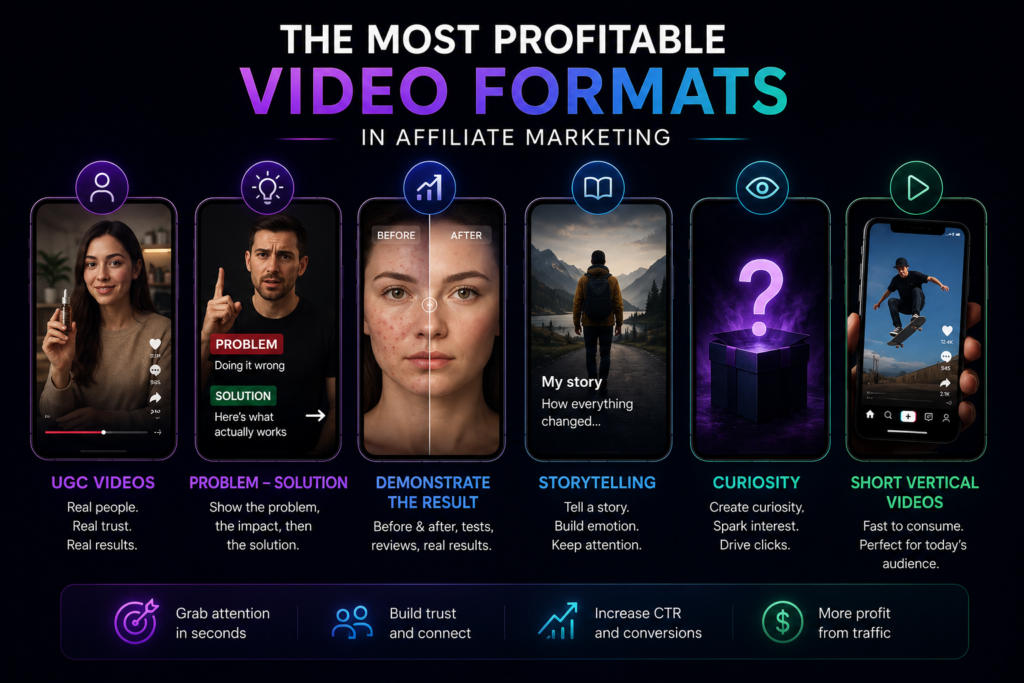
UGC videos remain market leaders

Despite the development of neural networks and professional production, ordinary user-generated videos continue to deliver some of the best results. The reason is simple. The audience trusts people far more than they trust adverts.

When a user sees a video that looks like a standard review, a personal experience or an everyday recommendation, their resistance drops significantly.

This is precisely why UGC remains one of the most popular formats in nutra, retail, finance and crypto.

Videos where a person highlights a problem, tells their story and demonstrates the result work particularly well.

Incidentally, approaches to creating effective advertising materials and the reasons why some levels of creativity deliver a high ROI whilst others quickly lose their appeal are discussed in detail in this article.

The ‘problem – solution’ format
Profitable video formats

One of the strongest scripts of recent years. The video begins with a common mistake made by the audience. The consequences are then shown. After that, the solution to the problem appears.

This approach works brilliantly in virtually all sectors. People instantly recognise themselves in the situation and continue watching the video.

Moreover, this format often yields a higher CTR than classic sales videos.

Demonstrating the result

If a product can be shown visually, this format is almost always effective:

  1. before and after;
  2. comparison;
  3. testing;
  4. real-world testing.

All of this helps to quickly convey the product’s value to the user. These videos work particularly well in the retail, beauty, fitness and various household goods sectors.

The main rule here is simple. The user must see the result as quickly as possible.

Video through storytelling

Storytelling remains one of the most underrated tools in affiliate marketing. Many webmasters try to sell straight away.

In practice, videos that tell a story first work much better. People start watching the narrative, not the advert.

This is precisely why many successful campaigns are built around personal experience, an unusual situation or a conflict. The user watches the video to the end because they want to know the outcome.

This approach is particularly effective on TikTok and other recommendation-based platforms.

Videos driven by curiosity

This format can be found in almost any industry. The user is shown an unusual situation, a strange object or an unexpected outcome.

This sparks a desire to find out what happens next. Such videos often achieve a high CTR and good retention. But it’s important to strike a balance here.

If a video promises too much and fails to deliver an answer, the audience quickly loses trust. That’s precisely why strong teams use curiosity as a tool for engagement, rather than as a way to deceive the user.

Short vertical videos continue to dominate

Despite the popularity of long reviews and educational content, the bulk of traffic in affiliate marketing continues to be generated through short vertical videos.

The reason is obvious. They better suit modern audience behaviour. The user receives information quickly and without unnecessary steps. At the same time, the platforms themselves continue to actively promote this format.

We have already analysed in detail how the short-form video market has changed and which approaches continue to deliver results on TikTok – you can find out more by following the link.

Why format is more important than editing

Many beginners spend weeks on editing and visual effects. In practice, a video’s profitability often depends on the script. You can shoot a video on a standard smartphone and get excellent results.

Or you can spend thousands of dollars on production and not make a single sale. That is why strong webmasters test ideas first and foremost, and only then focus on improving content quality.

This principle has long been effective across all traffic sources.

What will work in the future

Judging by market trends, the following will remain popular in the coming years:

  1. UGC videos;
  2. short vertical videos;
  3. demonstration of results;
  4. personal stories;
  5. educational content.

At the same time, the creativity itself will become increasingly personalised thanks to the development of artificial intelligence and platform algorithms.

It is no coincidence that many teams are already actively testing new approaches to working with content and automating its creation. 

Conclusion

In 2026, the most profitable videos in affiliate marketing will share one common feature. They don’t look like adverts. They look like content that people actually want to watch.

That is precisely why, today, it is not those who make the most visually stunning videos who come out on top, but those who best understand their audience, their pain points, and the reasons why a user pauses their feed and starts watching a video.
Video content vs text-based SEO: which will drive more traffic in 2026

Over the last few years, the content market has effectively split into two camps. Some are convinced that the future belongs exclusively to video. TikTok, Reels, Shorts and other formats have captured the audience’s attention, and users increasingly prefer to watch rather than read.

Others continue to invest in SEO, develop websites and create in-depth expert content that consistently generates search traffic for years.

We regularly witness this debate. And the main question usually sounds the same: which is more profitable to develop in 2026: video content or text-based SEO?

The answer is not as obvious as it seems at first glance.

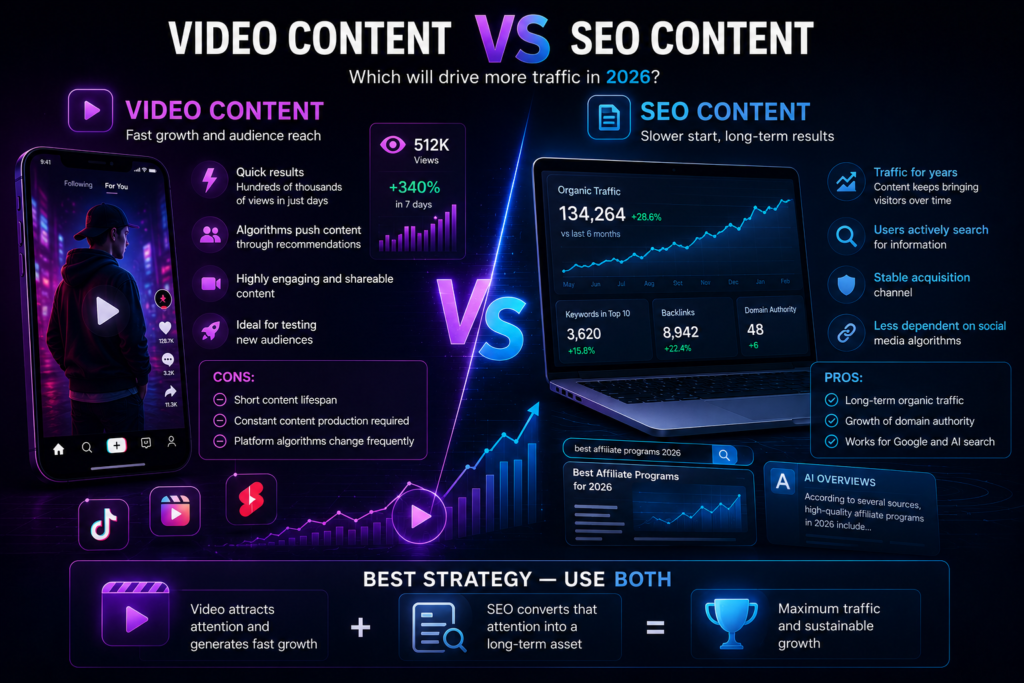
Why video is growing faster right now

Video has one huge advantage. It grabs attention faster. Users don’t need to search for, read or analyse anything. The algorithms themselves display the content in the recommendations feed.

That’s why a good video can rack up hundreds of thousands of views in just a few days.

This is particularly noticeable on TikTok, where new accounts can achieve significant reach almost from their very first posts.

At the same time, the algorithms themselves continue to actively promote high-quality video content. We have already examined in detail which factors influence the spread of videos and why some videos get millions of views whilst others go unnoticed — we discussed this in more detail in this article.

But video has a serious drawback. It very quickly becomes outdated.

video content and SEO content

The main problem with video

Most videos have a short lifespan. Even successful content often stops driving traffic after a few weeks or months.

Algorithms switch their focus to new posts. The audience burns out. New trends emerge. As a result, you have to constantly create new content.

This is precisely why many projects become dependent on the regular production of videos. Stop producing them, and you lose reach. Stop publishing, and you start losing your audience.

SEO works more slowly, but for longer

With text content, the situation is the opposite. Yes, a good article rarely garners tens of thousands of views in the first few days after publication.

However, high-quality material can generate search traffic for years. This is particularly relevant for affiliate marketing, marketing, SEO, crypto and other niches where users regularly search for answers to specific questions.

This is precisely why many major media projects continue to invest heavily in SEO, even amidst the rise of video platforms.

Artificial intelligence enhances the importance of text

Interestingly, the development of neural networks has not killed SEO, as many experts predicted; on the contrary, ChatGPT, Gemini and other AI systems are increasingly using high-quality articles as a source of information.

Because of this, expert content gains additional value. Websites are starting to receive traffic not only from Google, but also from AI search.

We have already discussed in detail how artificial intelligence affects search results and why website owners should take these changes into account right now — we covered this in more detail here.

Essentially, a good piece of content starts working across several audience acquisition channels at once.

Where is it easier for a webmaster to make money?

If we’re talking purely about the speed of getting results, video usually wins out. Through TikTok, Reels or Shorts, you can quickly test hypotheses, find a new audience and get initial results.

But if the goal is to create a long-term asset, SEO looks far more reliable. Every published article becomes part of the site’s overall structure.

Over time, such content begins to reinforce each other through internal linking, backlinks and accumulated domain authority.

The best option is to combine both approaches

In practice, the most successful projects stopped choosing between video and SEO long ago. They use both tools simultaneously. Video helps to quickly attract a new audience.

A website helps retain that audience and generate stable search traffic. For example, a TikTok video can garner tens of thousands of views and drive users to a website where detailed reviews, case studies and expert content are already available.

This approach allows you to reap the benefits of both formats at once.

We have already discussed how content helps increase traffic volumes and why different acquisition channels reinforce one another – you can find out more by following the link.

Conclusion

By 2026, the question will no longer be ‘video or SEO’. Video provides speed. SEO provides stability.

Video helps to quickly capture the audience’s attention. SEO allows you to turn that interest into a long-term asset.

That is why the best results today are achieved by projects that use both approaches simultaneously and build an ecosystem where content works across multiple platforms at once.

Step-by-step guide to running an advertising account: how to prepare your account

One of the most costly mistakes made by newcomers to affiliate marketing is attempting to run aggressive ad volumes on a brand-new account straight away. A user creates an account, links a card, and tries to run through their budget from day one, as if the account had already been running for several months.

In 2026, this approach rarely ends well. Advertising platform algorithms have long since learnt to distinguish natural behaviour from attempts to scale up rapidly. That is precisely why it is necessary to run an account properly before it is launched, and this has now become part of the infrastructure, rather than an optional precaution.

And this applies not only to Facebook. Similar principles apply to both Google Ads and TikTok Ads.

Why the system runs, even

From the advertising platform’s perspective, a new account is an unknown entity. The system does not know who the account owner is, how they will operate, what traffic they plan to purchase, or how safe it is to interact with them.

Therefore, the first few days after creating an account effectively become a trust assessment phase.

This is precisely where many people make a mistake. Instead of gradually building up activity, advertisers start creating adverts en masse, changing billing details, connecting new devices, and launching campaigns in high-risk verticals. Afterwards, they are surprised by the restrictions.

Incidentally, the mistakes that lead to problems with advertising accounts even before scaling have already been discussed in detail in this article.

Stage one: building a normal history

The warm-up phase does not begin with launching adverts. First, the account must look like a regular advertiser.

In practice, this means a completed profile, correct payment details, a clear account structure, and no suspicious activity.

A great many webmasters underestimate this stage. It seems as though it achieves nothing. But it is precisely these small details that build initial trust.

In affiliate marketing, people tend to look for complex schemes, although problems often arise simply because of a lack of a systematic approach. This point has already been discussed separately here.

Stage two: initial advertising activities

The next mistake is to launch complex ad campaigns immediately after creating an account. Standard practice looks different.

First come simple campaigns with small budgets. Their aim is not to make money, but to demonstrate clear and predictable behaviour to the system. At this stage, there is no need to try to squeeze out maximum ROI.

On the contrary, it is better to focus on stability. Many experienced teams treat their initial campaigns as an investment in the account’s future performance.

Stage three: gradually increasing activity

The biggest problem for most beginners is impatience. The first conversion appears. The first profit appears, and immediately you want to increase the budget several times over.

It is at this very moment that many accounts start to attract undue attention from the algorithms.

Growth should look natural. The advertising platform is much more relaxed about gradual scaling than about sudden budget increases. This principle works in virtually all traffic sources.

Incidentally, the very logic of scaling campaigns and finding stable growth points has already been discussed in detail at the link.

Why running doesn’t save a poor infrastructure

It’s important to understand: running isn’t a magic button. If you’re using problematic consumables, unstable proxies, poor White pages, unsuitable profiles or a weak technical infrastructure, even a perfectly run account can face bans.

That is why strong teams usually view running as part of an overall system.

This includes accounts, virtual cards, infrastructure, anti-detect browsers, proxies, high-quality White pages and the quality of the traffic itself.

The main mistake made by most webmasters

Almost all problems stem from the desire to speed up the process. A person sees that the account is working and starts to drastically increase budgets, change ad groups, add new GEOs and run several campaigns simultaneously.

From the platform’s perspective, such behaviour looks unnatural. This is precisely why many accounts last only a few days, even though they could have run for months.

Conclusion

In 2026, running an advertising account remains an essential part of working with virtually any traffic source. Not because it guarantees the absence of bans.

But because a properly run account gains more trust from the platform and allows for smoother scaling.

In affiliate marketing, speed has long ceased to be the deciding factor. Today, predictability, consistency, and an understanding of what constitutes normal advertiser behaviour from the algorithms’ perspective are far more important.

TikTok → Telegram → Offer Funnel: How It Works in 2026

In 2026, direct traffic from TikTok to an offer is becoming increasingly difficult. Moderation has gotten stricter, the audience burns out faster, and “hard-sell” approaches get shut down in literally just a couple of days.

That’s exactly why many webmasters have started directing users to Telegram first, and only then to the offer.

Essentially, Telegram has become an intermediate “warm-up” step between TikTok and the sale.

Why this strategy works at all

TikTok is great at grabbing attention, but it’s bad at retaining users. A person watches a video, clicks, closes the page, and that’s it.

Telegram works differently. The audience there is already more engaged: they read posts, click on links, and return to the channel. This creates an opportunity to run the user before the offer.

This works especially well in niche markets, crypto, and gambling, where a single click is rarely enough for the user. We’ve already discussed why multi-step funnels work better than direct traffic right now—we covered it in more detail here.

What the workflow looks like

It usually starts with a short TikTok ad of creativity. Its goal isn’t to sell, but to spark interest or evoke an emotion. After that, the user is directed to a Telegram channel, where the main running process begins.

There you might find:

  1. case studies;
  2. reviews;
  3. screenshots;
  4. analyses;
  5. or simply content tailored to the target audience.

And only then does the transition to the actual offer take place.

BUTTON – We recommend reading the article “Ad Creativity in Affiliate Marketing: Secrets of Creation and Testing

Why Telegram Has Become So Important

The main advantage of Telegram is audience control. On TikTok, an account can get banned, reach can drop, and a campaign can die within a day. Telegram allows you to retain part of your audience and continue working with them.

That’s exactly why many webmasters are now building entire networks of channels for different offers and verticals. We’ve already discussed which traffic sources work best with Telegram and why this approach continues to grow—you can find more details at the link.

Where the most common mistakes happen

The main mistake is trying to sell directly on Telegram right away. If the channel looks like nothing but a showcase of offers, the user quickly loses interest. A normal channel should feel like it has live content, not endless ads.

The second problem is weak TikTok creativity. If the video doesn’t grab attention in the first few seconds, people simply won’t make it to the Telegram channel.

And the third mistake is the lack of a system. Many run chaotically, without analyzing exactly where they’re losing their audience. We’ve noted time and again that without proper analytics, even a good funnel quickly starts to falter—we wrote about this HERE.

Conclusion

The TikTok → Telegram → offer funnel in 2026 is no longer a “clever scheme,” but a standard working model.

TikTok generates attention. Telegram runs and nurtures it. The offer drives conversions.

And it is precisely because of this approach that many are now achieving more stable results than when running the offer directly on a landing page.

TikTok Is Cutting Reach: How to Get Out of a Soft Ban

Many users notice that almost no one is watching their new videos. They then start to think they’ve been hit with a soft ban. This is when an account seems to be working, but TikTok deliberately doesn’t show the videos in the For You page. But in reality, a drop in views isn’t always due to a soft ban. Let’s break this down step by step.

4 main reasons why your video isn’t getting views (when it’s not a shadow ban)

Sometimes the creator makes mistakes themselves, and TikTok has nothing to do with it. Here are the most common ones.

Low video quality

People like to watch beautiful, clear footage. If a video is shot with a low-quality camera, is shaky, or is too dark, viewers will immediately scroll past it. TikTok notices this too and stops showing such videos to others. To fix this, you need to shoot with a better camera, learn how to set up lighting, and use simple editing software.

Boring openings and long introductions

The creator has only 2–3 seconds to grab the viewer’s attention. If someone spends too long introducing themselves or talking about something uninteresting at the start of the video, the user will simply scroll past it. TikTok sees that the video is only being watched for a couple of seconds and decides: “This is boring; we won’t show it to others.” That’s why the first frame and the first words must grab attention immediately.

A jumble of topics in one profile

If today a user posts a pie recipe, tomorrow—how to wash a car, the day after—tarot readings, and then—tips on removing warts, their profile lacks a single theme. When a new person visits such a page, they don’t understand what this blogger is about. Let’s say they liked the recipe. They visit the profile, but everything is jumbled together. As a result, they leave and don’t follow. TikTok gets confused too: it’s unclear who to show these videos to.

Irregular or infrequent posts

Even if the content is high-quality and focused on a single topic, but the creator posts videos once every two weeks or sporadically, TikTok starts to consider the profile “dormant.” The algorithm prioritizes those who post at least once every 1–2 days. If you take long breaks, the platform stops trusting the account, and reach drops even without any shadow ban. It’s better to post short videos frequently and on a schedule than one perfect one once a month.

Conclusion: if you fix these four things (quality, a catchy opening, a single theme, and consistency), your reach will most often return without any shadow ban.

What is a shadow ban, really, and how do you recognize it?

A shadow ban is when TikTok secretly blocks an account. On the surface, everything looks normal: you can log into the app, watch other people’s videos, and like them. But as soon as a user posts their own video—there are almost no views (0–50). TikTok doesn’t show it in recommendations or in hashtag searches. This is a very unpleasant situation.

How can you tell the difference between a shadow ban and a temporary glitch?

Sometimes TikTok experiences technical issues or updates that cause views to drop for everyone or many users. This usually lasts 1–2 days. However, if your views have dropped to zero and haven’t recovered for over a week, while other creators are doing fine, it’s most likely a shadow ban. You can also check using a secondary account: search for your video by its exact title or hashtag. If it doesn’t appear, it’s a ban.

Getting a shadow ban isn’t easy, but if it happens, it’s hard to get rid of. If the creator has a small audience, recovery can take 1–2 months. Many simply abandon their old account and start a new one.

Why might TikTok issue a shadow ban?

Here are the main reasons why an account gets shadowbanned:

  1. Fake followers. If you buy bots, TikTok quickly detects this and penalizes you. Bots don’t help growth; they only hurt it.
  2. Spam in comments. When people write the same thing under other people’s videos: “follow me,” “follow for follow,” “follow for a follow”—this is considered spam. You’ll get banned for this too.
  3. Age listed as under 15. According to TikTok’s rules, if a user is under 15, their account must be private. If you set your age to under 15, the platform won’t promote your videos.
  4. Too many complaints about the profile. If people don’t like the content and complain, TikTok may ban the creator. Sometimes competitors deliberately file mass complaints to get someone else’s account removed.
  5. Frequent video deletion. TikTok doesn’t like it when videos are deleted. It’s better not to delete them, but to hide them (make them private). Then no one will see them, but you won’t get banned.
  6. Adult content 18+. TikTok is not the place for explicit videos. If you post such content, it will end up in a special 18+ feed that very few people see. In effect, this is also a shadow ban. Even simply mentioning adult topics in the text or voiceover can be harmful.

You can read more about the moderation rules here.

The easiest way to check for a shadow ban is to ask a friend or log in to the creator’s page from a second account. If the video appears in the Followers feed but isn’t in the “For You” section and can’t be found via a hashtag, it’s a ban. Second method: post a short video with a unique hashtag and search for that hashtag an hour later. If the video doesn’t show up, your account is shadowbanned. Third sign: not only have views dropped sharply, but so have likes and comments from strangers.

What should you do if you’ve already been shadowbanned?

The simplest and most reliable advice is to create a new account and start from scratch. You can spend a lot of time and effort trying to recover your account, but in most cases, it won’t work. It’s easier to create a new page and avoid repeating the same mistakes.

But after creating a fresh profile, don’t rush to post a lot of videos on the very first day. It’s better to spend the first week simply watching other people’s videos, liking them, and writing normal (non-spam) comments. This will show TikTok that you’re a real, active person. Then you can post one video, and a second one a day later. It’s important to stick to a single theme from the very beginning, avoid buying followers, and follow the rules. A new account is like a blank slate: if you do everything right, TikTok will show your videos in the recommendations. You can read more about approaches to running traffic in this article.

The key is to choose a single theme right away, shoot high-quality content, hook the viewer from the very first seconds, post regularly, and follow TikTok’s rules. Then you won’t have to worry about a shadow ban—and you’ll be able to successfully promote your brand on this platform.

How to Prepare Smartphones for Conditional Free Traffic from TikTok

Before running traffic on TikTok, it’s important to configure your device properly. The platform analyzes a wide range of parameters: device specifications, network data, geolocation, and even user behavior patterns. Any suspicious deviations can lead to restrictions or account suspension at an early stage.

For this reason, real smartphones are most often used for this purpose. Attempts to run traffic through PCs or emulators are virtually ineffective. TikTok’s anti-fraud system easily identifies virtual environments based on non-standard parameters and system characteristics. As a result, accounts quickly lose trust and can be blocked almost immediately after creation.

How to Prepare an iPhone

Start by creating a new Apple ID that will be used exclusively for work purposes. Old accounts may contain activity history, which increases the likelihood of account linking.

To minimize risks, it is advisable to perform a full factory reset of the device. This clears the system of past data and allows you to start with a clean slate.

After initial activation, you need to perform the following basic steps:

  • disable the SIM card or remove it from the device;
  • deactivate the eSIM, if available;
  • completely turn off location services.

Settings related to tracking are located in the Privacy section. It’s best to disable them so the device doesn’t transmit your actual coordinates.

The next step is to change the region and time. You must select the country where you plan to launch the device and set the corresponding time zone. It is also advisable to set the system language to match the selected region so that the device’s behavior appears as natural as possible.

Additionally, keep in mind that after working with multiple accounts, it is recommended to reset the network settings. This helps prevent data overlap between profiles.

How to Set Up Android

With Android, the process is a bit simpler but still requires care. First, you need to reset the device to factory settings to remove any traces of previous use.

During the initial setup, it is recommended to:

  • disable geolocation access;
  • remove the advertising ID;
  • do not sign in to a Google account.

Opting out of Google sign-in helps avoid accumulating additional history that could affect the device’s trust score. This is particularly important when working with Conditional free traffic, as such traffic sources are heavily dependent on the platform’s trust—you can read more about this in this article.

After completing the setup, you should manually configure the system’s main settings:

  • select the interface language;
  • set the correct time zone;
  • specify the region corresponding to the traffic’s geographic location.

When all settings are synchronized with the selected GEO, the device appears more “native” to the platform’s algorithms. This reduces the likelihood of restrictions and makes account management more stable.

Ultimately, proper smartphone setup is a fundamental step that directly determines the lifespan of accounts and the effectiveness of running traffic.

TikTok and Gambling in 2026: How to Adapt to New Filters

TikTok’s modern algorithms have learned to instantly recognize standard advertising videos. Old methods of driving massive traffic have stopped working. Webmasters have to become true magicians to create truly great content. Now, those who can portray gambling as part of everyday life rise to the top, so that the algorithms don’t distinguish such videos from everyday posts. Account reputation and content quality have become more important than bet size.

A meticulous approach to theory

Direct advertising of slots in 2026 instantly leads to account suspension. TikTok’s neural networks are trained to recognize casino interfaces and typical winning sounds, even if the video has been heavily edited. There’s only one way out: stop selling the game and start explaining it.

Instead of a video showing a big win, the publisher releases a video explaining how slot machine math works. Content discussing return-to-player (RTP) percentages, volatility, or verifying a casino’s license is considered useful educational content by the algorithms. Such content is perceived by the system as valuable and receives greater reach. In addition, it builds a higher-quality audience. You can read more about the changes in moderation in this article.

Storytelling in affiliate marketing

In 2026, the “Deposit” button only causes irritation among users and gets blocked by moderators. People come to TikTok for emotions and other people’s stories, not for promises of easy money. That’s why aggressive creativity has been replaced by storytelling.

Today’s winning formula looks like a regular lifestyle vlog: “How I spent the evening waiting for my flight” or “My way to de-stress after work.” These videos contain no shouting or flashy numbers. There’s a person, their phone, and a calm account of the process. When gaming is presented as a form of leisure rather than a get-rich-quick scheme, moderators don’t see it as deception or a promise of profit. The creator sells an atmosphere, not an offer—and that’s exactly what allows these videos to rack up millions of views.

UGC Features

If a video looks like an ad, it dies within 10 minutes of being uploaded. In 2026, TikTok’s neural networks flag professional editing and studio lighting as a threat. That’s exactly why content from ordinary people has become the only way to turn a profit.

A video shot on an old iPhone with shaky hands, in a dimly lit room, and full of genuine emotion appears in recommendations 10 times more often than a polished designer video. The algorithm considers this natural user behavior. When a person simply shares their evening or their emotions from a game, the system doesn’t see an attempt to sell something. In 2026, webmasters no longer buy creativity from designers: they hire real people who record reviews of their lives. It’s cheaper, more natural, and safer for accounts.

A Surprise from Google Ads

Google has prepared a major surprise for gambling teams. Starting March 23, 2026, new certification rules for gambling will take effect. The main change: the introduction of the concept of “healthy policy reputation.”

Now Google grants permission for gambling ads by evaluating the account’s past history.

Whereas previously it was possible to create a new account and immediately apply for certification, the system now checks the entire history of the managing account (MCC). If there are traces of banned accounts or revoked certifications for sub-accounts, the entire MCC is blacklisted. It becomes impossible to obtain a new certificate, and existing ones may be revoked “by association.”

Google states explicitly: “We look at the total number of violations within your manager.” If a team is accustomed to operating on a massive scale and using unethical methods, its infrastructure will collapse starting March 23.

Such changes require a complete overhaul of the infrastructure. More details on the impact of moderation on the market are discussed here: https://affcommunity.org/en/how-affiliate-marketing-changed-after-google-and-meta-tightened-their-moderation-in-2026/ 

Results of the Update

The main consequence of the March update is the end of the “disposable accounts” approach. Previously, it was possible to lose accounts in batches and open new ones within a single master account. Now Google is introducing collective liability.

The master account transforms from a convenient folder into an asset with its own reputation. A single inexperienced specialist on the team who makes a mistake with creativity and gets several certificate blocks can nullify the work of the entire agency. If an MCC has a bad reputation, Google simply blocks access to gambling traffic. Because of this, account farming and running the account to warm it up become much more expensive, and entering the niche for newcomers is practically impossible.

Checklist for changes

To prevent the infrastructure from collapsing, the approach to running traffic needs to change:

  1. Strict isolation. You cannot mix “dirty” tests of new ad groups with a stable traffic flow in a single MCC. Separate, unrelated management accounts are required for experiments.
  2. Forget about subdomains. Google has stated: sites on website builders and third-party hosting (e.g., casino.mysite.com) will no longer pass certification. You need to purchase clean second-level domains and verify ownership.
  3. Monitoring certificate revocations. Keep track of the percentage of revoked certificates within the network. As soon as it starts to rise, immediately suspend operations on that MCC until it receives a permanent black mark.
  4. Quality is more important than quantity. In 2026, it’s more profitable to launch 5 perfectly clean accounts with a good history than 50 “gray” profiles that will get banned within an hour and ruin the reputation of the entire structure.

Even with perfect content and a clean reputation, you can’t operate blindly. Webmasters are advised to maintain a separate spreadsheet or dashboard tracking each account: creation date, traffic sources, bounce rate, and link lifespan. This allows you to notice in time that a particular account has started to “limp” and disable it before it ruins the statistics of the entire MCC. Without such analytics, the team risks losing dozens of accounts in a single week without even understanding what the cause was.

Brief Conclusion

By 2026, affiliate marketing in the gambling sector will no longer be a quick way to make money. TikTok and Google want to see only high-quality market players.

Those who learn to create authentic content featuring real people, tell compelling stories, and maintain the health of their ad accounts will reap the greatest profits. Spring 2026 will act as a filter, leaving only professional teams with a clean reputation in the market. Those who master these rules now will take all the traffic away from those who continue to operate the old-fashioned way.

New TikTok moderation rules: what has changed for webmasters

In 2026, moderation on TikTok became significantly stricter. While many people used to visit this source because of its more lenient rules and cheap traffic, the situation has now changed dramatically. The platform is actively cleaning up advertising and strengthening content verification.

For webmasters, this means one thing: old approaches are starting to break down. Links that worked fine a year ago may not even pass the first moderation stage today.

The platform has started to check landing pages more carefully

Previously, the main focus of moderation was on the creativity itself. Now the system looks much deeper. Not only the video or text of the ad is checked, but also the page where the user ends up.

If the landing page looks suspicious, contains aggressive promises, or poorly explains the product, the ad is often rejected. This is especially true for financial offers, cryptocurrency, and some nutra products.

The platform is increasingly analyzing the correspondence between the ad and the content of the site. If a user clicks on one message and sees something completely different on the page, the ad can quickly be blocked.

It is best to use verified White pages from the Money Safe service. Use the promo code AFFCOMMUNITY to get a 10% discount on all rates. You can learn more about the service by following the link.

Algorithms have begun to better recognize clickbait

Another notable change is the fight against clickbait. Previously, videos with loud promises could easily gain views and clicks. Now, such videos are more often cut.

Algorithms analyze not only the text, but also the structure of the video. For example, if a video is built around a shocking promise or strong emotional pressure, it may be restricted.

Because of this, many publishers have started to make their creativity more native. Videos increasingly look like regular user content rather than advertising.

Attention to account quality has increased

In recent months, the platform has become stricter with new advertising accounts. New accounts are more likely to be subject to additional checks.

If an account has no history and aggressive campaigns are launched immediately, the likelihood of being blocked is much higher. Therefore, many teams have started to pay more attention to running accounts and gradually launching ads.

This increases the start-up time, but helps to avoid quick bans.

User complaints have begun to have a greater impact on advertising

TikTok actively takes audience reaction into account. If users complain about an ad en masse, the algorithms can quickly limit its display.

This means that even ads that have passed moderation are not guaranteed a long life. If the creativity annoys the audience or looks too intrusive, it may stop being shown.

Therefore, many have started to take a softer and more native approach.

Let’s summarize

TikTok is still a strong source of traffic. The platform continues to grow, and the audience actively interacts with the content.

But it has become more difficult to work. Now, it is not only the idea of the link that is important, but also how neatly it is packaged. Native creativity, understandable landing pages, and a normal account structure give us a much better chance of stable performance.

Affiliate marketing on TikTok is gradually becoming similar to other large advertising platforms. Simple and aggressive schemes are disappearing, and in their place comes a more systematic approach to content and audience.

Find a selection of affiliate networks with top offers at https://affcommunity.org/en/ 

TikTok 2026: What Influences Reach and How to Get into the For You Page

Sometimes you can post videos one after another and get virtually no results, while in other situations a single video unexpectedly gains massive reach and brings in a new audience. This is no coincidence—it’s how TikTok’s algorithms work, and in 2026, they’ve become even more dependent on user behavior and data analysis.

Let’s break down how TikTok works today, what makes videos go viral, how the audience grows, and what factors actually influence reach.

TikTok Algorithms 2026

The platform doesn’t reveal the exact ranking formula, but the basic principles are clear. It’s based on AI that analyzes user actions and tailors the recommendation feed to their interests.

Every user sees unique content. TikTok takes into account:

  • likes and comments;
  • video watch time;
  • views to the end;
  • repeat views;
  • subscriptions and profile visits.

These signals shape the personalized feed. This is why recommendations vary significantly from user to user.

If the content in your feed is no longer relevant, you can “reset” the algorithm. To do this, simply search for a topic of interest, watch a few videos, and interact with them. Your recommendations will change shortly thereafter.

TikTok’s algorithms are constantly learning. They analyze not only audience engagement but also the content itself: the topic, sound, and format. If a video shows strong engagement, it receives further promotion.

How Video and Audience Growth Happens

Every video goes through several stages of distribution. First, the video is shown to a small group of users. At this stage, basic metrics are evaluated:

  1. view retention.
  2. view-through rate.
  3. initial engagement.

If the metrics are good, TikTok begins to expand its reach and shows the video to more people. This is exactly how popular videos emerge, capable of garnering hundreds of thousands or even millions of views.

If, however, users quickly scroll past the video and do not interact with it, the system stops promoting it.

Growth happens gradually: each new wave of views depends on the results of the previous one.

View Retention

One of the key factors is retaining attention.

The first 2–3 seconds determine whether a user will continue watching the video. If the video doesn’t grab their attention right away, they’ll scroll past it. This is a negative signal for the algorithm.

Important:

  • engage the viewer quickly;
  • avoid long introductions;
  • provide value or intrigue from the very first seconds.

If a user watches the video to the end or rewatches it, this is a strong positive signal. Such videos get more reach.

Audience Engagement

TikTok’s algorithms take into account not only views but also user reactions.

Key signals:

  1. Likes.
  2. Comments.
  3. Saves.
  4. Reposts.

If a video is watched but not engaged with, it won’t gain traction.

Modern social networks place a strong emphasis on audience activity. That’s why it’s important to create content that evokes emotions and a desire to interact.

You can read more about evaluating creativity here.

Caption and hashtags

There’s a belief that high-quality video can “go viral” without text. In some cases, this is true.

However, a caption helps amplify the result. It can:

  • set the context;
  • hold the viewer’s attention;
  • encourage action.

Hashtags no longer play a key role as they did before. But they remain a useful tool. You should use them:

  1. Relevant to the video’s topic.
  2. Without overdoing it.
  3. To indicate the content category.

Overusing hashtags is ineffective and can even worsen results.

Video Quality

Technical quality affects promotion. TikTok tends to promote videos with:

  • clear visuals;
  • clear audio;
  • adequate lighting.

This doesn’t mean you need expensive equipment. A smartphone with a good camera and basic lighting is enough.

The main thing is that the video is comfortable to watch.

TikTok Trends 2026

TikTok trends remain an important promotion tool.

Popular formats, challenges, and sounds help you get into recommendations faster. The algorithms are already “primed” for these types of content.

However, building your strategy entirely on trends is a mistake.

The best approach:

  1. Keep track of current formats.
  2. Adapt them to your niche.
  3. Add a unique twist.

Algorithms and AI promote content better when it stands out from mass-produced copies. Read this article to find out where to look for trends—and how to apply them.

Where to look for trends

You can find current ideas within the platform:

  • in the For You page;
  • among popular sounds;
  • in the Challenges section.

It’s important not just to repeat trends, but to rework them. This is exactly how new popular videos are created, the ones that get maximum reach.

Why some videos go viral

The main factor is audience reaction.

If a video:

  1. Holds attention.
  2. Evokes emotions.
  3. Stimulates engagement—it gets further promotion.

If not—its reach remains minimal.

The algorithm focuses not on the creator’s opinion, but on user behavior.

In summary

In 2026, TikTok’s algorithms operate based on behavioral analysis via AI.

To gain reach and attract an audience, it’s important to:

  • hold attention from the very first seconds;
  • increase engagement;
  • take TikTok trends into account;
  • use hashtags effectively;
  • adapt to the principles of modern social media.

It is impossible to fully predict virality. But systematic work with content allows you to regularly create popular videos and achieve steady growth.

How TikTok’s New Standards Are Changing the Promotion of AI Content 

In recent years, TikTok has introduced strict rules for videos created or modified using artificial intelligence. Previously, neural networks were used freely; now, the platform requires full transparency. All videos created by AI or significantly altered by it must be marked with a special label. In addition, TikTok has learned to recognize such AI-generated content on its own, even if the creator tried to hide it. Finally, users can now customize how many AI videos they want to see in their feed, which directly impacts the reach of ad campaigns and conversion rates.

When a video must be labeled as “made by AI”

According to TikTok Support’s official guidelines, labeling is required in several cases.

First, it is necessary if the video is entirely generated by a neural network. For example, a video created in Midjourney, Runway, Pika, or Sora, or an animation entirely made by artificial intelligence. This also includes deepfakes, where the faces of real people are replaced with fictional ones.

Second, labeling is required if the video was filmed with a camera but then heavily modified using AI. This includes:

  • face swapping;
  • realistic filters that alter facial features, movements, or body type;
  • a voice entirely generated by a neural network and mimicking human speech;
  • a background or scene that is artificially created and looks real.

If artificial intelligence was used only for minor processing (stabilization, quality enhancement, color correction), labeling is not required. The main principle: if a viewer might be under the illusion that they are watching a real recording, when in fact it is the work of a neural network, the video must be labeled as AI content.

How TikTok identifies AI content

Recently, the platform has been implementing technologies that automatically detect synthetic videos, even if the creator has not labeled them. You can learn more about how the platform’s algorithms work in general here: https://affcommunity.org/en/how-tiktok-algorithms-work-in-2026-what-publishers-should-consider-before-launching-an-advertising-campaign/ 

One such technology is the C2PA (Content Credentials) standard. This is an international system that adds metadata to videos:

  • where the video came from;
  • what tools were used;
  • whether changes were made using AI.

TikTok has learned to read this data and automatically applies the “Made by AI” tag.

The second technology is watermarks. These can be invisible, embedded directly into the video’s pixels: they are invisible to the naked eye, but TikTok’s algorithms easily recognize such watermarks. This type of labeling is already being tested in the US and Europe, and will soon be rolled out worldwide. Thanks to it, it becomes nearly impossible to hide the fact that a video was created by a neural network.

Users decide for themselves how much AI content they want to see

TikTok has added a new feature to its settings. Now, every user can choose how often they want to see videos marked as AI content in their feed. You can set the “less AI” mode: in this case, the algorithm will show such videos less frequently. Or the “more AI” mode, and then the feed will be filled with synthetic and experimental content.

This decision has a significant impact on advertisers and creators. Previously, reach depended solely on how interesting the video was. Now, the “content type” factor is added to this. If the target audience has selected “Less AI” mode, then ads created by neural networks (or AI-generated creativity), will be shown less frequently. The cost per impression may rise, while the number of views will automatically decrease. If, on the other hand, the audience is open to new content, such ads may, conversely, receive more impressions and higher conversion rates.

What This Means for Creators and Businesses

TikTok is effectively establishing a three-tier system for controlling AI-generated content. First, videos are checked for watermarks and C2PA metadata. Then, if the content is fully generated or heavily modified by artificial intelligence, mandatory labeling is required. Finally, users can filter out such videos using new settings, and the algorithm takes their preferences into account when distributing views.

For creators, this means that hiding the use of AI will no longer be possible. However, labeling can serve as an honest signal to viewers, showing that the creator follows the platform’s rules. For advertisers, choosing AI-generated creativity becomes part of their media strategy: they must consider how the audience perceives synthetic content, or risk losing reach and reducing conversion rates. You can read more about creativity requirements on platforms here.

Transparency and compliance with TikTok’s new standards are shifting from a recommendation to a mandatory requirement for successful promotion. All creators who want to monetize their channel on the platform should take this into account.

How TikTok algorithms work in 2026: what publishers should consider before launching an advertising campaign

TikTok is more than just a social network. It is a platform where you can quickly learn new things and develop projects on any topic for free. With its help, any webmaster can take affiliate marketing to a new level.

TikTok has long been considered not only an entertainment platform, but also a full-fledged source of traffic, which is discussed in detail in the article “TikTok as an effective source of traffic.”

What does the system track?

The TikTok algorithm takes everything into account: which videos a person likes, which ones they comment on, and which ones they subscribe to. But more importantly, it measures how long a user watches each video, whether they rewatch it, and whether they watch it to the end. Even the speed at which the feed is scrolled matters.

Can you control the feed?

If a user is tired of seeing the same recommendations, they can “reset” them. To do this, go to the search bar, find a topic that interests you, and start actively watching, liking, and commenting on such videos.

How does AI evaluate content?

When a user posts a video, the platform’s artificial intelligence analyzes the image and sound, as well as recognizing text in the description, subtitles, objects in the frame, and even the mood of the music. This is necessary to understand the essence of the video as accurately as possible.

What makes the algorithm promote a video?

The most important signal for the system is audience engagement. If the first viewers who are shown a new video actively interact with it, the algorithm reads this as “wow, this is cool!” After that, it starts showing the video to an increasingly wider audience, which can lead to it going viral.

Practical examples of how offers are scaled through organic and advertising traffic are discussed in the article “Promoting Offers on TikTok.”

Shadow ban: an invisible wall that hinders growth

One of the biggest problems for creators on TikTok is the shadow ban. This is a hidden restriction that the system does not notify the account owner about. Formally, everything works: a person can log into their account, view their feed, and post creativity. But these new videos almost never appear to other people. They don’t appear in the “For You” feed, they can’t be found by hashtags, and views stall at 200-300.

The account seems to become invisible. Removing a shadow ban is a difficult and time-consuming task. The process can take anywhere from two weeks to two months, and there are no guarantees. Why might TikTok quietly block an account?

  1. Using bots. Buying followers, likes, or comments from bots is an unreliable source of traffic and target customers. Modern algorithms can easily distinguish fake activity from real activity. Such actions are not beneficial and only damage the account’s reputation in the eyes of the system.
  2. Spam behavior. Mass mailing of identical comments under other people’s videos is strictly punished. This is considered a violation of community comfort.
  3. Age mismatch. TikTok’s policy provides for additional restrictions for minors. If the profile settings indicate an age of under 16, but the account is public and active, the algorithm may limit its reach to protect the child.
  4. Mass complaints from other users. If the account owner’s content or actions receive many complaints (reports), the system automatically lowers its rating. Sometimes unscrupulous competitors use this tool to “remove” a rival.
  5. Frequent deletion of published content. This looks strange to the algorithm: why publish something only to delete it later? This can be interpreted as manipulation or inconsistency. The platform recommends not deleting videos, but sending them to the “Archive.” In this case, the video becomes private and is only visible to the author, but does not disappear from the account history.
  6. Publishing adult content (18+). Despite the availability of special settings for age restrictions, the open publication of explicit, erotic, or frankly shocking content almost always leads to sanctions.

Algorithms scan not only visuals, but also text descriptions, speech, and even tags.

Why videos aren’t getting views: analyzing common mistakes

When there is no obvious shadow ban, but views are still not growing, the reason most likely lies in the content itself. The algorithm tests each new video on a small group of people, and if their reaction is weak, promotion stops: the video ad is no longer shown.

What the algorithm looks at and what scares away the target audience:

  • low quality of filming and sound. Users are accustomed to good visuals. Videos shot in the dark, blurry, shaky, or with background noise will be instantly skipped. A low percentage of views to the end is the main signal to the algorithm that the video is uninteresting. At the same time, there is no need to buy an expensive camera. It is often enough to shoot in good natural light (by a window), use a tripod or simply place your phone on a stable surface, and make sure the sound is clear;
  • slow and uninteresting beginning. The first 1-3 seconds of a video are crucial. If the author starts with a long greeting, water, or a slow intro, most viewers will simply leave. The algorithm detects low retention and marks the video as a failure. It’s best to start right away with the main point: an intriguing question, image, action, or unexpected statement. It’s better to grab attention instantly;
  • lack of a clear theme (niche). This is one of the key problems for growth. If a user’s profile is a “hodgepodge” — today a video about a pie recipe, tomorrow about car repairs, the day after tomorrow about politics — a new viewer will not understand why they should subscribe. They came for the pie and saw a car.
  • irregularity of publications. The algorithm likes active and predictable authors. If a person posts 10 videos in two days and then disappears for a month, it confuses the system. Growth becomes chaotic. It is better to choose a comfortable but stable schedule. Even 2-3 high-quality videos a week are better than ten in one day and then silence.Every publisher should take these and other recommendations into account.

How to live in the world of TikTok in harmony with the algorithm

TikTok is a powerful tool, and communication with it is based on understanding simple rules of the game:

  1. The algorithm is not an enemy, but a mechanism. It has no personal preferences. Its task is to show users content that maximizes their time in the app. If a person’s video solves this task, the algorithm will promote it.
  2. A critical eye is the key to improvement. If a video isn’t getting views, don’t immediately blame the blind algorithm. Ask yourself: “Is the beginning catchy?”, “Is it easy to see and hear?”, “Will this topic be interesting to my target audience?” Analysis and working on mistakes always pay off. By understanding these basic principles, any user can stop being a hostage to the system and start using TikTok as an effective tool for various purposes: self-realization, creativity, or developing advertising campaigns for a project.
  3. Honesty and quality are the best strategy. All attempts to cheat the system (cheating, spamming) work for a very short time and ultimately only cause harm. Slow but organic growth with a live audience is the most sustainable path.

To maximize the results of advertising campaigns, webmasters must work in accordance with current trends and the rules of advertising networks.

Promoting offers on TikTok in 2025

In 2025, the TikTok platform will remain relevant for traffic affiliate marketing specialists, as it is one of the few channels that provides access to significant volumes of relatively inexpensive and fast traffic. This accessibility applies to both legal promotion methods and conditionally gray market segments. Despite a noticeable increase in blocking, automation of moderation, and consistent tightening of platform rules, its functionality for webmasters remains high.

The key factors determining success in the current environment are competent packaging of creativity, effective use of tools for hiding digital traces (anti-detection), and strategic selection of relevant, promising geographic directions (GEO).

For more information on how webmasters use anti-detect browsers for stable work with platforms, see the review of anti-detect services

Stable work on the platform requires specialists to constantly monitor evolving trends, flexibly adapt strategies, and continuously test a variety of approaches to packaging and linking. Experts position modern TikTok more as a platform for systematic, methodical activities, including account farm management, well-coordinated traffic generation through messengers (primarily Telegram), and the development of compelling storytelling tailored to specific niches and regional audience characteristics.

Why TikTok will work in 2025

The platform’s sustainability is explained by its continued audience growth, especially in developing regions. Users in these countries are highly active in consuming short videos and are easily engaged with content. This creates conditions for launching offers with low competition and affordable ad costs. The platform remains universal for various verticals:

  • gambling;
  • dating;
  • health products and financial services.

The most promising geographies are Mexico, Brazil, Indonesia, Kazakhstan, and the Philippines. In these regions, both paid promotion tools and organic traffic methods are effective.

The ability to get millions of free views with the right account and content settings without serious moderation remains a key advantage of the platform amid rising prices for paid channels. Advertising campaigns through agency accounts remain effective, allowing some restrictions to be circumvented.

Success in 2025 will be associated not with the amount of investment, but with the intelligent choice of geographies, adaptation of bundles, and experimentation with new formats.

Promotion methods: how to promote offers on TikTok

Effective promotion requires a comprehensive approach that combines various tactics. When using paid TikTok Ads, experts recommend working through agency accounts with prepared accounts and anti-detection tools in conditions of enhanced moderation.

Creativities should be executed in a neutral format, such as educational content or personal stories, avoiding direct references to sensitive topics. The use of intermediate pages before the main offer is considered mandatory.

Organic traffic is characterized by the mass creation of accounts on behalf of characters demonstrating success stories without an explicit commercial offer.

The main task is to generate interest and redirect the audience to Telegram or landing pages. Scaling is achieved through cross-publishing and automation. Modern methods focus on regions with low traffic costs, where the working scheme involves a sequential transition of the user from TikTok to Telegram, followed by a follow-up with bots.

You can learn more about the practical application of this model in the article on working with Telegram in affiliate marketing

To bypass blocks, techniques such as redirection through neutral resources and specialized masking tools are used.

Challenges and solutions

The main challenges are related to the platform’s algorithms that analyze all content elements. Direct references to commercial topics often lead to blocks.

The solution is to present the material in the format of a personal blog using first-person storytelling and hidden redirects. The problem of face and voice recognition when maintaining multiple accounts is mitigated by shooting from different angles, using masks, filters, synthesized voice, or neural networks.

The rapid loss of creativity reach is compensated for by the constant generation of new content with variations in presentation.

Account blocks due to suspicious activity are prevented by creating profiles in secure browsers, gradually running them, and using clean proxies. Link restrictions are bypassed through intermediate pages, Telegram bots, and specialized masking services.

Prospects for working with the platform

Experts in the affiliate marketing industry agree that working with TikTok in 2025 requires, first and foremost, a systematic, strategic approach, in-depth analysis, and a rejection of short-lived “quick” schemes.

Success on the platform now directly depends on the specialist’s ability to deeply analyze the target audience in the selected GEO, understand its cultural codes and behavioral patterns, as well as the skill of combining various promotion tactics (organic + paid advertising + messengers) into a single, well-coordinated funnel.

For those who build systematic approaches and analyze the dynamics of the affiliate marketing market, it may be useful to review modern affiliate marketing tools and affiliate programs that help to comprehensively work with payments, accounts, and analytics.

Continuous testing of hypotheses — new content formats, follow-up channels, offer packages, and technical solutions — is becoming not just a recommendation, but a prerequisite for survival on the platform.

At the same time, it is important to understand that there are no universal, “magic” solutions—each vertical, each geographic niche, and each monetization business model requires careful, individual strategy customization and constant fine-tuning to changing algorithms.

Conclusion

Despite all the difficulties, TikTok remains one of the very few major channels that still offers potential access to significant traffic volumes at a relatively competitive cost, especially against the backdrop of unprecedented tightening of policies and algorithms by giants such as Meta (Facebook, Instagram) and Google.

This accessibility, however, comes with a high barrier to entry in the form of the need to master complex technical tools (anti-detection, cloaking, farm management) and ongoing training. Thus, the platform retains significant potential primarily for experienced, technically savvy professionals who are willing to invest time and resources in continuous learning and building sustainable systems for their target audience.