How to Avoid a Risk Payment in Meta Ads

One of the most unpleasant notifications any webmaster can see in Meta Ads is Risk Payment. It usually appears out of the blue: payments stop going through, ad campaigns are paused, and the ad account is flagged for further review.

Our team regularly encounters these situations, and we can say one thing for certain: in most cases, a “Risk Payment” doesn’t happen by accident. It’s the result of Meta’s anti-fraud system flagging your payment activity or infrastructure as potentially risky.

It’s important to understand that the problem is rarely related solely to your credit card. Meta analyzes dozens of factors simultaneously, so you need to address the entire system, not just a single issue.

Why “Risk Payment” Appears

Meta uses its own algorithms to assess the risk of each financial transaction. When a payment is attempted, the system analyzes:

  • Business Manager history;
  • card payment history;
  • the device used to log in;
  • the IP address;
  • advertising activity;
  • the number of previous rejections;
  • and the account’s behavior since creation.

If several of these indicators appear suspicious at once, the likelihood of triggering a “Risk Payment” significantly increases. Therefore, an error doesn’t always mean the problem is specifically with the card.

Payment diclined in meta ads

Don’t Switch Cards After the First Error

The most common reaction is to immediately remove the card and add a new one. In practice, this approach often only makes the situation worse.

Meta can clearly see when an advertiser is constantly changing payment methods. If, within a short period, several cards from different banks, countries, or with different BINs are linked to a single Business Manager account, it looks like an attempt to bypass internal checks.

It’s much safer to figure out the cause of the error than to endlessly change your payment details.

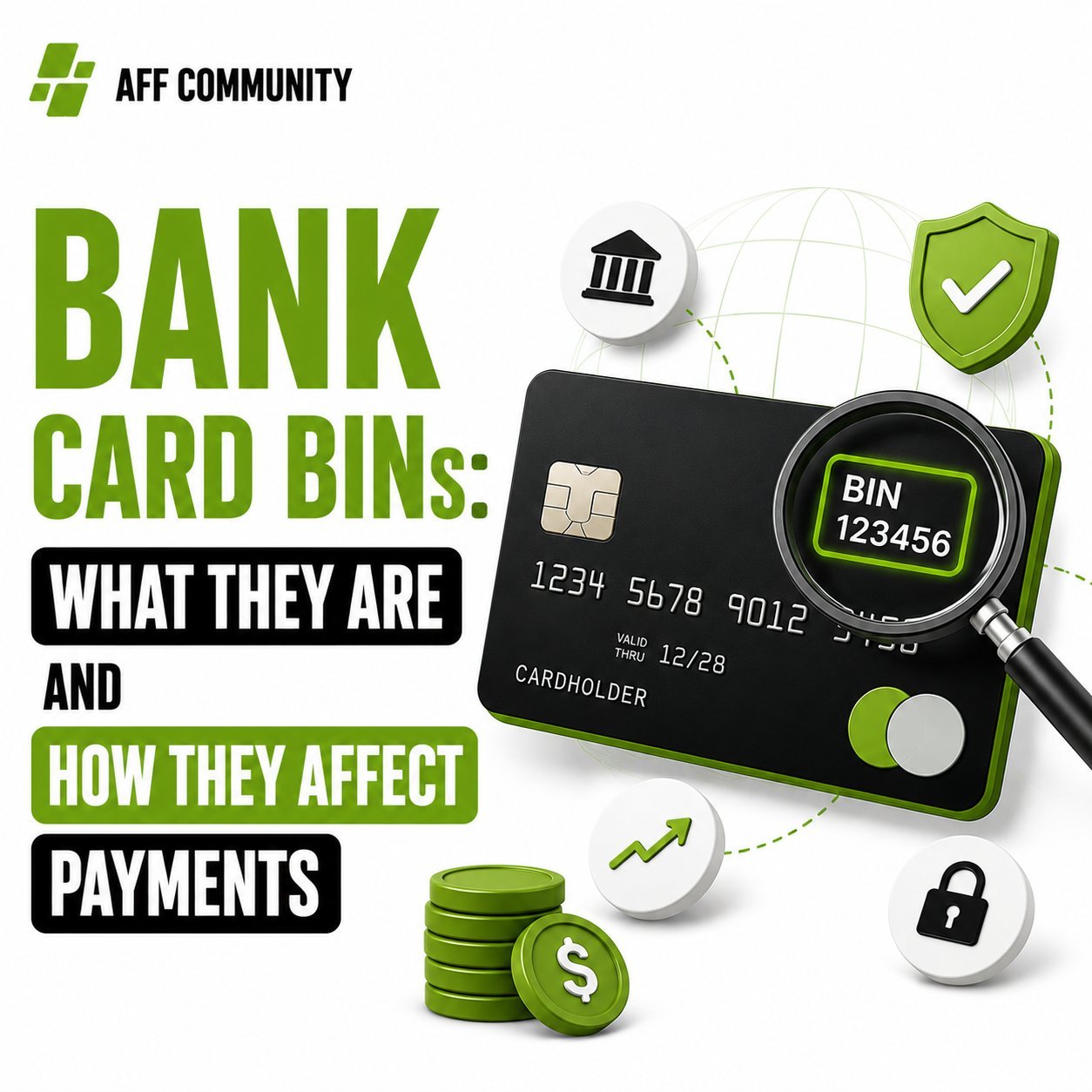
By the way, we discussed in detail in this article how bank card BINs affect the operation of advertising platforms and why different cards go through moderation differently.

Business Manager Trust Plays a Huge Role

Many people underestimate the impact of Business Manager itself. Even a high-quality bank card doesn’t guarantee a successful payment if the Business Manager regularly violates the platform’s rules.

Meta evaluates the history of ad campaigns, the number of blocked accounts, the quality of ad creatives, payment discipline, and many other factors.

The more consistently Business Manager operates, the less likely you are to face additional reviews.

That’s exactly why strong teams devote just as much attention to developing their infrastructure as they do to finding profitable ad combinations.

BUTTON – We recommend reading the article “What Affects Business Manager Trust

Don’t ignore the importance of running your infrastructure

Another reason for a “Risk Payment” flag is attempting to work with large budgets right away.

A new ad account, a Business Manager account that’s just been created, and the very first campaign worth several thousand dollars look suspicious. Meta’s algorithms expect more natural behavior.

That’s why experienced advertisers first gradually run their infrastructure:

  1. They add employees.
  2. Verify the domain.
  3. Run small ad campaigns.
  4. Build a positive payment history.

Only then do they begin scaling up. It is precisely this approach that significantly reduces the likelihood of a Risk Payment.

We discussed in detail how to properly run your ad infrastructure in the article at this link.

Monitor the quality of your ad campaigns

Many people believe that Meta’s payment system has nothing to do with ad quality. In practice, the opposite is true.

If Business Manager regularly has ads rejected, runs questionable creativity, or violates advertising policies, the trust level gradually decreases.

As a result, additional reviews begin to affect not only the ads but also the payment side of the account.

That’s exactly why high-quality White Pages, proper ad creatives, and careful handling of moderation become an important part of the overall strategy.

Stability is more important than constant change

The more chaos there is within the infrastructure, the higher the likelihood of triggering internal reviews:

  • frequent device changes;
  • new IP addresses;
  • logging in from different countries;
  • constantly switching payment methods;
  • creating a large number of ad accounts.

All of this generates additional risk signals. Professional teams, on the other hand, strive to stabilize their operations as much as possible.

They use a consistent infrastructure, avoid sudden changes, and gradually increase their ad budgets. It is precisely this behavior pattern that appears most natural to Meta’s algorithms.

It’s no coincidence that modern Facebook algorithms are increasingly focused on a comprehensive assessment of the advertiser rather than on individual actions. This process was discussed in detail here.

What to Do If a “Risk Payment” Flag Has Already Appeared

If the error has already appeared, don’t panic. Don’t immediately link five new cards or create dozens of new Business Manager accounts.

It’s much more effective to check your entire infrastructure:

  • payment history;
  • Business Manager status;
  • ad campaign quality;
  • device and IP stability;
  • and whether the card is linked to the right ad account.

Most often, the problem lies in a combination of factors, not in any single element.

Conclusion

A “Risk Payment” is not a random error, but a signal that Meta has detected an elevated level of risk.

You can only avoid such restrictions by taking a comprehensive approach: use a high-quality payment infrastructure, gradually run your Business Manager, follow the platform’s rules, and avoid triggering unnecessary red flags.

It is precisely stability, consistency, and careful management of the infrastructure that allow strong affiliate marketing teams to operate for months without serious payment issues and to scale their ad campaigns with confidence.
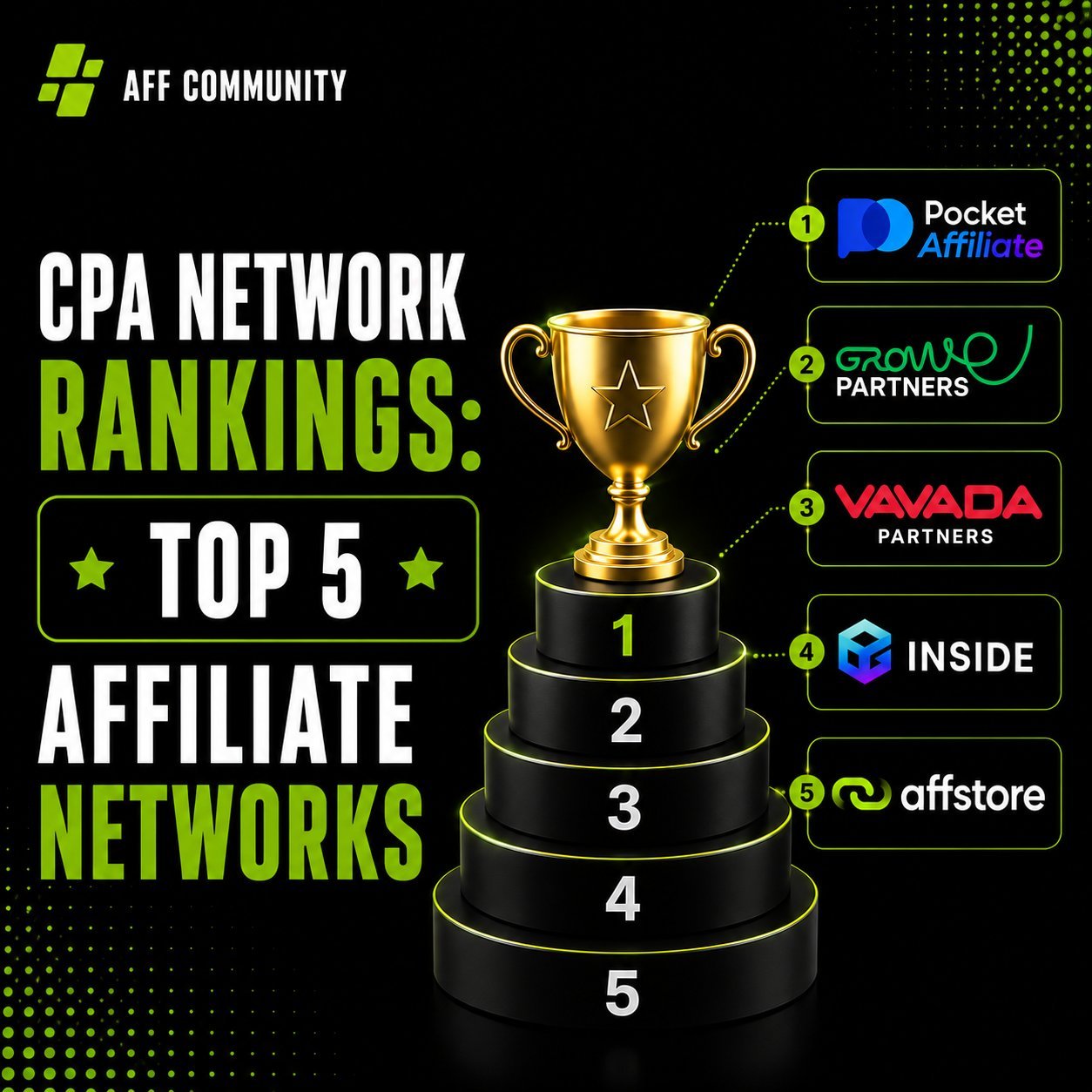
CPA Network Rankings: Top 5 Affiliate Networks

The choice of an affiliate network largely determines a buyer’s future profits. Even a strong partnership can yield mediocre results if the affiliate networks delay payments, cut rates, or fail to assist with traffic optimization.

Our team regularly tests new CPA networks, reviews feedback from webmasters, and monitors market trends. This ranking features five affiliate programs that deserve attention in 2026 due to their reputation, terms of service, and quality of support.

Pocket Affiliate

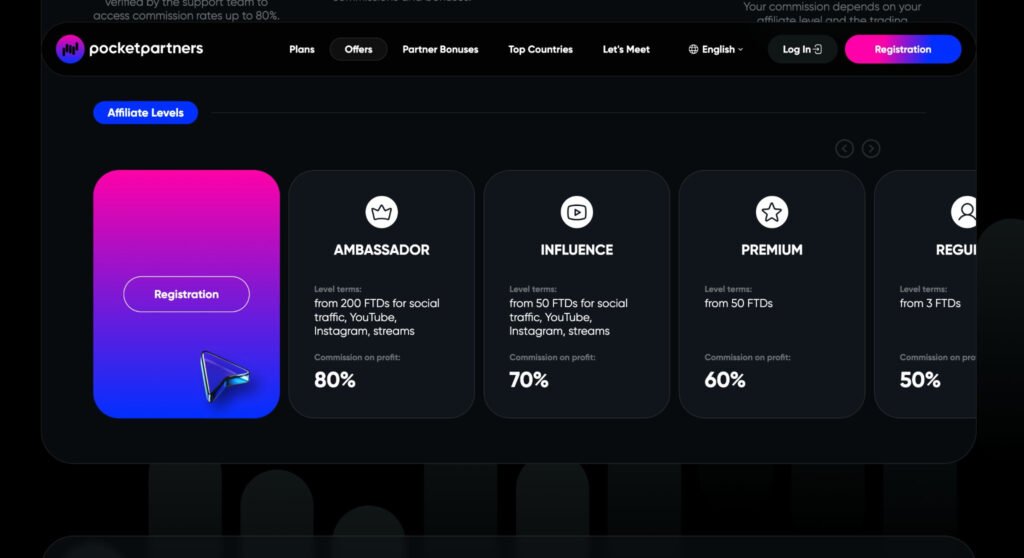
Pocket Affiliate is the official affiliate program of the Pocket Option platform, focused on the financial vertical. The affiliate network offers RevShare and CPA models, as well as additional bonus programs for active webmasters. Among its advantages are RevShare payouts of up to 80%, weekly payouts, a wide selection of promotional materials, and the ability to work with virtually all GEOs.

Pocket Affiliate is suitable for both experienced webmasters and owners of their own media outlets who work with financial traffic.

Growe Partners

Growe Partners is one of the fastest-growing iGaming affiliate networks in recent years. The platform works directly with its own brands and is actively developing Tier-2 and Tier-3 GEOs.

The affiliate networks offer several partnership models—CPA, RevShare, and Hybrid—provide dedicated account managers and their own analytics system, and regularly launch exclusive promotions for webmasters. The company is actively operating in Latin America, Asia, and Africa, where there is currently high growth potential for iGaming traffic.

Vavada Partners

Vavada Partners is a well-known affiliate program of the brand of the same name, focused on gambling traffic.

The affiliate networks offer stable payouts, high RevShare, a wide geographic reach, and a robust analytics system. For webmasters, a key advantage is the brand’s recognition, which often results in conversion rates above the market average.

Additionally, webmasters can access personalized partnership terms for high traffic volumes.

Inside

Inside is a modern CPA platform geared toward professional publishers and teams.

One of the affiliate networks’ strengths is its wide selection of offers, flexible partnership terms, and high-quality support. Webmasters have access to detailed statistics, various payment models, and the ability to quickly scale successful campaigns.

Inside is a good fit for those who work with multiple traffic sources simultaneously and regularly test new offers.

AffStore

AffStore is an affiliate program that is actively expanding across multiple verticals and offers webmasters a wide selection of advertising offers.

The platform’s strengths include an intuitive interface, prompt payments, personal account managers, and the ability to find an offer suited to virtually any traffic source.

For beginner publishers, assistance in selecting offers and recommendations on scaling campaigns are significant advantages.

How to Choose the Right Affiliate Network

We recommend not focusing solely on the commission rate.

Before getting started, it’s worth evaluating several factors:

  • quality of support;
  • payment speed;
  • advertiser reputation;
  • available partnership models;
  • ease of access to statistics;
  • genuine reviews from webmasters.

It’s the combination of these factors that usually determines how comfortable working with an affiliate program will be.

By the way, we discussed how to choose the right niche and avoid getting lost at the start at this link.

Conclusion

In 2026, a good affiliate program is no longer just a place to pick up an offer. It’s a full-fledged partner that helps you scale traffic, increase ROI, and resolve issues more quickly.

When it comes to the most interesting options available today, Pocket Affiliate, Growe Partners, Vavada Partners, Inside, and AffStore are rightfully among the top choices for webmasters thanks to their stable payouts, high-quality support, and modern approach to working with buyers.

Bank Card BINs: What They Are and How They Affect Payments

Virtually every publisher has encountered a situation at least once where one bank card successfully processes a payment for an advertising account, while another receives an error, is declined, or is subject to additional verification. Many attribute this solely to the card’s balance or the issuing bank.

But in practice, it all starts much earlier—with the BIN.

Our team regularly receives questions about why cards of the same type behave completely differently when paying for Facebook Ads, Google Ads, or other advertising platforms. This is largely due to BINs, which have long been one of the factors used to evaluate payment transactions.

What Is a BIN

A BIN (Bank Identification Number) is the first few digits of a bank card, which the payment system uses to determine key information about the card.

It is the BIN that reveals:

  • which bank issued the card;
  • the payment system (Visa, Mastercard, and others);
  • the country of issue;
  • the card type (Debit, Credit, Business, Prepaid);
  • and sometimes the product category.

When an advertising platform receives a payment request, it analyzes not only the transaction itself but also the BIN’s characteristics. Essentially, even before the funds are debited, the system already has a basic understanding of the card.

Why is the BIN important for publishers?

Many believe that Meta or Google check only whether the payment was successful. In reality, modern anti-fraud systems analyze significantly more parameters.

If a BIN regularly appears in suspicious transactions, mass account registrations, or a large number of declined payments, the trust level for such cards gradually decreases.

This does not mean automatic blocking. But the likelihood of additional checks increases. This is especially noticeable when working with a large number of ad accounts.

BUTTON – We recommend reading the article “Running an Ad Account Step by Step: How to Prepare Your Account

Not all BINs are equally suitable for advertising

There is a huge variety of banking products on the market. Some cards are designed for everyday purchases. Others are intended for corporate expenses. Still others are issued as virtual or prepaid cards.

Advertising platforms treat these categories differently. For example, widespread use of the same type of virtual BINs can attract additional attention from anti-fraud systems.

This is precisely why professional teams take a meticulous approach to selecting payment infrastructure and regularly test various options.

The BIN is just one part of the bigger picture

A common mistake among beginners is trying to attribute all problems solely to the card’s BIN. In practice, the platform analyzes many more factors:

  1. Business Manager history.
  2. Ad account age.
  3. User behavior.
  4. IP address.
  5. Device.
  6. Payment history.
  7. Ad campaign quality.

All these signals are evaluated simultaneously. That’s why even a good BIN can’t compensate for errors in the rest of the infrastructure.

We discussed the factors affecting Business Manager trust in detail in this article.

Why You Shouldn’t Constantly Switch Cards

At the first sign of trouble, many people start endlessly switching payment methods. This approach rarely yields results. Frequent card changes can, in and of themselves, appear suspicious to the advertising platform’s algorithms.

It’s much more important to find a stable payment infrastructure and use it consistently.

It is precisely this consistency that more often than not has a positive impact on the overall trust score.

How to Reduce the Risk of Rejections

It’s impossible to completely eliminate payment issues. But you can significantly reduce the likelihood of errors.

To do this, it’s important to:

  • use high-quality banking products;
  • avoid changing cards unnecessarily;
  • maintain a stable infrastructure;
  • avoid a large number of failed payments;
  • monitor your Business Manager’s reputation.

Additionally, it’s important to remember that the payment aspect is closely linked to the quality of the entire advertising infrastructure.

Even a perfectly selected BIN won’t save a campaign if the advertising account regularly violates the platform’s rules.

BIN and Modern Anti-Fraud Algorithms

Every year, advertising platforms are increasingly using machine learning to analyze financial transactions. The algorithms don’t evaluate a single card, but rather a combination of dozens of signals.

The BIN has become one element of the overall risk assessment system. That’s precisely why it’s no longer enough to simply select the “right” card.

You need to build your entire infrastructure in such a way that it appears as natural as possible to the platform’s algorithms.

The article at this link provides a detailed explanation of how Meta’s modern algorithms analyze advertiser behavior and make decisions.

Conclusion

A bank card’s BIN does indeed affect how you work with advertising platforms, but it cannot be considered in isolation from the entire infrastructure.

Successful affiliate marketing teams take a comprehensive approach: they use high-quality payment solutions, maintain a good Business Manager trust score, comply with platform rules, and minimize suspicious activity.

It is precisely this approach that allows them to encounter payment restrictions much less frequently and scale their ad campaigns with confidence.

What Affects Business Manager Trust

Business Manager (BM) has long been the backbone of most affiliate marketing teams that run traffic through the Meta ecosystem. It is within BM that ad accounts are created, payment methods are set up, employee roles are assigned, and the entire infrastructure is managed.

However, many webmasters still believe that Business Manager trust depends solely on its age.

Our team constantly sees examples to the contrary. A young BM can perform significantly more reliably than an older one if it’s set up correctly from the start. Conversely, a BM that’s been around for years can be subject to restrictions after just a few missteps.

Therefore, trust is the sum of many factors, not a single specific metric.

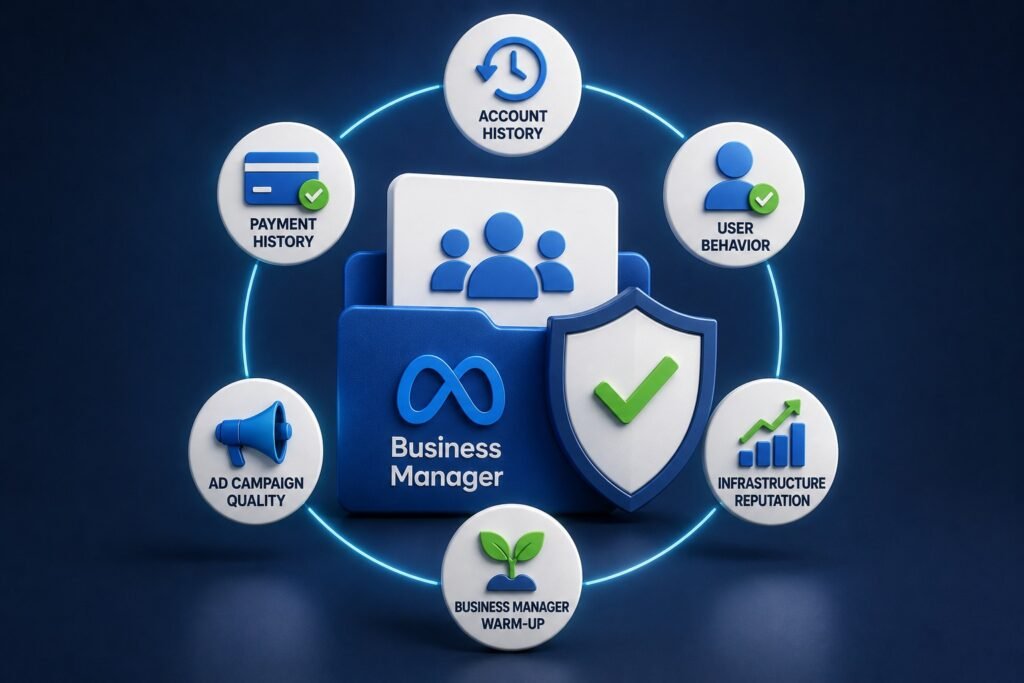
Account History

The first thing Meta’s algorithms look at is the Business Manager’s history.

If a Business Manager has been used for a long time without violations—with no mass bans, suspicious payments, or constant changes in ownership—its trust level gradually increases.

Business Manager history

Accounts where new ad accounts are regularly created, dozens of rejected campaigns are launched, and infrastructure changes occur constantly look very different.

Such activity automatically increases the risk level. This is precisely why experienced teams strive to manage Business Manager as carefully as possible from the very first days of its existence.

Payment History

One of the most underrated factors is the quality of your payment history. Meta analyzes not only successful payments but also canceled transactions, refunds, debit errors, and suspicious financial activity.

Frequent card changes, constant payment declines, and the use of questionable payment methods negatively impact the system’s trust in you.

For this reason, proper billing management becomes part of the overall strategy for building trust in your Business Manager.

User Behavior Within Business Manager

Meta analyzes not only ads but also the actions of the administrators themselves. If Business Manager is constantly accessed from different devices, countries, or browsers, the system begins to perceive such activity as potentially dangerous.

Therefore, large affiliate marketing teams pay close attention to the stability of their operational infrastructure.

They use proven anti-detection browsers, fixed digital fingerprints, and high-quality proxies. This helps reduce the number of suspicious signals detected by Meta’s algorithms.

A list of the best anti-detection browsers is available on our website at this link.

Ad Campaign Quality

Many believe that the rejection of a single ad does not affect Business Manager trust.

In practice, things are much more complicated.

If campaigns that violate the rules are regularly launched within Business Manager, a large number of ads get rejected, and ad accounts are blocked en masse, trust gradually declines.

This is especially true for gray-area verticals.

That’s why strong teams pay close attention to creativity preparation, White Page quality, and compliance with platform requirements even before launching ads.

Run Business Manager

Creating a BM and immediately launching large-scale campaigns is one of the most common mistakes.

A new Business Manager should gradually build up its history:

  1. Adding employees.
  2. Connecting a domain.
  3. Setting up business information.
  4. Creating your first ad campaigns with small budgets.

This sequence looks much more natural to Meta’s algorithms. That’s why it’s important to run proper warm-up during infrastructure preparation.

The detailed process of gradually building trust in ad accounts is explained in this article.

The Reputation of the Entire Infrastructure

It’s important to understand that Meta doesn’t evaluate Business Manager in isolation. The system analyzes the entire ecosystem.

  • domains;
  • pixels;
  • ad accounts;
  • Facebook Pages;
  • payment methods;
  • user accounts.

If one of these elements is regularly subject to sanctions, it can negatively impact the other associated entities as well.

This is precisely why professional teams view the infrastructure as a single mechanism, where every detail influences the overall level of trust.

Conclusion

Business Manager trust cannot be earned in a single day. It is built gradually through consistent performance, high-quality infrastructure, a clean payment history, and compliance with platform rules.

In 2026, it is precisely this comprehensive approach that allows teams to keep their Business Managers active longer, scale ad campaigns faster, and encounter account suspensions much less frequently.

That’s why strong affiliate marketing teams invest not only in finding new ad combinations but also in developing their own infrastructure, understanding that high Business Manager trust is one of the most important assets when working with Meta Ads.

Which Verticals Work Best with Bloggers

Influencer marketing has long since ceased to be a tool exclusively for major brands. Today, affiliate marketing teams, affiliate program owners, and advertisers actively use blogger advertising in virtually all popular verticals.

Our team regularly observes that a well-chosen blogger can drive higher-quality traffic than traditional targeted advertising. Users receive recommendations from people they trust, which significantly increases the likelihood of conversion.

However, not every vertical performs equally well with native integration.

Gambling and Betting

Despite restrictions on most platforms, the gambling industry continues to actively leverage blogger traffic.

Telegram channels, streamers, YouTube bloggers, and creators of short videos work best—especially those who can organically showcase the product without overt advertising.

The main focus is not on direct sales, but on showcasing the experience, emotions, and game mechanics. That’s why many teams first direct users to Telegram or an intermediary platform, where the audience is run until engagement builds.

This approach helps build trust and improve overall conversion rates.

Nutra and Health Products

One of the most stable verticals for working with bloggers. The audience responds well to personal experiences, reviews, transformation stories, and demonstrations of results.

Micro-influencers with highly engaged followers are particularly effective. Practice shows that smaller niche creators often drive higher-quality traffic than bloggers with millions of followers.

The key is to target the right audience and avoid turning the collaboration into overt advertising.

By the way, the importance of audience segmentation when launching advertising campaigns was discussed in detail in this article.

Finance and Investments

Financial products also perform well through influencers. But trust is especially important here. Users are only willing to submit an application when they consider the creator to be competent.

Therefore, successful integrations are built around expertise, service reviews, product comparisons, and personal experience.

The more value the audience receives, the higher the likelihood of further conversion.

E-commerce and Social Commerce

Selling physical goods is one of the strongest aspects of influencer marketing. Short reviews, unboxing videos, product demonstrations, and authentic testimonials can significantly boost sales.

This approach works especially well on TikTok, Instagram, and YouTube Shorts. Impulse purchases happen much more frequently here than after traditional banner ads.

It’s no coincidence that the growth of social commerce has become one of the major trends in recent years.

SaaS and AI Services

SaaS products and AI-based services deserve special attention. Unlike product offers, users rarely make a decision immediately here.

That’s why bloggers focus on demonstrating functionality, solving specific problems, and sharing practical case studies.

This format significantly boosts trust in the product even before the first visit to the website.

The article at this link. discusses in detail how artificial intelligence is gradually changing digital marketing and traffic management.

Why Smaller Bloggers Have the Edge Today

Just a few years ago, most advertisers sought to purchase placements exclusively from major influencers. Today, the situation has changed.

Micro- and nano-influencers often demonstrate higher levels of engagement, and the cost per customer acquisition turns out to be significantly lower.

In addition, niche communities build a more loyal audience. That’s precisely why strong affiliate marketing teams are increasingly working directly with dozens of small bloggers instead of relying on a single large placement.

How to Evaluate the Effectiveness of Integrations

A common mistake among beginners is evaluating a placement based solely on the number of clicks. In practice, it’s much more important to analyze the user’s entire journey.

You need to consider:

  • customer acquisition cost;
  • lead quality;
  • depth of engagement with content;
  • repeat sales;
  • long-term ROI of the integration.

Only a comprehensive analysis allows you to understand whether a blogger is truly profitable.

It’s no coincidence that funnel optimization and conversion analysis have become an essential part of any large-scale advertising campaign. This process was discussed in detail HERE.

Conclusion

In 2026, influencer marketing continues to be one of the most effective sources of high-quality traffic.

The best results are seen in gambling, nutra, finance, e-commerce, and SaaS products, but success depends not so much on the vertical itself as on the right choice of blogger, the quality of integration, and sound analytics.

That is precisely why strong affiliate marketing teams view bloggers not as a one-time source of sales, but as a full-fledged tool for building trust and long-term scaling.

The Best Scaling Strategies in Meta Ads

Virtually every publisher has faced the same situation. A campaign shows excellent ROI on a test budget, passes the initial learning phases, and starts generating a steady profit—but as soon as the budget is increased, the campaign’s performance begins to deteriorate rapidly.

Our team regularly encounters cases like this. Scaling in Meta Ads has long since ceased to be a simple matter of increasing the daily budget. The algorithms have become significantly more complex, and mistakes at this stage are much more costly than failed tests.

That’s why successful scaling today is a distinct skill that requires no less attention than finding new audience segments.

Don’t scale your campaign too early

The most common mistake is trying to increase the budget immediately after receiving the first conversions. Even if the campaign is showing a good ROI, that doesn’t mean the algorithm has fully trained itself yet.

Facebook requires a sufficient volume of high-quality events to consistently find the right audience.

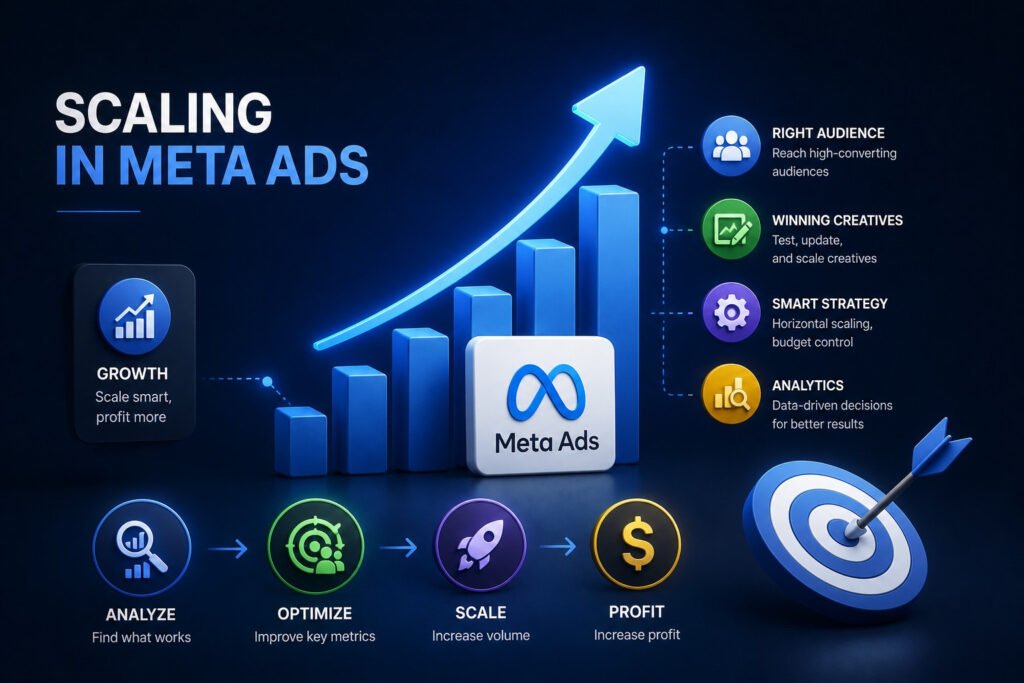
scaling in meta ads

If you start sharply increasing the budget prematurely, the algorithm reverts to the learning phase, and the cost per lead can increase severalfold.

This is precisely why experienced advertisers first achieve stability and only then begin scaling.

Vertical scaling doesn’t always work

The simplest way to increase traffic volume is to gradually raise the daily budget. However, this approach most often leads to a rise in CPM and a decline in results.

It’s much safer to increase the budget in small increments, typically by 15–20% per day. This approach allows the algorithm to adapt without significantly disrupting the auction.

If you need to increase volume sharply, it’s better to use other methods.

Horizontal scaling is often more effective

In many cases, creating multiple active campaign groups works significantly better than increasing the budget of a single campaign. Teams launch duplicate campaigns with different audiences, creativities, or placements.

This approach reduces the load on a single ad algorithm and allows you to generate additional traffic without a sharp increase in traffic costs.

Horizontal scaling performs particularly well in competitive verticals such as Gambling, Nutra, and Finance.

At the same time, it’s important to regularly update ad creativity, since creativity is most often the cause of declining performance when traffic volumes are high. This issue was discussed in detail in this article.

Watch for signs of ad set burnout

Even a perfectly scaled campaign won’t work indefinitely. Over time, the audience begins to burn out, CTR drops, CPM rises, and conversion rates gradually fall.

If you don’t notice these changes in time, you could lose a significant portion of your profit.

That’s exactly why strong teams analyze key metrics daily and prepare new creativity, audiences, and advertising approaches in advance.

Scaling Starts with Analytics

One of the most underrated parts of the process is working with data. Many webmasters make decisions based on intuition. But with large budgets, the cost of a mistake becomes too high.

Before each scaling stage, you need to understand:

  • which audience delivers the best CPA;
  • which creativity maintains a high CTR;
  • which placements yield the cheapest conversions;
  • which ad combinations are already starting to lose effectiveness.

It is precisely detailed analytics that allows you to scale profits, not expenses.

It’s no coincidence that many teams build their processes around systematic data analysis. This approach is discussed in detail in the article at this link.

Meta’s algorithms continue to evolve

Many scaling tips that worked two or three years ago no longer deliver the same results today.

Meta is increasingly using machine learning. The system automatically redistributes the budget among audiences, tests new user segments, and makes decisions faster than a human.

Because of this, manual intervention in campaigns should be kept to a minimum. The advertiser’s task today is not constant manual tweaking, but rather the proper preparation of high-quality input data for the algorithm.

Conclusion

By 2026, scaling in Meta Ads will no longer be a matter of increasing the budget. Successful teams scale the system, not the campaigns.

They prepare new creativity in advance, regularly update their audiences, analyze every metric, and give the algorithms enough time to learn.

It is precisely this approach that allows them to increase traffic volumes without a sharp rise in CPA and maintain profitability even in highly competitive environments.

Case Studies on Traffic Redirection to Telegram

Telegram has long since ceased to be merely a platform for publishing news. Today, it is a full-fledged monetization tool that many affiliate marketing teams use as an intermediary between advertising and the offer.

Our team regularly sees cases where Telegram is the key factor that significantly boosts the final conversion rate of a campaign. The reason is simple: users rarely make a decision immediately after their first exposure to an ad. They need time to get to know the product and start trusting the source.

That’s why more and more teams are building their conversion funnels specifically through Telegram.

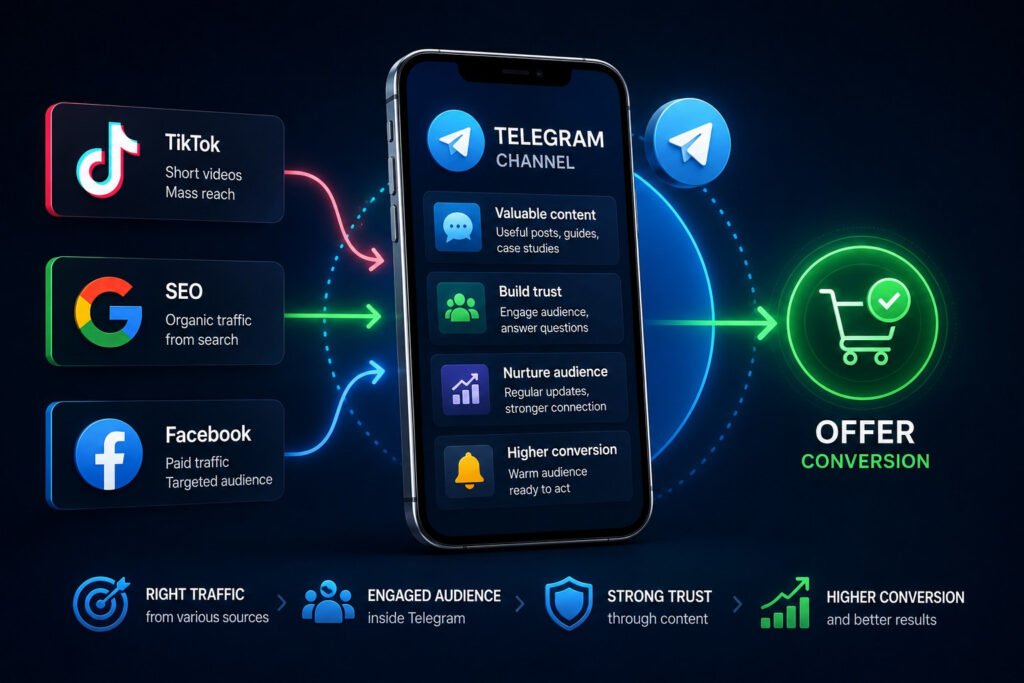
Case Study #1: TikTok → Telegram → offer

One of the most popular strategies in recent years is funneling an audience from TikTok to Telegram. In a short video, users are presented only with a problem or a teaser.

Key information, case studies, and analyses are then published within the Telegram channel. This approach not only reduces the cost per subscriber but also significantly increases the time users spend engaging with the brand.

offers for telegram traffic

Through regular content, the audience is gradually nurtured and becomes much more ready to make a purchase.

This is precisely why many teams continue to use TikTok as a source of reach and Telegram as a platform for further monetization.

Case Study #2: SEO → Telegram

The second working model is built around informational traffic. A user arrives from Google at an expert article, finds answers to their questions, and sees an invitation to subscribe to Telegram, where new case studies, market news, and practical resources are published.

This scenario works particularly well in affiliate marketing media. Essentially, SEO begins not only to drive visitors but also to build a loyal audience for the project.

Case #3. Facebook → Telegram

Despite the growth of other sources, Facebook remains one of the most powerful channels for attracting an audience. However, instead of directing users straight to the offer, many teams first send them to Telegram.

This works especially well in complex verticals where users need additional time to run the offer.

The channel features reviews, results, answers to frequently asked questions, and useful content. After several interactions, the likelihood of conversion increases significantly.

This is precisely why Telegram is increasingly viewed as a full-fledged part of the affiliate marketing funnel, rather than just a place to store subscribers.

Why Telegram Boosts Conversion Rates

Telegram’s main advantage lies in its ability to constantly engage with the audience. Unlike a traditional landing page, the user remains within the project’s ecosystem:

  • They read new posts.
  • They follow case studies.
  • They receive notifications.
  • They return to the content.

As a result, trust grows much faster.

It’s no coincidence that more and more teams are starting to build long-term funnels instead of trying to make a sale on the first click. The approach to optimizing such funnels was discussed in detail in this article.

What Successful Case Studies Have in Common

If you look at most profitable traffic-redirecting strategies, it becomes clear that they’re all built on the same principle.

First, the user receives value. Then they begin to trust the author. And only after that are they presented with an offer.

It’s precisely this sequence that allows you to significantly increase the final conversion rate, regardless of the traffic source.

Conclusion

Telegram is no longer just a regular messaging app for communication. Today, it’s a full-fledged audience engagement tool that helps consolidate traffic from TikTok, Facebook, SEO, and other sources into a single sales system.

That’s exactly why top affiliate marketing teams view Telegram not as an additional channel, but as a crucial part of their marketing strategy. We’ve covered the advertising opportunities within the Telegram ecosystem in detail at this link.

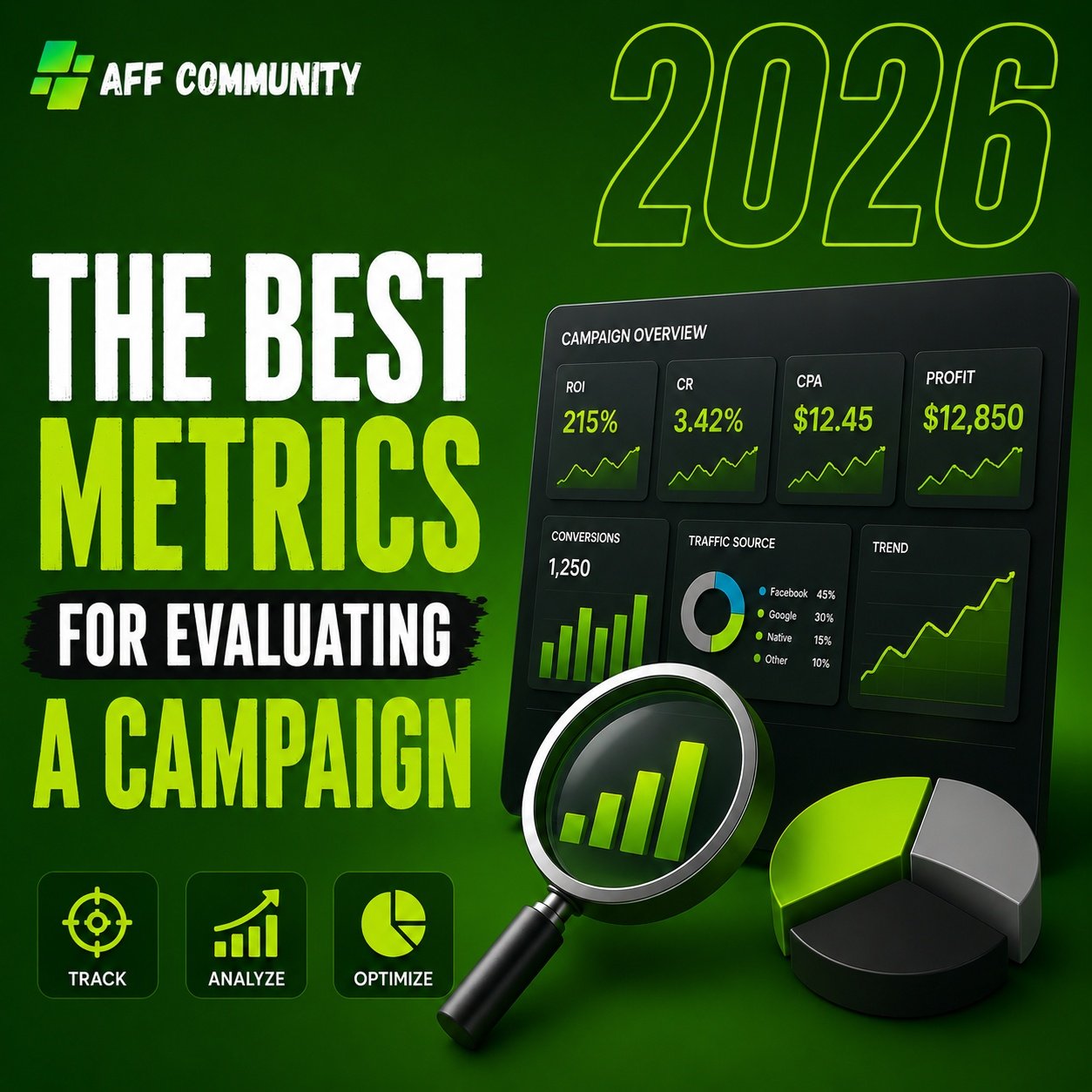
The Best Metrics for Evaluating a Campaign

One of the most common mistakes among beginners in affiliate marketing is focusing solely on profit or ROI. If a campaign is in the black, everything is fine. If it’s in the red, it’s time to pause it. In practice, things are much more complicated.

Our team regularly encounters situations where a seemingly profitable campaign gradually fizzles out, while a promising one is shut down too early due to incorrect data analysis.

That’s exactly why skilled webmasters evaluate not just one metric, but a whole set of indicators.

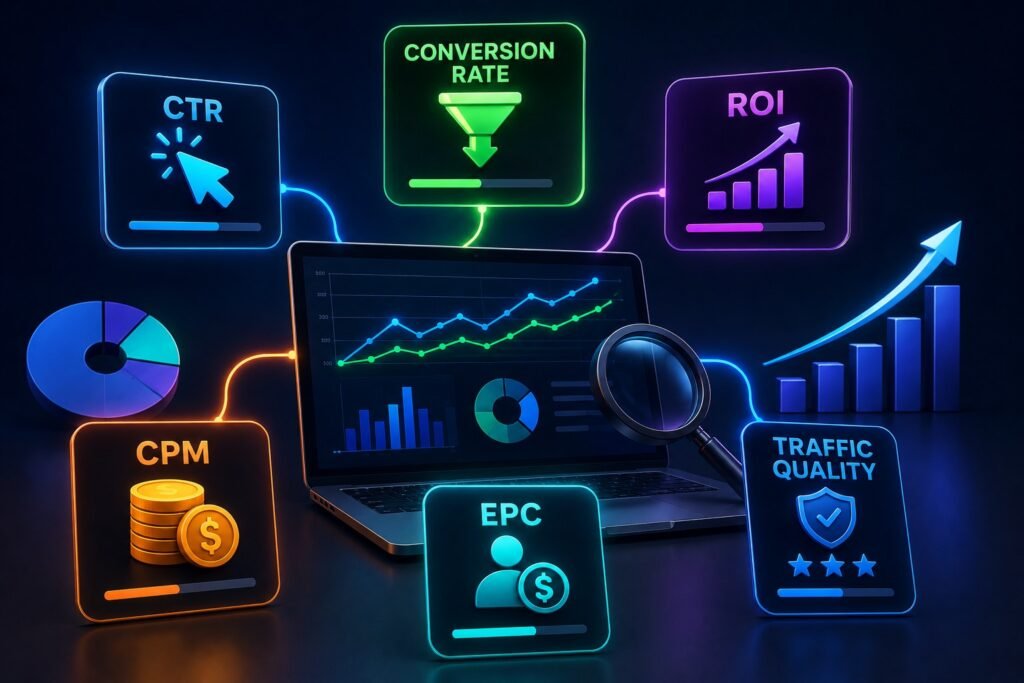
ROI—An Important, but Not the Most Important, Metric

Virtually every publisher starts their analysis with ROI. This makes sense. The metric allows you to quickly understand the effectiveness of your investments.

But the problem is that ROI only shows the final picture. It doesn’t explain the reasons behind the result. That’s why relying solely on it is risky.

A campaign might show a good ROI at small volumes and completely fall apart after scaling up.

CTR Shows the Strength of the Creativity

When it comes to the early stages of analysis, CTR remains one of the most useful metrics. It helps you understand how well an ad captures the audience’s attention.

A low CTR often indicates problems with the creativity, the offer, or the presentation. A high CTR doesn’t guarantee a campaign’s profitability, but it almost always indicates that the ad is generating interest.

That’s precisely why experienced buyers start their optimization efforts with the ad creatives.

It’s no coincidence that the impact of creativity on the effectiveness of ad campaigns remains one of the industry’s key topics. This issue was discussed in detail in this article.

metrics in affiliate marketing

Conversion Rate Indicates Traffic Quality

After a click, the next stage of the funnel begins. Here, conversion plays a crucial role. It helps determine how well the audience aligns with the offer.

If the CTR is high but there are no conversions, the problem usually lies beyond the ad itself. For example:

  • a poorly designed landing page;
  • an unsuitable offer;
  • an error in audience segmentation.

Therefore, it’s practically impossible to analyze a campaign without evaluating conversions.

CPM helps assess the effectiveness of ad spending

In many verticals, CPM is one of the first indicators of future problems. A rise in the cost per impression often signals high competition, audience issues, or a decline in creativity.

However, many webmasters only notice CPM when the ad campaign has already started losing money.

Strong teams monitor this metric constantly—especially in competitive niches like gambling, crypto, and finance.

EPC and Lead Quality

If you’re working through affiliate programs, you can’t ignore EPC. This metric helps you understand the true value of each click.

Two campaigns may generate the same number of leads but yield completely different profits. Additionally, it’s important to consider the quality of the leads themselves.

Poor-quality traffic may temporarily show good numbers but can quickly lead to a drop in the ability to approve requests and a deterioration in relations with the advertiser.

Therefore, monitoring audience quality becomes an essential part of a webmaster’s job.

The approach to evaluating traffic quality is discussed in detail at this link: https://affcommunity.org/kontrol-lidov-kak-ne-pereplachivat-za-odin-i-tot-zhe-trafik/

Metrics Only Work Together

The main mistake made by novice webmasters is looking for a single, universal metric. In practice, no such metric exists: CTR indicates interest, conversion shows audience relevance, and CPM reflects the auction environment. ROI demonstrates the final result.

It is precisely the combination of these metrics that enables you to make the right decisions. That’s why strong teams analyze the entire funnel as a whole, rather than individual numbers in reports.

Conclusion

In 2026, the winners won’t be the webmasters who know how to run ads, but those who know how to interpret data correctly. ROI remains an important metric.

But truly effective decisions are made only when CTR, CPM, conversion rate, EPC, and traffic quality are analyzed simultaneously.

It is precisely this approach that allows you to identify profitable combinations before your competitors and scale them without any unpleasant surprises.

Will AI Buyers Replace Webmasters?

Over the past two years, artificial intelligence has become one of the most talked-about topics in the affiliate industry. Neural networks are already capable of writing copy, creating creativity, analyzing data, and even launching ad campaigns.

Against this backdrop, a question is being asked more and more often: Will AI webmasters replace traditional publishers?

Our team and I believe that the market is indeed changing. But talk of a complete replacement of media webmasters is still greatly exaggerated.

Why Many Are Talking About the End of Manual Arbitrage

The reason is obvious. Modern advertising platforms are increasingly using machine learning.

Meta selects audiences on its own. Google automates bid management. TikTok is increasingly making decisions without human intervention.

At the same time, AI tools are emerging that help create creativity, write copy, and analyze statistics.

From the outside, it may seem that the role of the webmaster is gradually disappearing. But in practice, things look different.

AI buyers

What AI systems can already do

Today, artificial intelligence is indeed capable of automating a significant portion of routine work.

It can:

  • analyze large volumes of data;
  • identify patterns;
  • generate options for creativity;
  • write ad copy;
  • assist with analytics.

It’s no coincidence that many teams are already actively integrating AI into their processes. We discussed in detail how neural networks are used in modern affiliate marketing in this article.

But even the most advanced tools currently operate only within the scope of a specific task.

Where AI Still Falls Short Compared to Humans

The main problem with artificial intelligence is a lack of context. A neural network can analyze numbers. It can propose hypotheses. But it doesn’t understand the market the way an experienced webmaster does. Affiliate marketing is constantly changing: new offers appear, and moderation rules shift. New connections and approaches emerge.

In many cases, it is human experience that allows one to spot opportunities before competitors do.

This is especially noticeable when working with new traffic sources and non-standard verticals.

AI Is Becoming an Assistant, Not a Replacement

In practice, we’re seeing a different trend. Strong teams aren’t replacing people with machine learning. They’re using AI to empower buyers. For example:

  • a buyer analyzes statistics faster;
  • a designer receives dozens of options for creativity;
  • a content creator speeds up the preparation of materials;
  • and an analyst identifies patterns more quickly.

As a result, the entire team’s efficiency increases. Essentially, those who know how to use new tools correctly come out on top.

The biggest threat isn’t AI itself, but other publishers using AI

Many people fear that neural networks will take away their jobs. In our view, the real threat looks different. The problem isn’t artificial intelligence itself. The problem is that competitors are starting to use it sooner.

If one team analyzes data manually while another automates processes using AI, the advantage gradually shifts to the latter.

That’s exactly why it’s important today not to ignore new technologies, but to learn how to work with them.

We discussed in detail how artificial intelligence is changing the traffic market and advertising processes in this article.

What Will Happen in a Few Years

Most likely, the profession of a publisher won’t disappear. But the requirements for specialists will change. There will be fewer routine tasks and more analytical work: strategic thinking will become more important than technical actions.

The ability to quickly test hypotheses will prove more valuable than manually configuring campaigns.

Essentially, the market is moving toward a model where humans make decisions and artificial intelligence helps implement them. This scenario currently appears to be the most likely.

Conclusion

AI buyers won’t replace webmasters in the coming years. However, they are already changing the rules of the game.

Buyers who learn to use neural networks for analytics, creativity, and process automation will gain a significant advantage over their competitors.

Therefore, the main question today is not “Will AI replace publishers?” but “How effectively can publishers themselves work with AI?”

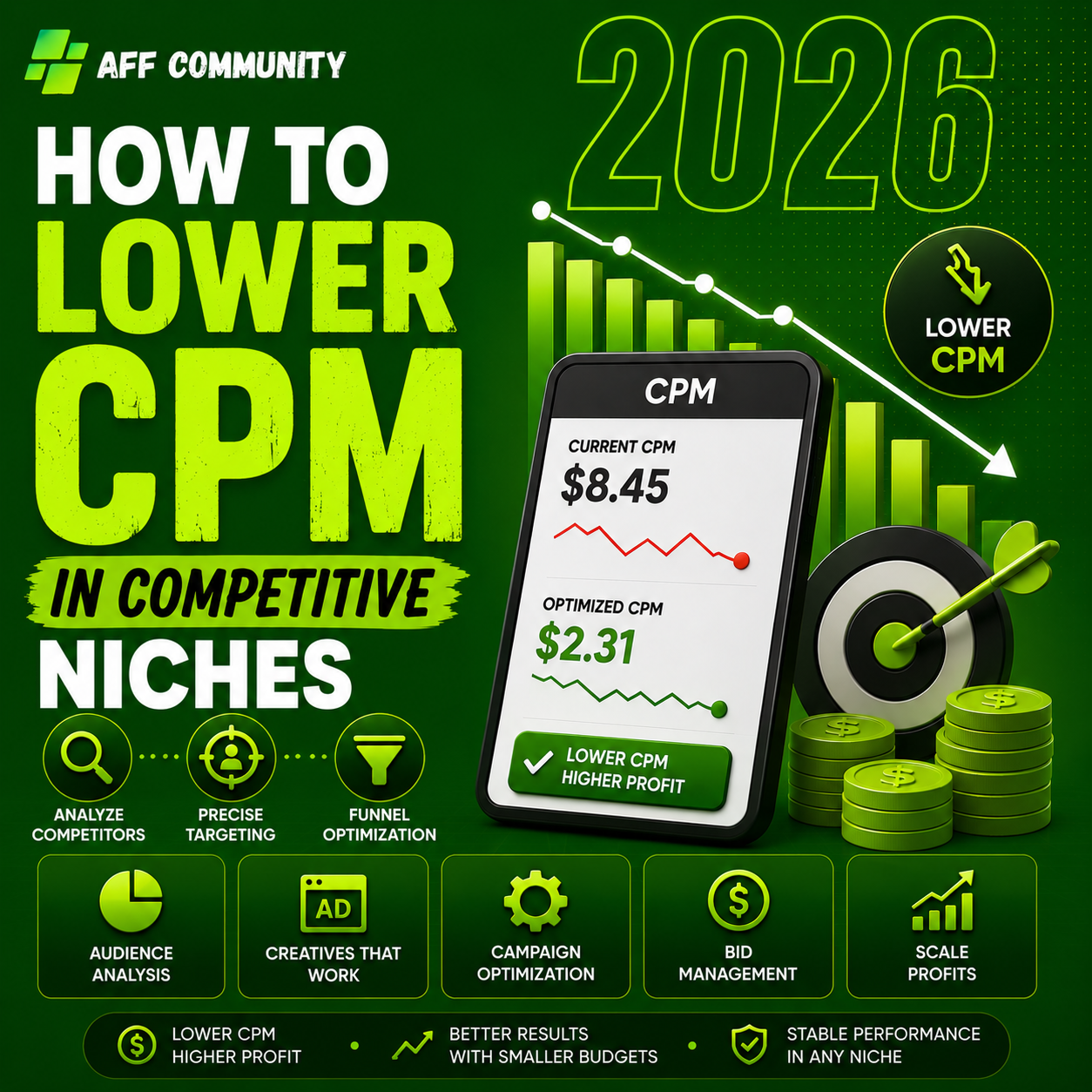
How to Lower CPM in Competitive Niches

High CPM is one of the main challenges for webmasters working in gambling, crypto, adult content, and other overheated verticals.

When the cost per thousand impressions starts to rise, many immediately look for new accounts, switch payment providers, or try to find a different GEO.

But our team and I constantly see the same mistake: most advertisers try to address the symptoms rather than the root cause.

In practice, a high CPM isn’t always related to the niche itself. Very often, the problem lies within the ad campaign.

Algorithms look at more than just the bid

Many beginners believe that CPM is determined solely by competition in the auction. In reality, ad platforms evaluate dozens of additional factors:

  1. Creativity quality.
  2. Audience engagement.
  3. CTR.
  4. Account history.
  5. User behavior after interacting with the ad.

If the algorithm deems an ad useful to the audience, the cost per impression is often significantly lower than the market average.

This is precisely why the quality of ad creativity directly impacts the overall cost-effectiveness of the campaign. We’ve analyzed the impact of creativity on ad performance in detail in this article.

Targeting the wrong audience almost always increases CPM

One of the most costly mistakes is using targeting that’s too broad or too obvious. Virtually all competitors use similar settings. As a result, the auction heats up, and the cost per impression begins to rise. This happens particularly often in the gambling and finance sectors.

Strong teams try to find less competitive audience segments and test additional interests.

Sometimes even a small change in the audience can significantly lower CPM without sacrificing traffic quality.

Creativity directly influences the cost per impression

In many verticals, it’s not the one who pays the most who wins, but the one who best holds the user’s attention. If a user pauses their feed, interacts with the ad, and shows interest, the algorithms begin to view the ad more positively.

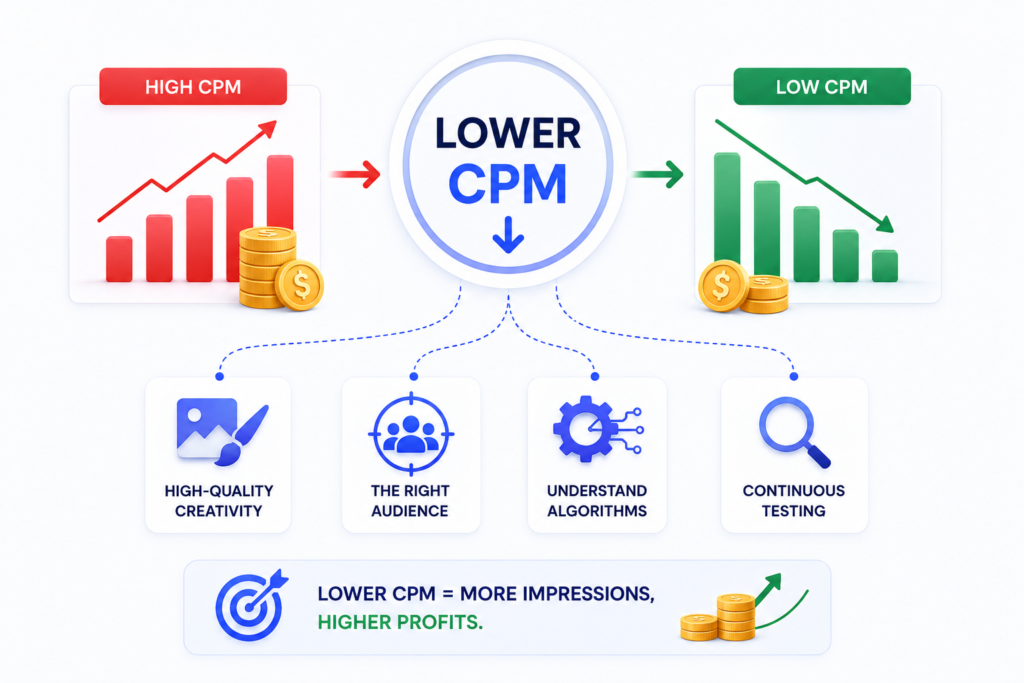
Lower CPM

This allows you to get more impressions for the same amount of money. This is precisely why experienced webmasters constantly update their ad creatives and test new approaches.

By the way, the specifics of adapting creativities to the modern requirements of advertising platforms were discussed in detail in this article.

Don’t ignore the new algorithms

In 2026, advertising algorithms are increasingly relying on machine learning. Old methods of setting up campaigns are becoming less effective.

Many approaches that delivered results a couple of years ago may now only increase the cost of traffic. This is especially noticeable on Meta.

Algorithm changes directly affect auction costs, ad distribution, and ad performance.

Ignoring such changes often leads to a rise in CPM, even with good creativity and a high-quality audience.

Testing Is Cheaper Than Constant Scaling

Another common mistake is trying to solve the problem with money. If CPM is rising, many simply increase their budget. This might work in the short term.

But in the long run, this approach rarely proves effective. It’s much more beneficial to regularly test new angles, audiences, creativity formats, and approaches to presenting the offer.

It’s no coincidence that many teams achieve the best results precisely through optimization, rather than by constantly increasing spending. This process is discussed in detail at this link.

Conclusion

It’s possible to lower CPM in a competitive niche even without changing the vertical or traffic source.

Most often, four factors yield results:

  • high-quality creativity;
  • the right audience;
  • an understanding of the platform’s algorithms;
  • and continuous testing of new hypotheses.

That is precisely why strong affiliate marketing teams focus not only on increasing their budget but also on the effectiveness of every impression. In the long run, this approach almost always proves more profitable than simply increasing spending.

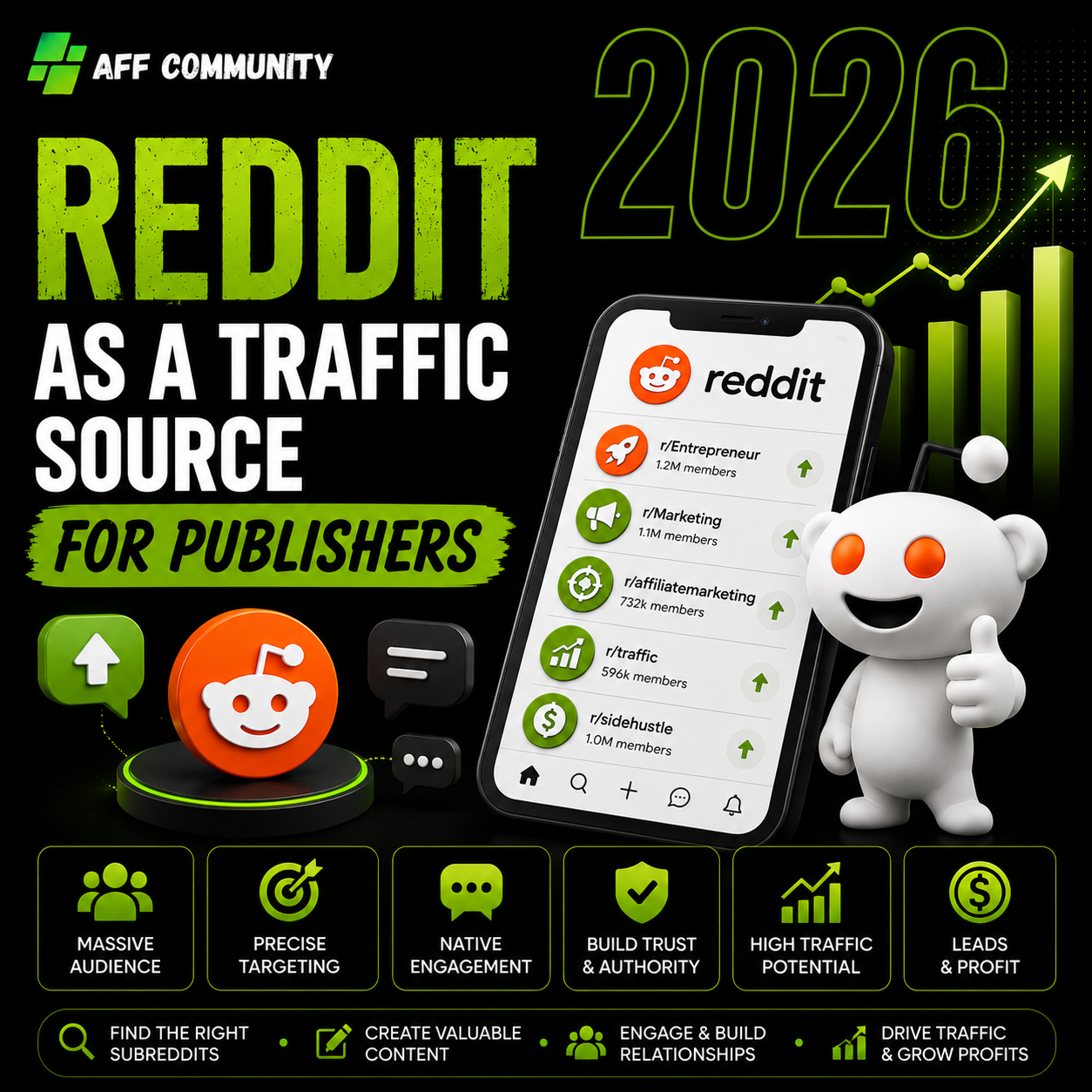
Reddit as a traffic source for publishers

When it comes to traffic sources, most publishers immediately think of Facebook, TikTok, Google Ads, Bing or Telegram. But there is one source that has remained underestimated by many webmasters for years – Reddit.

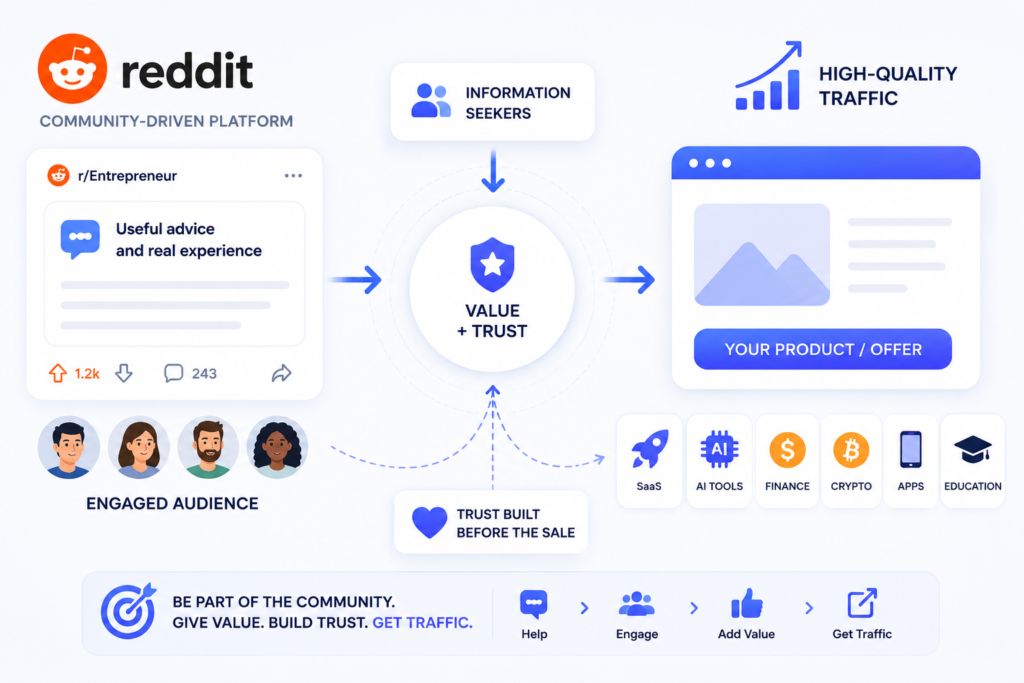
Our team regularly observes how Reddit serves as a source of both free and freemium traffic for a wide variety of verticals. The platform performs particularly well in the SaaS, crypto, finance, AI services, apps and various digital products niches.

The main difference between Reddit and most social media platforms is that its audience doesn’t go there for entertainment, but to seek information, solutions to problems and recommendations.

This is precisely why using Reddit effectively can generate very high-quality traffic.

Why Reddit works differently

The main mistake beginners make is to view Reddit as just another social network. In practice, it is a vast community of themed forums.

Each subreddit operates according to its own rules. Each audience has its own interests. Every community is quick to spot direct advertising.

That’s why the classic ‘post a link and get traffic’ approach hardly works here. Reddit users value expertise, usefulness and real-life case studies.

The more value the audience gets, the more likely it is that a post will start attracting views and discussions.

Which verticals work best on Reddit

Reddit performs best in areas where people are actively seeking advice and recommendations.

The following work particularly well:

  • SaaS services;
  • AI tools;
  • financial products;
  • crypto projects;
  • mobile apps;
  • educational products.

That said, success depends directly on understanding the audience.

It is no coincidence that user segmentation remains one of the most important factors when working with any traffic source. This issue was discussed in detail in this article.

Content sells better than links

One of the most interesting features of Reddit is that it is often the content itself, rather than links, that drives engagement. A helpful comment can generate more clicks than a promotional post.

A detailed analysis of an issue can attract thousands of views without a single call to action. This is precisely why many webmasters use Reddit as a tool to run their audience.

First, the user gains something of value. Then they start to take an interest in the author. And only then do they click through to the website or product.

This approach is very similar to modern content marketing strategies, where trust is built before the sale. 

Reddit and SEO

Many people overlook another advantage of the platform. Reddit posts regularly feature in Google’s top results.

For a large number of search queries, Reddit pages compete with major media outlets and corporate websites. Therefore, activity within the community can bring not only direct traffic from the platform but also additional visibility in search engines.

This is particularly noticeable following the rise in popularity of user-generated content and forum sites in search results.

Incidentally, the impact of changes to search algorithms and new approaches to website ranking has been analysed in detail at this link.

The main mistake made by webmasters

Most failures on Reddit stem from trying to sell too soon. Users quickly spot advertising. Subreddits remove spam. Accounts face restrictions. That’s why strong teams operate differently. They become part of the community. They publish useful content. They answer questions. They take part in discussions.

And only then do they begin to gently guide the audience towards their products. Essentially, Reddit requires a long-term approach and building trust.

This is precisely why aggressive promotion tactics rarely yield good results here.

Why Reddit will become more important

By 2026, competition on traditional advertising platforms will continue to grow. The cost of traffic is rising. Moderation is becoming stricter. Algorithms are getting more complex.

Against this backdrop, platforms with high audience engagement are becoming particularly valuable.

Conclusion

Reddit can hardly be called a straightforward source of traffic. It requires time, an understanding of the audience and a systematic approach to content.

But this is precisely why many webmasters underestimate its potential.

Those who know how to build trust within communities and create genuinely useful content gain access to a high-quality audience that is becoming increasingly difficult to reach through traditional advertising channels.

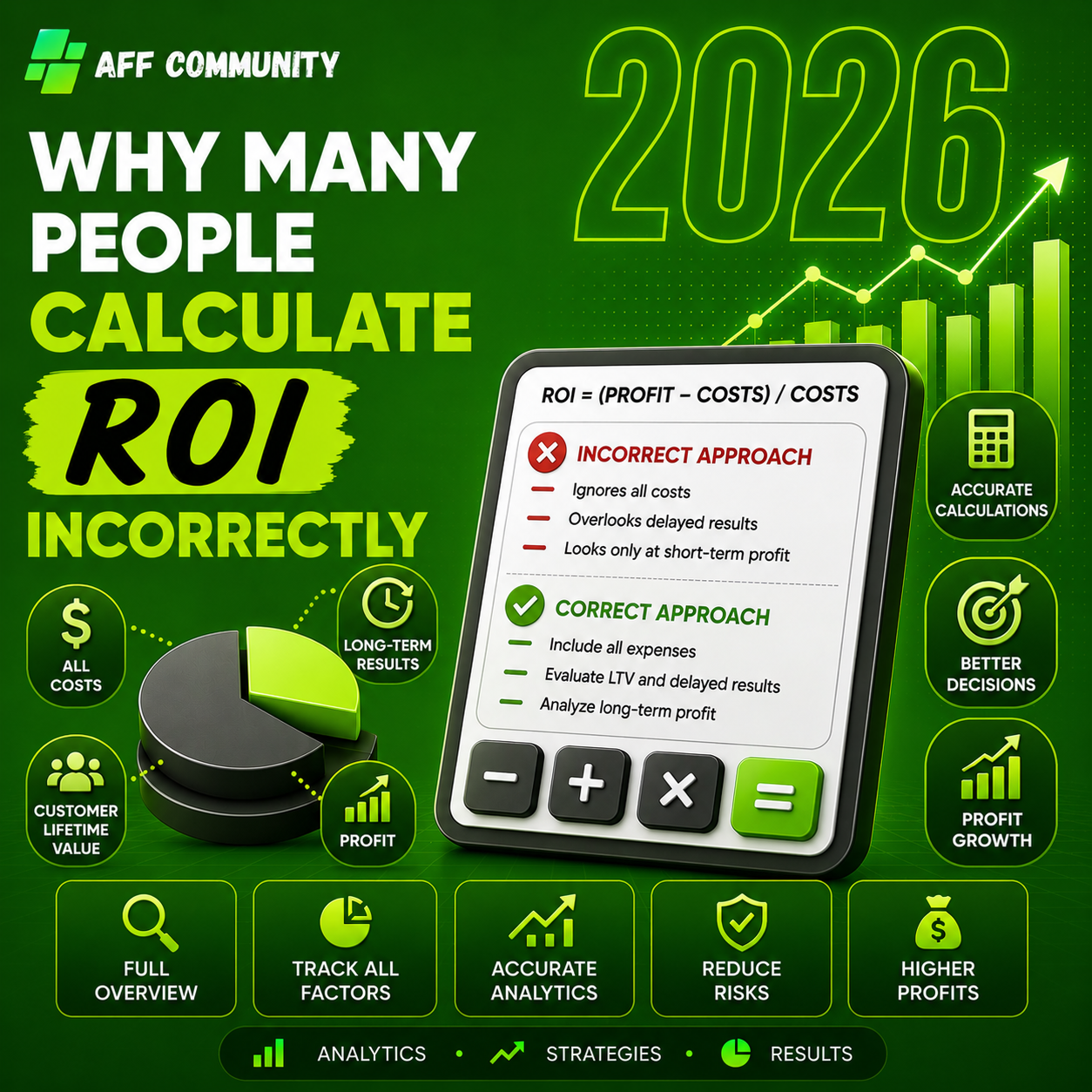
Why many people calculate ROI incorrectly

ROI is one of the most popular metrics in affiliate marketing. Virtually every buyer checks this figure daily and makes decisions based on it. The problem is that a huge number of webmasters calculate ROI incorrectly.

Our team regularly comes across situations where a campaign appears profitable at first glance, but upon closer inspection turns out to be loss-making. Or, conversely, a promising campaign is paused too early due to erroneous conclusions.

This is precisely why understanding ROI is more important than the calculation formula itself.

Why a high ROI doesn’t always mean a profit

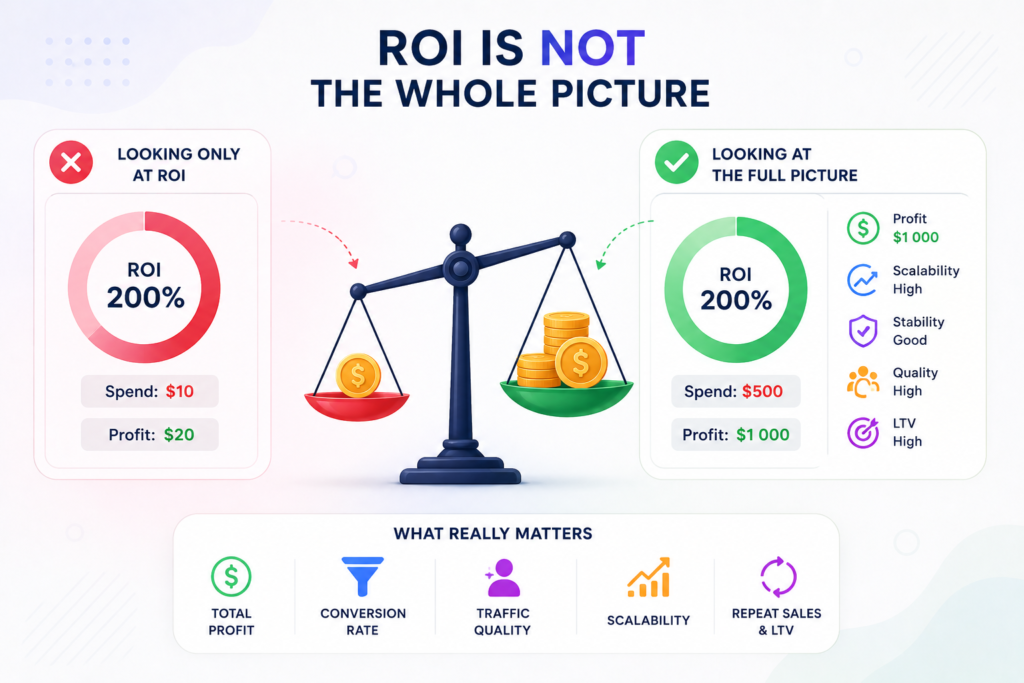
The most common mistake made by beginners is to focus solely on the ROI percentage. Let’s consider two campaigns. The first generated a profit of $20 against costs of $10. The ROI was 200 per cent.

The second generated a profit of $1,000 against costs of $500. The ROI was also 200 per cent.

Top roi result

On paper, the figures are identical. But for a business, the value of these campaigns is completely different. This is precisely why experienced webmasters always look not only at ROI, but also at profit volume, scalability and the stability of results.

Often, the pursuit of an impressive percentage leads to the loss of truly strong campaigns.

The small sample size fallacy

The second problem arises when analysing an insufficient volume of data. Many people run a test, get a few leads and immediately draw conclusions. In the long run, such decisions often prove to be flawed.

A campaign might show an excellent ROI on the first $50 of the budget and completely fall apart once scaled up.

Or, conversely, it might only start turning a profit once the algorithms have completed their learning phase. This is precisely why, when analysing advertising campaigns, it is important to consider the statistical significance of the data, rather than individual successful or unsuccessful results.

Many people forget to factor in actual costs

Another classic mistake is to consider only the advertising budget. In practice, costs often turn out to be significantly higher.

The following should be included in calculations:

  1. account costs;
  2. anti-detection browsers;
  3. proxies;
  4. trackers;
  5. creativity costs;
  6. payment system fees;
  7. White pages;
  8. team labour costs.

If you only take the advertising budget into account, the ROI may appear significantly better than the actual situation.

This mistake is particularly noticeable in large teams, where infrastructure costs make up a significant proportion of expenditure.

ROI does not reflect audience quality

Very often, webmasters assess effectiveness solely on the basis of lead cost and return on investment.

However, there are metrics that ROI does not take into account. For example:

  • lead quality;
  • approve rate;
  • repeat sales;
  • customer retention;
  • LTV.

Therefore, two campaigns with the same ROI can generate completely different profits for the advertiser.

It is no coincidence that experienced teams pay close attention to analysing the audience and its behaviour. The impact of user segmentation on the effectiveness of advertising campaigns was discussed in detail in this article.

Scaling changes the maths

One of the most frustrating situations for any webmaster is a successful test that stops working after scaling. The reason is simple.

As volumes increase, the metrics begin to change:

  1. The cost of traffic rises.
  2. Competition increases.
  3. CTR decreases.
  4. Audience quality deteriorates.

As a result, ROI begins to fall gradually. This is precisely why a successful test does not guarantee successful scaling.

Why you shouldn’t focus solely on ROI

In practice, strong webmasters use several metrics simultaneously. ROI remains an important metric, but it is by no means the only one.

The following are also analysed:

  • profit volume;
  • conversion rate;
  • cost per lead;
  • traffic quality;
  • scalability of the campaign.

It is precisely the combination of these factors that enables well-informed decisions to be made.

We’ve already explained why optimising the sales funnel and working on conversion rates often have a greater impact on profit than attempts to improve a single metric – you can find out more via the link: https://affcommunity.org/en/optimizing-traffic-processing-and-increasing-conversion/ 

ROI and the Age of Automation

By 2026, the situation will become even more complex. Advertising platform algorithms are increasingly making decisions independently.

As a result, publishers must analyse not only the final metrics but also the reasons behind any changes in them.

Those who understand the factors that make up their profit gain a significant advantage over those who focus solely on the ROI figure in their reports.

Conclusion

ROI remains one of the most important metrics in affiliate marketing, but on its own this figure rarely reflects the full picture. A high ROI does not always mean high earnings. A low ROI does not always mean a poor campaign.

That is why professional teams analyse not just a single figure, but the entire system of metrics as a whole.

It is precisely this approach that enables them to make the right decisions and scale profitable campaigns without any unpleasant surprises.